
Non-surgical shoulder pain management is defined as a structured, evidence-based approach that combines physical therapy, anti-inflammatory treatment, and targeted self-care to restore function without operative intervention. Most adults with chronic shoulder pain can achieve meaningful, lasting relief through this approach. Many patients who come through Nortexspineandjoint have already tried rest and over-the-counter medications with limited results. What they often lack is a structured program that addresses the root cause. This guide explains how to reduce shoulder pain non-surgically using methods supported by current 2026 clinical evidence and the kind of practical guidance you would receive in a specialist consultation.
What are the key non-surgical treatments for shoulder pain?
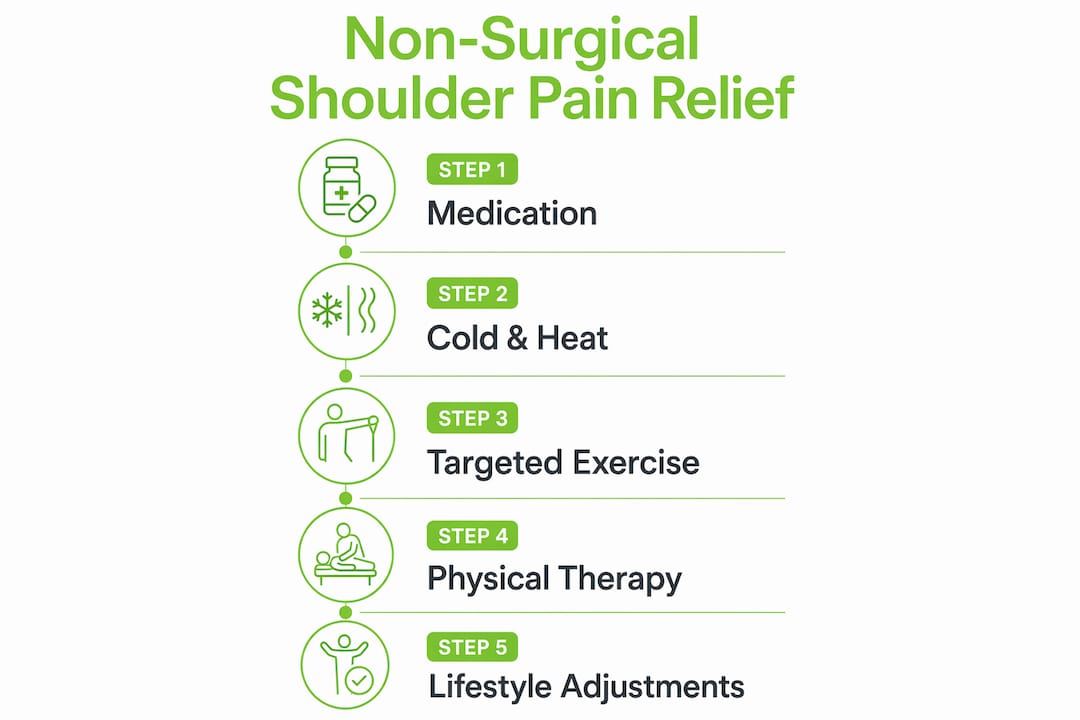
Conservative shoulder pain management draws from several treatment categories, each targeting a different aspect of the condition. Understanding which tool fits which situation is the difference between slow progress and real recovery.
Medications and topical agents
NSAIDs such as ibuprofen or naproxen are the first-line pharmacological option for shoulder pain. A consistent 5–7 day course reduces inflammation more effectively than taking a pill only when pain spikes. Sporadic dosing allows inflammatory cycles to restart, which prolongs tissue irritation. For patients who prefer to avoid oral medications, diclofenac gel applied 2–3 times daily delivers localized anti-inflammatory relief with minimal systemic absorption. This makes it a practical option for older adults or those managing gastrointestinal sensitivities.
Cold and heat therapy
Cold and heat are not interchangeable. Applying cold for 15–20 minutes, 3 to 4 times daily during the first 24–48 hours after an acute flare controls swelling and numbs pain. After the acute phase passes, moist heat applied for 15 minutes before stretching improves tissue pliability and prepares the joint for movement. Applying ice to a chronically stiff shoulder can actually reduce needed blood flow and slow healing. Knowing the phase of your injury determines which therapy belongs in your routine.

Injection therapies
Corticosteroid injections reduce inflammation in the subacromial space and are appropriate when pain prevents participation in physical therapy. Hyaluronic acid injections support joint lubrication in cases of glenohumeral arthritis. Subacromial injections are typically used as a bridge to rehabilitation, not as a standalone treatment. The goal is always to restore enough comfort that structured exercise can begin.
- NSAIDs: Use a consistent 5–7 day course, not as-needed dosing
- Topical diclofenac: Apply 2–3 times daily for localized relief with fewer side effects
- Cold therapy: Best in the first 24–48 hours for acute inflammation
- Moist heat: Use before stretching to improve tissue flexibility
- Corticosteroid injections: Appropriate when pain blocks participation in therapy
- Activity modification: Avoid overhead loading and painful arcs while maintaining gentle movement
Pro Tip: If you are unsure whether to use ice or heat, default to ice for a new flare and heat for a stiff, chronic ache. When in doubt, ask your clinician before your next therapy session.
How do targeted exercises relieve shoulder pain without surgery?
Exercise is the most evidence-supported non-invasive shoulder pain treatment available. The mechanism is not simply strengthening. It is restoring the coordinated muscle control that protects the joint during movement.
Why scapular stability matters more than you think
Scapular dyskinesis is frequently the underlying driver of shoulder pain, even when the patient points to the joint itself. When the scapula fails to rotate and tilt correctly, the rotator cuff muscles work at a mechanical disadvantage, leading to impingement and tendon overload. Rehabilitation that targets scapular stabilizers, including the serratus anterior, lower trapezius, and rhomboids, produces better long-term relief than exercises focused solely on the shoulder joint. This is why physical therapists at clinics like Nortexspineandjoint build programs around scapular control from the first session.
A progressive exercise protocol
A structured 6–8 week program consistently outperforms sporadic activity for chronic shoulder pain, according to a 2024 network meta-analysis published in PLOS ONE. That timeline reflects the biological reality of tendon and muscle adaptation. Rushing the process or skipping progressions typically leads to setbacks.
The following sequence reflects a standard evidence-based progression:
- Pendulum swings: Stand with your unaffected arm on a table, let the painful arm hang freely, and make small circles. This decompresses the joint and restores early mobility without loading the rotator cuff.
- Scapular retractions: Sit or stand tall, squeeze the shoulder blades together gently, and hold for 5 seconds. This reactivates the lower trapezius and corrects forward shoulder posture.
- External rotation with a resistance band: Anchor a band at elbow height, keep the elbow at 90 degrees against your side, and rotate the forearm outward. This directly strengthens the infraspinatus and teres minor.
- Wall slides: Stand with your back flat against a wall, arms in a “W” position, and slide them upward into a “Y.” This trains scapular upward rotation under low load.
- Side-lying external rotation: Lie on your unaffected side, elbow bent to 90 degrees, and lift the forearm toward the ceiling. This isolates the posterior rotator cuff without compressive load.
The painful arc between 60–120 degrees of shoulder abduction signals subacromial impingement. Any exercise that reproduces pain in that range should be modified or temporarily avoided. Working within a pain-free range is not avoidance. It is smart tissue management.
| Exercise | Primary Target | Sets and Reps |
|---|---|---|
| Pendulum swings | Joint decompression | 2 sets, 30 seconds each direction |
| Scapular retractions | Lower trapezius | 3 sets of 10, 5-second hold |
| External rotation (band) | Infraspinatus, teres minor | 3 sets of 12–15 |
| Wall slides | Scapular upward rotation | 3 sets of 10 |
| Side-lying external rotation | Posterior rotator cuff | 3 sets of 12 |
Pro Tip: Once pain resolves, do not abandon your exercise routine entirely. Two sessions per week of maintenance exercises is enough to preserve the gains you worked 6–8 weeks to build.
What lifestyle and self-care adjustments support shoulder pain management?
Structural exercises alone will not hold if daily habits keep reloading the injured tissue. Ergonomic posture correction and sleep position changes significantly reduce shoulder joint compression over time. These adjustments are not complicated, but they require consistency.
- Sleep position: Avoid sleeping directly on the affected shoulder. Sleeping on your back with a pillow supporting the arm in a neutral position reduces overnight compression. If you are a side sleeper, use a body pillow to prevent rolling onto the painful side.
- Desk ergonomics: Position your monitor at eye level and keep your keyboard close enough that your elbows rest near 90 degrees. Reaching forward repeatedly loads the anterior shoulder capsule and aggravates impingement.
- Lifting technique: Lead with your legs, keep loads close to your body, and avoid reaching overhead with a loaded arm until your therapist clears you for that range.
- Posture correctors: Wearable posture braces can provide a useful reminder to retract the shoulders, but they should not substitute for strengthening. Wearing one for more than 2–3 hours at a time can create dependency and weaken postural muscles.
- Massage and topical agents: Soft tissue massage to the upper trapezius and posterior shoulder reduces muscle guarding and improves circulation. Combined with topical diclofenac, this approach addresses both muscular and inflammatory contributors to pain.
Avoiding absolute rest is one of the most important principles in shoulder recovery. Dr. Voloshin at the University of Rochester emphasizes that gentle movement, unless a fracture or dislocation is present, prevents the joint from stiffening into adhesive capsulitis. Immobilizing a shoulder for more than 48 hours accelerates muscle atrophy and increases the risk of frozen shoulder, a condition that can extend recovery by months. Keep the joint moving, even if that means only gentle pendulum exercises in the early days.
When should you escalate care and seek specialist consultation?
Conservative care resolves most shoulder pain cases, but not all. Recognizing when to step up is as important as knowing which exercises to perform.
Symptoms persisting beyond 4–6 weeks despite consistent conservative management warrant MRI imaging and a specialist evaluation. That timeline is not arbitrary. It reflects the point at which structural damage, such as a partial or full-thickness rotator cuff tear, becomes a more likely explanation than simple inflammation or muscle imbalance.
Red flags that require prompt evaluation include:
- Sudden severe weakness in the arm following an injury
- Visible deformity or significant swelling of the shoulder
- Pain that wakes you from sleep consistently and does not respond to position changes
- Loss of passive range of motion, which may indicate adhesive capsulitis
- Numbness or tingling radiating down the arm, suggesting cervical spine involvement
“The goal of early, correct diagnosis is not to rush toward surgery. It is to prevent a manageable condition from becoming a structural problem that limits your options.”
For patients whose pain does not resolve with physical therapy and injections, regenerative medicine options such as platelet-rich plasma therapy offer a non-surgical path forward. PRP uses concentrated growth factors from your own blood to support tissue repair at the cellular level. It is not appropriate for every diagnosis, but for partial rotator cuff tears and chronic tendinopathy, the evidence base is growing. You can read more about non-surgical treatment options and how specialists approach each case before deciding on a path forward.
Key takeaways
Reducing shoulder pain non-surgically requires a structured combination of targeted exercise, appropriate therapy selection, and consistent lifestyle adjustments sustained over a minimum of 6–8 weeks.
| Point | Details |
|---|---|
| Use NSAIDs consistently | A 5–7 day course reduces inflammation more effectively than sporadic dosing. |
| Prioritize scapular stability | Exercises targeting the lower trapezius and serratus anterior address the root cause of most shoulder pain. |
| Match therapy to injury phase | Use cold in the first 24–48 hours for acute flares; switch to moist heat before stretching for chronic stiffness. |
| Keep the shoulder moving | Avoiding absolute rest prevents frozen shoulder and accelerates recovery timelines. |
| Escalate after 4–6 weeks | Persistent symptoms beyond this window warrant MRI and specialist evaluation to rule out structural damage. |
What i have learned treating shoulder pain over the years
The most common pattern I see is patients who rested their shoulder for weeks, assumed the pain would resolve on its own, and then arrived with a stiff, guarded joint that was harder to treat than the original injury. Rest feels intuitive when something hurts. The clinical reality is different.
The second pattern is patients who exercised aggressively through pain, believing that pushing through discomfort builds strength. Exercising through the painful arc of impingement does not build resilience. It reinforces the mechanical problem that caused the pain in the first place.
What actually works is less dramatic than most people expect. A structured program, performed consistently over 6–8 weeks, with attention to scapular mechanics and pain-free range, produces real results for the majority of patients. The challenge is adherence, not complexity. Many patients feel significantly better at week four and stop the program. That is exactly when the tissue is still consolidating its gains and most vulnerable to relapse.
My honest advice: treat the 6–8 week program as a minimum commitment, not a maximum. If you are not seeing progress by week six, that is the time to reassess with imaging and a specialist, not to push harder on your own.
— Felix
Personalized shoulder care at Nortexspineandjoint
If conservative measures have not produced the relief you expected, Nortexspineandjoint offers a full spectrum of non-surgical options tailored to your specific diagnosis. The clinical team builds individualized rehabilitation programs targeting scapular stability and rotator cuff function, supported by advanced therapies when exercise alone is insufficient. For patients with chronic tendinopathy or partial tears, PRP therapy for shoulder pain delivers concentrated growth factors directly to damaged tissue, supporting repair without surgery. If you are considering your options and want to understand what your insurance may cover for physical therapy, Medicare coverage for PT is a useful starting point. Schedule a consultation with Nortexspineandjoint to receive a personalized plan grounded in current clinical evidence.
FAQ
Can physical therapy fully resolve chronic shoulder pain?
Physical therapy resolves chronic shoulder pain in the majority of cases when the program is structured, progressive, and sustained for at least 6–8 weeks. Outcomes depend on the underlying diagnosis, with tendinopathy and impingement responding better than full-thickness rotator cuff tears.
How long does non-surgical shoulder treatment typically take?
Most patients see meaningful improvement within 6–8 weeks of consistent conservative care. Complete resolution of symptoms may take 3–6 months depending on the severity of the condition and how consistently the program is followed.
What exercises for shoulder pain should i avoid early in recovery?
Avoid any movement that reproduces pain in the 60–120 degree abduction range, which indicates subacromial impingement. Overhead pressing, behind-the-neck movements, and loaded reaching should be deferred until your clinician clears you for those ranges.
When does shoulder pain require surgery?
Surgery becomes appropriate when structural damage, such as a full-thickness rotator cuff tear or severe glenohumeral arthritis, fails to respond to 4–6 months of conservative care including physical therapy, injections, and regenerative treatments. A specialist evaluation with MRI imaging guides that decision.
Is PRP therapy a viable non-surgical option for shoulder pain?
PRP therapy is a clinically supported option for chronic rotator cuff tendinopathy and partial tears. It uses growth factors from your own blood to promote tissue repair and is appropriate for patients who have not responded adequately to physical therapy and corticosteroid injections alone.