
Spine mobility is defined as the spine’s ability to move through its full, pain-free range of motion across flexion, extension, rotation, and lateral bending. Knowing how to improve spine mobility matters because restricted movement is one of the most common complaints seen in clinical practice, and it responds well to targeted, consistent exercise. The spine is designed to move, and frequent gentle movement prevents the stiffness and gradual degeneration that follow prolonged inactivity. Clinical guidance from 2026 supports exercises performed 3–5 times per week as the standard starting point for adults with chronic stiffness. Techniques like cat-cow, thread the needle, and spinal twists, combined with core stabilization work, form the foundation of any effective spinal mobility routine.
How to improve spine mobility with targeted exercises
The most effective spine mobility exercises work by moving the vertebral segments through controlled ranges while circulating synovial fluid through the joints. Synovial fluid acts as the spine’s lubricant. When you move, it spreads across joint surfaces, reducing friction and keeping cartilage nourished. Skipping movement starves those joints of the fluid they need.

The core exercise list
These five exercises address the full spine and are appropriate for most adults with stiffness:
- Cat-cow pose. Cat-cow increases flexibility and activates core muscles while circulating synovial fluid through the spinal joints. Perform 8–10 slow repetitions, breathing into each position.
- Thread the needle. This targets thoracic rotation, the area most restricted in desk workers. Start on all fours, slide one arm under your body, and hold for 20–30 seconds per side.
- Child’s pose. Gently decompresses the lumbar spine and stretches the thoracolumbar fascia. Hold for 30–60 seconds, focusing on lengthening through the lower back.
- Supine spinal twist. Lying on your back, draw one knee to your chest and rotate it across your body. This mobilizes the lumbar and thoracic segments simultaneously.
- Foam roller thoracic extension. Place a foam roller perpendicular to your spine at mid-back level and gently extend over it. This counteracts the forward rounding that builds up from sitting.
Pro Tip: Start each session with cat-cow before moving to static stretches. The rhythmic motion warms up the joints and makes subsequent stretches more effective and comfortable.
The table below summarizes each exercise, the spinal region it targets, and its primary benefit.
| Exercise | Targeted area | Primary benefit |
|---|---|---|
| Cat-cow pose | Full spine | Joint lubrication, core activation |
| Thread the needle | Thoracic spine | Rotational mobility |
| Child’s pose | Lumbar spine | Decompression, fascial stretch |
| Supine spinal twist | Lumbar and thoracic | Segmental rotation |
| Foam roller extension | Thoracic spine | Extension, posture correction |
One safety note applies to all of these: stop if you feel sharp, shooting, or radiating pain. Mild muscle tension is normal. Nerve-like pain is not. If you want a deeper look at yoga poses for spinal flexibility, that resource covers additional options with clear form cues.
How often should you do spine mobility exercises to see results?
Frequency and consistency matter more than any single session. Exercising 3–4 times weekly for 10–20 weeks produces measurable improvements in spine health. That timeline is longer than most people expect, which is why so many patients quit before they see real change.
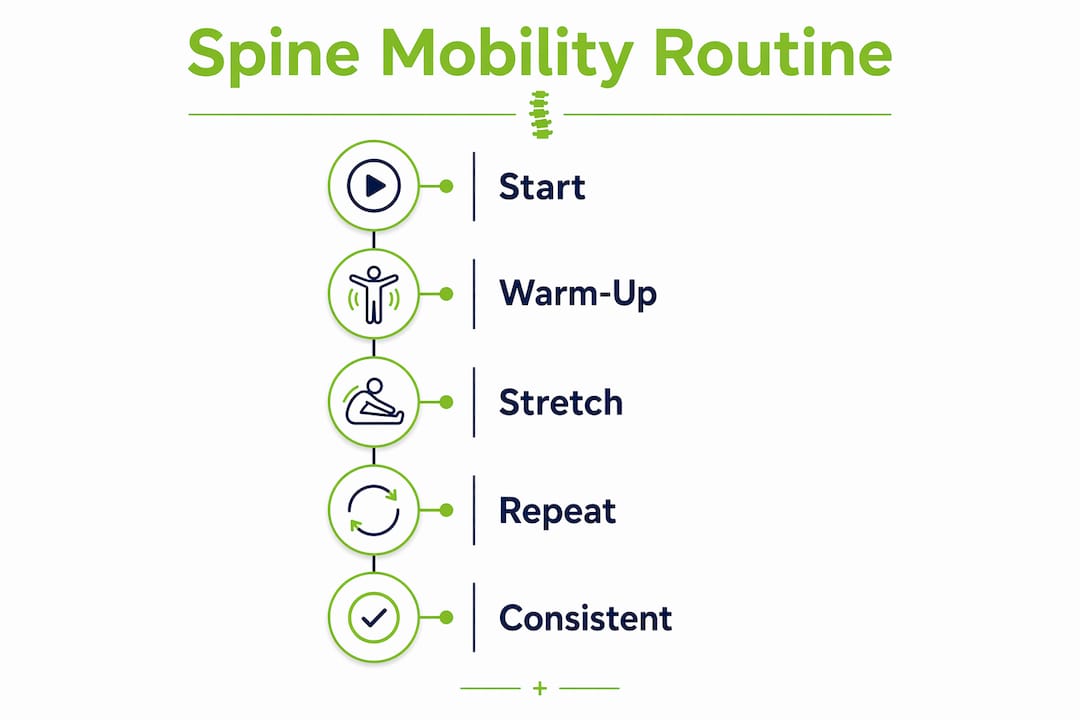
For adults with chronic stiffness, targeted mobility work 3–5 times per week is the recommended standard, with daily short sessions also proving effective. The key distinction is that daily sessions should be brief, around 10–15 minutes, rather than long and intense.
Most people notice meaningful relief within 2–4 weeks of consistent daily stretching. That early improvement is mostly neurological: your nervous system learns to allow more range of motion before the structural changes in tissue flexibility begin. Longer-term gains in actual tissue length and joint capacity take closer to 10–20 weeks.
| Frequency | Expected timeline | Primary outcome |
|---|---|---|
| Daily (10–15 min) | 2–4 weeks | Reduced stiffness, early relief |
| 3–4 times per week | 10–20 weeks | Measurable flexibility gains |
| 3–5 times per week | Ongoing | Chronic stiffness management |
Pro Tip: Pair a short morning session with a brief evening routine. Short morning and evening routines are more effective than one longer session because they maintain joint mobility throughout the day rather than letting stiffness rebuild.
What lifestyle habits support better spinal flexibility?
Exercise sessions alone are not enough if the hours between them involve prolonged static positions. The spine stiffens when held in one position for too long, regardless of how well you stretch in the morning. Movement variety throughout the day is as important as the formal routine itself.
Low-impact activities like walking and swimming promote spinal mobility by maintaining muscle engagement and circulation without loading the discs excessively. A 20-minute walk after lunch does more for your spine than most people realize. Swimming, in particular, allows the spine to move through multiple planes while the water reduces compressive load.
Core and glute strength directly support spinal mobility. Practices like Pilates and yoga build the deep stabilizing muscles that allow the spine to move freely without compensating through other joints. Core stability through isometric exercises like planks builds spinal support without the risky flexion forces that traditional sit-ups create. For more on building that foundation, the guide on back strengthening exercises covers the clinical rationale clearly.
Do’s and don’ts for daily spine health:
- Do stand up and move for 2–3 minutes every 45–60 minutes of sitting
- Do walk, swim, or cycle regularly as your primary aerobic activity
- Do strengthen your core with planks, dead bugs, and bird-dogs
- Do check your workstation setup: monitor at eye level, hips at 90 degrees
- Don’t perform traditional sit-ups or crunches; sit-ups place excessive stress on the intervertebral discs
- Don’t hold a forward-flexed posture for extended periods
- Don’t push through sharp or radiating pain during any exercise
Non-surgical conservative care, including physical therapy and low-impact activity, is the first-line treatment for spine issues before any advanced intervention is considered. This is consistent with how Nortexspineandjoint approaches new patients: conservative, evidence-based care first. The role of conservative therapy in orthopedics is well established and worth understanding before pursuing more involved options.
How to progress safely and recognize warning signs
Safe progression in a spinal mobility routine follows one principle: increase range before you increase load or duration. Trying to stretch further before your nervous system is ready creates protective muscle guarding, which makes stiffness worse, not better.
Micro-dosing gentle movements throughout the day is more effective for chronic stiffness than long, intense sessions. Performing 2–3 gentle repetitions of cat-cow or a seated spinal twist every 1–2 hours keeps the joints lubricated and prevents the stiffness from resetting between formal sessions. This approach works especially well for people who sit at a desk for most of the day.
Common mistakes that slow progress or cause injury:
- Bouncing or forcing a stretch at end range
- Skipping the warm-up and going straight into deep stretches
- Progressing too quickly by adding resistance or depth before the baseline range is stable
- Ignoring asymmetries, such as rotating more easily to one side
- Stopping exercise entirely after a flare-up, which worsens long-term stiffness
Recognizing the difference between productive discomfort and a warning sign is critical. Pain that improves with movement is generally safe to work through. Pain that is sharp, radiating down a limb, or accompanied by numbness or weakness requires professional evaluation before continuing.
Red flags that require medical attention before continuing any exercise program: sharp or stabbing pain that does not ease with movement, pain radiating into the leg or arm, numbness or tingling in the extremities, loss of bladder or bowel control, and pain following a fall or trauma. These symptoms indicate a structural problem that stretching alone cannot address. Recognizing serious spine pain early prevents further injury and guides appropriate care.
If you are unsure whether your pain pattern is safe to exercise through, reviewing exercises to stop lower back pain with clinical guidance can help clarify appropriate starting points.
Key Takeaways
Consistent, targeted spine mobility exercises performed 3–5 times per week, combined with daily movement habits and core stabilization, produce measurable improvements in spinal flexibility within 2–4 weeks and lasting structural gains within 10–20 weeks.
| Point | Details |
|---|---|
| Start with cat-cow | Cat-cow lubricates spinal joints and activates core muscles before deeper stretches. |
| Exercise 3–5 times weekly | This frequency produces early relief in 2–4 weeks and lasting gains in 10–20 weeks. |
| Micro-dose movement daily | Performing 2–3 gentle reps every 1–2 hours prevents stiffness from rebuilding between sessions. |
| Avoid sit-ups and crunches | Planks and isometric core work build spinal support without harmful disc compression. |
| Know your red flags | Sharp, radiating, or neurological pain requires professional evaluation before continuing exercise. |
What I’ve learned treating patients with spine stiffness
The patients who make the most consistent progress are rarely the ones who do the most. They are the ones who do something every day. A 10-minute morning routine done six days a week outperforms an hour-long session done once a week, every time. The spine responds to frequency, not heroics.
What I see repeatedly in clinical practice is that people wait too long to address stiffness. By the time they come in, they have been compensating for months, and the restricted segment has started to affect the joints above and below it. Early, gentle movement is protective. Waiting for pain to become severe before acting makes recovery slower and more complex.
Aggressive stretching is also a common mistake. Patients often believe that more force equals faster results. The opposite is true for spinal mobility. The nervous system interprets a forced stretch as a threat and responds with protective tension. Gentle, controlled movement repeated consistently is what actually changes tissue length and joint range over time.
The other thing worth saying plainly: perfect posture is not the goal. The goal is movement variety. A spine that moves well through many positions throughout the day is healthier than one held rigidly “correct” for hours. Integrate mobility work into your daily life, not just your workout, and the results will follow.
— Felix
When conservative care is not enough
For many patients, a consistent spinal mobility routine resolves stiffness and discomfort over time. When it does not, the underlying cause may be structural, such as disc degeneration, facet joint inflammation, or soft tissue damage that exercise alone cannot fully address. Nortexspineandjoint specializes in non-surgical solutions for exactly these situations. Treatments like PRP therapy for chronic back pain and regenerative medicine options are designed to target the root cause of persistent spine pain, not just manage symptoms. If your stiffness has not responded to several weeks of consistent exercise, a consultation with the Nortexspineandjoint team can clarify what is driving it and what treatment options are appropriate for your specific condition.
FAQ
What is spine mobility and why does it matter?
Spine mobility is the spine’s ability to move through its full range of motion across flexion, extension, rotation, and lateral bending without pain. Restricted mobility leads to compensatory movement patterns that increase injury risk and accelerate joint degeneration.
How long does it take to improve spinal flexibility?
Most people notice meaningful relief within 2–4 weeks of consistent daily stretching, with measurable structural improvements developing over 10–20 weeks of regular exercise.
What are the best stretches for spine stiffness?
Cat-cow pose, thread the needle, child’s pose, supine spinal twists, and foam roller thoracic extension are the most clinically supported stretches for increasing spinal flexibility and reducing stiffness.
Can I exercise my spine every day?
Daily short sessions of 10–15 minutes are effective and safe for most adults. Micro-dosing 2–3 gentle movements every 1–2 hours throughout the day is particularly effective for chronic stiffness.
When should I see a doctor about spine stiffness?
Seek professional evaluation if you experience sharp or radiating pain, numbness or tingling in the arms or legs, weakness, or any neurological symptoms. These signs indicate a structural issue that requires assessment beyond a standard mobility routine.
Recommended
- Spine Health Tips: Build a Stronger Back Daily
- Yoga for Lower Back Pain: Best Poses to Strengthen and Stretch Your Spine – Nortex | Pain Management | Allen, Garland, McKinney & Plano Texas
- Lower Back Pain and Posture: How to Improve Your Spine Health – Nortex | Pain Management | Allen, Garland, McKinney & Plano Texas
- How to Address Spine Pain: Nonsurgical Relief Guide