
EMTT therapy reduces pain and improves function in patients with tendon, joint, and bone healing problems, and that claim now rests on more than manufacturer literature. A 2025 double-blind, placebo-controlled randomized trial found pain scores dropped to roughly 2.8 on a 10-point scale in the treated group versus 4.3 in the sham group at six weeks, with the gap holding at twelve weeks. That is a real signal, not a rounding error, but the evidence base is still young. Most trials are small, and several combine EMTT with other regenerative treatments, which makes isolating its independent effect harder than a single headline number suggests.
Here is what you need to know before your first visit:
- Strongest evidence: Musculoskeletal pain and function (RCT-backed), tendon healing markers, and post-surgical bone union in pilot studies.
- Common side effects: Mild, transient skin redness or local discomfort; no serious adverse events reported in published trials.
- Typical protocol seen in trials: Roughly 80 mT field strength, 8 Hz frequency, about 10,000 pulses per session, once weekly for eight weeks.
At Nortexspineandjoint, we offer EMTT as one option among several evidence-aware regenerative treatments, and we walk patients through exactly what the data does and doesn’t support before recommending it.
Key Takeaways
EMTT therapy benefits are strongest for localized tendon, joint, and bone healing conditions, backed by RCT-level pain reduction and mechanistic cell studies, though evidence remains limited by small trial sizes.
| Point | Details |
|---|---|
| RCT-level pain reduction | A 2025 double-blind trial found VAS pain fell to 2.8 vs. 4.3 (placebo) at 6 weeks, holding at 12 weeks. |
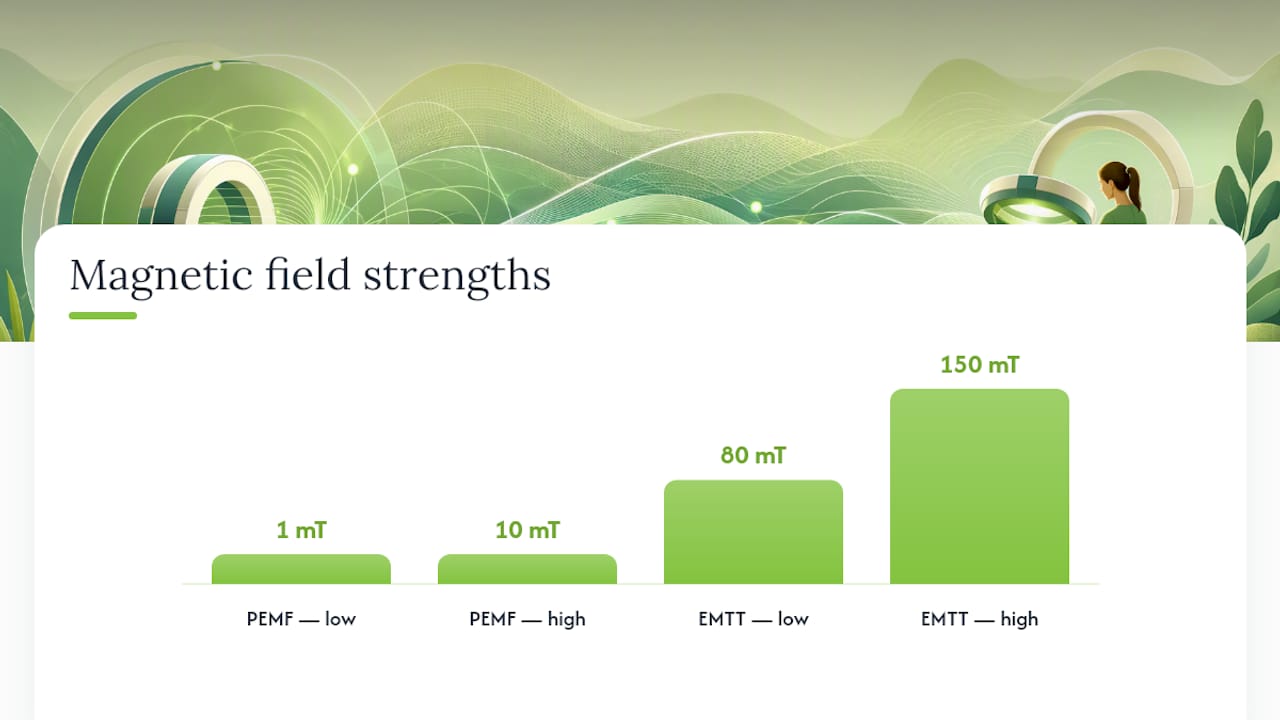
| Mechanism differs from PEMF | EMTT uses 80 to 150 mT fields at over 100 kHz, far higher than PEMF’s 1 to 10 mT range. |
| Best evidence in specific conditions | Tendinopathy, post-op bone healing, and low back pain (with physiotherapy) show the clearest benefit. |
| Safety profile is favorable | Trials report only mild, transient skin redness or discomfort, with no serious adverse events. |
| Works best as an adjunct | Combining EMTT with ESWT, PRP, or rehab shows stronger outcomes than EMTT alone in pilot data. |
| Nortexspineandjoint integrates EMTT clinically | The clinic pairs EMTT with regenerative options like PRP and rehab based on individual pain patterns. |
This article is general information, not a substitute for advice from a qualified doctor. Consult a qualified healthcare professional about your own circumstances before acting on anything here.
Table of Contents
- What Clinical Evidence Supports EMTT Therapy Benefits?
- How Does EMTT Therapy Work Differently Than PEMF?
- Which Conditions Show the Most Benefit From EMTT?
- Are There Side Effects or Risks With EMTT Treatment?
- What Happens During EMTT Treatment and How Long Until Results?
- How Does EMTT Compare to PEMF and ESWT?
- Who Is a Good Candidate for EMTT Therapy?
- How Nortexspineandjoint Approaches EMTT in Practice
- Ready to Explore EMTT Treatment at Nortexspineandjoint?
- Sources
- FAQ
What Clinical Evidence Supports EMTT Therapy Benefits?
The best evidence for EMTT therapy benefits comes from a 2025 double-blind, placebo-controlled randomized trial, the study design that carries the most weight in orthopedic medicine because neither patient nor evaluator knows who received real treatment. Participants receiving active EMTT under an 80 mT, 8 Hz protocol, delivered weekly for eight sessions, showed VAS pain scores of about 2.8 at six weeks compared with 4.3 in the placebo arm. At twelve weeks, the gap remained meaningful: 2.2 versus 4.2. That is not a marginal difference. On a standard 10-point pain scale, a two-point separation sustained across three months is the kind of effect size that changes how a clinician counsels a patient.
Key trial numbers: VAS pain fell to 2.8 (EMTT) vs. 4.3 (placebo) at 6 weeks, and 2.2 vs. 4.2 at 12 weeks, using an 80 mT, 8 Hz, weekly protocol over 8 sessions.
A separate pilot case-control study looked at a very different clinical question: does adding EMTT to extracorporeal shockwave therapy (ESWT) after foot and ankle surgery speed up recovery? The results were notable. Post-operative pain scores averaged 0.2 in the combined-treatment group versus 3.1 in controls. Return to normal activity took roughly 13.2 weeks instead of 22.4. Radiographic healing at four weeks was confirmed in 8 of 10 patients receiving EMTT plus ESWT, compared to 2 of 10 in the comparison group. Those are small numbers, so treat the percentages with appropriate caution, but the direction and magnitude of the effect are consistent with what the mechanism studies would predict.
Earlier work on rotator cuff tendinopathy, combining EMTT with ESWT, reported improved Constant Murley scores, a validated shoulder function measure orthopedic surgeons use routinely. A separate study combining EMTT with physiotherapy for non-specific low back pain found pain dropped by roughly 64.7% in the EMTT group, with Oswestry Disability Index scores improving from about 53.5 to 25.6 over twelve weeks, a meaningfully larger gain than physiotherapy alone.
Before you take any of this as settled science, understand the limitations clearly:
- Most published studies involve small cohorts, often 20 to 40 patients per arm.
- Many trials pair EMTT with ESWT, physiotherapy, or post-surgical care, making it hard to isolate EMTT’s standalone contribution.
- Protocols vary across studies in field strength, frequency, and session count, which limits direct comparison.
- A scoping review of current evidence concluded the modality is promising but needs larger, standardized randomized trials before firm clinical guidelines can be written.
In my clinical experience, this pattern is common with newer regenerative modalities. The early data looks genuinely encouraging, the mechanism makes biological sense, and yet the sample sizes haven’t caught up to the enthusiasm. That doesn’t mean you should dismiss EMTT. It means you should ask specific questions about which study your provider is basing their recommendation on.
How Does EMTT Therapy Work Differently Than PEMF?
EMTT stands for electromagnetic transduction therapy, and confusing it with standard PEMF (pulsed electromagnetic field) therapy is one of the most common mistakes I see patients make when researching their own care. The two technologies share a family resemblance but operate at very different intensities.
Conventional PEMF devices typically deliver magnetic field strengths of 1 to 10 mT at relatively low oscillation frequencies. EMTT devices operate at 80 to 150 mT, and crucially, the oscillation frequency exceeds 100 kHz, roughly ten thousand times faster than the pulse rate of older PEMF units. That difference in frequency architecture is not a marketing distinction. It changes how the induced electrical current interacts with cell membranes and tissue matrix.
In vitro research helps explain why that matters. Laboratory studies exposing osteoblasts (bone-forming cells) to EMTT found upregulation of key osteogenic genes, including SP7, RUNX2, COL1A1, ALPL, and BGLAP. These genes govern the sequence of bone matrix production and mineralization. Cultures exposed to EMTT showed stronger Alizarin Red and Von Kossa staining, lab markers that indicate earlier and more complete mineral deposition, compared to untreated controls.
Separate tenocyte studies (tenocytes are the primary cells in tendon tissue) found EMTT at 80 mT increased cell migration significantly, boosted expression of scleraxis and tenomodulin (proteins tied to tendon identity and repair), and downregulated senescence markers like CDKN2a/INK4a, genes associated with aging, damaged cells that stop dividing and can slow healing.
The proposed biological pathways include:
- Osteogenesis: Direct stimulation of bone-forming gene pathways, relevant to fracture healing and implant integration.
- Angiogenesis: Improved blood vessel formation in treated tissue, supporting nutrient delivery to healing sites.
- Anti-inflammatory signaling: Reduced local inflammatory markers in treated tissue models.
- Electroporation and piezoelectric effects: Hypothesized mechanisms by which the rapid field oscillation temporarily alters cell membrane permeability, allowing ionic and molecular signaling changes.
You should hold one caveat firmly in mind: what happens in a petri dish does not automatically happen in a human tendon or vertebra. Cell culture studies tell us a mechanism is plausible, not that it will reliably translate into the pain relief a patient feels at week six. That gap is exactly why the RCT data described above matters so much. It’s the bridge between cellular theory and something you can actually measure in a clinic.
Which Conditions Show the Most Benefit From EMTT?
Not every musculoskeletal condition responds to EMTT the same way, and knowing where the evidence is strongest helps you set realistic expectations before you commit to a treatment plan.
-
Osteoarthritis. Patients with degenerative joint pain, particularly knee and hip OA, report meaningful pain and function improvement in trial settings, though EMTT here functions best as an adjunctive therapy rather than a replacement for weight management, targeted exercise, or injection-based options like PRP. If you have advanced structural joint damage, EMTT is unlikely to reverse it, but it may reduce the inflammatory pain that limits your rehab progress.
-
Tendinopathies. Rotator cuff, Achilles, and patellar tendon conditions show some of the more consistent signals, both at the cellular level (tenocyte migration and reduced senescence) and clinically, with improved Constant Murley scores when EMTT is combined with ESWT for shoulder tendinopathy. Chronic tendon pain that hasn’t responded to rest and eccentric loading exercises is a reasonable candidate profile.
-
Low back pain. The physiotherapy-combination trial noted above found substantial pain and disability improvement, but this remains a smaller body of evidence than the tendon and bone-healing literature. Treat these results as encouraging rather than conclusive.
-
Fracture healing and post-operative recovery. This is where the case-control pilot data stands out. Faster return to activity, lower post-op pain, and higher rates of radiographic union at four weeks make EMTT a reasonable adjunct for patients recovering from foot and ankle surgery, and the underlying gene-expression research supports a biological rationale for broader fracture applications.
Pro Tip: Ask your provider whether EMTT is being recommended as your primary treatment or as an adjunct to something else, like physical therapy or PRP. The strongest published outcomes almost always involve EMTT paired with another modality, not used in isolation.
In practice, I rarely present EMTT as a stand-alone fix. It fits most naturally into a broader plan, one that might also include structured rehab, PRP for tissue-level regeneration, or targeted injections, depending on what’s actually driving your pain.
Are There Side Effects or Risks With EMTT Treatment?
EMTT has a favorable safety profile across the studies published so far. The 2025 randomized trial and the pilot case-control study both reported no serious adverse events, and the side effects that did occur were mild and temporary. That track record is one reason clinicians feel comfortable offering it as a low-risk option compared to more invasive procedures.
Here’s what patients and providers have observed:
- Common effects: Transient skin redness or mild local discomfort at the treatment site, usually resolving within hours.
- Rare reports: Occasional mild fatigue or a brief increase in localized soreness after the first one or two sessions, similar to a post-exercise response.
- No documented systemic complications in the peer-reviewed trials reviewed here.
Precautions still matter, and this is where your clinician’s screening process earns its place. EMTT is generally avoided in patients with implanted electronic devices, including pacemakers and certain neurostimulators, because of the field strength involved. Pregnancy is another area where data is simply too limited to recommend treatment, so we advise against it out of caution rather than documented harm. Active infection or malignancy at the treatment site is a contraindication as well. If you’re being evaluated for EMTT, a thorough medical history should come before anything else. It is worth comparing this profile to older PEMF devices, and an independent overview of PEMF side effects is a useful reference if you’re weighing the two technologies.
Monitoring in published studies typically involved follow-up assessments at six and twelve weeks, using standardized outcome measures like VAS pain scores and functional indices. That’s a reasonable rhythm to expect from your own provider: a baseline assessment, then structured check-ins rather than a single follow-up visit months later.
If you notice unusual swelling, worsening pain rather than gradual improvement, or any signs of infection near the treatment site, contact your provider promptly rather than waiting for your next scheduled visit. Those symptoms fall outside what trials have documented as a typical response and deserve direct evaluation.
What Happens During EMTT Treatment and How Long Until Results?
Most patients want two questions answered before booking: how many sessions, and when will I actually feel different? The clinical trial data gives a reasonably clear answer to both.
-
Protocol structure. The 2025 RCT used an 80 mT field strength at 8 Hz, delivering roughly 10,000 pulses per session, administered once weekly for eight consecutive weeks. Some clinics adjust pulse count or frequency slightly based on the condition being treated, but this eight-week, once-weekly framework is the most well-documented protocol in the literature.
-
Timeline to improvement. In the RCT, meaningful pain reduction was measurable at six weeks, with the treatment effect holding steady, and in some cases improving further, at twelve weeks. That means you should not expect dramatic relief after one or two sessions. The data suggests a gradual, cumulative response over one to three months.
-
The session itself. Treatment is delivered externally over the affected area, typically taking 10 to 20 minutes per visit. There’s no sedation, no incision, and no significant downtime. Most patients return to normal activity immediately afterward, and many clinics schedule physical therapy or targeted exercise the same week to reinforce functional gains.
Cost is one area where I encourage patients to ask directly rather than assume. Clinic fees vary based on the number of sessions, whether EMTT is bundled with other regenerative treatments, and geographic location. Insurance coverage for EMTT is inconsistent industry-wide since it is still considered an emerging modality by many payers, so verify your specific policy’s stance before committing to a full eight-session course.
How Does EMTT Compare to PEMF and ESWT?
Choosing between EMTT, standard PEMF, and shockwave therapy (ESWT) comes down to understanding what each does mechanically, not just what each is called.
EMTT’s key advantage over conventional PEMF is intensity and frequency architecture. At 80 to 150 mT and oscillation frequencies above 100 kHz, EMTT delivers a fundamentally different cellular stimulus than PEMF’s 1 to 10 mT range. That higher energy density is part of why EMTT sessions run 10 to 20 minutes rather than the longer sessions often associated with lower-intensity PEMF protocols.
ESWT works through a different physical principle entirely, using acoustic shockwaves rather than magnetic fields to stimulate tissue repair and disrupt calcific deposits. The evidence for combining ESWT and EMTT is genuinely compelling. In the foot and ankle pilot study, patients receiving both therapies together showed faster radiographic healing and quicker return to activity than would typically be expected from either modality alone. Rotator cuff tendinopathy studies found a similar pattern, with combined protocols outperforming single-modality treatment on Constant Murley function scores.
Here’s how I frame the decision tree for patients:
- Start conservative with structured physical therapy and activity modification for straightforward tendon or joint pain, particularly if symptoms are recent.
- Consider EMTT or ESWT when conservative care plateaus after six to eight weeks without meaningful improvement.
- Consider combination therapy for surgical recovery, chronic tendinopathy, or slow-healing fractures, where the pilot evidence supports additive benefit.
- Discuss cost and coverage upfront, since combination protocols mean more total sessions and higher out-of-pocket exposure if insurance doesn’t cover the modality.
Neither EMTT nor ESWT replaces surgery when surgery is genuinely indicated, and neither should be your first move for an acute injury that hasn’t had a chance to heal with rest.
Who Is a Good Candidate for EMTT Therapy?
The patients who respond best to EMTT tend to share a specific profile, and recognizing whether you fit it will save you time and money.
Good candidates typically have chronic tendon pain that hasn’t resolved with rest and standard exercise, degenerative joint pain with a limited response to conservative care, or an elevated risk of delayed bone union following fracture or surgery. Localized, structural pain responds more predictably than diffuse, centralized pain patterns, which is a distinction worth raising directly with your provider.

Certain symptoms should prompt a full medical workup before anyone discusses EMTT: unexplained weight loss, signs of systemic infection, or uncontrolled anticoagulation therapy. These are red flags that point toward conditions EMTT was never designed to address.
Before agreeing to a treatment plan, ask your clinician these questions directly:
- What specific protocol will you use, and is it based on published trial parameters?
- How will you measure success, pain scores, functional testing, or imaging?
- What are the realistic alternatives, and how do their costs compare?
- Does combining EMTT with PRP or another regenerative option make sense for my specific condition?
If your provider can’t answer the second question with a concrete plan, that’s worth noting.
How Nortexspineandjoint Approaches EMTT in Practice
At Nortexspineandjoint, patients typically arrive at EMTT after trying multiple conservative treatments that didn’t provide lasting relief. Many have already gone through physical therapy, anti-inflammatory medications, or basic injections without the improvement they hoped for. That pattern is common, and it’s exactly the population where the trial evidence is most applicable.
Our workflow starts with a consultation and functional assessment to determine whether your pain source is structural and localized, the profile that responds best to EMTT, rather than diffuse or centralized. From there, treatment is often integrated with other services when appropriate:
- EMTT alone for tendon or joint pain responding well to conservative measures but needing an additional push.
- EMTT combined with PRP therapy when tissue regeneration is the primary goal.
- EMTT paired with structured rehabilitation to reinforce functional gains between sessions.
We set expectations honestly at the first visit: improvement is typically gradual, measured in weeks rather than days, and not every condition responds equally well. That’s consistent with what the published data actually shows, and it’s a more useful starting point than a promise of quick results.
A Clinician’s View on Where EMTT Fits
In practice, EMTT earns its place when conservative care has plateaued but surgery isn’t yet warranted, a middle zone that frustrates a lot of patients. I tend to reach for it, or recommend combining it with ESWT or PRP, when someone has chronic tendon pain or slow-healing bone that hasn’t responded to six to eight weeks of standard rehab.
Where I’m more cautious is diffuse, centralized pain, fibromyalgia-type presentations or widespread nonspecific back pain, where the evidence is thinner and expectations need to stay modest.
Many patients come to us after multiple failed conservative trials, frustrated and unsure what’s left to try. EMTT isn’t a miracle fix, but for the right candidate, it’s a reasonable, low-risk next step worth discussing honestly.
— Felix
Ready to Explore EMTT Treatment at Nortexspineandjoint?
If chronic tendon or joint pain has outlasted physical therapy and basic conservative care, EMTT at Nortexspineandjoint gives you a lower-risk next step before considering more invasive options. Unlike a general wellness clinic offering generic magnet therapy, our approach integrates EMTT with regenerative options like PRP and structured rehab when your evaluation calls for it, based on your specific pain pattern rather than a one-size protocol.
Booking a consult starts with a functional assessment. Bring any recent imaging, a list of treatments you’ve already tried, and a clear description of when your pain worsens or improves. That history helps determine whether EMTT alone fits your case or whether combining it with another regenerative approach makes more sense. Visit our EMTT therapy page to see how sessions are structured, or explore our full regenerative medicine offerings if you’re weighing multiple treatment paths before your first appointment.
Sources
- Extracorporeal Magnetotransduction Therapy (EMTT) for management of musculoskeletal disorders: A double-blind, placebo-controlled, randomised trial
- Effects of EMTT on human tenocytes: migration, matrix remodeling, and senescence marker changes
FAQ
How Effective Is EMTT Therapy?
A 2025 double-blind randomized trial found meaningful pain reduction, VAS scores of 2.8 versus 4.3 at six weeks compared with placebo, though evidence is still limited to a relatively small number of well-controlled studies.
Are There Side Effects of EMTT Therapy?
Reported side effects are mild and temporary, mainly local skin redness or discomfort, with no serious adverse events documented in published trials to date.
How Much Does EMTT Treatment Cost?
Cost varies by clinic, number of sessions, and whether EMTT is combined with other regenerative treatments, so check directly with your provider, including insurance coverage, since coverage for EMTT is inconsistent.
Does Magnetic Therapy Actually Work?
Traditional low-intensity magnet therapy has weak clinical support, but EMTT operates at far higher field strengths and frequencies, and it has RCT-backed evidence for pain and function improvement in specific musculoskeletal conditions.
Is EMTT the Same as PEMF?
No. EMTT delivers 80 to 150 mT fields at oscillation frequencies above 100 kHz, while conventional PEMF typically operates at 1 to 10 mT, a difference that affects both treatment time and clinical results.