
Most people go home the same day after radiofrequency ablation (RFA), feel some soreness for a few days, and return to ordinary activity within about a week. Pain relief is usually slower than that. It tends to build over one to several weeks as the treated nerves quiet down. The sections below walk through each stage, the way we would in a consultation, so you know what is normal and what deserves a phone call.
TL;DR
- The procedure itself is short, and you go home the same day. Plan on a ride home if you receive sedation.
- Temporary soreness, a sunburn-like sensation or mild swelling at the needle sites commonly lasts 2 to 3 days.
- Pain relief usually begins about 1 to 3 weeks after the procedure, so a sore first week does not mean it failed.
- Relief often lasts for many months and sometimes longer, but nerves can regrow, and the procedure can be repeated if pain returns.
- Fever, spreading redness, new weakness or numbness in a leg or arm, or loss of bladder or bowel control needs same-day medical attention.
Table of Contents
- What RFA actually does, and why that shapes recovery
- The procedure day: how long it takes and what happens afterward
- Days 1 to 3: the soreness phase
- Weeks 1 to 3: when relief begins
- Returning to work, driving and exercise
- How long RFA relief can last
- Can RFA be repeated?
- Symptoms that need a call, and symptoms that are normal
- Our perspective on recovery
- When RFA is part of a bigger plan
- Planning your own recovery
- Talk to a pain specialist in North Dallas
- FAQ
- Sources
What RFA actually does, and why that shapes recovery
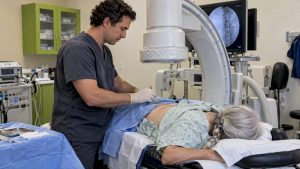
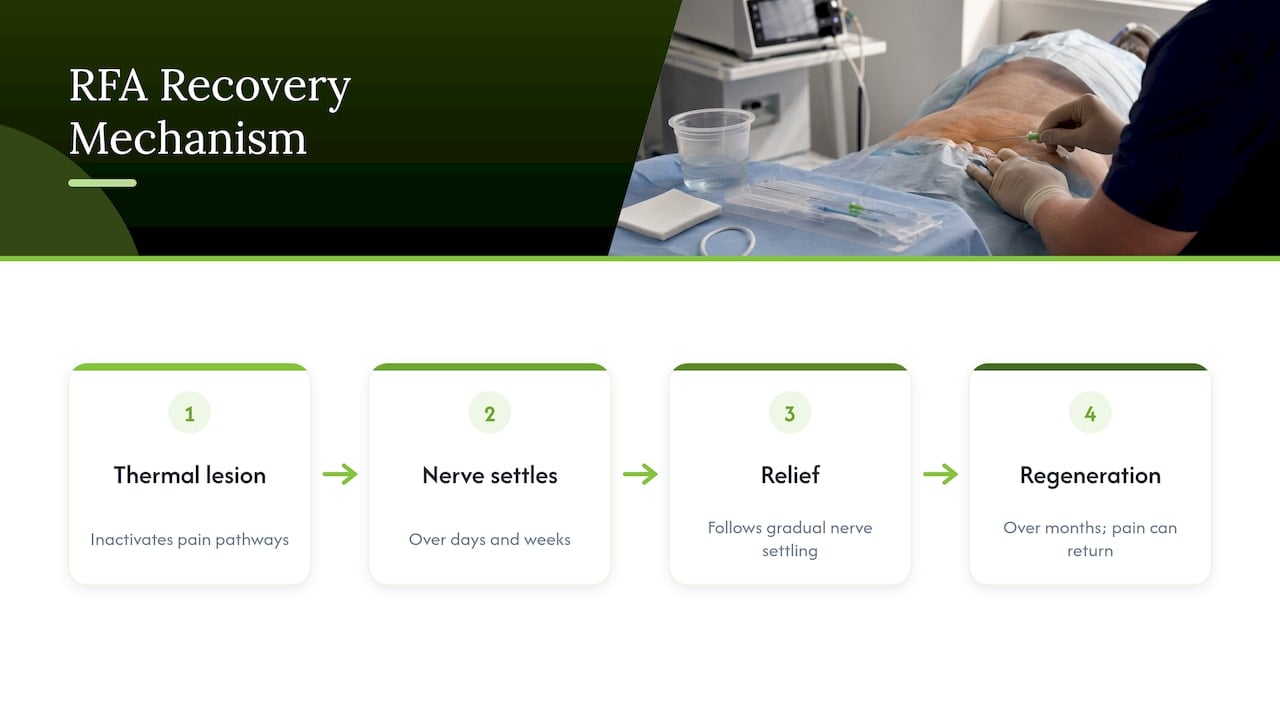
Radiofrequency ablation uses a small needle, placed with X-ray guidance, to deliver heat to a sensory nerve that carries pain signals from an arthritic joint. The heat creates a small lesion on that nerve so it stops relaying pain to the brain. The academic literature on the mechanism describes it as a thermal lesion that inactivates pain pathways, with the nerve regenerating over months, which is why pain can eventually return.
This explains the recovery pattern better than any generic timeline. You are not healing a surgical wound. You are letting a nerve that was irritated by heat settle down, and that process is gradual. The needle sites are tiny, so the early soreness is mostly from the needle path and the local inflammation around the nerve. The longer wait for relief reflects the nerve calming over days and weeks.
The nerves we treat most often are the medial branch nerves of the spinal facet joints in the neck, mid back and low back, and the genicular nerves around the knee. If you are not sure which applies to you, our pages on lumbar radiofrequency neurotomy, cervical facet radiofrequency neurotomy, thoracic facet radiofrequency neurotomy and genicular nerve ablation describe each version.
The procedure day: how long it takes and what happens afterward
The time on the table is short, usually well under an hour, although the number of nerves treated changes it. Most of the visit is check-in, positioning, numbing the skin and monitoring afterward. Plan on a couple of hours from arrival to departure, and ask our team about the expected timing for your specific levels.
After the treatment you rest in a recovery area. According to Spine-health’s overview of RFA recovery, this is typically 15 minutes to an hour if sedation was used, with vital signs watched throughout. The same source notes that, depending on the area treated, you may feel a superficial burning pain with hypersensitivity, similar to a sunburn, and sometimes slight numbness of the skin over the area.
A few practical points for day one:
- If you had sedation, arrange a driver and do not make major decisions or operate machinery until the next day.
- Expect the numbing medicine to wear off within hours. This is when some people notice the first soreness.
- Use a cold pack on the needle sites for short periods, with a cloth between the pack and your skin.
- Walk around the house and move gently. Prolonged bed rest tends to make a stiff back feel worse.
- Keep the needle sites clean and dry as instructed in your discharge sheet, and hold off on soaking in a bath, hot tub or pool until your clinic says the sites have sealed.
Days 1 to 3: the soreness phase
A temporary increase in your usual discomfort is the most common complaint. FloridaHealthFinder, a state health encyclopedia, states that this mild flare commonly lasts 2 to 3 days, that swelling at the needle site can occur, and that a cold pack may help.
Many patients are surprised by this phase because they expected to feel better right away. What we tell them is that the early soreness and the later relief are two different events. The soreness comes from the needle and local irritation. The relief comes later, as the treated nerve stops signaling.
During these days:
- Over-the-counter pain relievers are often used, but check with your physician first if you take blood thinners, have kidney or stomach problems, or take other regular medications.
- Light walking is fine. Avoid heavy lifting, deep twisting and long drives for the first day or two.
- Do not judge the procedure yet. The pain you feel now is not a reliable forecast of the result.
Weeks 1 to 3: when relief begins
Pain relief after RFA is typically noticed 1 to 3 weeks after the procedure. Some patients notice a change in the second week, while others need closer to three before the difference is clear. Relief is often gradual, not a switch that flips. Many people describe it as getting through a morning without the usual stiffness, then realizing they have not thought about their back for a few hours.
There are patterns we see often. Patients who come in after trying several treatments tend to be anxious in week one, because they have been disappointed before. We ask them to track simple things: how long they can stand, how they sleep, how far they walk. These markers are more reliable than a daily pain score, which swings with weather, stress and activity.
If you reach week four with no change at all, call us. It does not always mean the procedure failed. Sometimes the pain is coming from a source other than the facet joints, or only some of the nerves feeding the joint were treated. That conversation is better had early.
Returning to work, driving and exercise
Most people with desk-based jobs return within a day or two, once the sedation has worn off and the soreness allows sitting comfortably. Physically demanding work may need a few more days. These are general patterns and not a rule, so follow the instructions from the physician who treated you.
A reasonable progression looks like this:
| Timeframe | Typical guidance |
|---|---|
| Day of procedure | Rest, short walks, cold pack, no driving if sedated |
| Days 1 to 3 | Light activity, avoid heavy lifting and forceful twisting |
| Days 3 to 7 | Return to usual daily tasks as soreness settles |
| Weeks 1 to 2 | Gradually resume gym work and sport, starting lighter than before |
| Weeks 2 to 6 | Build strength and endurance, ideally with a structured program |
One point deserves emphasis. RFA reduces pain, but it does not rebuild the muscles that support your spine or knee. Spine-health notes that many patients have been deconditioned over months or years of pain, and that physicians may prescribe guided physical therapy to increase strength and activity tolerance safely. That matches what we see. People who add physical therapy once the soreness settles tend to hold on to their progress better than those who simply return to old habits.
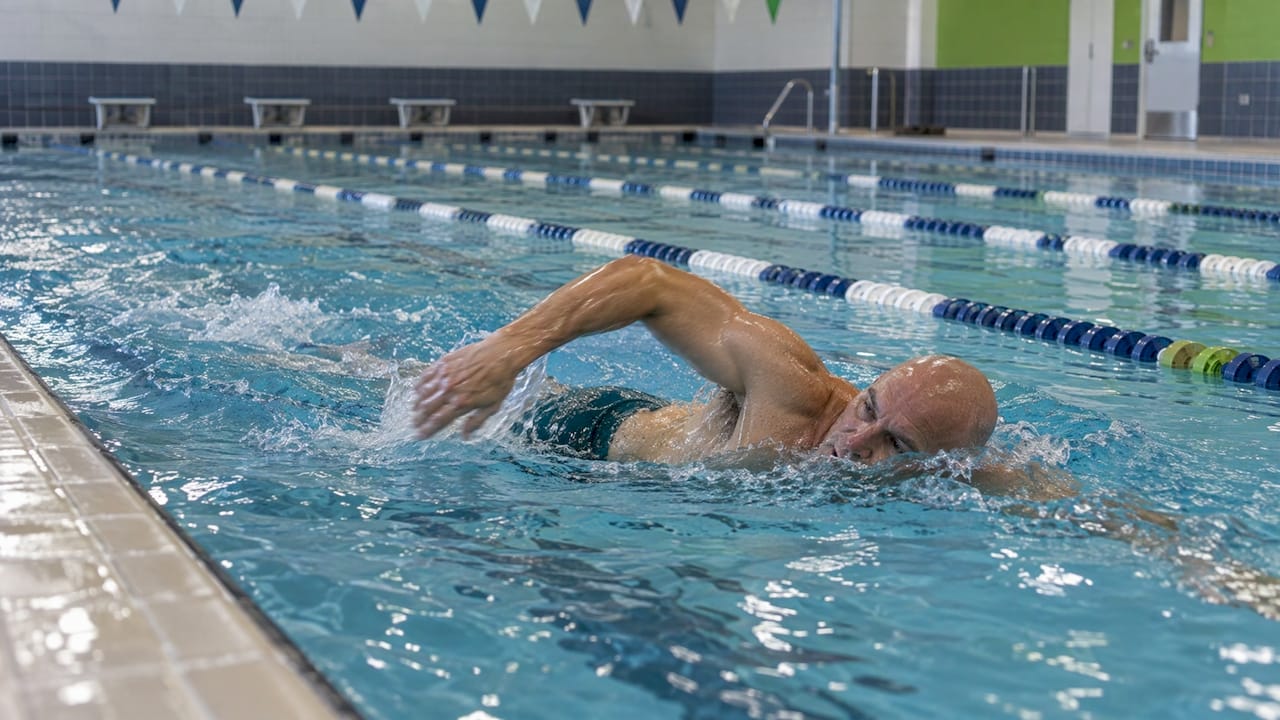
Athletes and very active adults should reintroduce impact slowly. Start with walking, cycling or swimming, and test running or heavy lifting only when your daily movements feel comfortable.
How long RFA relief can last
The length of relief varies widely between people. Many patients get relief lasting from several months up to a year or more, and some get longer. The reason it is not permanent is biological: the nerve can regenerate over months, and once it does, the pain signal can return.
Factors that influence duration include which joint was treated, how well the diagnostic blocks predicted the result, how much underlying arthritis is present, your activity level and your body weight. One more variable is the technique. Recent comparative research from India suggests that cooled RFA may offer better long-term relief and function than conventional RFA for certain conditions such as knee osteoarthritis. Whether a particular technique suits you is a decision to make with your physician.
Selection matters a great deal. Patients who respond well to carefully performed diagnostic blocks before RFA are generally better candidates. If you want to understand that step, read our article on what happens if dual blocks give 80% relief, and the page on the lumbar medial branch block.
Can RFA be repeated?
Yes, in many cases. When pain returns after the nerves regrow, the procedure can often be performed again, and many patients get similar relief the second time. There is no single universal cap on repeats. The practical questions are whether the previous procedure gave meaningful relief, how long it lasted, and whether your symptoms still point to the same joints. If relief was brief or fading faster each time, we reassess the diagnosis rather than simply repeat the treatment.
Repeat procedures are typically spaced by how long your relief lasted, not by the calendar. If you got nine months of relief, you would generally wait until the pain meaningfully returns instead of scheduling by the date.
Symptoms that need a call, and symptoms that are normal
Normal after RFA:
- Soreness, bruising or mild swelling at the needle sites
- A sunburn-like burning or skin hypersensitivity over the treated area
- A patch of skin numbness that is small and stable
- A temporary rise in your usual pain for 2 to 3 days
Call the clinic promptly for:
- Increasing redness, warmth, drainage or pain at a needle site
- Fever or chills
- Soreness that keeps escalating after the first few days instead of fading
- A rash or hives after the procedure
Go to the emergency department or call 911 for:
- New weakness in an arm or leg
- New numbness spreading in the legs, groin or saddle area
- Loss of bladder or bowel control
- Chest pain or trouble breathing
If you have a pacemaker, spinal cord stimulator or another implanted device, tell us before the procedure. Professional guidance from the American Society of Pain and Neuroscience says preoperative assessment should identify implanted-device details and consider electromagnetic interference risks so devices can be managed during RFA. For a fuller list of questions to ask in advance, see our six safety checks before radiofrequency ablation.
Our perspective on recovery
We approach RFA recovery as a conversation with expectations, not as a promise. Many patients come to us after months of medications, therapy and injections that helped briefly or not at all, and they are understandably wary. We tell them plainly that the first week can be sore, that relief usually arrives gradually, and that the nerve can regrow.
Our view is that the best results come from treating the right target. That is why we favor careful diagnostic blocks first, precise needle placement under imaging, and a rehabilitation plan that begins once the soreness settles. Ablation quiets the pain signal, and strengthening gives you the chance to move differently while the signal is quiet.
Because our physicians are trained across the full range of non-surgical options, we can compare RFA with injections, regenerative treatments and rehabilitation and recommend the one that fits your anatomy and goals. If RFA is the right step, we want your recovery to be predictable and well supervised.
Felix
When RFA is part of a bigger plan
RFA is one tool in a stepwise approach. Some patients begin with facet joint injections, which help with diagnosis and short-term relief. Our guide to facet joint injection recovery day by day shows a similar early course. If the diagnostic work points to the facet nerves and the response is strong, RFA becomes a logical next step. Others need a different approach, such as epidural injections, back pain therapy, or regenerative options, depending on what is generating the pain.
If you are also considering biologic treatment, recovery looks different. Our article on post-PRP rehabilitation covers the strengthening timeline that follows platelet-rich plasma.
Planning your own recovery
A little preparation makes the first week easier:
- Arrange transportation and, if possible, a lighter schedule for two or three days.
- Stock a cold pack and loose clothing that does not rub the needle sites.
- Ask what to do with blood thinners and other medications before the day of treatment.
- Write down your baseline: pain level, walking distance, sleep, and the activities you most want back.
- Schedule a follow-up for roughly three to four weeks out, when the result is clearer.
Bringing the baseline to the follow-up gives you and your physician something concrete to compare, instead of relying on memory.
Talk to a pain specialist in North Dallas
If you are weighing RFA for chronic back, neck or knee pain, we can review your history, imaging and prior treatments and explain what a realistic recovery looks like for you. Our team treats patients across Allen, McKinney, Plano, Garland and the surrounding area. You can see the full range of options on our treatments page or learn about our regenerative medicine program if you are also exploring ways to avoid surgery. Call us to schedule a consultation.
FAQ
How long will I be sore after RFA?
For most people, a temporary rise in usual discomfort lasts about 2 to 3 days, according to FloridaHealthFinder. Swelling or tenderness at the needle site can occur, and a cold pack may help. Soreness that grows worse after the first few days is not typical, and you should call your clinic.
When can I exercise after radiofrequency ablation?
Light walking is usually fine the same day or the next. Many patients resume gym work and sports gradually over the first one to two weeks, starting lighter than before. Your physician may adjust this based on the area treated and your overall condition.
How many times can you have radiofrequency ablation?
There is no single fixed limit. When the nerves regrow and pain returns, the procedure can often be repeated. Your physician looks at how much relief you got and how long it lasted before recommending another round.
How long does the RFA procedure take?
The treatment itself is typically well under an hour, depending on how many nerves are treated. Allow a couple of hours for check-in, preparation and monitoring afterward. Your clinic can give you a more precise estimate for your levels.
When does pain relief start after RFA?
Relief is typically noticed one to three weeks after the procedure. It tends to build gradually, and the first days can be sore before it does.
Sources
- FloridaHealthFinder: Radiofrequency ablation for chronic pain
- Advances in radiofrequency ablation: mechanism of action
- Long-term outcomes of cooled versus conventional radiofrequency ablation
- ASPN guidelines for radiofrequency ablative procedures (Journal of Pain Research)
- Spine-health: Radiofrequency ablation procedure and recovery