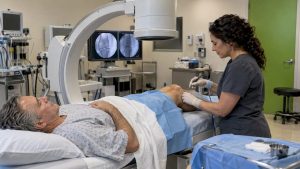

Chiropractic care can be a reasonable part of a sciatica plan. Spinal manipulation may ease pain and improve movement, and several clinical guidelines support it as one piece of multimodal care. It works best after someone has confirmed what is actually pressing on the nerve, because sciatica is a symptom with several possible causes, not a diagnosis. In our practice we start by identifying the cause, then match chiropractic, rehabilitation and, when needed, interventional treatment to it.
This guide is for adults in North Dallas who have had leg pain from the low back for a while, often after trying several things, and want to know where chiropractic fits before they commit.
TL;DR
- Sciatica is pain traveling from the low back through the buttock and down the leg. It is usually caused by a herniated disk or another source of pressure on a nerve root.
- Chiropractic adjustments are aimed at restoring spinal movement and reducing pain. Guidelines tend to favor them as part of a combined plan, not as a stand-alone fix.
- Most sciatica improves on its own: about one-third of people recover within 2 weeks and three-fourths feel better within 3 months.
- Leg weakness, loss of bladder or bowel control, numbness in the groin area or a new fever call for a medical professional right away.
- If symptoms last past about 12 weeks, a reevaluation is the next step, and that is where imaging, injections or a broader plan come in.
Table of Contents
- What sciatica is, and why the cause matters
- How sciatica is diagnosed
- What a chiropractor does for sciatica
- What the evidence says
- Safety: who should be assessed first
- What recovery usually looks like
- Building a plan beyond adjustments
- What to do and avoid during a flare
- A realistic first appointment
- Perspective
- Where we can help
- FAQ
- Sources
What sciatica is, and why the cause matters
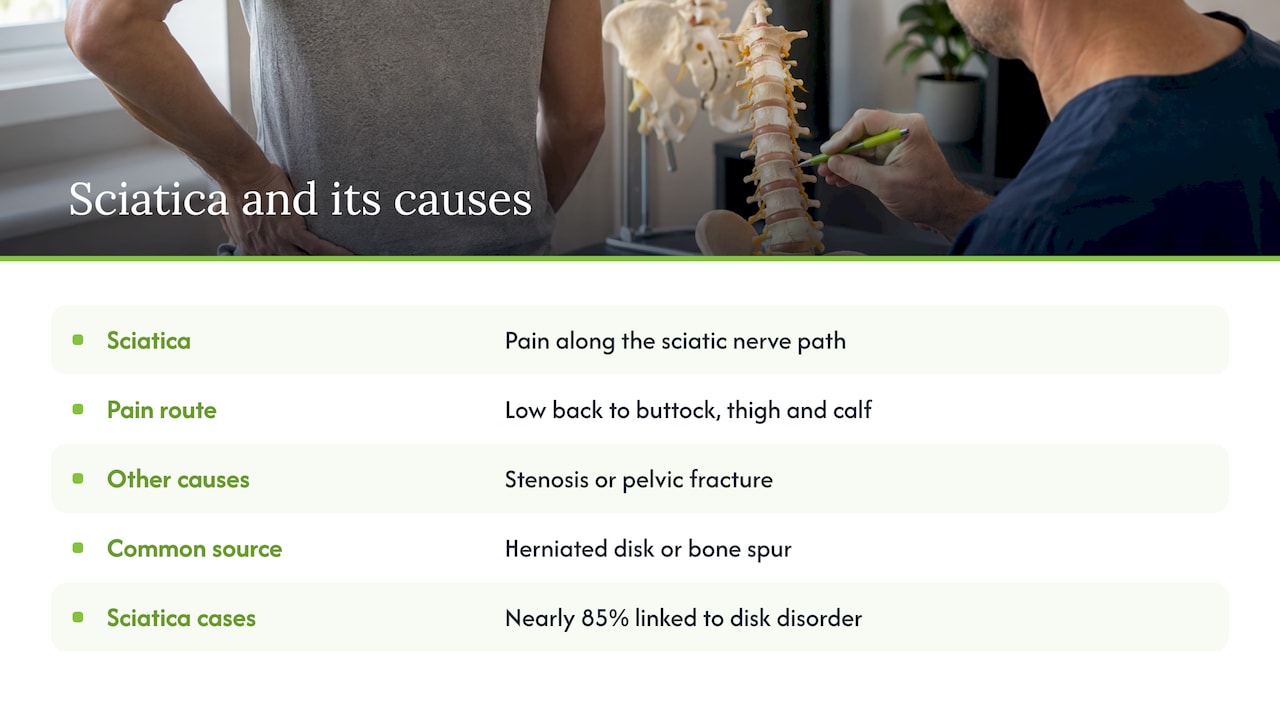
Sciatica describes pain along the path of the sciatic nerve, the largest nerve in the body. MedlinePlus explains that it is a symptom of a problem with that nerve, with causes that include a ruptured disk, spinal stenosis (narrowing of the spinal canal) or an injury such as a pelvic fracture. In many cases no cause is found.
The typical pattern, according to Mayo Clinic, is pain that travels from the low back to the buttock and the back of the thigh and calf. It can feel like a mild ache, a sharp burning pain or a jolt like an electric shock. It is often worse with coughing, sneezing or long periods of sitting, it usually affects one side, and it can come with numbness, tingling or muscle weakness.
The most common source is a herniated disk or a bone spur pressing on a nerve root in the lower spine. A 2015 review in the New England Journal of Medicine states that nearly 85% of sciatica cases are associated with a disk disorder. That matters for treatment choice. A disk that is irritating a nerve behaves differently from a tight piriformis muscle or a stiff sacroiliac joint, and the best plan differs for each.
Mayo Clinic lists several risk factors: being between 20 and 50 for herniated disks, obesity, jobs that involve twisting, heavy lifting or long drives, prolonged sitting and diabetes. Many of the patients we see in the North Dallas area are professionals who sit for hours and then push hard in the gym on weekends, which fits that picture.
How sciatica is diagnosed
Diagnosis is more conversation and examination than technology. According to a JAMA Internal Medicine patient page, a medical professional can usually diagnose sciatica by asking about your symptoms and examining you. Blood tests and imaging such as x-rays or MRI are not necessary for most people.
A good examination looks at:
- where the pain travels and what position or movement brings it on
- reflexes, muscle strength and sensation in the legs
- whether straightening the leg while lying down reproduces the pain
- how the hips, pelvis and lower spine move
Imaging becomes useful when findings point to a structural problem that could change treatment, when weakness is progressing, or when symptoms persist and an injection or procedure is being considered. Many patients arrive with an MRI already in hand. A disk bulge on a scan is common even in people with no pain, so the scan only matters when it matches the pattern of symptoms found on examination.
What a chiropractor does for sciatica
Mayo Clinic’s treatment overview says chiropractors can make spinal adjustments or manipulations to restore spinal movement and decrease pain. It also notes that spinal manipulation appears to work and to be as safe as standard treatments for low back pain.
In practice, a chiropractic visit for sciatica commonly includes some combination of the following:
- Spinal manipulation. A quick, controlled thrust to a spinal joint, intended to improve motion and reduce pain.
- Soft tissue work. Hands-on treatment of the muscles around the low back, hips and buttock that often tighten in response to nerve irritation.
- Movement and home exercise guidance. Simple positions and movements to practice between visits.
The session should begin with the same kind of history and examination described above. If the examination shows progressive leg weakness or signs of a serious spinal problem, manipulation is not the right first step, and a medical evaluation should come first.
What the evidence says
The honest summary is that results are encouraging but modest, and the strongest support is for chiropractic as part of a combined plan.
NCCIH, part of the National Institutes of Health, reports that manipulation may help sciatica. In a 2014 study of 192 people, those who received manipulation plus advice and home exercise had less pain at 12 weeks and used less medication a year later. Leg pain was the same in both groups after one year.
Guideline groups have looked at the same question. A review by Trager and colleagues summarizing recommendations for spinal manipulative therapy in sciatica and lumbar radiculopathy found that several guidelines, including those from 2018 and the UK’s NICE, are in favor, mostly as part of multimodal care. One 2020 guideline favors multimodal care when there is no neurological deficit but does not favor manipulation when progressive motor loss is present.
A 2021 perspective from chiropractic researchers cites a randomized trial in which adding chiropractic care to usual medical care for back pain improved function and pain ratings at six weeks.
What that means for you:
- Chiropractic is a reasonable option to try for sciatica, particularly in the first weeks and when the examination shows a mechanical pattern.
- It tends to be most useful alongside activity, exercise and medical follow-up.
- Expect a gradual change over several visits, not an instant resolution.
Safety: who should be assessed first
NCCIH’s 2017 review of 250 publications on spinal manipulation found that mild to moderate side effects such as increased pain, stiffness or headache are fairly common and usually resolve within 24 hours. Serious complications, including serious spinal or neurological problems, are very rare, and the risk may be higher in people with underlying health problems. NCCIH advises that practitioners assess patients thoroughly and that patients share their health conditions and medications.
In practical terms, tell the clinician before any adjustment if you have:
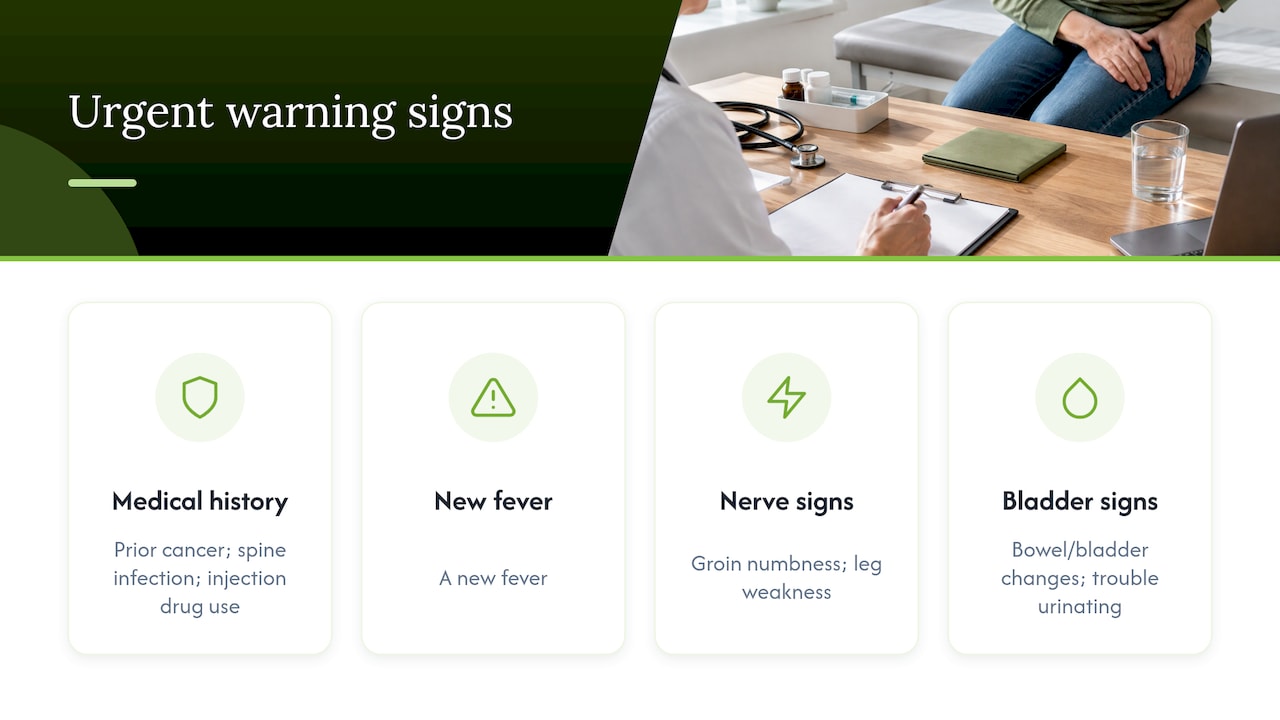
- a history of cancer, a spinal infection or injection drug use
- osteoporosis or low bone density, or an unexplained bone-density result (one explainer on how spine T-scores can mislead covers why that number deserves a careful read)
- numbness, tingling or weakness that is getting worse
- blood-thinning medication
- recent significant trauma such as a car accident or a fall
Symptoms that need a medical professional right away
The JAMA Internal Medicine patient page lists these as reasons to see a medical professional immediately instead of waiting for sciatica to settle: prior cancer, spine infection or injection drug use, a new fever, inability to feel the groin area, loss of bowel or bladder control, trouble urinating, or leg weakness. Merck Manuals also warns that continued pressure on a nerve is serious and can lead to long-term weakness and numbness. If you have any of these, go to an emergency department or call your physician the same day. Do not book an adjustment.
What recovery usually looks like
The timeline is more reassuring than most patients expect. The JAMA patient page notes that most people with sciatica recover fully: about one-third within 2 weeks and three-fourths within 3 months. It is hard to predict who will improve, and sciatica can come and go.
Two practical points follow from that:
- Stay gently active. Walking and light household tasks, as tolerated, are important for recovery. Long bed rest tends to leave people stiffer and more sensitive.
- Set a checkpoint. If symptoms are serious or last more than a month, Mayo Clinic advises seeking care. If they last more than 12 weeks, the JAMA page advises reevaluation by a health care professional.
Many patients come to us at exactly that point, after several weeks or months of trying a mix of rest, over-the-counter medication, stretching videos and sometimes a few adjustments, and still waking with leg pain. That is not a failure on their part. It usually means the cause deserves a closer look than a general approach gave it.
Building a plan beyond adjustments
When sciatica persists, the next step is a layered plan. We think of it as moving from conservative care to more targeted options only as the findings justify them.
| Stage | Typical focus | Where it fits |
|---|---|---|
| First weeks | Staying active, examination, chiropractic care, activity changes | Mechanical or flare-up patterns without red flags |
| Weeks 2 to 12 | Structured rehabilitation, core and hip strengthening, movement retraining | Pain that is improving slowly or recurring |
| Beyond 12 weeks | Reevaluation, imaging when it will change decisions, targeted injections | Persistent radiating pain, confirmed nerve root irritation |
| Selected cases | Regenerative options or neuromodulation | Chronic pain after conservative care has been tried |
A few details on the middle and later stages:
- Physical therapy. A structured program builds the strength and control that keep a disk or nerve from being re-irritated. Our article on whether physical therapy is effective for sciatica walks through what to expect, and our week-by-week outline for lumbar radiculopathy covers the first six weeks in more detail.
- Epidural steroid injections. These place anti-inflammatory medication near an irritated nerve root. We offer lumbar transforaminal and caudal epidural steroid injections for radiating leg pain when conservative care has not been enough. They are generally used to calm symptoms enough to let rehabilitation progress.
- Radiofrequency and nerve procedures. When the pain generator is a facet joint rather than a nerve root, treatments such as facet injections and lumbar radiofrequency neurotomy address that source.
- Regenerative and device options. For some chronic spine problems, platelet-rich plasma (PRP, a concentrate made from your own blood) or stem cell therapy for spinal discs may be discussed, and spinal cord stimulation is a trial-based option for long-standing nerve pain. Whether either is appropriate depends on your examination and imaging.
None of these replaces the first step. If you want a fuller view of how we sort the options, our pages on non-surgical lower back pain treatments and understanding sciatica go deeper.
What to do and avoid during a flare
A few habits make flares shorter and less frequent:
- Walk in short, frequent bouts instead of resting for days.
- Change positions often. Long sitting is a known aggravator, so stand and move every 30 minutes or so.
- Avoid heavy lifting with a twisting motion while the leg is symptomatic.
- Do not push through new weakness or numbness. Those signs deserve a prompt evaluation.
- Be careful with aggressive stretching of the hamstring or buttock if it sends pain down the leg. Gentle, guided movement is a better choice.
A realistic first appointment
When you book an evaluation for sciatica, expect to describe your symptoms in detail: when they started, what makes them worse, and what you have already tried. Bring any imaging reports and a list of medications. The examination will test strength, sensation and reflexes and look at how your spine and hips move. From there, the plan should state what is most likely causing the pain, what the first treatments are, and when you would be reevaluated if you are not improving. A plan with a clear checkpoint is a good sign, because it keeps sciatica from drifting for months.
Perspective
Many patients who come to us with sciatica have already been told one of two things: that it will go away on its own, or that they need an operation. Both can be true for some people, but a large group falls in between, and that is where careful assessment matters most.
We favor starting with a precise diagnosis. Chiropractic care and rehabilitation have a real place early on, particularly when the examination shows a mechanical pattern. When the leg pain persists, we look harder at the source and consider targeted, non-surgical options such as image-guided injections, regenerative treatments and neuromodulation, matched to what the findings show.
Our physicians are Harvard fellowship-trained and board-certified, and we build treatment plans around the individual, not a single technique. We set expectations plainly: sciatica often improves gradually, outcomes vary, and the goal is steady function, not a promise of a specific result.
Felix
Where we can help
If your sciatica has lasted more than a few weeks, or keeps coming back, a structured evaluation is the most useful next step. At Nortex Spine and Joint in North Dallas we offer chiropractic care and physical therapy, along with back pain therapy and interventional options, all under one roof. You can read how we approach lumbar radiculopathy and sciatica and then request an appointment through our site.
FAQ
Is chiropractic care good for sciatica?
It can be a useful part of treatment. Mayo Clinic notes that spinal manipulation appears to work and to be as safe as standard treatments for low back pain, and several guidelines favor it within multimodal care. It works best when the cause has been identified and when it is combined with activity and exercise.
How many visits does it take to feel better?
There is no fixed number, because the cause and severity differ. Many people notice a gradual change over several weeks, and the 2014 study cited by NCCIH measured pain at 12 weeks. If you are not improving by about a month, or symptoms last 12 weeks, ask for a reevaluation.
What should I not do with sciatica?
Avoid prolonged bed rest, heavy lifting with twisting, and long uninterrupted sitting while symptoms are active. Gentle activity such as walking is encouraged. Do not wait if you develop leg weakness, trouble urinating, loss of bowel or bladder control or numbness in the groin area, which need urgent medical care.
Do I need an MRI before seeing a chiropractor?
Usually not. A history and physical examination are typically enough to diagnose sciatica, and imaging is not needed for most people. It becomes useful when weakness is progressing, symptoms persist, or an injection or procedure is being considered.
When should I look beyond adjustments?
Consider a broader evaluation when pain continues beyond 12 weeks, when leg pain is worse than back pain despite treatment, or when numbness or weakness develops. At that stage, rehabilitation, targeted injections and other non-surgical options can be discussed.
Sources
- Sciatica: Symptoms and causes, Mayo Clinic
- Sciatica: Diagnosis and treatment, Mayo Clinic
- Sciatica, MedlinePlus
- Sciatica, New England Journal of Medicine (2015)
- I Am Worried I Have Sciatica, JAMA Internal Medicine
- Spinal Manipulation: What You Need To Know, NCCIH
- Chiropractic and Spinal Manipulation: A Review of Research
- Back and neck pain: in support of routine delivery of chiropractic care, PMC (2021)
- Low Back Pain, Merck Manual Consumer Version
- When Your Spine T-Score Is Misleading