
What are the best alternatives to carterpt.com in Austin?
If you’re looking for carterpt.com alternatives in Austin, you have several solid options across both conventional physical therapy clinics and complementary care modalities. The right choice depends on your diagnosis, your insurance, and how much you’re willing to commit to a structured rehab program.
Here’s a quick orientation to what’s available:
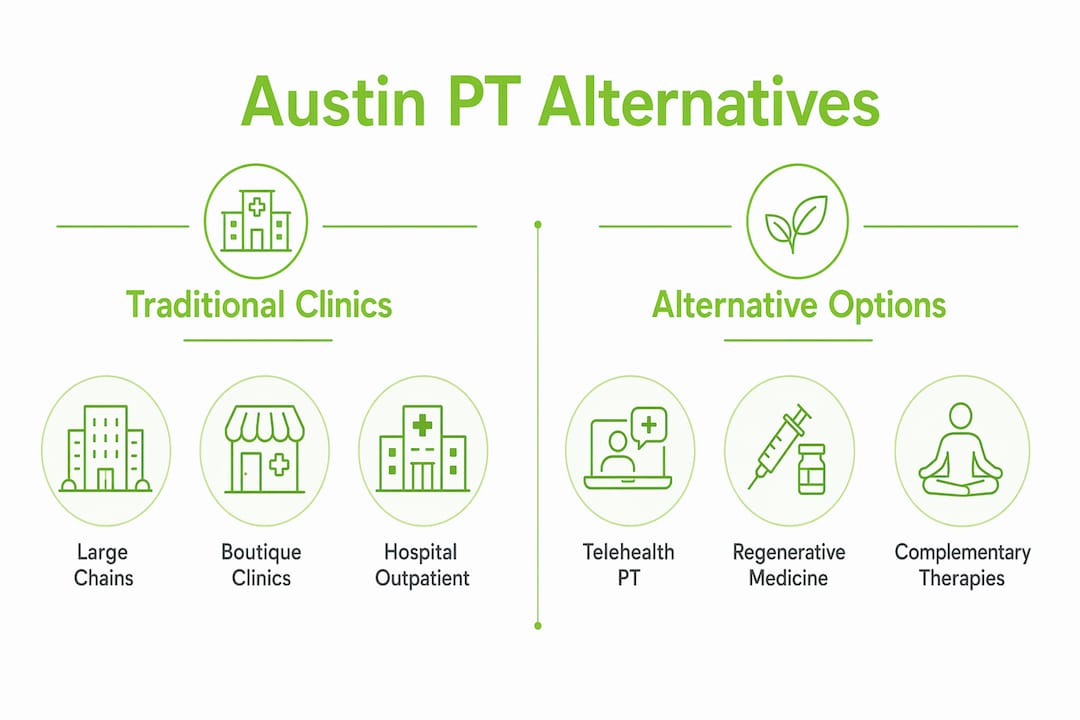
- Large outpatient PT chains like ATI Physical Therapy, which operates over 1,176 locations nationally and offers broad access, though care quality varies by location and therapist
- Independent and boutique PT clinics in Austin, which tend to offer more personalized attention and consistent therapist assignment
- Specialty-focused practices aligned with orthopaedics, sports medicine, or neurological rehab, credentialed through the American Physical Therapy Association
- Complementary modalities such as acupuncture, chiropractic care, and massage therapy, used alongside or between PT sessions
- Regenerative medicine clinics offering PRP therapy, stem cell treatments, and non-surgical pain management for patients who haven’t responded to standard PT
Most physical therapy programs involve twice-weekly sessions over several weeks, with home exercises of roughly 30 minutes each. Expect to commit consistently. Recovery timelines depend heavily on your adherence, not just the clinic you choose.
Which complementary therapies can work alongside physical therapy?
Many patients come in after trying one or two things on their own, whether that’s heat packs, a few chiropractic visits, or a YouTube stretching routine. These approaches aren’t wrong, but they work best when coordinated with a licensed PT plan rather than used as substitutes.
Common options worth knowing:
- Low-impact aerobic exercise: Swimming, cycling, walking, tai chi, and yoga keep joints mobile without excessive loading. Brown University Health notes that weak or imbalanced muscles often drive joint stress, so movement matters.
- Heat and cold therapy: Cold packs reduce acute swelling; heat relaxes muscle tension and improves circulation. Both are inexpensive and useful between sessions.
- Acupuncture: Widely used for musculoskeletal pain. Research on efficacy is mixed, but many patients report meaningful relief, particularly for chronic conditions.
- Chiropractic adjustments: Useful for spinal alignment and short-term pain reduction. For a detailed comparison of how this stacks up against PT, see physical therapy vs chiropractic.
- Massage therapy: Addresses soft tissue tension and can improve circulation around injured areas.
- Anti-inflammatory dietary changes: Omega-3 fatty acids, turmeric, and leafy greens support systemic inflammation reduction. These are adjuncts, not treatments.
- Glucosamine and chondroitin supplements: May support cartilage health in patients with knee or hip osteoarthritis, though results vary.
Pro Tip: Passive modalities like massage and heat alone generally do not substitute the active muscle strengthening that licensed PT provides. Use them to manage symptoms between sessions, not to replace the program itself.
How do you choose the right physical therapy provider?
Choosing a PT clinic is not just about proximity. The provider’s clinical focus, communication style, and administrative transparency all affect your outcome. Many patients who’ve cycled through multiple clinics without improvement often discover the mismatch was about specialization, not effort.
Key criteria to evaluate:
- Clinical specialization: Does the therapist’s training match your diagnosis? A post-surgical knee patient and a patient with chronic low back pain need different expertise. For guidance on this, choosing the right physical therapist is worth reading before your first call.
- Patient reviews: Look beyond star ratings. Read for patterns around therapist consistency, wait times, and billing clarity.
- Insurance and cost transparency: Large networks sometimes struggle here. BBB complaint records for ATI Physical Therapy show recurring issues with billing transparency and cost communication at some locations.
- Location and scheduling: A clinic 40 minutes away with limited appointment windows is a real adherence risk, especially for twice-weekly programs.
- Therapist continuity: Seeing the same therapist each visit matters. Fragmented care across multiple providers at the same clinic slows progress.
Why physical therapy specialization affects your recovery
The American Physical Therapy Association recognizes 10 clinical specialty areas through the American Board of Physical Therapy Specialties, including orthopaedics, sports medicine, geriatrics, and neurology. Board-certified specialists have completed advanced training beyond entry-level licensure, which matters considerably for complex or chronic conditions.
Matching a therapist’s specialty to your diagnosis tends to produce better outcomes than defaulting to the nearest available provider. A generalist PT can handle many common presentations, but if you’re managing a chronic rotator cuff tear, post-stroke rehabilitation, or degenerative disc disease, a board-certified specialist in the relevant area offers deeper clinical judgment.
Physical therapy effectiveness depends heavily on patient adherence to prescribed exercises outside of clinic visits. Active, progressive loading under therapist guidance drives recovery. Expect some muscle fatigue and manageable discomfort as part of that process. Therapists are trained to distinguish productive discomfort from warning signs, but you need to communicate openly throughout.
The role of physical therapy in pain management extends beyond the clinic visit itself. What you do between sessions, including home exercises, sleep, and activity modification, shapes how quickly you recover.
Comparing types of alternative PT providers in Austin
Not all clinics operate the same way, and understanding the differences helps you set realistic expectations before you commit.

Large outpatient chains offer broad geographic access and often accept most major insurance plans. ATI Physical Therapy, for example, operates across the country with numerous locations. However, care quality at large networks depends heavily on the individual therapist and branch rather than the national brand. Some ATI locations achieve strong patient satisfaction scores, while others draw complaints around billing practices and administrative responsiveness.
Independent and boutique clinics typically assign one therapist per patient and maintain smaller caseloads. This structure supports more consistent, personalized care. The tradeoff is that insurance coverage may be narrower and scheduling less flexible.
Hospital-affiliated outpatient PT departments carry strong clinical oversight and often integrate well with referring physicians. They suit patients with complex medical histories or those recently discharged from inpatient care.
Telehealth PT platforms have expanded since 2020 and work well for patients with mobility limitations or those managing chronic conditions that don’t require hands-on manual therapy. They’re not appropriate for every diagnosis.
For patients whose joint or spine pain hasn’t responded to standard PT, alternative treatments for joint pain that target the underlying tissue, rather than just managing symptoms, may be worth exploring.
Nortexspineandjoint: a regenerative medicine option worth considering
If you’ve worked through physical therapy and still haven’t reached the relief you were expecting, Nortexspineandjoint offers a different approach. Rather than replacing PT, regenerative medicine addresses the tissue-level causes of chronic joint and spine pain that standard rehabilitation sometimes cannot fully resolve.
Nortexspineandjoint specializes in non-surgical treatments including PRP therapy, which uses your own platelet-rich plasma to promote tissue repair, and stem cell therapy, which targets degenerated structures in joints and the spine. Customized rehabilitation programs are built around each patient’s specific condition, whether that’s a chronic knee problem, hip arthritis, shoulder pain, or degenerative disc disease. The clinic serves active adults, athletes, and patients who want to avoid surgery without simply managing pain indefinitely. If you’re at that point in your care, it’s a conversation worth having.
FAQ
What is the largest physical therapy company in the United States?
ATI Physical Therapy is one of the largest outpatient PT providers in the country, operating numerous corporate locations. Care quality varies significantly by individual clinic and therapist.
What can you do instead of physical therapy for joint pain?
Low-impact exercise, acupuncture, chiropractic care, massage, heat and cold therapy, and anti-inflammatory dietary changes are common options. These work best as complements to licensed PT, not full replacements, since passive modalities alone don’t replicate the benefits of active strengthening.
Is ATI Physical Therapy a good choice?
ATI offers broad access and accepts most major insurance plans, but patient satisfaction varies considerably by location. Billing transparency and administrative responsiveness have been recurring concerns at some branches, so reviewing location-specific reviews before committing is advisable.
What are the main specialties within physical therapy?
The American Board of Physical Therapy Specialties recognizes 10 clinical specialty areas, including orthopaedics, sports medicine, geriatrics, neurology, and cardiovascular and pulmonary care. Matching the therapist’s specialty to your diagnosis generally produces better outcomes.
Key Takeaways
Choosing the right physical therapy alternative in Austin requires matching clinical specialization to your diagnosis, not just finding the nearest available clinic.
| Point | Details |
|---|---|
| Specialization matters most | The American Board of Physical Therapy Specialties recognizes 10 clinical areas; matching one to your diagnosis improves outcomes. |
| Adherence drives recovery | Home exercises and lifestyle consistency between sessions determine how quickly you progress, regardless of clinic quality. |
| Large chains carry variability | ATI Physical Therapy’s numerous locations show wide differences in patient satisfaction, particularly around billing transparency. |
| Complementary therapies are adjuncts | Acupuncture, massage, and heat therapy support symptom management but do not replace active PT strengthening programs. |
| Nortexspineandjoint offers a next step | For patients whose pain persists after PT, Nortexspineandjoint provides PRP therapy, stem cell treatment, and non-surgical rehabilitation in North Dallas. |