
Across the strongest available evidence, PRP produces clinically meaningful improvement in roughly 50 to 70% of appropriately selected patients with knee osteoarthritis and tendon injuries, and 60 to 80% of patients with androgenetic alopecia show measurable hair-density gains. Those numbers move a lot depending on how the plasma was prepared, how advanced the condition is, and how success gets measured. The rest of this guide breaks down exactly where those ranges come from and what changes them.
TL;DR:
- PRP treatment achieves meaningful improvements in 50 to 70 percent of knee osteoarthritis cases and 60 to 80 percent of androgenetic alopecia cases, depending on preparation and patient factors.
- Success measurement varies: pain reduction, functional improvement, and hair density gains are reported using different scales, timeframes, and thresholds like the MCID, affecting perceived outcomes.
- Platelet concentrations above one million per microliter and the leukocyte profile can influence the durability and effectiveness of PRP, with patient age, disease stage, and technique playing critical roles.
- PRP effectiveness is higher in early to mid-stage joint disease and tends to diminish in advanced structural damage, with multiple injections and maintenance strategies often necessary for sustained results.
- Poor injection placement, underdosed preparations, and unrealistic expectations are primary reasons for treatment failure, emphasizing the importance of careful candidate selection and tailored protocols.
Table of Contents
- What Does “PRP Success Rate” Actually Mean?
- PRP Success Rates by Condition
- Why PRP Results Vary So Much From One Clinic to the Next
- How Long Do PRP Results Last?
- Why PRP Fails and What the Recovery Process Looks Like
- How to Evaluate Your Own Candidacy Before You Book
- How Nortexspineandjoint Approaches PRP Treatment Planning
- A Clinician’s View on Setting Realistic PRP Expectations
- Ready to Find Out if PRP Fits Your Case?
- Sources
- FAQ
What Does “PRP Success Rate” Actually Mean?
When you hear a clinic quote a success rate, ask what they are measuring. A “success rate” in one study might mean a patient’s pain dropped by two points on a 10-point scale. In another, it might mean 50% functional improvement sustained for a year. These are not the same claim, and conflating them is where a lot of patient confusion starts.
Most orthopedic PRP trials define a “responder” using a minimum clinically important difference, or MCID, a threshold below which a change is unlikely to be perceptible to the patient in daily life. Two scales dominate the literature: the WOMAC index (Western Ontario and McMaster Universities Osteoarthritis Index), which scores pain, stiffness, and physical function in knee and hip osteoarthritis, and the VAS (Visual Analog Scale) for pain intensity. A meta-analysis might report a “significant WOMAC improvement,” but the size of that improvement, and whether it clears the MCID for that specific scale, is what actually tells you whether the treatment worked for the average patient.
For androgenetic alopecia, researchers typically track hair density per square centimeter, sometimes alongside hair thickness or patient-reported satisfaction. A meta-analysis of randomized trials found PRP monotherapy increased hair density by a mean of roughly 25 hairs per square centimeter compared to controls. That is a real, statistically significant effect. Whether it looks like “success” to a specific patient depends on their baseline density and expectations.
You will also see success reported three different ways in the literature:
- Absolute change: the raw difference in a score before and after treatment (for example, a 15-point WOMAC drop).
- Percent responders: the share of patients who crossed the MCID threshold, which is closer to what “success rate” colloquially means.
- Statistical effect size: a pooled measure like a standardized mean difference, useful for comparing studies but harder to translate into a patient conversation.
Timing changes everything, too. A trial measuring outcomes at 3 months will report different numbers than one measuring at 12 months, because PRP’s benefit curve rises, peaks, and can taper. A broad review of PRP across musculoskeletal applications found an aggregated overall success rate near 55% when pooling many different studies, timeframes, and conditions together. That number is a reasonable floor for a very mixed population, but it undersells what well-selected patients with a well-prepared injection can achieve, and it overstates what a poor candidate should expect.
The honest caveat here, and one worth sitting with before you look at condition-specific numbers, is that PRP research is genuinely heterogeneous. Trials use different platelet concentrations, different injection counts, different control groups, and different follow-up windows. When you read that “PRP has a 70% success rate,” that figure was measured under conditions that may not match the clinic down the street from you.
PRP Success Rates by Condition
Numbers change substantially depending on what you’re treating. Here’s what the evidence actually shows, condition by condition.
Knee osteoarthritis
Knee OA has the deepest body of PRP research, and it’s where the evidence is most convincing. A meta-analysis of 18 randomized controlled trials covering nearly 2,000 patients found clinically significant WOMAC and VAS improvements at 1, 3, 6, and 12 months. The same analysis found that platelet concentration mattered: PRP prepared above roughly 1,000,000 platelets per microliter (about five times baseline blood concentration) produced more durable pain relief and functional gains than lower-concentration preparations.
In practical terms, midterm responder rates for knee OA commonly fall in the 50 to 70% range for patients with mild to moderate disease. A separate network meta-analysis comparing leukocyte-rich PRP, leukocyte-poor PRP, and hyaluronic acid injections found both PRP formulations outperformed hyaluronic acid at 6 months for pain and function, though benefits in some analyses diminished by the 12-month mark without a maintenance plan. Clinical consensus is shifting accordingly. The ESSKA-ORBIT European consensus on injectable orthobiologics now leans toward recommending PRP over hyaluronic acid for knee OA at midterm follow-up, a meaningful shift from where guidelines stood even a few years ago.
If you’re evaluating a PRP knee injection, age and disease stage matter more than almost anything else. Subgroup data in a meta-analysis on knee, hip, and traumatic osteoarthritis found larger WOMAC improvements in patients under 60. We see this pattern clinically, too. A 45-year-old with early cartilage wear on imaging tends to respond better than a 70-year-old with bone-on-bone changes, because PRP works by supporting the biology of a joint that still has some healing capacity left, not by regrowing cartilage that’s already gone.
Hip and shoulder osteoarthritis
The evidence base for hip and shoulder PRP is thinner than for the knee, mostly because fewer large randomized trials have been run on these joints. Where data exists, functional improvement ranges tend to land in the modest-to-moderate territory, generally below what’s seen in knee OA trials. That doesn’t mean PRP doesn’t work at the hip or shoulder. It means the confidence interval around any reported success rate is wider, and you should treat a specific percentage for these joints with more caution than a knee OA figure.
In our experience, shoulder PRP tends to perform best for partial rotator cuff tears and early-stage osteoarthritis, where there’s still healthy tendon and cartilage tissue to support. Hip OA candidates who respond best usually have mild to moderate joint space narrowing on imaging rather than advanced collapse.
Tendinopathies
Chronic tendon injuries, things like lateral epicondylitis (tennis elbow), patellar tendinopathy, and Achilles tendinopathy, show variable but often encouraging results. Many trials report clinically meaningful improvement in roughly half or more of treated patients, though the exact number shifts depending on which tendon is involved and how chronic the injury is at the time of treatment.
Tendons are a somewhat different biological environment than joint cartilage. They have limited blood supply, which is part of why they heal slowly and why growth factors delivered locally via PRP can matter more here than almost anywhere else PRP gets used. A tendon injury that’s been symptomatic for years, with significant degenerative changes already visible on ultrasound, is a harder case to turn around than one caught within the first several months.
Androgenetic alopecia
For pattern hair loss, PRP has accumulated a surprisingly strong evidence base given how the treatment is sometimes dismissed as cosmetic rather than medical. The meta-analysis referenced earlier found a mean density increase of about 25 hairs per square centimeter, and across included trials, many studies report that 60 to 80% of appropriately selected patients show measurable improvement in density or thickness.
The certainty of that evidence is best described as low to moderate, not high. Protocol heterogeneity is the culprit again: injection intervals ranged from monthly to quarterly across studies, activation methods varied, and follow-up windows differed enough that pooling the data required real statistical caution. Patients with early-stage thinning (Norwood stage 2 to 4, or the female pattern equivalent) tend to respond better than those with long-standing, advanced miniaturization where the follicles have largely stopped producing terminal hairs.
Why PRP Results Vary So Much From One Clinic to the Next
Here’s something that surprises a lot of patients: “PRP” is not one standardized product. It’s a category, and what’s inside that syringe can differ substantially from clinic to clinic, even when everyone is using the same three letters to describe it.
The biggest variable is leukocyte content. Leukocyte-rich PRP (L-PRP) contains a higher concentration of white blood cells, while leukocyte-poor PRP (LP-PRP) filters most of them out. Researchers have debated for years which is better, and the honest answer is that it depends on the tissue being treated. The network meta-analysis on knee OA found no clear superiority between L-PRP and LP-PRP for that particular joint, though both outperformed placebo and hyaluronic acid. For tendons, some clinicians prefer leukocyte-poor formulations to limit inflammatory irritation, though the evidence here is still evolving.
Platelet concentration is the second major lever. As covered above, the knee OA meta-analysis found a real durability advantage above the roughly 1,000,000 platelets per microliter threshold. Below that concentration, you’re still injecting something biologically active, but it’s a materially weaker dose than what the best-performing trials used.
A few procedural details worth understanding:
- Single vs. double spin: Double-centrifugation protocols generally concentrate platelets more effectively than a single spin, which affects the final platelet dose delivered.
- Blood-draw volume: Larger draws, often 40 mL or more, tend to yield higher platelet concentrations than smaller draws, though this is more of a practice-level observation than a randomized finding.
- Injection frequency: Some protocols use a single injection, others use a series of two to three spaced weeks apart, and the right choice depends on the tissue and condition being treated.
- Activation method: Whether the plasma is activated with calcium chloride, thrombin, or left to activate naturally on contact with collagen changes how quickly growth factors are released.
Patient factors compound all of this. Age, as we discussed, correlates with outcome in several subgroup analyses. Disease stage matters just as much. Someone with early-to-moderate osteoarthritis has living cartilage and synovial tissue that can respond to growth factor signaling. Someone with end-stage, bone-on-bone arthritis is asking PRP to do a job it was never built to do, and no amount of platelet concentration changes that biological ceiling. Smoking status and metabolic health (particularly uncontrolled diabetes) also correlate with weaker healing responses across regenerative medicine broadly, not just PRP specifically.
Pro Tip: When a clinic quotes you a success rate, ask what platelet concentration and leukocyte profile they aim for. A number without a protocol behind it tells you almost nothing about what to expect.
Putting this together, when you read a published success rate, you’re reading the average result of a specific protocol applied to a specific patient population. Your outcome depends on how closely your case, and the clinic’s technique, matches the conditions that produced that number in the first place.
How Long Do PRP Results Last?
Patients almost always ask two versions of the same question: when will I feel better, and how long will it last? The honest answer requires walking through the timeline in stages.
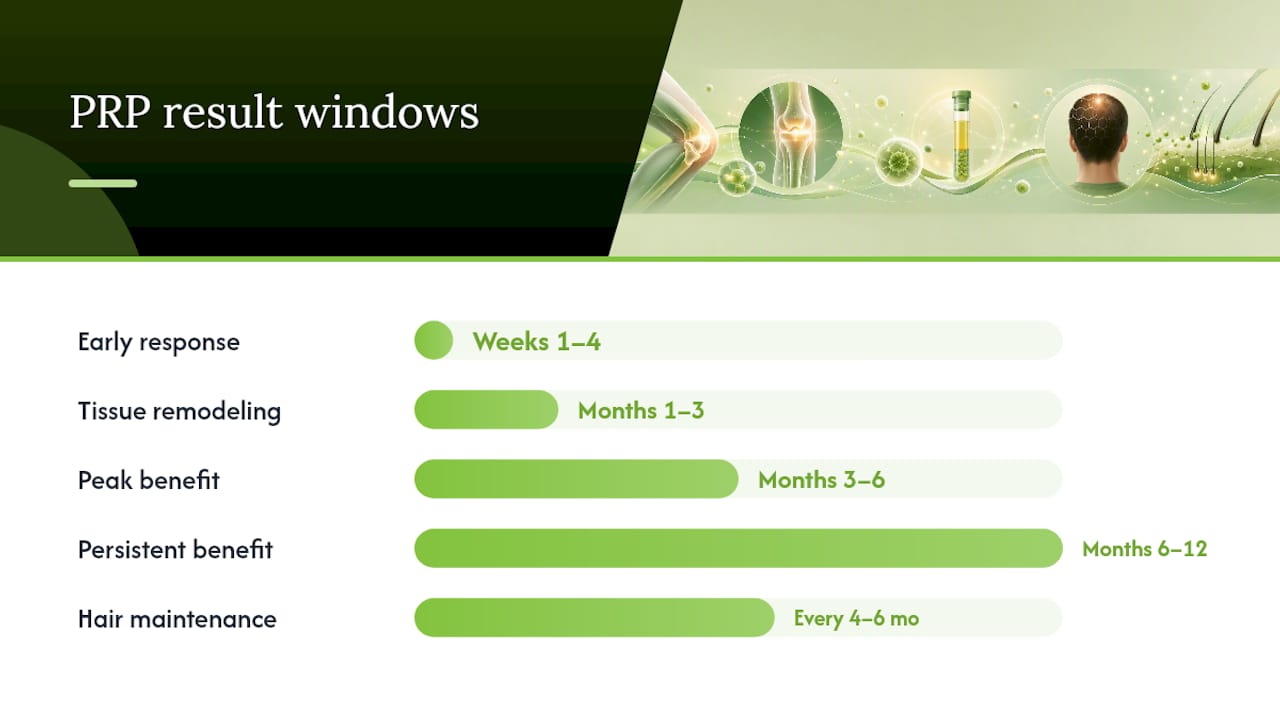
- Weeks 1 to 4: Some patients notice early symptom changes, though this initial window can also include a temporary flare as the injection triggers a local inflammatory response. This is expected and usually resolves within a few days.
- Months 1 to 3: Growth factor signaling drives tissue remodeling during this window, and many patients report their first substantial improvement here.
- Months 3 to 6: This is generally where peak benefit shows up across most musculoskeletal trials, and it’s the timepoint most meta-analyses use to report their headline WOMAC and VAS numbers.
- Months 6 to 12: Benefit often persists through this window, though the network meta-analysis on knee OA found that some measures of improvement diminished by 12 months without a repeat injection or maintenance plan.
That waning pattern is one reason many clinics build a maintenance conversation into the treatment plan from the start rather than treating PRP as a one-and-done procedure. Whether a repeat injection makes sense depends on how well the first round worked and how much of that benefit has faded. In practice, we typically reassess function and pain around the 9 to 12 month mark before deciding whether a second series is worthwhile.
Different outcome types also fade at different rates. Pain relief tends to be the most variable over time, since it’s influenced by activity level, weight changes, and general inflammation. Objective functional measures often hold steadier. For hair density in androgenetic alopecia, most protocols call for maintenance sessions every 4 to 6 months indefinitely, since PRP supports the follicle cycle but doesn’t reverse the underlying genetic process driving the thinning. If you’re weighing frequency and cost against realistic gains, reviewing how injection schedules are structured before you start is worth the time.
Why PRP Fails and What the Recovery Process Looks Like
Not every patient responds, and understanding why helps you set realistic expectations going in. Many patients come in after trying multiple treatments, oral anti-inflammatories, physical therapy, maybe a cortisone shot, and PRP isn’t automatically the answer just because those other options fell short.
The most common reasons PRP doesn’t work:
- Wrong indication: PRP performs best on tissue with some remaining healing capacity. End-stage structural disease, like bone-on-bone knee arthritis or a fully torn (not partially torn) tendon, is often a poor match.
- Underdosed platelets: A preparation with a low platelet yield is unlikely to deliver the biological signal that drove the results in the strongest trials.
- Poor injection technique: Placement matters, particularly for structures like the hip labrum or specific tendon insertion points that require image guidance to hit accurately.
- Unrealistic expectations: A patient hoping for a complete reversal of years of degenerative change is going to be disappointed even by a technically successful injection.
- Insufficient follow-up care: Skipping the physical therapy or activity modification that typically accompanies PRP can blunt the functional gains it’s meant to support.
On safety, PRP has a favorable profile precisely because it uses your own blood. There’s no rejection risk and minimal risk of allergic reaction. Expect short-lived soreness, mild swelling, or a local reaction at the injection site for a few days. Because the technique is autologous (drawn from and returned to the same person), infection risk is low when sterile technique is followed, though it’s not zero. Call your clinic if you develop worsening pain, fever, spreading redness, or drainage at the injection site beyond the first few days. That’s not typical and warrants a prompt evaluation.
How to Evaluate Your Own Candidacy Before You Book
If you’re deciding whether PRP is worth pursuing, a short self-assessment and a focused consultation can tell you most of what you need to know before you spend a dollar.
Start with your own profile:
- Age and activity level: Younger, more active patients with earlier-stage disease tend to see the strongest response.
- Disease severity: Mild to moderate structural changes respond better than advanced, end-stage degeneration.
- Treatment history: If you’ve tried physical therapy, activity modification, and possibly a cortisone injection without lasting relief, you’re a more typical PRP candidate than someone who hasn’t tried conservative measures at all.
- Comorbidities: Uncontrolled diabetes, active smoking, and certain autoimmune conditions can blunt the healing response PRP depends on.
Then bring specific questions to your consultation:
- What is the target platelet concentration for my final preparation, and how is it measured or estimated?
- Is the preparation leukocyte-rich or leukocyte-poor, and why is that the right choice for my condition?
- What centrifugation method do you use, single spin or double spin, and what blood volume is drawn?
- How many injections are planned, and what’s the interval between them?
- How will you measure my progress, WOMAC score, VAS pain rating, range of motion, imaging, and at what follow-up intervals?
Ask for documentation of your baseline measurements before treatment starts. Without a baseline, neither you nor your provider has an objective way to know whether the treatment worked. On cost, PRP is typically billed per session and isn’t uniformly covered by insurance, so ask for a full breakdown of what a single session versus a full series will run before you commit, and confirm what happens if you need a repeat round.
Pro Tip: If a clinic can’t answer your platelet concentration and leukocyte content questions with specifics, that’s worth noting. It usually signals a less standardized protocol, which is one of the biggest predictors of inconsistent results.
How Nortexspineandjoint Approaches PRP Treatment Planning
PRP protocols are built around the same variables the research points to: platelet concentration, patient selection, and realistic outcome tracking. Every patient starts with a clinical evaluation and imaging review to confirm PRP is a reasonable fit for their specific stage of disease, not a default recommendation handed out regardless of severity.
A first PRP visit typically includes a review of prior treatment history, a physical exam focused on the affected joint or area, and a conversation about what outcome measures will be used to track progress, whether that’s a pain scale, a functional assessment, or imaging follow-up. Blood is often drawn on-site the same day as the injection, processed, and delivered under the same visit, which may keep the whole process to a single appointment for many patients.
Because PRP outcomes depend heavily on patient-specific factors like age, joint condition, and treatment history, dosing and injection planning should be tailored to the individual rather than applying a single fixed protocol to every case.
A Clinician’s View on Setting Realistic PRP Expectations
The pattern I see most often in clinic is a patient who tried rest, anti-inflammatories, and maybe one cortisone shot, and is now looking for something that addresses the underlying joint biology rather than just masking pain. PRP fits that gap well for the right candidate, but it isn’t a substitute for an honest conversation about disease stage.
Some patients do best with PRP alone. Others need it paired with a structured physical therapy plan to hold onto the gains. And a subset, usually those with advanced structural damage, are better served by a conversation about surgical options rather than another round of injections. The only way to know which category you fall into is a real clinical evaluation, not a percentage you read online.
— Felix
Ready to Find Out if PRP Fits Your Case?
PRP success depends on getting the details right, not just getting the injection. Effective treatment plans are built around each patient’s joint, imaging, and treatment history, rather than applying a one-size-fits-all protocol and hoping averages work in your favor. That’s the practical difference between a clinic that treats PRP as a commodity and one that treats it as a customized regenerative medicine tool.
A first visit includes a clinical exam, a review of any prior treatments, and a direct conversation about whether your condition and stage make you a strong candidate before anything gets scheduled. If you’re dealing with knee, hip, shoulder, or back pain and want to know where you land in the responder range discussed above, start with the PRP therapy page to see what a consultation involves, or explore the full range of regenerative medicine options if you’re still weighing PRP against other approaches. Many patients also pair PRP with a course of physical therapy to protect the functional gains once the injection takes effect. Booking a consultation is the fastest way to get a straight answer about your own odds instead of guessing from a published average.
This article is general information, not a substitute for advice from a qualified doctor. Consult a qualified healthcare professional about your own circumstances before acting on anything here.
FAQ
How long do PRP results last?
Benefit typically peaks around 3 to 6 months and often persists through the 6 to 12 month mark, though some improvement can taper by 12 months without a maintenance injection. For hair loss, most protocols call for repeat sessions every 4 to 6 months to sustain density gains.
What causes PRP to fail?
The most common causes are treating an advanced-stage condition PRP isn’t designed to reverse, using an underdosed platelet preparation, imprecise injection placement, and skipping the physical therapy or activity changes that support the biological response.
Is PRP even worth it?
For appropriately selected patients, meta-analytic data supports clinically meaningful improvement in roughly 50 to 70% of knee osteoarthritis and tendon cases, and 60 to 80% of androgenetic alopecia cases, which makes it a reasonable option once conservative treatments have been tried without lasting relief. It’s worth less to patients with advanced structural disease, where expectations should be set accordingly during a consultation.
How much do 3 sessions of PRP cost?
Pricing for PRP sessions varies depending on treatment area and protocol; current pricing details are available directly through the clinic during a consultation.