
Regenerative injections are increasingly sought by adults dealing with chronic joint pain, sports injuries, and early-stage arthritis who want to avoid surgery. The appeal is real: the idea of using your own biology to repair damaged tissue is genuinely compelling. But here’s what most patients aren’t told upfront. The difference between a meaningful recovery and a disappointing result often comes down to details that have nothing to do with the injection itself, including how the product was prepared, how many doses you received, and what you were asked to do afterward. This guide gives you an honest, evidence-based look at what regenerative injections can and cannot do.
Table of Contents
- What are regenerative injections?
- How do PRP and stem cell injections work?
- Where is the evidence strongest, and what are the limitations?
- Why patient outcomes vary: The protocol problem
- What most overviews miss about regenerative injections
- Explore your regenerative medicine options in North Dallas
- Frequently asked questions
Key Takeaways
| Point | Details |
|---|---|
| Know your injection type | Results differ by PRP, stem cell therapy, or prolotherapy—ask what’s being used. |
| Protocol details matter | Preparation, dosing, and aftercare can impact outcomes as much as the injection itself. |
| Evidence is strongest for mild cases | Best results are typically seen in early joint degeneration, not severe cases or advanced disease. |
| Be an informed advocate | Ask detailed questions and seek a provider willing to customize your treatment. |
What are regenerative injections?
Regenerative injections are treatments designed to stimulate the body’s own repair mechanisms by delivering concentrated biologics directly to damaged tissue. Unlike corticosteroid injections, which primarily suppress inflammation short-term, regenerative options aim to influence cellular repair processes at the site of injury or degeneration. The underlying theory is that introducing the right biological signals into a joint or tendon can trigger tissue remodeling and reduce chronic pain more durably.
The three most widely used types include:
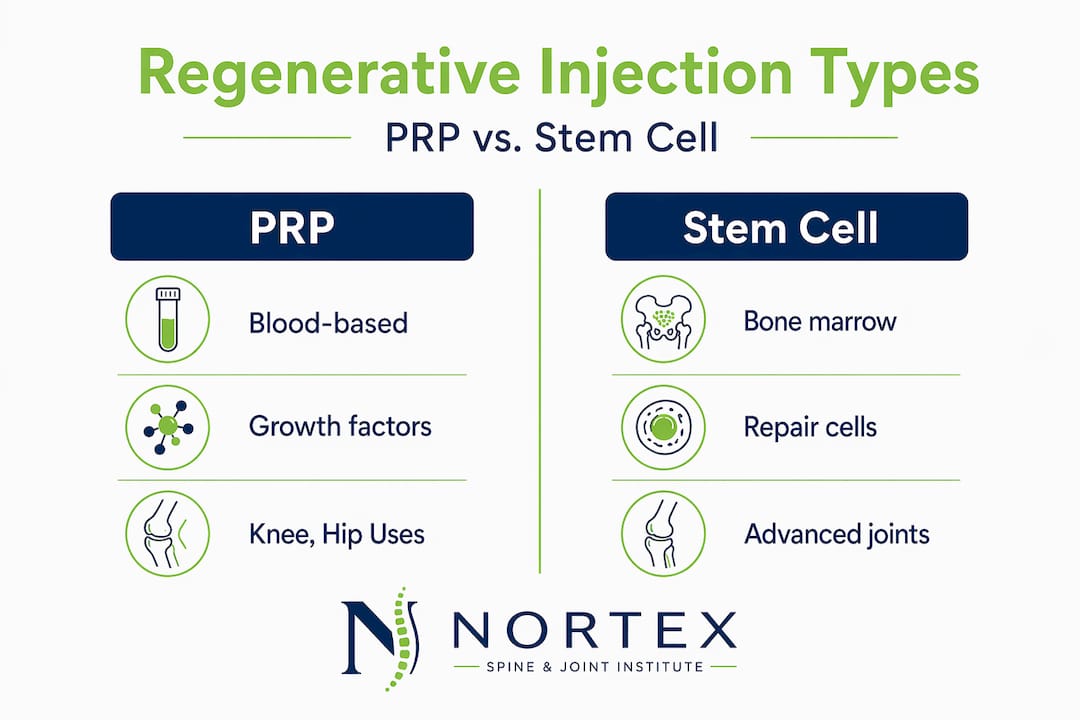
- Platelet-rich plasma (PRP): Blood is drawn from the patient, processed in a centrifuge to concentrate platelets, and injected into the affected area. PRP uses concentrated platelets to release growth factors that aim to influence inflammation and tissue repair.
- Mesenchymal stem cell (MSC) therapy: Stem cells, often harvested from bone marrow or adipose (fat) tissue, are processed and injected to support cellular regeneration. You can read a detailed stem cell therapy overview to understand how this approach differs from PRP.
- Prolotherapy: A solution, typically dextrose-based, is injected to create a mild inflammatory response intended to stimulate connective tissue repair. This option is less frequently discussed but is still used for chronic ligament and tendon conditions.
All three approaches share a common goal: activating the body’s own healing pathways rather than masking symptoms with medications or removing tissue through surgery.
What makes these treatments appealing as non-surgical options is that they are autologous (using the patient’s own cells or blood in the case of PRP), carry relatively low risk of rejection or major adverse reactions, and can be performed as outpatient procedures. However, the word “regenerative” can set expectations that don’t always match what the science currently supports.
How do PRP and stem cell injections work?
Now that you know the basics, let’s look closer at the most common regenerative options and why they aren’t always created equal.
PRP is prepared by drawing a small volume of blood, typically 15 to 60 milliliters, and spinning it in a centrifuge to separate red blood cells from the platelet-rich layer. That concentrated layer is then activated, sometimes using calcium chloride or thrombin, and injected into the target tissue. The goal is to flood the damaged area with growth factors such as PDGF, TGF-beta, VEGF, and IGF-1, which signal cells to proliferate and begin tissue remodeling.
MSC therapy follows a similar outpatient model but involves harvesting stem cells, usually from the iliac crest (hip bone) or adipose tissue, processing them, and re-injecting them into the joint. Stem cells are thought to differentiate into chondrocytes (cartilage cells) or to release anti-inflammatory signals that support the healing environment.

| Factor | PRP | MSC therapy |
|---|---|---|
| Source | Patient’s blood | Bone marrow or fat tissue |
| Active agents | Platelets, growth factors | Stem cells, signaling molecules |
| Processing time | 20 to 45 minutes | 30 to 90 minutes |
| Number of sessions | 1 to 3 typically | 1 to 2 typically |
| Evidence base | Moderate, best for mild-moderate OA | Early stage, promising but variable |
| Cost | Lower | Higher |
The critical issue is that protocol variability is a major factor in study results and clinical outcomes. Two patients receiving “PRP” at two different clinics may be receiving products with dramatically different platelet concentrations, leukocyte (white blood cell) content, and activation methods. Some preparations are leukocyte-rich, which may be better suited for tendon injuries, while leukocyte-poor versions are more commonly used for intra-articular (inside the joint) applications. These are not minor technical distinctions. They directly affect how the tissue responds.
Pro Tip: Before your first appointment, ask your provider specifically whether they use leukocyte-rich or leukocyte-poor PRP and how they determine which is right for your condition. A provider who can answer that question with specifics is one who takes the science seriously. You can also review what makes PRP therapy effective to better understand these distinctions before your visit.
For knee-specific applications, PRP therapy for knees and PRP for hip pain follow slightly different protocols depending on joint anatomy and the degree of degeneration present.
Where is the evidence strongest, and what are the limitations?
But how well do these treatments hold up when tested, and what can you reasonably expect?
The strongest evidence for PRP currently centers on mild to moderate knee osteoarthritis (OA). Multiple controlled trials and systematic reviews confirm that PRP shows pain and functional improvement in mild to moderate knee OA, though long-term superiority over other treatments and clear cartilage regeneration remain unproven. In practical terms, this means PRP is most likely to help you move better and hurt less, not necessarily to rebuild the cartilage you’ve lost.
Here’s what the evidence currently supports and where it falls short:
- Pain reduction: PRP consistently outperforms placebo and often hyaluronic acid injections for short to medium-term pain relief in knee OA, typically measured at 3, 6, and 12 months.
- Functional improvement: Patients frequently report better scores on validated outcome measures like the WOMAC and KOOS scales after PRP.
- Cartilage regeneration: This is where expectations often exceed reality. Imaging studies have not consistently demonstrated cartilage regrowth following PRP or MSC injections.
- Advanced OA: Benefits become less consistent in patients with Grade III or Grade IV osteoarthritis, where the structural damage is too extensive for biologic signals alone to overcome.
- Long-term durability: Most studies follow patients for 6 to 12 months. Evidence for sustained benefit beyond that window is limited and inconsistent.
Evidence-based guidelines recommend PRP primarily for mild to moderate knee OA, with the explicit acknowledgment that long-term regeneration remains unproven. This cautious positioning reflects both the genuine promise of the therapy and the honest gaps in our current knowledge.
Key takeaway: If you’re in the early to moderate stages of joint degeneration, regenerative injections may offer meaningful symptom relief. If you’re expecting to regrow cartilage or avoid joint replacement indefinitely regardless of disease severity, a candid conversation with your provider is essential.
For a balanced look at the tradeoffs, reviewing the pros and cons of PRP is a valuable step before committing to treatment.
Why patient outcomes vary: The protocol problem
Results aren’t just about the injection. They’re about the full process, from preparation through recovery.
One of the most underappreciated reasons why patients experience such different outcomes is the lack of standardization across clinics and studies. Protocol variability is the main reason why study results differ. Preparation method, cell content, dosing, and post-injection care are rarely standardized in a way that allows meaningful head-to-head comparisons. This means that when you read a headline saying “PRP doesn’t work,” or conversely “PRP is a breakthrough,” both conclusions may be accurate for the specific protocol studied, but neither tells the whole story.
Here are the key protocol variables you should understand and ask about:
- Platelet concentration: The optimal platelet count for joint injections is still being studied, but higher concentrations are not always better. Over-concentration may actually inhibit healing in some tissues.
- Leukocyte content: White blood cells in PRP can be inflammatory or anti-inflammatory depending on the tissue type and preparation. This matters significantly for intra-articular vs. tendon applications.
- Activation method: Some preparations are activated before injection to trigger growth factor release; others rely on the body’s own clotting mechanisms post-injection. Neither approach is universally superior.
- Number of injections and timing: Single-injection protocols vs. series of two or three injections spaced weeks apart show different response rates in clinical data.
- Post-injection care: This is frequently overlooked but critically important. Postinjection care protocols, including activity restrictions and NSAID (non-steroidal anti-inflammatory drug) limitations, are inconsistently reported in studies yet directly affect how well the body responds to the treatment.
Knowing what to ask clinicians about before your procedure includes the specific biologic being used, how it’s processed, dosing, and aftercare recommendations. Patients who ask these questions are better positioned to evaluate whether a provider’s approach aligns with current evidence.
Pro Tip: You should never stop NSAIDs, blood thinners, or other medications on your own before a regenerative injection. Always follow your provider’s specific instructions, and confirm in writing what your post-injection activity restrictions are and for how long.
Before your procedure, understanding what to expect at your PRP appointment and preparing for PRP therapy can reduce anxiety and help you participate more effectively in your own care.
“Patients must be empowered to ask detailed questions, not simply accept a generic ‘regenerative injection’ without understanding what’s in it or what happens next. The quality of that conversation directly shapes the quality of the outcome.”
What most overviews miss about regenerative injections
Let’s step back and highlight what matters most in practice for anyone considering regenerative care.
Most articles about regenerative injections focus on whether PRP or stem cells “work.” That framing misses the point entirely. The better question is: does this protocol, administered by this provider, using this preparation, in this patient with this degree of joint degeneration, produce meaningful benefit? The answer to that question is far more nuanced and far more useful.
In our experience working with patients across North Dallas, the outcomes that fall short almost always trace back to one of two problems. Either the protocol wasn’t tailored to the individual, or the patient didn’t know what questions to ask. Cookie-cutter injections without personalized dosing, product selection, or structured aftercare are unlikely to achieve the results that well-designed protocols can. This isn’t pessimism. It’s a call to higher standards.
What often goes unsaid in the regenerative medicine space is that the technology is genuinely promising, but it’s not mature enough yet to be applied uniformly. That’s not a reason to avoid it. It’s a reason to seek out providers who engage with the nuances, who can explain why they chose a leukocyte-poor preparation for your knee rather than a leukocyte-rich one, and who give you a post-injection plan, not just a “take it easy for a day.”
Educated patients also fare better because they can recognize when something isn’t going as expected and communicate it early. If you’re considering these treatments, investing time in reviewing regenerative medicine options available to you is a meaningful first step. A second opinion from a specialist is never a waste of time. In fact, it’s often what transforms a vague interest in regenerative care into a well-matched treatment plan.
The honest summary is this: regenerative injections represent a legitimate, minimally invasive path forward for many patients with chronic joint and soft tissue conditions. But “regenerative” does not mean “guaranteed,” and the gap between a mediocre result and a strong one is almost always found in the details.
Explore your regenerative medicine options in North Dallas
If you’re managing chronic knee, hip, or spine pain and want to understand whether regenerative care is right for your situation, Nortex Spine and Joint offers evidence-based, individualized treatment plans designed around your specific diagnosis and goals. Our approach to personalized PRP therapy focuses on proper preparation protocols, appropriate patient selection, and structured aftercare, because those details make the difference. If you’re also curious about whether stem cell treatment options may be appropriate for your condition, our specialists can walk you through the current evidence and help you weigh your choices. Reach out to our North Dallas clinic to schedule a consultation and get a clear picture of what’s actually possible for your condition.
Frequently asked questions
Are regenerative injections safe?
When performed by qualified providers using sterile technique, PRP and stem cell injections are generally considered safe, though protocol variability is a key consideration for both safety and outcomes, making provider experience and standardization essential.
How long do results from PRP last?
Most patients experience meaningful pain relief for 6 to 12 months after PRP treatment, but long-term benefits beyond 12 months are inconsistent across studies and vary based on the individual’s degree of joint degeneration.
Can regenerative injections truly regrow cartilage?
Current evidence shows that PRP and stem cell injections can reliably relieve pain and improve joint function, but evidence for cartilage regeneration remains limited and has not been consistently demonstrated in imaging studies.
What should I ask my doctor before a regenerative injection?
Ask specifically about the product’s preparation method, platelet or cell concentration, number of planned sessions, and your post-injection activity restrictions, since key details about the biologic used, dosing, and aftercare directly influence how well the treatment works for you.