
Shockwave therapy in Dallas typically runs from $100 to $500 per session, with treatment courses often totaling $1,800 to $6,900 depending on your diagnosis and clinic. Most patients pay out of pocket, since coverage depends heavily on whether the treatment addresses erectile dysfunction or a musculoskeletal condition like plantar fasciitis or tendinitis. The right price for you depends on your specific diagnosis, the protocol your clinician recommends, and what the quote actually includes.
TL;DR:
- The typical cost per shockwave session in Dallas ranges from $100 to $500, with full treatment courses averaging around $3,292 but potentially reaching $6,900.
- Prices vary widely based on device type, protocol, and whether a physician or technician delivers the treatment, so detailed quotes should specify device, settings, and provider involvement.
- Insurance coverage is inconsistent, especially for musculoskeletal conditions, requiring patients to obtain diagnosis and procedure codes before confirming coverage or paying out of pocket.
- Evidence of shockwave therapy’s effectiveness is limited for erectile dysfunction, with small benefits and low-certainty data, but stronger support exists for conditions like tendinitis and plantar fasciitis.
- Patients should prioritize matching the protocol to their diagnosis over simply comparing prices, and always ask clinics for detailed, itemized quotes before proceeding.
Table of Contents
- Typical shockwave therapy prices in Dallas: what a quote should include
- Why prices vary: device, protocol, and who delivers the treatment
- Insurance and Medicare: why most patients pay out of pocket
- Is shockwave therapy worth the money? What the evidence actually shows
- How to compare quotes and choose a Dallas clinic
- What Dallas patients tend to get wrong about shockwave pricing
- Getting a transparent shockwave quote in North Dallas
- Sources
- FAQ
Typical shockwave therapy prices in Dallas: what a quote should include
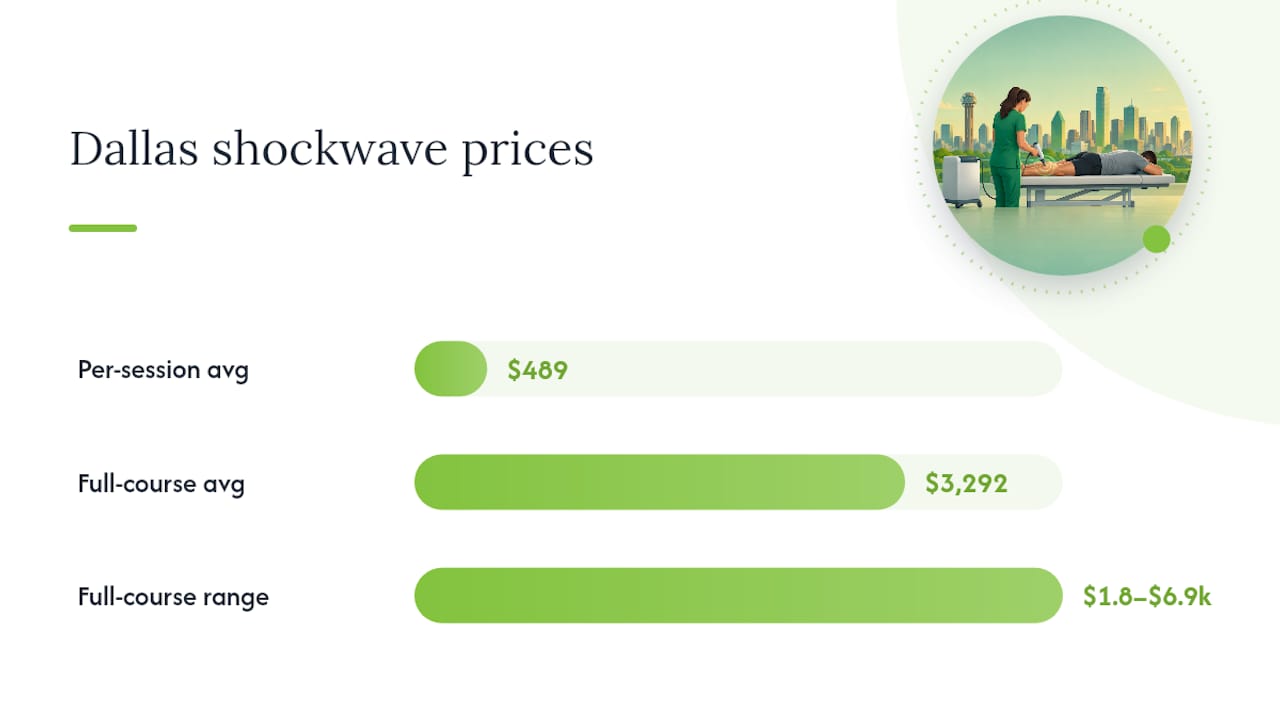
When you start calling clinics, you will notice the numbers vary more than you might expect for what sounds like the same treatment. A metropolitan pricing study covering major U.S. cities found that Dallas clinics average about $489 per session, with full treatment courses averaging roughly $3,292 and ranging from $1,800 to $6,900 depending on the number of sessions and the clinic’s fee structure. Many of these figures come from ED-focused shockwave listings, which tend to run on the higher end because of the protocols involved.
Musculoskeletal shockwave therapy, used for conditions like tendinitis, plantar fasciitis, or chronic joint pain, often prices differently from ED-specific packages. Nortex publishes a patient-facing estimate of $100 to $500 per session for shockwave treatment in the United States, a range that reflects the variation in device type, session length, and whether the visit includes an evaluation.
Before you compare two quotes side by side, find out what’s actually bundled into the price:
- Initial consultation and diagnostic imaging, which some clinics include and others bill separately.
- Number of sessions in the course, since a “package price” only makes sense once you know how many treatments it covers.
- Follow-up visits, which matter for tracking whether the treatment is working.
- Clinician fees, which can shift depending on whether a physician or a technician delivers the treatment.
A metropolitan pricing study found Dallas treatment courses average $3,292, a figure that matters mainly as a benchmark: if a quote lands far outside that range with no clear explanation, ask why before you book.
Why prices vary: device, protocol, and who delivers the treatment
Two clinics can quote wildly different prices for what both call “shockwave therapy,” and the reason usually comes down to four variables. Device type matters first: focused shockwave devices generate a concentrated energy wave that reaches deeper tissue, while radial devices spread energy over a broader, shallower area. Focused devices generally cost more to operate and often carry a higher price tag.
Energy flux density and the number of pulses per session also shape both treatment time and cost. A protocol built for calcific tendinitis looks nothing like one designed for erectile dysfunction, so comparing an ED package price to a tendon protocol price rarely tells you anything useful.
Who performs the treatment plays a role too. A visit that includes a physician’s evaluation, imaging review, and hands-on treatment costs more to deliver than a quick in-and-out session run by support staff. Practice overhead, whether the clinic bundles evaluation and imaging into the quoted price, and whether you’re billed per session or per package all factor into the final number.
- Device and protocol: focused versus radial technology, energy settings, and pulse count change both time and cost.
- Clinician involvement: physician-led visits typically cost more than technician-delivered sessions.
- Billing structure: package pricing can look cheaper per session but only if you confirm exactly what’s included.
Pro Tip: Ask every clinic to write down the device brand, energy settings, and pulse count for your protocol, then use that sheet to compare apples to apples across quotes.
Insurance and Medicare: why most patients pay out of pocket
Coverage for shockwave therapy is inconsistent, and understanding why helps set realistic expectations before you call your insurer. CMS Local Coverage Determination L38775 documents that many Medicare Administrative Contractors consider high-energy extracorporeal shockwave therapy not reasonable and necessary for a range of musculoskeletal conditions. That determination is a major reason so many Dallas clinics price shockwave therapy as a self-pay service rather than something billed through insurance.
Coverage decisions can still vary by payer, diagnosis code, and the specific contractor reviewing your claim, so a blanket assumption in either direction can cost you money. Take these steps before committing to a treatment plan:
- Ask your clinic for the exact diagnosis and procedure codes they plan to bill, since coverage decisions hinge on those specifics.
- Call your insurer directly for a written coverage determination rather than relying on a verbal estimate from clinic staff.
- Request an itemized self-pay quote as a backup, so you know your out-of-pocket ceiling regardless of what your insurer decides.
Is shockwave therapy worth the money? What the evidence actually shows
The honest answer depends entirely on what you’re treating, and the research paints two very different pictures for erectile dysfunction versus musculoskeletal conditions. Many patients come in having read enthusiastic marketing about shockwave therapy without understanding how thin the evidence base is for some uses and how solid it is for others.
For erectile dysfunction, a 2025 Cochrane review of 21 randomized trials involving 1,357 participants found a small short-term improvement in erectile function, but rated the evidence as low certainty and found no data at all on sexual quality of life. The American Urological Association’s ED guideline-guideline) classifies low-intensity shockwave therapy for ED as investigational, a conditional recommendation backed by Grade C evidence. That means a clinician should be discussing genuine uncertainty with you, not promising a cure.
Musculoskeletal evidence tells a more varied story depending on the condition. Randomized trials on calcific tendinitis have shown positive results, and plantar fasciitis evidence tends to be stronger than for some other joint conditions, though differences in protocols across studies limit how well those findings generalize to any one clinic’s approach.
A 36-month follow-up study found durable improvement through two years with some decline between years two and three, while other trials on shockwave therapy found no significant advantage at twelve months. Set your expectations around that variability rather than around the most optimistic result you’ve read.
- Erectile dysfunction: small, low-certainty short-term benefit; no sexual quality-of-life data.
- Musculoskeletal conditions: benefit varies by diagnosis, with calcific tendinitis and plantar fasciitis showing stronger trial support than some other uses.
- Durability: some studies show benefit up to two years; others show no twelve-month advantage.
How to compare quotes and choose a Dallas clinic
Once you understand what drives the price, vetting a clinic becomes a matter of asking the right questions rather than just comparing sticker prices. Bring a short list of questions to your consultation, whether it’s over the phone or in person.
- What device and protocol will you use, including whether it’s focused or radial, the energy flux density, and the number of pulses per session.
- How many sessions make up the full course, and what happens if you need additional treatments beyond that estimate.
- Who actually performs the treatment, and whether a physician reviews your case before and after.
- What’s included in the quoted price, specifically consultation, imaging, and follow-up visits.
- What is the clinic’s policy if the treatment doesn’t work, since a written refund or adjustment policy tells you a lot about how the clinic stands behind its own outcomes.
Watch for red flags along the way: a clinic that skips a real consultation, promises a permanent cure, quotes a price far below the local range with no explanation, or won’t tell you who holds the clinician’s credentials. A patient safety checklist should also come up early, particularly around disclosing anticoagulant use, since bleeding risk is a real consideration for shockwave candidates.
Pro Tip: Get every quote in writing, itemized line by line, before you schedule anything. A clinic confident in its pricing will hand this over without hesitation.
What Dallas patients tend to get wrong about shockwave pricing
The biggest misconception isn’t about price, it’s about what price is supposed to tell you. A lower quote doesn’t mean a better deal if it skips the physician evaluation that catches a contraindication, and a higher quote doesn’t guarantee a better outcome if the protocol doesn’t match your diagnosis. In years of evaluating these referrals, the pattern that stands out is how often patients anchor on the number they saw advertised online, usually an ED package price, and then apply that expectation to an unrelated musculoskeletal condition where the evidence and the pricing look completely different.
The conventional advice to “shop around” is fine as far as it goes, but it undersells what you’re actually shopping for. You’re not comparing identical products at different prices. You’re comparing different devices, different protocols, and different clinician involvement, each of which changes both the cost and the realistic odds of benefit. Prioritize matching the protocol to your diagnosis first. Let the price comparison happen after that, not before it.
— Felix
Getting a transparent shockwave quote in North Dallas
If you’re weighing shockwave therapy against other non-surgical options, Nortex Spine and Joint offers shockwave therapy alongside a broader range of regenerative and pain management treatments, including PRP therapy, stem cell therapy, and physical rehabilitation. The clinic builds treatment plans around your specific diagnosis rather than a one-size-fits-all package, and consultations are structured to give you an itemized estimate before you commit to anything.
That matters most for patients who’ve already tried other treatments without lasting relief and want a clearer picture of what a shockwave protocol would actually involve, and cost, in their case. Nortex’s approach draws on:
- Board-certified physicians who evaluate your diagnosis before recommending a protocol.
- Itemized, self-pay estimates that spell out what’s included, from consultation through follow-up.
- Access to alternative regenerative medicine options, including PRP therapy, when shockwave isn’t the best fit for your condition.
If you’re ready to find out what a personalized shockwave protocol would cost for your diagnosis, request a consultation with Nortex Spine and Joint and ask for a written, itemized estimate before you decide.
This article is general information, not a substitute for advice from a qualified doctor. Consult a qualified healthcare professional about your own circumstances before acting on anything here.
Sources
- Shock Wave Therapy for Erectile Dysfunction: Marketing and Practice Trends in Major Metropolitan Areas in the United States
- Low-intensity shockwave therapy (LiSWT) for erectile dysfunction — Cochrane review
- LCD – Extracorporeal Shock Wave Therapy (ESWT) (L38775)
FAQ
How much does a session of shockwave therapy cost?
A single shockwave session in the Dallas area typically costs between $100 and $500, according to a patient-facing cost estimate from Nortex. The exact price depends on factors including device type, condition treated, and whether the visit includes a physician evaluation.
How much does shockwave therapy cost overall?
A full course of shockwave therapy in Dallas averages around $3,292, with total costs ranging from about $1,800 to $6,900 depending on the number of sessions and the clinic. ED-specific packages tend to sit at the higher end of that range compared to musculoskeletal protocols.
How long does shockwave therapy for ED last?
Follow-up data is mixed: one long-term report found durable improvement through two years with some decline between years two and three, while other trials found no significant advantage at twelve months. The American Urological Association classifies this treatment as investigational, so durability should be discussed with your clinician rather than assumed.
Is shockwave therapy worth the money?
Whether shockwave therapy is worth the cost depends heavily on your diagnosis. A 2025 Cochrane review found only a small, low-certainty benefit for erectile dysfunction, while musculoskeletal evidence, particularly for calcific tendinitis and plantar fasciitis, tends to show stronger results in randomized trials.