
Spinal decompression is a treatment that relieves pressure on spinal discs and nerves. In non-surgical care, it uses computer-controlled motorized traction as part of a multimodal plan. If conservative measures like rest, medication, or basic physical therapy haven’t brought lasting relief, a 2022 randomized controlled trial found that adding non-surgical decompression to routine physical therapy produced better outcomes than physical therapy alone — making it worth discussing with a board-certified spine specialist at a clinic like Nortexspineandjoint.
Surgical vs. non-surgical decompression at a glance:
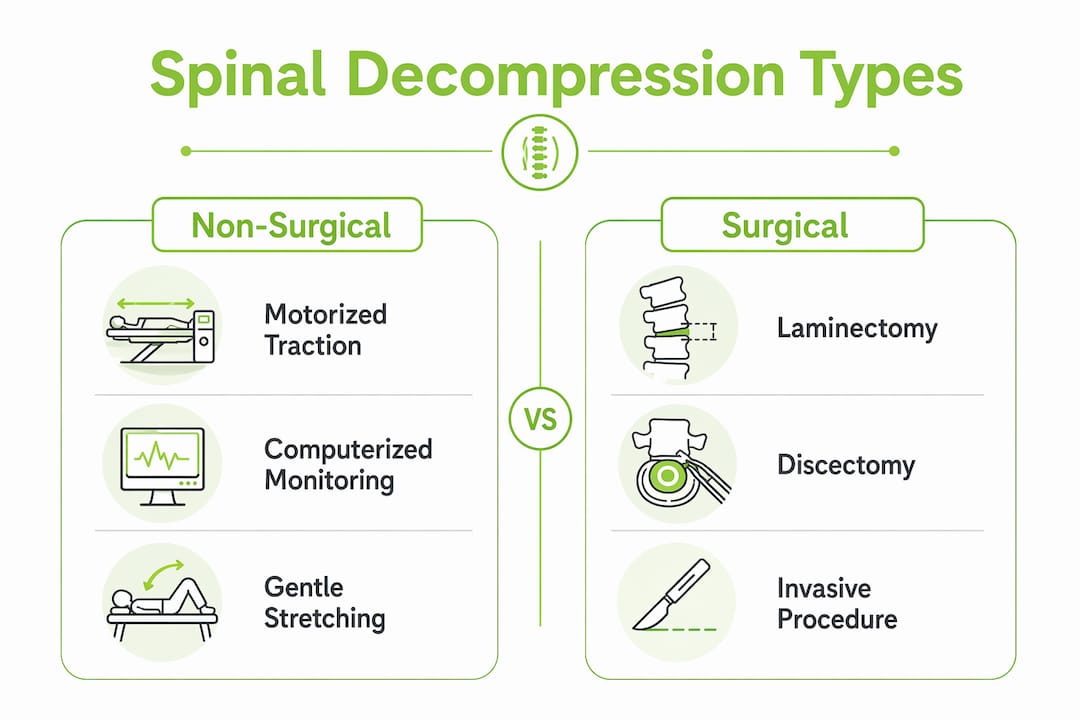
- Non-surgical (mechanical traction): Computer-controlled, no incision, outpatient sessions, typically multiple visits spread over several weeks, used when conservative care has not resolved radicular pain
- Surgical (laminectomy/discectomy): Requires anesthesia and incision, longer recovery, reserved for progressive neurologic deficits or structural compromise that does not respond to conservative care
Table of Contents
- What is spinal decompression and how does it work?
- Who is a good candidate, and who should avoid it?
- What to expect from a full course of treatment
- What does the evidence actually show?
- How does decompression compare to other treatment options?
- How to choose a provider for spinal decompression
- Key Takeaways
- A clinician’s perspective on realistic expectations
- Nortexspineandjoint offers integrated, non-surgical spine care in North Dallas
- Useful sources
- FAQ
What is spinal decompression and how does it work?
The term covers two distinct clinical categories. Surgical decompression, such as laminectomy or discectomy, physically removes bone or disc material to relieve nerve compression. Non-surgical spinal decompression uses computerized motorized traction to apply precise, controlled force to the spine without any incision.
The mechanism behind non-surgical decompression is straightforward. By gently distracting specific spinal segments, the device aims to create negative intradiscal pressure, which may encourage herniated or bulging disc material to retract away from the nerve root. That pressure reduction also promotes fluid and nutrient exchange into the disc, supporting tissue recovery over time.
What distinguishes modern decompression from older traction methods is the computerized feedback loop. The device monitors resistance and adjusts force in real time, which helps avoid the muscle spasm that can occur with simpler, fixed-load traction. During a session, you lie on a motorized table, fully clothed. A harness is fitted around your pelvis and lower trunk. The machine then applies gentle, rhythmic traction cycles, and you hold a safety stop button throughout. Most patients describe the sensation as mild pulling, not pain.
Pro Tip: Ask any clinic you evaluate how they measure your progress objectively, whether through pain scores, range-of-motion testing, or functional assessments, and whether decompression is integrated with physical therapy or regenerative injections rather than offered in isolation.
Who is a good candidate, and who should avoid it?
Non-surgical decompression tends to work best for specific, well-defined diagnoses. Patients with lumbar radiculopathy or sciatica caused by a herniated or bulging disc are the most studied population; chronic low back pain that hasn’t responded to standard conservative care is another common indication.
Typical indications:
- Herniated or bulging lumbar disc with radicular leg pain
- Lumbar radiculopathy or sciatica
- Degenerative disc disease with discogenic pain
- Chronic low back pain refractory to standard conservative care
Absolute and relative contraindications:
- Pregnancy
- Uncontrolled osteoporosis or significant bone loss
- Spinal instability or fracture
- Certain spinal implants or hardware at the target level
- Recent spinal surgery at the segment being treated
- Severe, uncontrolled medical or psychiatric conditions
Urgent red flags requiring immediate evaluation, not decompression:
- New bowel or bladder dysfunction
- Progressive leg weakness
- Saddle anesthesia (numbness in the groin and inner thighs)
These red flags suggest possible cauda equina syndrome, a medical emergency. If you experience any of them, go to an emergency department rather than scheduling a decompression session.
What to expect from a full course of treatment
Most patients complete 20–28 sessions over a 5–7 week program, typically attending three to five times per week. Each session runs roughly 30–45 minutes, including setup and any adjunct therapies scheduled alongside it.
| Phase | Timeframe | What typically happens |
|---|---|---|
| Early sessions (1–6) | Week 1–2 | Baseline force established; mild soreness possible |
| Mid-course (7–18) | Week 2–5 | Gradual force progression; most patients notice improvement |
| Final sessions (19–28) | Week 5–7 | Consolidation; PT and home exercise integration |
| Follow-up | After course | Reassessment of pain, function, and imaging if indicated |
During therapy, a mild pulling sensation is normal. What you should report to your clinician:
- Increasing pain during or after a session
- New or worsening numbness or tingling
- Any change in bowel or bladder function
Between sessions, tracking your pain on a simple 0–10 scale, noting how far you can walk comfortably, and logging any functional changes gives your clinician the data needed to adjust the plan. Decompression is a passive procedure, so combining it with non-surgical back pain strategies and home exercise tends to produce better results than decompression alone.

What does the evidence actually show?
A 2022 randomized controlled trial is the clearest recent evidence supporting non-surgical decompression. Patients with lumbar radiculopathy who received decompression combined with routine physical therapy showed greater improvements in pain, lumbar range of motion, back muscle endurance, functional disability, and quality of life at four weeks compared to those who received physical therapy alone.
Key finding: The 2022 RCT demonstrated that decompression added to routine physical therapy outperformed physical therapy alone across five outcome measures in lumbar radiculopathy patients at four weeks.
That result is meaningful, but the broader literature has real limitations. Most decompression studies involve small sample sizes, variable protocols, and inconsistent sham controls. High-quality, large-scale randomized trials are still limited, and long-term durability of benefit is not well established.
What the evidence supports:
- Short-term improvements in pain and function for lumbar radiculopathy when combined with PT
- Low risk of serious adverse events when patients are appropriately selected
What remains uncertain:
- Long-term outcomes beyond a few months
- Whether results differ meaningfully across device types or protocols
- Efficacy as a standalone treatment without adjunct therapies
The safety profile is generally favorable. Serious complications are rare when a board-certified physician oversees patient selection and contraindications are respected. The practical takeaway: decompression is best understood as one component of a multimodal plan, not a standalone cure.
How does decompression compare to other treatment options?
Many patients considering decompression are also weighing physical therapy, injections, regenerative treatments, or surgery. Each has a distinct role depending on diagnosis severity and how far along the treatment pathway you are.
| Treatment | Best for | Invasiveness | Typical course | Evidence level |
|---|---|---|---|---|
| Non-surgical decompression | Herniated disc, radiculopathy | None | 20–28 sessions, 5–7 weeks | Moderate (2022 RCT + case series) |
| Physical therapy | Most back pain presentations | None | Ongoing, 6–12 weeks | Strong |
| Nerve blocks / injections | Acute radicular pain, diagnostic | Minimally invasive | 1–3 injections | Moderate to strong |
| PRP therapy | Disc/facet degeneration, adjunct | Minimally invasive | 1–3 sessions | Emerging |
| Radiofrequency ablation | Facet-mediated pain | Minimally invasive | Single procedure | Moderate to strong |
| Surgery (laminectomy/discectomy) | Progressive neurologic deficit | Invasive | Single procedure, weeks of recovery | Strong for specific indications |
Physical therapy is the foundation of conservative spine care and pairs well with decompression, as the 2022 RCT confirms. Nerve blocks or epidural injections are often used to manage acute radicular pain while longer-term therapies take effect. PRP therapy for back pain is an emerging regenerative adjunct for disc and facet conditions, and it is increasingly integrated into multimodal plans at regenerative clinics. Surgery remains appropriate when conservative care fails and there is progressive neurologic compromise. You can read more about non-surgical spinal decompression outcomes and how it fits among other options.
How to choose a provider for spinal decompression
The quality of patient selection and clinical oversight matters as much as the device itself. A well-run program integrates decompression into a broader plan rather than selling it as a standalone solution.
Provider checklist:
- Board certification in pain management, physiatry, orthopedics, or neurosurgery
- Documented contraindication screening before starting treatment
- Objective outcome tracking (pain scores, functional tests, range of motion)
- On-site or coordinated physical therapy and injection capability
- Transparent discussion of realistic timelines and limitations
Questions to ask at your first evaluation:
- “How do you determine whether I’m a candidate for decompression?”
- “What outcomes do you track, and how often do you reassess?”
- “How does decompression fit with PT, injections, or PRP in my plan?”
- “What happens if I don’t respond after the first several sessions?”
Red flags to avoid: clinics that guarantee results, lack physician oversight, apply no individualized screening, or pressure you into prepaid packages without a proper evaluation first. Coverage for non-surgical decompression varies by insurer and plan. Ask the clinic’s billing team about your specific benefits before committing to a course.
For a broader look at spinal therapies and where decompression fits, patient-oriented overviews can help you frame the right questions before your consultation.
Key Takeaways
Non-surgical spinal decompression is most effective when combined with physical therapy and appropriate patient selection, as confirmed by a 2022 randomized controlled trial.
| Point | Details |
|---|---|
| Definition | Non-surgical decompression uses computerized motorized traction; surgery (laminectomy/discectomy) is a separate, invasive category. |
| Best candidates | Patients with herniated disc, lumbar radiculopathy, or sciatica who haven’t responded to standard conservative care. |
| Treatment course | Typically multiple sessions over several weeks, with multiple visits each week. |
| Evidence takeaway | The 2022 RCT showed decompression plus PT outperformed PT alone for pain, range of motion, and function at four weeks. |
| Nortexspineandjoint | Offers individualized evaluation and integrates decompression with PRP, stem cell therapy, and rehabilitation for North Dallas patients. |
A clinician’s perspective on realistic expectations
Many patients who come in for a decompression consultation have already tried medication, a round of physical therapy, or even an injection or two. They’re not looking for a miracle. They want to understand whether there’s a logical next step before considering surgery. That’s exactly the right question to be asking.
When I evaluate someone for decompression, I’m looking at the full picture: the imaging, the symptom pattern, how long they’ve had it, and what’s already been tried. Decompression is not appropriate for everyone, and I’d rather tell you that at the first visit than have you complete a 28-session course without a clear rationale. For patients who are good candidates, combining decompression with physical therapy and, where appropriate, a regenerative option like PRP tends to produce more durable results than any single treatment alone. Measurable goals matter: I want to see your pain score drop, your walking tolerance improve, and your functional capacity increase at defined checkpoints, not just at the end of the program.
If you’re in the North Dallas area and want to know whether decompression fits your situation, a focused evaluation at Nortexspineandjoint is the right starting point.
Nortexspineandjoint offers integrated, non-surgical spine care in North Dallas
Patients who want a thorough evaluation before committing to any procedure will find that Nortexspineandjoint combines diagnostic precision with a full range of non-surgical options, including PRP therapy, stem cell treatments, nerve blocks, physical rehabilitation, and decompression-compatible protocols. No guarantees are made, because honest medicine doesn’t work that way. What you get is an individualized treatment plan built around your specific diagnosis, history, and goals. To take the next step, schedule an evaluation at Nortexspineandjoint and find out which combination of therapies makes the most clinical sense for your spine.
Useful sources
- Effects of non-surgical decompression therapy added to routine PT (PubMed, 2022 RCT) — The primary randomized controlled trial showing decompression plus PT outperformed PT alone for lumbar radiculopathy at four weeks.
- Spinal Decompression Therapy: Is It Right for You? (WebMD) — Accessible overview of mechanism, session experience, and patient preparation.
- What Is Spinal Decompression? (Healthline) — Balanced patient-facing summary of surgical and non-surgical categories.
- Spinal decompression for back pain (Medical News Today) — Useful for understanding when surgery is reserved versus conservative care.
- Non-surgical decompression: scientific literature vs. advertising claims (ResearchGate) — Critical appraisal of evidence quality; important reading before choosing a provider.
- Nortexspineandjoint pain management case series — Clinic-level outcome examples showing how multimodal plans are structured.
FAQ
What is spinal decompression therapy, exactly?
Non-surgical spinal decompression therapy uses a computer-controlled motorized table to apply gentle, rhythmic traction to the lumbar spine, aiming to reduce intradiscal pressure and relieve nerve compression. It is distinct from surgery and is delivered in outpatient sessions without anesthesia or incision.
Is spinal decompression effective for back pain?
A 2022 randomized controlled trial found that decompression combined with physical therapy produced better short-term outcomes than physical therapy alone for lumbar radiculopathy. Evidence for long-term durability is still limited, and results depend heavily on appropriate patient selection.
How many sessions does spinal decompression require?
A typical course runs 20–28 sessions over 5–7 weeks, with visits three to five times per week. Completing the full course is generally necessary to achieve the physiologic changes the treatment targets.
Who should not have spinal decompression?
Contraindications include pregnancy, uncontrolled osteoporosis, spinal instability, certain implants, and recent surgery at the target spinal level. New bowel or bladder dysfunction, progressive weakness, or saddle anesthesia require emergency evaluation, not decompression.
Can spinal decompression be combined with PRP or other regenerative treatments?
Yes. Regenerative clinics like Nortexspineandjoint often integrate decompression with PRP therapy for back pain or stem cell treatments as part of a multimodal plan, particularly for patients with degenerative disc or facet conditions alongside radicular symptoms.
Recommended
- Spinal Decompression for Lower Back Pain: Is It Effective? – Nortex | Pain Management | Allen, Garland, McKinney & Plano Texas
- What Is Spinal Pain Management: A Practical Guide
- Chiropractic Pain Case Studies 2 – Nortex | Pain Management | Allen, Garland, McKinney & Plano Texas
- Spine Secrets Unveiled: Top Tips for a Healthy Back – Nortex | Pain Management | Allen, Garland, McKinney & Plano Texas