
Chronic pain is not simply a sensation that signals tissue damage. It reshapes how you think, sleep, relate to others, and move through your day. Understanding why pain management matters begins with recognizing that pain lasting beyond three months operates through biological, psychological, and social factors simultaneously, not just through injured nerves or inflamed joints. Many people arrive at a clinic after years of trying to push through discomfort, assuming the pain will eventually resolve on its own. It rarely does without a structured, evidence-based plan. Effective pain management does not promise zero pain. It promises a better life.
Table of Contents
- Key takeaways
- What chronic pain actually is
- Evidence-based pain management strategies
- The role of communication and realistic expectations
- Applying pain management strategies in daily life
- My perspective on what pain management really changes
- How Nortexspineandjoint supports your pain management goals
- FAQ
Key takeaways
| Point | Details |
|---|---|
| Chronic pain affects more than the body | Unmanaged chronic pain disrupts mood, cognition, sleep, and relationships, not just physical function. |
| Multimodal care outperforms single treatments | Combining physical therapy, behavioral therapies, and appropriate medications produces better functional outcomes. |
| Function matters more than pain scores | Measuring success by sleep quality, work capacity, and daily activity reflects real progress more accurately than intensity ratings. |
| Patient communication changes outcomes | Aligning treatment goals with personal values reduces medication reliance and sustains long-term engagement. |
| Early, structured intervention reduces long-term risk | Untreated chronic pain is associated with increased risk of cognitive impairment and depression over time. |
What chronic pain actually is
Most people understand acute pain. You sprain an ankle, it hurts for a few weeks, and it heals. Chronic pain is categorically different. By clinical definition, chronic pain persists for more than three months, often continuing well beyond the resolution of the original injury or condition. It affects an estimated 20 to 30 percent of adults in the United States, making it one of the most prevalent medical challenges in the country.
The key distinction between acute and chronic pain lies in the underlying mechanisms. Acute pain is protective. It alerts you to potential harm. Chronic pain, by contrast, frequently involves changes in how the central nervous system processes pain signals, a process called central sensitization. The nervous system becomes hypersensitive, responding to stimuli that would not normally cause pain, or amplifying signals far beyond what the original tissue damage would warrant.
The consequences extend well beyond physical discomfort. Research shows chronic pain raises cognitive impairment risk with a pooled adjusted odds ratio of 1.30, meaning long-term, poorly managed pain measurably increases your dementia risk. This is not a minor footnote. It represents one of the most overlooked reasons why pain control is critical for older adults especially.
The impact of chronic pain on daily life includes:
- Disrupted sleep patterns, which worsen pain sensitivity and mood
- Difficulty concentrating and reduced cognitive performance
- Increased rates of depression and anxiety
- Social withdrawal and strained personal relationships
- Reduced work capacity and economic burden on individuals and families
These effects compound over time. A person who sleeps poorly because of pain becomes more sensitive to pain the following day, which further disrupts sleep, and the cycle continues. This is why the importance of pain management lies not just in symptom relief, but in breaking these interconnected cycles before they cause lasting harm.
Evidence-based pain management strategies

The clinical understanding of chronic pain has advanced substantially over the past two decades. Pain management strategies that were once centered almost entirely on medication have shifted toward multimodal, patient-centered approaches that address the full scope of how pain affects a person’s life.
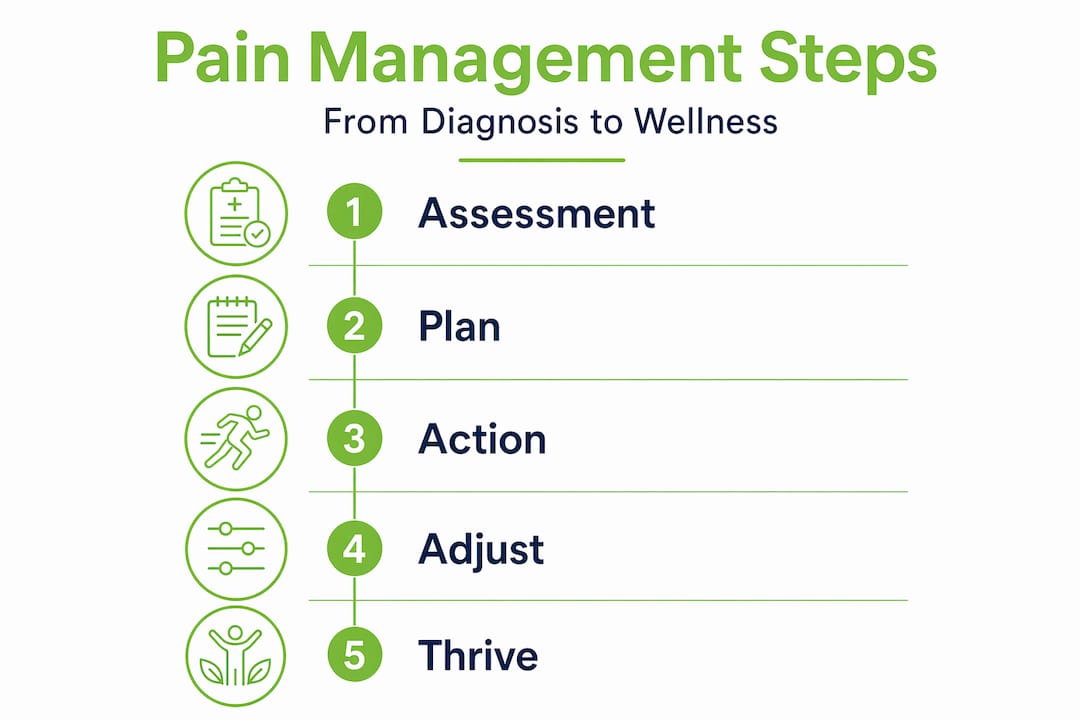
The core of modern evidence-based care is multimodal treatment, which means combining several complementary approaches rather than relying on a single intervention. This typically includes physical rehabilitation, behavioral therapies, appropriate medications where indicated, lifestyle modifications, and complementary health approaches such as acupuncture or massage.
Among behavioral therapies, three have the strongest evidence base:
- Cognitive Behavioral Therapy (CBT): Addresses the thought patterns and coping behaviors that amplify the pain experience. CBT teaches patients to recognize and reframe catastrophic thinking, which is one of the strongest predictors of disability in chronic pain.
- Mindfulness-Based Stress Reduction (MBSR): Trains attention and awareness to observe pain without judgment, reducing the emotional reactivity that magnifies suffering. Research supports MBSR as a first-line non-pharmacologic treatment for both chronic pain and associated mental health conditions.
- Acceptance and Commitment Therapy (ACT): Helps patients clarify their personal values and commit to behaviors that improve quality of life despite persistent pain, rather than waiting for pain to disappear before living fully.
One of the most compelling datasets on the benefits of managing pain through interdisciplinary care comes from the VA Whole Health program. This model combines coaching, integrative therapies, and traditional medical care in a coordinated system. In a rigorous trial, pain interference dropped from 6.6 to 4.9 with the Whole Health approach, a substantially larger reduction than standard care or CBT alone.
Integrated care also yields better outcomes when comorbid mental health conditions like depression or PTSD are treated alongside the pain. Multidisciplinary coordination for co-occurring conditions is not optional in serious chronic pain cases. It is often what separates meaningful recovery from stagnation.
Pro Tip: If you are currently seeing only one type of provider for chronic pain, ask specifically whether a referral to physical therapy, a pain psychologist, or a rehabilitation specialist would be appropriate. Single-modality care rarely addresses the full picture.
The role of communication and realistic expectations
One of the most consistent patterns in chronic pain treatment is this: patients who expect complete elimination of their pain often disengage from therapy when that goal is not achieved quickly. This matters enormously for outcomes, because patient expectations shape perceived success throughout the treatment process.
Effective pain management is not about chasing zero pain. It is about restoring function, improving sleep, maintaining relationships, and participating in activities that give your life meaning. When clinicians and patients align on these goals from the beginning, treatment adherence improves and medication reliance tends to decrease.
Here is a practical framework for productive communication with your care team:
- Define your functional goals clearly. Instead of saying “I want my pain to go away,” try “I want to be able to walk two miles without stopping” or “I want to sleep through the night again.” These are measurable, meaningful benchmarks.
- Ask how success will be measured. A function-first treatment approach uses outcomes like pain interference with daily tasks, work capacity, and sleep quality rather than a simple 0 to 10 pain score.
- Acknowledge partial progress. Many patients dismiss 30 percent improvements because they expected 100 percent. In chronic pain research, a 30 percent reduction in pain interference is clinically meaningful and worth building on.
- Share what matters to you personally. A care plan aligned with your individual values and goals produces better outcomes than one designed around population averages.
Pro Tip: Before your next appointment, write down three specific activities you currently cannot do because of pain. Bring that list. It gives your provider concrete targets and shifts the conversation from symptom reporting to functional recovery.
Applying pain management strategies in daily life
Understanding the importance of pain management in theory is only part of the equation. How you apply these strategies between clinic visits determines much of your progress. Many patients come in having tried one or two approaches inconsistently, without a structured daily plan to reinforce what happens in treatment sessions.
Physical activity remains one of the most well-supported interventions for chronic pain. The goal is not high-intensity exercise but sustained, appropriate movement matched to your specific condition. Walking, aquatic therapy, and graded exercise programs all reduce central sensitization over time. Your physical therapist should design a program that progressively builds tolerance rather than provoking flares. The details on how to build that structure are covered in this guide on lasting pain relief approaches.
Behavioral therapies have become significantly more accessible through telehealth platforms. Research on the LAMP program, a mindfulness intervention delivered via telehealth, found it improved biopsychosocial outcomes safely even in patients with comorbid mental health diagnoses. You do not need to travel to a specialty center to access quality behavioral pain management.
Practical daily habits that support effective pain management include:
- Maintaining consistent sleep and wake times to reduce pain sensitivity related to sleep deprivation
- Pacing activities throughout the day rather than overdoing it on good days and crashing on bad ones
- Practicing brief mindfulness or breathing exercises during pain flares to reduce emotional amplification
- Staying connected socially, since isolation reliably worsens chronic pain outcomes
- Tracking functional wins, such as improved sleep or longer walks, rather than only monitoring pain intensity
Regular follow-up with a multidisciplinary care team allows your plan to be adjusted as your condition evolves. Pain management is not a fixed protocol. It is an ongoing process that requires monitoring and course corrections over time. Non-opioid treatment options, many of which carry lower long-term risk profiles, are reviewed thoroughly in Nortexspineandjoint’s resource on non-opioid chronic pain options.
My perspective on what pain management really changes
I have worked with a lot of patients who arrive frustrated after years of being handed a prescription and sent home. The prescription addressed the number on the pain scale. It did not address why they stopped coaching their kid’s soccer team or why they had not slept a full night in two years.
In my experience, the most meaningful shift in pain care is measuring what actually matters to patients. Pain scores are a proxy. Function is real. When we start tracking whether someone can return to their job, walk their dog, or sit through a family dinner, the entire treatment relationship changes. Patients stay engaged because they can see progress in things that matter to them.
I also think the field’s historic over-reliance on opioid medications created a generation of patients who associate pain management with passive treatment. You take something, you wait. The evidence consistently shows the opposite is true. The patients who do best are the ones who actively participate in rehabilitation, show up for behavioral therapy, and communicate honestly with their care team about what is and is not working.
The uncomfortable reality is that chronic pain rarely disappears entirely. What changes is your relationship with it and your capacity to function despite it. That shift is what good pain management delivers. And in my clinical experience, that shift changes lives more than a lower number on a pain scale ever could.
— Felix
How Nortexspineandjoint supports your pain management goals
At Nortexspineandjoint, we recognize that effective pain management requires more than a single treatment. Our approach in North Dallas integrates advanced regenerative therapies with personalized rehabilitation programs designed to address the root cause of your pain, not just the surface symptoms.
For patients with chronic joint pain, PRP therapy uses concentrated growth factors from your own blood to support tissue repair and reduce inflammation naturally. These treatments work as part of a broader plan that may include physical rehabilitation, movement therapy, and lifestyle support. For those managing specific conditions, targeted options like regenerative medicine protocols are available and tailored to your individual presentation.
If you are ready to move beyond symptom management toward a plan built around restoring your function and quality of life, contact Nortexspineandjoint to schedule a consultation. Our team will work with you to design a personalized approach that matches your goals and clinical needs.
FAQ
What does chronic pain do to the body long-term?
Chronic pain that goes unmanaged is associated with central sensitization, disrupted sleep, depression, and increased risk of cognitive impairment. Research shows a 1.30 odds ratio for cognitive decline in chronic pain patients compared to those without persistent pain.
Why is a multimodal approach better than medication alone?
Single-modality treatment rarely addresses the biological, psychological, and social dimensions of chronic pain together. Multimodal strategies that combine physical therapy, behavioral interventions, and appropriate medications produce better functional outcomes with lower harm risk.
How do I measure progress in pain management?
Rather than focusing only on pain intensity scores, track functional markers such as sleep quality, ability to complete daily tasks, work participation, and social engagement. These function-based outcomes reflect meaningful improvement more accurately.
Can mindfulness really help with chronic pain?
Yes. Mindfulness-based programs, particularly when delivered through structured formats like MBSR, have demonstrated measurable improvements in pain interference and mental health. Telehealth delivery of mindfulness programs has also shown effective outcomes for patients with complex presentations.
When should I seek specialized pain management care?
If your pain has persisted for more than three months, interferes with sleep or daily function, or has not responded adequately to initial treatments, a consultation with a pain management specialist is appropriate. Early, structured intervention reduces the risk of long-term disability and psychological complications.