
Start with activity modification and a structured progressive tendon-loading exercise program. Most people improve without surgery. Short-term ice, NSAIDs, and a patellar strap can ease symptoms early, but the real fix is loading the tendon correctly over months, not weeks. If a structured 12 to 24 week program stalls, PRP or shockwave therapy become reasonable next steps after a prolonged structured exercise program. Surgery stays a last resort, reserved for tendons that never respond.
TL;DR:
- Most patients improve with a 12 to 24-week structured tendon-loading exercise program, and adherence is crucial for success.
- Imaging such as ultrasound or MRI is only necessary for complex cases or when exam findings do not align, as clinical diagnosis is usually sufficient.
- Short-term symptom relief tools like ice, NSAIDs, and straps do not accelerate healing; load management remains the core treatment focus.
- Injections like PRP may benefit refractory cases when combined with proper loading, but their success depends on protocol choice and ongoing rehabilitation.
- Surgery is a last resort after a minimum of six months of failed conservative treatment, with long recovery timelines and staged return-to-sport protocols.
Table of Contents
- How Do Doctors Diagnose Patellar Tendonitis?
- What Should You Do Right Away for Pain Relief?
- What Is the Best Exercise Program for Tendon Healing?
- Do Shockwave Therapy and Other Adjunct Treatments Help?
- Are Injections Like PRP Worth Considering for Tendonitis?
- When Does Surgery Become Necessary?
- How Long Does Recovery Take and When Can You Return to Sport?
- How Does a Pain Clinic Approach Advanced Treatment Decisions?
- What I Want You to Take From This
- Find a Path Forward With Nortexspineandjoint
- Sources
- FAQ
How Do Doctors Diagnose Patellar Tendonitis?
You don’t usually need a scan to find out what’s wrong with your knee. Patellar tendonitis, also called patellar tendinopathy, is a clinical diagnosis. That means a careful history and a hands-on exam tell us most of what we need to know. When patients come into our clinic describing pain right at the bottom of the kneecap that flares with jumping, squatting, or going down stairs, the pattern is usually recognizable before we even touch the knee.
The physical exam looks for a few specific signs. Tenderness localizes to the inferior pole of the patella, right where the tendon originates. Pain reproduces with resisted knee extension and worsens with a single-leg squat, which loads the tendon eccentrically and tends to provoke the exact pain the patient came in with. We also look at how the knee tracks, check hip and ankle mobility, and ask about training volume, since a sudden jump in mileage or jump-training frequency is one of the most common triggers we see.
A few history questions almost always come up during a visit:
- When did the pain start, and did it follow a specific increase in training load or a new activity?
- Is the pain worse at the start of activity and then it warms up, or does it get progressively worse the longer you go?
- Does pain occur with everyday stairs and sitting, or only during sport-specific movements like jumping?
- Have you had this before, and if so, what treatment helped last time?
Imaging has a role, but it’s narrower than most patients expect. Ultrasound is useful when we want to look at tendon structure directly, confirm thickening, or check for a partial tear that isn’t responding to conservative measures. MRI comes into play when the picture is more complex or when we’re concerned about something beyond simple tendinopathy, like a stress reaction in the bone or intra-articular pathology. X-ray is mainly there to rule out bony causes such as Sinding-Larsen-Johansson syndrome in younger patients or patellar stress fracture.
For a straightforward case, though, routine imaging often adds cost without changing the plan. Reviews on the role of imaging in tendinopathy diagnosis back this up: imaging is best reserved for atypical presentations, surgical planning, or when the exam findings don’t add up. Early treatment decisions rest on the exam, not the picture.
What Should You Do Right Away for Pain Relief?
The instinct to rest completely until the pain disappears is one of the most common mistakes I see. Complete rest calms symptoms in the short term, but tendons respond to controlled load. Pull all load away for weeks and you often come back weaker, more deconditioned, and just as prone to flare-ups the moment you resume training.
Load management is the better first move. The goal isn’t zero pain. It’s keeping activity below the threshold that provokes a lasting flare, while still loading the tendon enough to maintain capacity. A useful rule many clinicians use with patients: pain during activity up to about 3 or 4 out of 10 that settles within 24 hours is generally acceptable. Pain that lingers into the next day, or climbs higher during the activity itself, means the load needs to come down.
Here’s a practical starting sequence for the first one to two weeks:
- Identify and reduce the specific movements provoking pain (deep squats, jumping, sprinting, stair-heavy training).
- Substitute lower-irritation activities that keep you active, like cycling or swimming, if your presentation allows it.
- Apply ice for 10 to 15 minutes after activity if swelling or acute soreness is present.
- Use an over-the-counter NSAID short term for pain control, understanding it doesn’t accelerate tendon healing.
- Try a patellar strap or tendon band during activity if it reduces symptoms.
A word on each of those tools matters. Ice and NSAIDs manage symptoms, they don’t repair tissue. Tendinopathy isn’t primarily an inflammatory condition in the way an acute sprain is, so anti-inflammatory medication is a comfort measure, not a treatment for the underlying tendon changes. I tell patients to think of NSAIDs as something that buys you tolerable days while the real work, the loading program, does the actual repair.
Patellar straps and tendon bands work for a meaningful subset of patients, particularly those with jumping or running-heavy sports. The strap changes the load distribution across the tendon slightly and seems to reduce pain during activity for some people. It’s not universal. If a strap doesn’t change your symptoms after a week of consistent use, don’t force it.
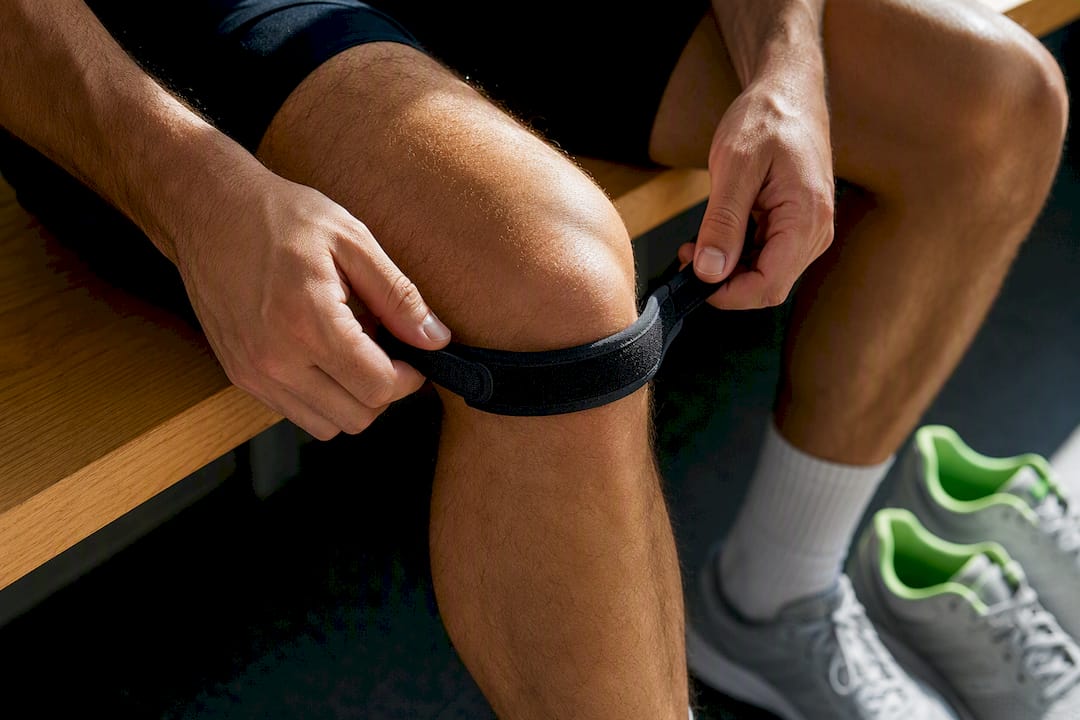
Activity modification looks different depending on your sport. A runner might drop hill repeats and speed work while keeping easy mileage. A volleyball or basketball player might cut jump-training volume in half rather than stopping entirely. A gym athlete doing heavy squats might reduce depth or load temporarily rather than abandon lower-body training altogether.
Pro Tip: Keep a simple daily pain log for the first two weeks, rating pain during activity and the next morning on a 0 to 10 scale. That single habit tells you faster than anything else whether your current load is too much, too little, or about right.
What Is the Best Exercise Program for Tendon Healing?
Exercise therapy is the backbone of patellar tendonitis treatment, and the evidence increasingly points toward a specific approach: progressive tendon-loading exercise, or PTLE, rather than the eccentric-only programs that dominated advice for years.
A randomized trial comparing the two found that patients following a progressive tendon-loading exercise program improved their VISA-P scores, a validated 0 to 100 questionnaire measuring pain and function in patellar tendinopathy, by 28 points at 24 weeks, compared to 18 points with eccentric exercise alone. That’s an adjusted mean difference of 9 points in favor of PTLE, a statistically significant result (p=0.023). In practice, that gap is the difference between a patient who’s back to modified training and one who’s still frustrated by nagging symptoms at the six-month mark.
PTLE structures rehab into four stages, each unlocked by tolerable pain during the prior stage’s exercises, not by a fixed calendar date.
- Isometric stage. Sustained holds, such as a wall sit or Spanish squat, at a joint angle and intensity the patient tolerates. This stage often calms pain quickly and builds a base of tolerance.
- Isotonic and heavy slow resistance stage. Full range-of-motion strengthening, like leg press or slow-tempo squats, with load increasing week over week.
- Plyometric stage. Controlled jumping and landing drills that reintroduce the elastic, fast-loading demands sport requires.
- Sport-specific stage. Movements that mimic the actual demands of the athlete’s activity, cutting, sprinting, sport-specific jumping, before full return to competition.
Progression between stages follows a pain-monitoring model. A common threshold used in trials and in clinic is a VAS score of 3 or less out of 10 during a provocative test, often a single-leg squat, before advancing to the next stage. Push through higher pain and you risk flaring symptoms and losing weeks of progress. This is where I see the most self-inflicted setbacks: motivated athletes who feel a little better and jump two stages ahead, only to be back at square one within days.
A realistic session might run three times per week, alternating heavier strength days with lighter isometric maintenance days, and many programs keep some isometric work in the mix even during the plyometric and sport-specific stages to manage pain between harder sessions.
By the numbers: Structured tendon-loading programs typically require 12 to 24 or more weeks to produce clinically meaningful improvement, and real-world adherence to these programs runs around 40 to 50 percent. Poor adherence, not a flawed program, is often the actual reason patients feel stuck.
The most common adherence pitfalls I see: skipping sessions once pain improves, under-loading out of fear, and abandoning the program the moment a flare occurs instead of temporarily backing off one stage. Clinical practice guidelines are consistent on this point. A Dutch multidisciplinary guideline for patellofemoral and patellar tendon pain recommends exercise therapy as the primary treatment, with additional interventions considered only if there’s no meaningful improvement after 6 to 12 weeks of consistent, correctly loaded exercise.
Do Shockwave Therapy and Other Adjunct Treatments Help?
Extracorporeal shockwave therapy, or ESWT, gets asked about often, usually by patients who’ve read that it can regenerate tendon tissue. The honest answer is more nuanced. A systematic review of ESWT for tendinopathy found that high-quality trials frequently show no consistent advantage over sham treatment, even though some longer-term comparisons suggest benefit over standard nonoperative care in certain populations. That inconsistency is exactly why ESWT is generally positioned as an option for refractory cases, patients who’ve completed a real loading program and still haven’t progressed, rather than a first-line treatment.
Other adjunct modalities come up in clinic conversations too, and it’s worth being direct about where the evidence stands on each:
- Therapeutic ultrasound has limited, inconsistent evidence for tendon healing specifically and is rarely used as a standalone treatment today.
- Class IV laser shows some pain-modulation benefit in small studies, but it isn’t a substitute for loading the tendon.
- Red light therapy has a similar profile: plausible for symptom relief, unproven for structural tendon change.
- PEMF (pulsed electromagnetic field therapy) has mixed evidence across musculoskeletal conditions. An independent review of PEMF therapy notes it may help in specific contexts but isn’t a reliable standalone fix.
- Compression sleeves and taping can reduce symptomatic discomfort during activity for some patients without evidence of changing the underlying tendon pathology.
None of these replace the loading program. Think of them as tools that might make the loading program more tolerable, reducing pain enough that a patient can complete their sessions consistently, rather than treatments that fix the tendon on their own. When patients ask me whether to add laser or PEMF to their plan, my answer is usually: sure, if it helps you stay consistent with the exercises, but don’t expect it to move the needle without the loading work behind it.
Are Injections Like PRP Worth Considering for Tendonitis?
Once a patient has completed a genuine trial of structured exercise, typically 12 weeks or more, and progress has stalled, injections enter the conversation. Not all injections carry the same evidence, and the differences matter for anyone weighing this decision.
Corticosteroid injections reduce pain quickly, sometimes within days, which makes them tempting. But the data on long-term outcomes is concerning. Reviews comparing injection options for tendinopathy consistently show that corticosteroids provide short-term pain relief but limited or even negative long-term function compared with exercise therapy, and there’s a legitimate concern about tendon weakening with repeated use. I use corticosteroids sparingly in tendinopathy, and almost never repeat them in the same tendon, because the risk-benefit balance shifts unfavorably the more you rely on them.
Platelet-rich plasma (PRP) occupies a different tier of evidence. Network meta-analyses comparing injection treatments for refractory patellar tendinopathy rank leukocyte-rich PRP among the top options for functional improvement, with SUCRA rankings between 87.5 and 94.9 percent, a statistical measure of how likely a treatment is to be among the best performers across the studies compared. That’s a meaningfully strong signal for a population that, by definition, hasn’t responded to simpler measures.
A broader review of published meta-analyses on patellar tendinopathy treatments found PRP and ESWT both show promise for refractory cases, but flagged variable protocols and heterogeneous study quality as real limitations on how confidently those results generalize.
That heterogeneity is worth understanding before you commit to an injection. PRP isn’t one standardized product. Leukocyte-rich versus leukocyte-poor formulations, injection volume, and the rehab protocol that follows the injection all appear to influence outcomes in observational data. Selecting the right protocol and pairing it with structured loading afterward, rather than treating the injection as a standalone fix, correlates with more consistent results.
Hyaluronic acid injections have a much smaller evidence base for patellar tendinopathy specifically and tend to fill a niche role rather than a primary one.
Points worth raising with any provider before choosing an injection:
- Ask whether they use leukocyte-rich or leukocyte-poor PRP, and why.
- Ask how many injections are typically planned and what the post-injection rehab protocol looks like.
- Ask what functional improvement, not just pain reduction, you should realistically expect and by when.
- Ask how the injection fits into your existing loading program, since injections work best as an addition, not a replacement.
Our approach at Nortex’s PRP therapy program is built around that combination: injections layered onto, not instead of, a structured rehab plan.
When Does Surgery Become Necessary?
Surgery sits at the far end of the treatment ladder, and it stays there for good reason. It’s considered only after a genuine, well-executed course of conservative care, typically 6 months or more of structured loading, activity modification, and often an injection trial, has failed to produce meaningful improvement, or in cases involving a structural tendon rupture.
Two general surgical approaches exist. Open debridement removes degenerated tendon tissue and can involve drilling the patellar bone to stimulate healing. Arthroscopic techniques accomplish something similar with smaller incisions and generally faster initial recovery, though outcomes between the two approaches are broadly comparable in most series.
A few things patients should know going in:
- Post-surgical rehab is long. Most protocols run 4 to 6 months before return to sport-specific training, with full return to competitive sport sometimes taking up to a year.
- Outcomes are generally favorable for pain and function, but “favorable” doesn’t mean immediate, and a subset of patients still report residual symptoms.
- Complications, while not common, include stiffness, delayed healing, and, rarely, infection, the same risk profile you’d expect from any orthopedic procedure.
- Surgery doesn’t skip the loading work. Post-op rehab still follows a staged strengthening progression similar to nonoperative PTLE.
Given that timeline and risk profile, surgery makes sense for a specific patient: someone who has truly exhausted structured conservative options, not someone six weeks into their first attempt at exercise therapy who’s frustrated with slow progress.
How Long Does Recovery Take and When Can You Return to Sport?
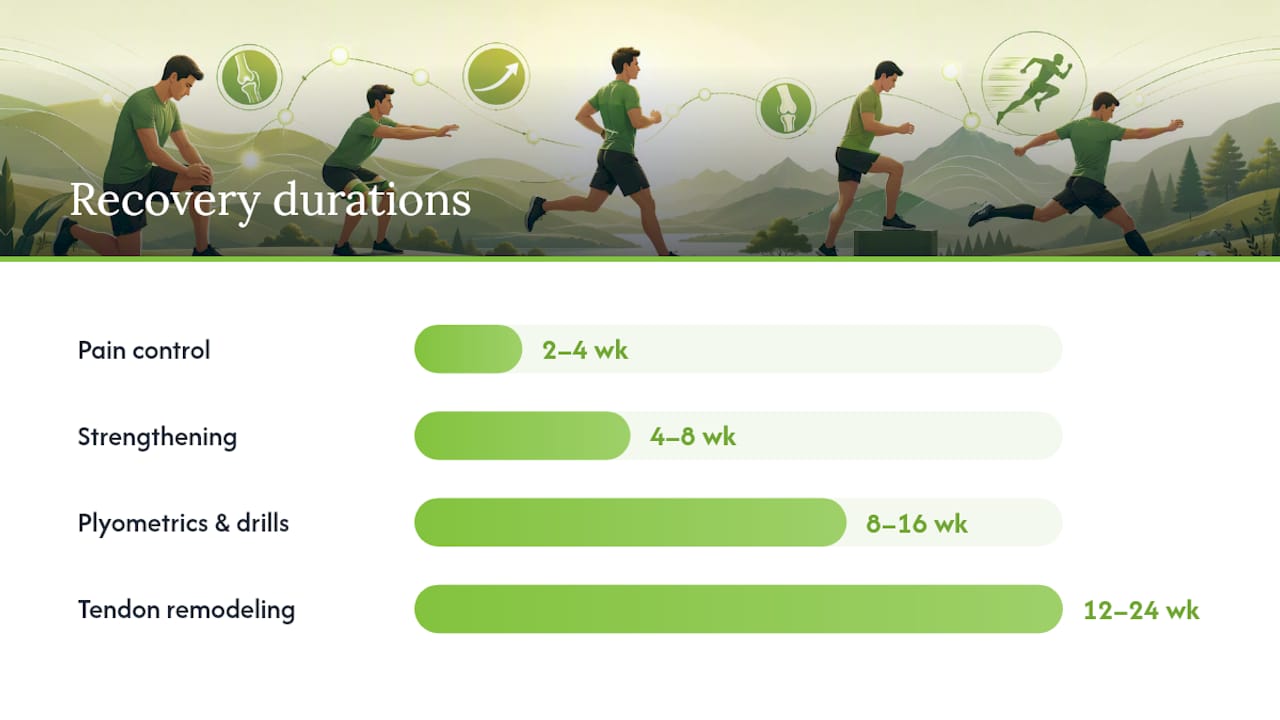
Patients want a date. I understand why, but patellar tendonitis doesn’t heal on a fixed calendar, it heals on a load-tolerance curve. Pain control often improves within the first 2 to 4 weeks of correct load management. Structural tendon remodeling, the actual biological change that makes the tendon more resilient, takes considerably longer, generally in the 12 to 24 week range, sometimes beyond that for higher-grade cases.
A staged return-to-sport framework helps make that timeline concrete:
- Weeks 1 to 4: Pain control and load management; begin isometric loading; reduce or eliminate provocative sport activity.
- Weeks 4 to 8: Progress into isotonic and heavy slow resistance strengthening as pain allows; reintroduce low-impact conditioning.
- Weeks 8 to 16: Introduce plyometric loading if single-leg squat pain stays at or below a 3 out of 10; begin sport-specific drilling at reduced intensity.
- Weeks 16 and beyond: Full sport-specific training, then graded return to competition once strength and provocation testing are symmetrical with the uninvolved side.
If there is no meaningful improvement after a consistent structured exercise program over several weeks, it is appropriate to re-evaluate the treatment approach rather than pushing forward blindly. That’s when adjuncts, PRP, or a deeper look at biomechanics and training load enter the conversation. Athletes returning to season-long sports benefit from thinking about this in the context of broader athletic career longevity planning, since rushing back too early is one of the most reliable ways to turn a manageable tendinopathy into a recurring, career-limiting problem.
Plateaus are common and usually explainable. The three culprits I see most often: inconsistent adherence to the loading program, an underlying biomechanical issue like poor hip control that keeps reloading the tendon the same way, and a training load that’s crept back up faster than the tendon can adapt. Fixing the plateau usually means addressing one of those three, not adding a new treatment.
How Does a Pain Clinic Approach Advanced Treatment Decisions?
At Nortex Spine and Joint, the pathway we follow with patients mirrors the evidence: structured PTLE first, with progress monitored over 12 to 24 weeks using functional tests and, when appropriate, the VISA-P questionnaire to track objective change rather than relying on how a patient feels on any given day. If that structured program doesn’t move the needle, we discuss PRP or ESWT as the next reasonable step, always framed as an addition to ongoing rehab, not a replacement for it.
Every plan gets individualized. A recreational runner in their 40s and a competitive jumping-sport athlete in their 20s might both have patellar tendinopathy, but their load tolerance, timeline pressures, and risk tolerance for advanced intervention look different, and the plan should reflect that.
If you’re evaluating a clinic for PRP or another regenerative option, a few questions are worth asking directly:
- What formulation of PRP do you use, and what’s the reasoning behind leukocyte-rich versus leukocyte-poor?
- How many injections are typically part of the protocol, and what does the rehab schedule look like afterward?
- How do you measure whether the treatment is working, beyond just asking about pain?
- What’s a realistic functional outcome, and by what point should I expect to see it?
Pro Tip: Bring your pain log and any prior imaging to your first advanced-treatment consultation. Providers can make far better decisions about PRP or ESWT candidacy when they can see your actual pain trend over time, not just a snapshot from one visit.
You can read more detail on how PRP therapy for tendonitis is used in cases that have plateaued on exercise alone.
What I Want You to Take From This
The evidence here is more consistent than a lot of orthopedic topics. Structured progressive loading beats eccentric-only programs, and it beats waiting around hoping rest alone will fix things. Give a well-built PTLE program a genuine 12 weeks before judging it. If it’s working, even slowly, stay the course toward the 24-week mark most trials use to measure real change.
If you’ve done that honestly and you’re still stuck, PRP has real evidence behind it for refractory cases, and ESWT is a reasonable option worth discussing. Surgery exists, but it’s for the minority who’ve exhausted everything else. Before any appointment, bring your training history, a pain log if you’ve kept one, and a clear list of what you’ve already tried. That single habit speeds up decision-making more than almost anything else you can do.
— Felix
Find a Path Forward With Nortexspineandjoint
If you’ve already tried rest, a strap, and a home exercise routine without lasting relief, Nortexspineandjoint offers what a generic home program can’t: a personalized plan that layers regenerative options onto structured rehab once conservative care has genuinely been given its chance. Rather than guessing at PRP formulations or ESWT timing on your own, you get an individualized assessment that tracks your functional progress and adjusts the plan around your actual response, not a one-size protocol.
Our regenerative medicine program is built for active adults and athletes whose patellar tendon pain hasn’t responded to standard conservative measures. If you’re at the point where you’re wondering whether PRP fits your case, schedule a consultation to review your history and discuss whether PRP therapy makes sense as your next step.
This article is general information, not a substitute for advice from a qualified doctor. Consult a qualified healthcare professional about your own circumstances before acting on anything here.
Sources
- Comparative meta-analyses reporting PRP efficacy in tendinopathy
- Effectiveness of progressive tendon-loading exercise therapy
FAQ
How long does it take for patellar tendonitis to heal?
Pain control often improves within 2 to 4 weeks of proper load management, but meaningful tendon remodeling typically takes 12 to 24 weeks or longer with a structured loading program.
Can you walk with a patellar tendon tear?
Walking is usually possible with a partial patellar tendon tear or tendinopathy, though pain and a sense of weakness with stairs or squatting are common; a complete rupture typically prevents active knee extension and needs urgent medical evaluation.
What are the symptoms of a patellar tendon injury?
Symptoms include localized pain at the bottom of the kneecap, pain with jumping or squatting, stiffness after rest, and in complete ruptures, an inability to straighten the knee or bear weight normally.
How long does it take to recover from a torn patellar tendon?
A partial tear managed conservatively often follows the same 12 to 24 week loading timeline as tendinopathy, while a complete rupture requiring surgical repair typically involves 4 to 6 months of rehab before sport-specific return, with full competitive return sometimes taking up to a year.
Is PRP a good treatment option for patellar tendonitis?
PRP, particularly leukocyte-rich formulations, ranks highly in network meta-analyses for functional improvement in refractory cases that haven’t responded to structured exercise, though it works best paired with ongoing rehab rather than used alone.