
Most patients pay a broad range for single-joint stem cell procedures in the United States, with full-body or multi-joint protocols costing significantly more. Insurance almost never covers these treatments, since payers still classify them as investigational. Before you commit to any clinic, ask for a written, itemized quote and confirm exactly where the cells come from and how they’re processed.
TL;DR:
- Costs for single-joint stem cell injections in the US typically range from a few thousand dollars, depending on the joint, cell source, and procedure specifics.
- Prices vary significantly based on whether cells are harvested autologously or are donor-derived, with lab expansion significantly increasing costs.
- Insurance almost never covers these treatments, which are classified as investigational, leading most patients to pay out of pocket through financing or savings.
- Comparisons of quotes require detailed breakdowns of cell source, lab processing, and included follow-up, as prices can differ due to clinic location, expertise, and treatment protocols.
- International options may be cheaper upfront but often involve hidden costs like travel, follow-up, and inconsistent safety standards, reducing overall savings.
Table of Contents
- How Much Does Stem Cell Therapy Cost in the US?
- What Drives the Cost of Stem Cell Injections?
- Does the Cost Vary by Cell Type: BMAC, Adipose, or Cord Tissue?
- Is Stem Cell Therapy Covered by Insurance?
- How Do You Compare Stem Cell Therapy Quotes?
- How Nortex Prices Stem Cell and Regenerative Treatments
- What Do Pre-Treatment Testing and Rehab Add to the Total Cost?
- What Happens If You Need Additional Treatments Later?
- Where Is Stem Cell Therapy Pricing Headed?
- Why the Cheapest Quote Is Rarely the Right Question
- Ready to Get a Real Quote for Your Condition?
- Sources
- FAQ
How Much Does Stem Cell Therapy Cost in the US?
You’ll see a wide spread of numbers when you start researching stem cell treatment pricing, and there’s a reason for that. A knee injection using your own bone marrow costs a fraction of what a multi-day systemic protocol for an autoimmune condition runs, and both get marketed under the same broad term. When patients come into our clinic asking “what does this actually cost,” we walk them through ranges based on the joint, the cell source, and the number of sessions rather than quoting a single number that doesn’t mean much on its own.
Simple orthopedic injections, meaning a single knee, shoulder, or hip treated with bone marrow aspirate concentrate (BMAC) or adipose-derived cells, typically cost several thousand dollars per session at most US clinics. Treating multiple joints adds to the cost without exactly doubling it, since some procedures share setup steps. Spine-related injections tend to be pricier due to the need for imaging guidance and precise placement.
Systemic or neurological protocols are a different category entirely. These involve larger cell doses, sometimes multiple infusions over several days, and often use donor-derived umbilical cord cells. Aggregated clinic pricing data indicates these protocols can cost tens of thousands, depending on the condition treated and number of infusion cycles involved, according to market summaries compiled by StemConnect.
Here’s what a typical single-knee quote might break down into common cost components including consultation, diagnostic imaging, harvest and lab processing, the injection procedure with imaging guidance, and follow-up visits, with prices varying by clinic and region.
Pro Tip: Ask every clinic whether their quoted price includes pre-procedure imaging and follow-up visits, or whether those get billed separately. That single question often explains a $2,000 gap between two quotes for the “same” treatment.
International clinics, particularly in Mexico, Panama, and parts of Asia, sometimes advertise lower sticker prices for stem cell procedures. Travel can make financial sense when a protocol is genuinely unavailable domestically or when a US price is unusually inflated. But once you factor in flights, lodging, and the reality that you’ll have no easy follow-up access if something feels off, the savings often shrink or disappear. We also see patients who traveled abroad for treatment come back needing US-based imaging and evaluation anyway, which adds cost they hadn’t budgeted for.
What Drives the Cost of Stem Cell Injections?
Two clinics can quote wildly different numbers for what sounds like the same procedure, and the gap almost always traces back to a handful of specific factors.
Cell source is the biggest one. Autologous procedures, where the clinic harvests cells from your own bone marrow or fat tissue, require in-office extraction time, physician skill, and same-day processing equipment. That labor and equipment cost gets built into the price. Donor-derived products, most commonly umbilical cord-derived mesenchymal stem cells, skip the harvest step but carry higher processing, testing, and cryopreservation fees before the product ever reaches the clinic.
Lab processing and cell dose matter more than most patients expect. A basic same-day centrifuge spin costs far less than a protocol requiring cell expansion, where a lab grows your harvested cells over several weeks in a GMP-certified facility to reach a higher dose. That expansion step is a major reason lab-expanded MSC protocols cost substantially more than same-day BMAC injections, since it requires specialized facilities and multi-week culture time before you ever get injected.
Physician expertise and image guidance add real value, and real cost. A board-certified physician using fluoroscopic or ultrasound guidance to place cells precisely into a joint space or disc charges more than a walk-in injection with no imaging. That’s not padding. Precision placement is often the difference between a treatment that helps and one that doesn’t, particularly for spine and deep joint work.
Regional overhead plays a role too. A clinic in a major metro area with higher rent and staffing costs will price differently than one in a smaller market, even for an identical protocol.
A few line items patients frequently overlook when comparing quotes:
- Lab work and bloodwork prior to treatment: $150 to $400
- Follow-up MRI to assess results: $300 to $1,500
- Physical therapy sessions after the procedure, often not included in the original quote
- Anesthesia or sedation fees for more invasive harvest sites
Pro Tip: If a quote seems unusually low compared to others you’ve gathered, ask directly what cell source and lab certification they’re using. The FDA has issued consumer alerts about unapproved regenerative products marketed without adequate safety evidence, and a suspiciously cheap price is sometimes a sign of exactly that.
Does the Cost Vary by Cell Type: BMAC, Adipose, or Cord Tissue?
It does, significantly, and understanding which category a quote falls into helps you figure out whether you’re comparing apples to apples.
PRP (platelet-rich plasma) sits at the low end, typically $500 to $2,000 per session. It’s not technically a stem cell therapy since it uses concentrated platelets from your own blood rather than stem cells, but clinics often present it alongside stem cell options because the logistics and goals overlap. For patients with mild to moderate joint degeneration, PRP is frequently the first step we recommend before considering a more expensive protocol, and you can read more about how PRP works for knee pain if you’re weighing the two.
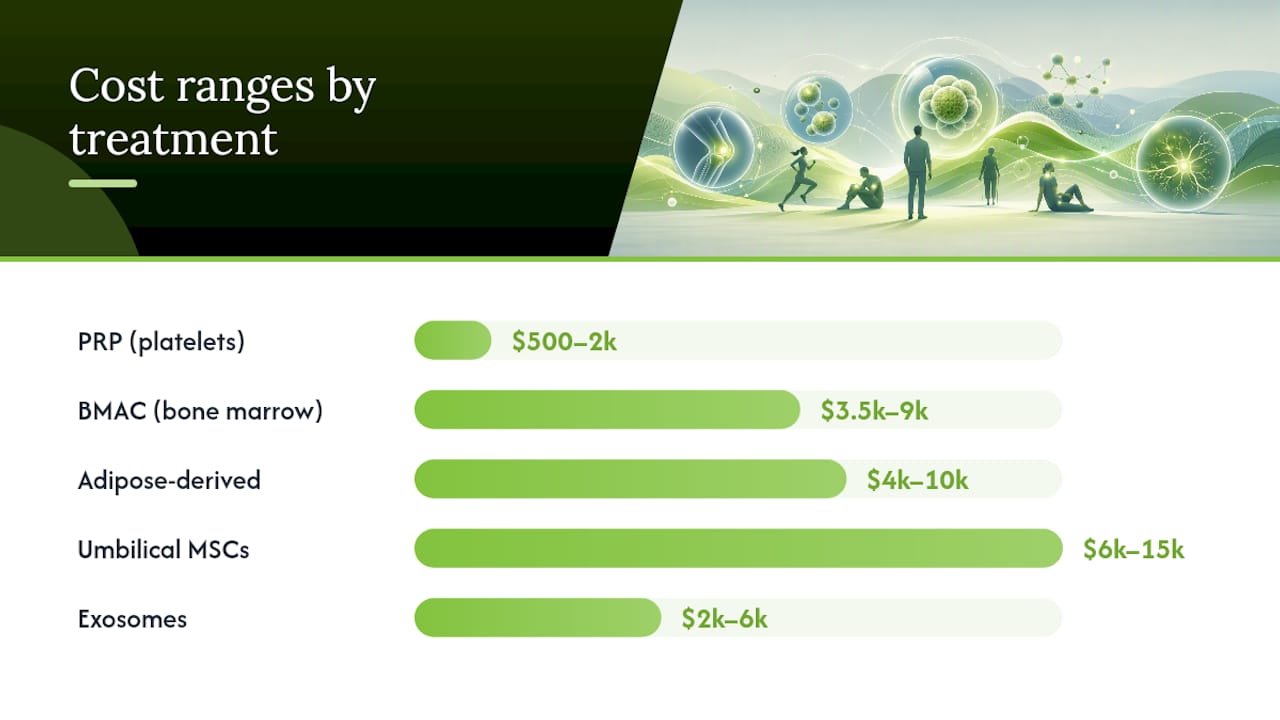
BMAC (bone marrow aspirate concentrate) runs $3,500 to $9,000 per joint. This involves drawing marrow, usually from the hip bone, spinning it down same-day, and re-injecting the concentrated cell fraction into the target area. It’s the most common autologous option for knee and hip osteoarthritis.
Adipose-derived cells come in a similar range, roughly $4,000 to $10,000, since fat harvest via mini-liposuction and same-day processing carries comparable lab costs to bone marrow, sometimes slightly higher depending on the extraction method.
Umbilical cord-derived MSCs typically cost $6,000 to $15,000 per infusion, and multi-infusion protocols push toward $25,000 or more. These are donor-derived, pre-processed products shipped to the clinic, which means no harvest procedure for you, but higher per-dose product cost.
Exosome therapy, which uses cell-signaling particles rather than whole cells, generally runs $2,000 to $6,000 per session. It’s newer, less standardized, and the evidence base is still developing, so pricing varies more clinic to clinic than with established protocols.
Lab-expanded MSC protocols, where harvested or donor cells are cultured for several weeks to multiply the dose before infusion, sit at the top of the range, often $20,000 to $50,000, because of the GMP facility time and quality testing involved.
Here’s a quick reference for typical per-session ranges:
| Procedure Type | Typical Cost Range | Cell Source |
|---|---|---|
| PRP | $500–$2,000 | Autologous (blood) |
| BMAC | $3,500–$9,000 | Autologous (bone marrow) |
| Adipose-derived | $4,000–$10,000 | Autologous (fat tissue) |
| Umbilical cord MSCs | $6,000–$15,000 | Donor-derived |
| Exosomes | $2,000–$6,000 | Donor-derived |
| Lab-expanded MSCs | $20,000–$50,000 | Autologous or donor, cultured |
Logistics matter as much as the label. A same-day harvest-and-inject procedure is a single visit. A donor-product infusion might require just one appointment since there’s no harvest step. A lab-expansion protocol, by contrast, means one visit to collect cells, a multi-week wait while the lab grows them, and a second visit to receive the infusion, which adds both time and cost most patients don’t anticipate going in.
Is Stem Cell Therapy Covered by Insurance?
For the vast majority of orthopedic applications, no. CMS and private insurers classify most regenerative orthopedic procedures as investigational, which means Medicare and standard health plans exclude them from routine coverage. That surprises a lot of patients who assume that because a treatment is legal and offered by a licensed physician, insurance should pay for at least part of it.
The one major exception is hematopoietic stem cell transplantation, used for specific blood cancers and disorders like leukemia and certain autoimmune conditions. Medicare’s national coverage determination does cover this procedure under defined criteria, and some allogeneic transplant uses are covered only through Coverage with Evidence Development, meaning the patient must be enrolled in a qualifying clinical study. That’s a completely different clinical category from the joint and spine injections most patients researching stem cell treatment pricing are actually asking about.
Given that reality, most patients pay out of pocket using one of these routes:
- HSA or FSA funds. IRS guidance confirms these tax-advantaged accounts can be used for eligible out-of-pocket medical expenses, and regenerative procedures generally qualify.
- CareCredit or similar medical financing. These third-party lenders offer payment plans, sometimes with promotional no-interest windows, specifically for elective medical procedures.
- Clinic-based payment plans. Many practices, including ours, offer structured payment options so the full cost doesn’t have to be paid upfront.
- Workers’ compensation, in cases where the injury is job-related and the treating physician documents medical necessity within that system’s guidelines.
If your injury resulted from an auto accident, personal injury protection or a liability claim sometimes covers regenerative treatment as part of a broader injury settlement, though this varies by case and by state.
How Do You Compare Stem Cell Therapy Quotes?
Getting quotes from two or three clinics only helps if the quotes actually cover the same ground. Use this checklist before you commit to a provider:
- Ask for a fully itemized quote, not a single bundled number. It should separately list the consultation, imaging, harvest or product acquisition, the procedure itself, and follow-up visits.
- Confirm the exact cell source. Is it your own bone marrow or fat, or a donor-derived product? Ask which lab processes it and whether that lab holds relevant accreditation.
- Ask how many cells you’re actually getting. Reputable clinics can tell you the approximate cell count or concentration in your injection; vague answers here are a red flag.
- Request the physician’s credentials and experience with the specific procedure you’re considering, not just general pain management experience.
- Ask what happens if the first treatment doesn’t work. Is there a reduced-cost second session, or are you paying full price again?
- Get the follow-up schedule in writing. How many visits are included, and for how long?
Pro Tip: If a clinic can’t produce a written treatment protocol or hesitates to explain their sterility testing process, that’s worth walking away from regardless of price. This is one area where the cheapest option and the safest option are rarely the same thing. For a broader framework on evaluating regenerative options, our guide to selecting regenerative treatments covers additional questions worth asking during a consultation.
How Nortex Prices Stem Cell and Regenerative Treatments
When patients come to us after researching stem cell therapy cost online, they usually arrive with a wide range of numbers and no clear sense of which one applies to them. Part of our job, before we ever discuss a procedure, is narrowing that range down to a real number based on their joint, their imaging, and their goals.
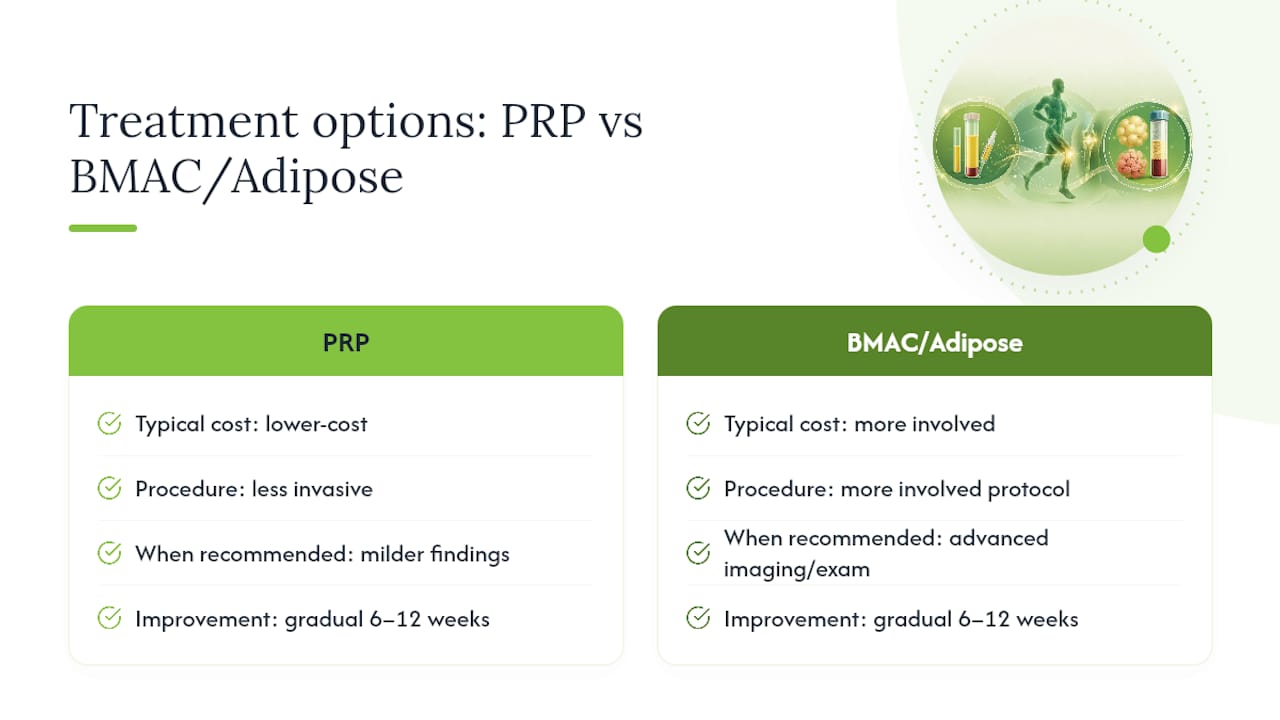
Our itemized quotes lay out the consultation, imaging review, the procedure, and the follow-up schedule as separate line items, so you know exactly what you’re paying for and what happens after the injection. Treatment options may include PRP and stem cell therapies depending on your imaging and exam findings, with guidance on which candidates suit a lower-cost PRP approach versus a more involved BMAC or adipose protocol. You can review our stem cell treatment page for more detail on how we structure these protocols.
We also set realistic timelines. Most patients see gradual improvement over 6 to 12 weeks following an orthopedic stem cell injection, not overnight relief, and we build follow-up visits into the plan specifically to track that progress and adjust care if needed. Some patients ask whether they should try conservative options first, like physical therapy or red light therapy for arthritis before considering a stem cell procedure. In many cases, we recommend exactly that, since a less expensive intervention sometimes resolves the issue without the added cost of a regenerative procedure at all.
For payment, we work with patients on financing options and HSA/FSA use, and we’re upfront about what a protocol is realistically likely to accomplish before you commit financially.
What Do Pre-Treatment Testing and Rehab Add to the Total Cost?
The procedure itself is rarely the only cost. Before any injection, most reputable clinics require diagnostic imaging, either X-ray or MRI, to confirm the treatment target and rule out conditions that stem cells won’t fix, like a full-thickness tear that needs surgical repair. If you don’t already have recent imaging on file, expect to add $300 to $800 for this step.
Baseline bloodwork, checking for clotting issues or active infection, typically runs $150 to $400 and is a standard safety step before any injection procedure, not an optional upsell.
After treatment, rehabilitation is where costs quietly accumulate. Physical therapy following a joint injection is common, and it’s often not bundled into the original procedure price. A typical course of PT for a knee or shoulder runs $75 to $200 per session, and many patients need 6 to 12 sessions over two to three months to support the tissue changes the injection is meant to encourage. That can add $500 to $2,000 to your real total cost, money that patients frequently don’t budget for when they’re only looking at the headline procedure price.
Follow-up imaging to assess whether the treatment worked, usually an MRI three to six months out, adds another $300 to $1,500. When you’re comparing quotes, ask whether any of this is included, because “the procedure costs $6,000” and “the total cost of care is $6,000” are often two very different numbers.
What Happens If You Need Additional Treatments Later?
Stem cell injections don’t always work on the first try, and that possibility deserves honest budgeting, not just optimism. Peer-reviewed evidence on orthopedic regenerative procedures remains mixed, with outcomes varying significantly by protocol, cell dose, and the specific condition being treated. Some patients get substantial relief from a single session. Others see partial improvement and need a second injection to reach a meaningful result.
If a first treatment falls short, you’re generally looking at either a repeat injection, which some clinics discount but many charge full price for again, or a shift toward a more invasive option like surgery. That’s a cost consideration worth raising during your initial consultation: ask directly what the plan is if the first round doesn’t deliver the improvement you’re hoping for.
Complications from stem cell injections are uncommon when performed by an experienced physician with proper imaging guidance, but they’re not zero. Infection at the injection site, though rare, can require antibiotic treatment or, in serious cases, additional procedures. Patients who pursue unregulated or poorly sourced products, particularly through clinics that skip proper sterility testing, face a higher risk of complications that can add thousands of dollars in unplanned care. This is precisely why the FDA’s warnings about unapproved regenerative products matter for your wallet as much as your health. A cheap procedure that leads to a complication is rarely actually cheap.
Where Is Stem Cell Therapy Pricing Headed?
Prices for orthopedic stem cell procedures have held relatively steady over the past few years, but a few forces are worth watching if you’re planning treatment further out.
Lab processing technology continues to improve, and as cell expansion techniques become more efficient, the cost gap between same-day procedures and lab-expanded protocols may narrow somewhat, though expansion will likely remain the pricier option given the facility and time requirements involved. Increased competition among US clinics in larger metro markets has also put mild downward pressure on pricing for standard BMAC and adipose procedures, as more practices now offer these treatments than five years ago.
On the regulatory side, the FDA continues to tighten enforcement around unapproved regenerative products, which may push some lower-cost, less rigorous clinics out of the market or force them into compliance, potentially narrowing the bottom end of the price range as the cheapest, least-regulated options become harder to find. Whether broader insurance coverage ever materializes remains uncertain. Given how payers currently classify these procedures, meaningful coverage expansion isn’t something patients should plan their budget around in the near term.
Why the Cheapest Quote Is Rarely the Right Question
The question most patients ask, “what’s the lowest price I can find,” is understandable but slightly off target. The better question is what you’re actually getting for that price, because a $3,500 BMAC injection with proper imaging guidance and a documented follow-up plan often delivers more value than a $2,000 injection with none of that structure.
Conventional advice on this topic tends to treat stem cell therapy cost as a single number to shop around for, the same way you’d compare prices on a commodity. It isn’t one. The wide range you’ll see across clinics reflects real differences in cell source, lab quality, physician skill, and what’s actually included in the quote. Chasing the lowest sticker price without understanding those differences is how patients end up paying twice, once for a treatment that underdelivers, and again for whatever comes next.
If there’s one thing worth prioritizing above all else, it’s asking for the itemized breakdown before you ask about the total. Once you can see what’s actually inside the price, you can judge whether it’s fair, not before.
— Felix
Ready to Get a Real Quote for Your Condition?
If you’re weighing stem cell therapy against a lower-cost option, Nortexspineandjoint gives North Dallas patients a clear, itemized path forward instead of a vague estimate pulled from a phone call. We evaluate your imaging and history first, then walk you through whether PRP, a stem cell protocol, or a combination approach fits your condition and your budget, rather than defaulting to the most expensive option on the menu. Our regenerative medicine program covers both PRP and stem cell therapies under one evidence-based framework, so you’re comparing real options, not marketing claims. If cost is a deciding factor, ask us directly about payment plans and HSA/FSA options during your consultation. Schedule an evaluation at our stem cell therapy page to get a written, itemized quote specific to your joint and your goals, serving patients across Allen, Garland, McKinney, and Plano, Texas.
This article is general information, not a substitute for advice from a qualified doctor. Consult a qualified healthcare professional about your own circumstances before acting on anything here.
Sources
Before scheduling anything, it’s worth reviewing primary sources directly rather than relying solely on clinic marketing. CMS’s Medicare coverage guidance confirms what’s actually reimbursable. The FDA’s consumer alert explains the safety concerns behind unapproved products. And peer-reviewed studies on regenerative orthopedic outcomes give you an honest read on evidence quality, separate from any clinic’s marketing claims.
- FDA consumer alert: regenerative medicine products including stem cells and exosomes
- PMC article (example review of regenerative orthopedics)
- StemConnect — Stem Cell Therapy cost summaries and clinic-sourced ranges
- IRS Publication 969: Health Savings Accounts and other tax-favored health plans
FAQ
Is Stem Cell Therapy Worth the Money?
It depends on your condition, the protocol, and how the clinic sources its cells. Evidence for orthopedic uses is promising but still developing in many trials, so it’s worth pairing a strong clinical evaluation with realistic expectations rather than assuming a guaranteed fix.
How Long Do Stem Cell Injection Results Typically Last?
Many patients report meaningful relief for one to two years following a well-performed injection, though results vary based on the joint, the severity of degeneration, and the cell dose used. Some patients need a repeat session to maintain results long term.
Which Country Is the Most Affordable for Stem Cell Therapy?
Countries like Mexico and Panama often advertise lower procedure prices than US clinics, but travel costs, limited follow-up access, and inconsistent regulatory oversight can offset those savings. For most patients, a domestic clinic with transparent, itemized pricing offers better overall value once you factor in the full picture.
Which Conditions Can Stem Cells Actually Treat?
Hematopoietic stem cell transplantation is an FDA and CMS recognized treatment for specific blood cancers and disorders. Orthopedic applications, like knee and hip osteoarthritis or tendon injuries, show encouraging results in many patients but remain investigational rather than a cure, and outcomes vary by individual case.
Does Nortex Offer Financing for Stem Cell Treatment?
Yes, Nortex provides itemized quotes and payment plan options, and patients commonly use HSA or FSA funds toward the cost since most orthopedic stem cell procedures fall outside standard insurance coverage.