
Most people with hip osteoarthritis can start with, and often stay with, treatment that does not involve an operation. Current guidance describes a combined plan: structured exercise and physical therapy, weight management when it applies, carefully chosen medicines, and image-guided injections when pain keeps you from moving. Our role at Nortex Spine and Joint is to build that plan around your hip, your schedule and your goals, and to offer PRP (platelet-rich plasma) and other regenerative options when they fit. This guide explains each layer in plain terms so you know what to expect at every stage.
TL;DR
- Non-operative care is the first-line approach for hip osteoarthritis, and it works best as a combination rather than a single treatment, according to a 2026 review of early hip OA.
- Exercise, physical therapy and, where relevant, weight loss form the base of every plan. Guidelines from the VA/DoD, the ACR and EULAR all point there.
- Anti-inflammatory medicines and image-guided corticosteroid injections can ease pain, but they are tools for symptom control and are best paired with strengthening.
- PRP is an autologous option, meaning it is made from your own blood, and we offer it for hip arthritis in our North Dallas clinics.
- Surgery stays on the table for later. Talking about it is not a failure of conservative care.
Table of Contents
- What hip osteoarthritis is and how it is diagnosed
- The foundation: exercise, physical therapy and weight
- Medicines for hip osteoarthritis
- Injections: what they can and cannot do
- Our perspective
- Putting a plan together
- When non-surgical care may not be enough
- Starting care in North Dallas
- FAQ
- Sources
What hip osteoarthritis is and how it is diagnosed
Osteoarthritis is the gradual wearing of the cartilage that cushions the ball-and-socket hip joint. According to the American Academy of Orthopaedic Surgeons (AAOS) patient guide, there is no single cause, but risk factors include increasing age, family history, a previous hip injury, obesity and developmental dysplasia of the hip, a condition in which the socket is shallow from birth.
The typical symptom is slowly progressive pain in the groin or thigh that can travel to the buttock or knee. Many people also notice morning stiffness, a catching or locking sensation, grinding, and a shorter stride that turns into a limp. Because hip pain often shows up in the knee or low back, we see patients who have spent months treating the wrong area.
Diagnosis combines a history, a physical exam and imaging. The exam checks tenderness, active and passive range of motion, crepitus (the grinding feeling) and how you walk. An X-ray then shows whether the joint space has narrowed and whether bone spurs, called osteophytes, have formed, per the same AAOS source. Seeing the X-ray together with your exam matters, since the picture and the pain do not always match.
The foundation: exercise, physical therapy and weight
If you take one thing from this article, take this: the treatments with the strongest agreement across guidelines are not injections. They are movement and load management.
Exercise and physical therapy
The June 2026 VA/DoD clinical practice guideline suggests a structured physical therapy program for hip and knee osteoarthritis. It describes an individualized plan that includes walking or cycling, regular self-directed exercise such as strengthening, yoga or tai chi, and weight reduction when appropriate. The 2019 ACR/Arthritis Foundation guideline strongly recommends exercise for hip osteoarthritis.

The AAOS guidance, summarized by the American Family Physician journal in 2025, moderately recommends physical therapy for mild-to-moderate hip osteoarthritis. About half of the studies it reviewed showed significant improvement in pain and function over controls, and none suggested that therapy made outcomes worse.
Many patients arrive worried that strengthening will grind the joint down further. The VA/DoD work group notes the same belief is common. Guided, progressive exercise is not the same as pushing through pain, and a therapist can adjust the dose to your joint. The ACR panel also points out that the evidence does not favor one specific exercise over another, so the best program is the one you can do consistently. That is why our physical therapy program is built around what you can realistically attend and continue at home.
A reasonable starting framework looks like this:
- Low-impact aerobic activity such as walking, cycling or water exercise, a few days a week.
- Strengthening for the glutes, hip abductors, quadriceps and core, progressed gradually.
- Flexibility and balance work, including yoga or tai chi if you enjoy them.
- Activity pacing: you adjust volume on flare-up days instead of stopping altogether.
Weight management
If extra body weight is part of your picture, the ACR/Arthritis Foundation guideline strongly recommends weight loss for people with hip osteoarthritis. It reports a dose-response pattern: losing at least 5% of body weight is linked to clinical improvement, and benefits grow at 5 to 10%, 10 to 20% and above 20%, especially alongside exercise. For a 200-pound person, 5% is 10 pounds, a goal that is reachable and meaningful.
Daily changes that add up
The EULAR 2023 recommendations, published in 2024, call for an individualized plan that combines education, exercise, weight management, footwear and walking aids, work-related advice and behavior-change techniques. Combining these produced larger effects on pain and function than single treatments. A cane in the hand opposite the painful hip, supportive shoes and a change in how you sit at work are small adjustments, yet they reduce load on the joint every day.
Medicines for hip osteoarthritis
Medication is meant to get you comfortable enough to exercise, not to replace the exercise.
- Oral NSAIDs (nonsteroidal anti-inflammatory drugs, such as ibuprofen or naproxen): the AAOS 2024 guideline update includes a strong recommendation that oral NSAIDs be used to reduce pain and improve function in symptomatic hip osteoarthritis. The AAFP summary notes no single NSAID is preferred and that they should be avoided in chronic kidney disease or cardiac disease.
- Acetaminophen: the VA/DoD pocket card lists it at the lowest effective dose, with a maximum of 4 g a day. The AAOS summary says it can be considered when there is no liver disease.
- Duloxetine: the same pocket card lists it as an alternative or add-on when first-line medicines are not enough or cannot be used.
- Opioids, including tramadol: guidance advises against starting them for hip osteoarthritis because of documented harm, per the AAFP summary and the July 2026 Defense Health Agency announcement of the revised VA/DoD guideline.
If you have kidney disease, heart disease, stomach ulcers or take blood thinners, speak with your physician before using NSAIDs. We review your medication list and medical history at your visit, since the safest option differs from one person to the next.
Injections: what they can and cannot do
Corticosteroid injections
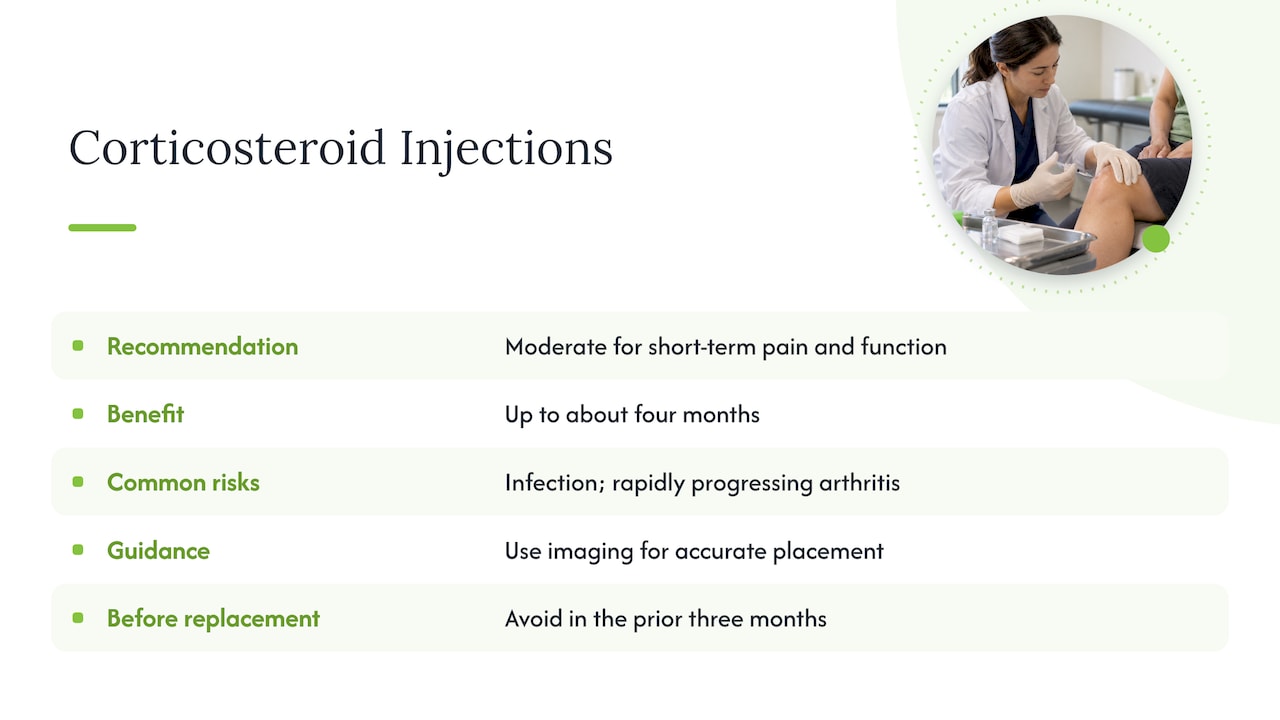
A corticosteroid injection places a strong anti-inflammatory medicine inside the joint. The AAOS guidance gives intra-articular corticosteroids a moderate recommendation for short-term improvement in pain and function, with benefit documented for up to about four months. The same summary names infection and rapidly progressing arthritis as the most common risks. A 2023 review of non-operative options stresses that hip injections should be done under imaging guidance so the needle lands accurately, and the VA/DoD pocket card says the same and advises avoiding a hip steroid injection in the three months before a joint replacement.
In practice, this means a steroid injection is best used as a window: a period of lower pain in which you can strengthen and walk more. We perform hip injections with ultrasound guidance; our article on ultrasound-guided hip injections explains what the visit involves. If you want the trade-offs in more detail, see our pieces on steroid injections for arthritis and steroid injection side effects.
PRP and regenerative care
Many patients come to us after trying several treatments: anti-inflammatories that wear off, one or two steroid injections that helped for a while, and then a plateau. For them, the question becomes whether something can support the joint itself rather than only quiet the pain.
PRP is one answer we offer. It is prepared from a sample of your own blood, concentrated so the platelets, which carry growth factors, are delivered into the hip under image guidance. Because it is autologous, it uses your own biological material. Our dedicated page on PRP therapy for hip arthritis covers how we select patients, and our article on PRP for hip osteoarthritis goes through the research. Our broader regenerative medicine program sits alongside PRP, and stem cell therapy is described on its own page.
What we tell every patient is that PRP is not a guarantee and not a substitute for strengthening. It is one component of a plan, and the response varies from person to person. Timelines are gradual: biologic treatments are typically judged over weeks to months, not days. Pairing an injection with physical therapy gives the joint the best chance to benefit from the pain relief.
Our perspective
Hip osteoarthritis is rarely solved by one injection or one pill. When we sit down with a patient, we start by asking what they have already tried, what they can no longer do, and what they want back, whether that is a round of golf, a long walk or a full day on their feet at work.
Our approach is to build a customized non-surgical plan: a physician evaluation with imaging, a physical therapy program that matches the findings, and, where it fits, an image-guided injection such as PRP. Our physicians are Harvard fellowship-trained and board-certified, and we offer advanced therapies that are not widely available at other local clinics. We think that combination, careful diagnosis and a layered plan, serves people better than treating the pain alone.
We also believe in being direct about expectations. Progress is usually gradual, it depends on how consistently you move, and it is judged by what you can do rather than by a number on a pain scale alone.
Felix
Putting a plan together
Here is how a typical sequence might unfold. Your own path may differ, and your physician sets the pace.
- Evaluation. History, exam and X-rays to confirm that the hip, and not the spine or knee, is the main source of pain.
- Weeks 0 to 12: foundation. Supervised therapy plus a home program, activity pacing, weight goals where relevant and, when appropriate, an NSAID or acetaminophen.
- If pain blocks progress: targeted injection. An image-guided corticosteroid injection can create a window for rehabilitation. Some patients, particularly those who want to avoid repeated steroid exposure, discuss PRP instead.
- Review. We look at function, not only pain: walking distance, stairs, sleep, getting in and out of the car.
- Adjust. Add, change or stop treatments based on that review.
Some patients also ask about supportive therapies such as light-based treatment. We offer red light therapy as part of our services, and you can read more about red light therapy for arthritis and bone health as background. It fits best as an addition to exercise and medical care, not a replacement.
When non-surgical care may not be enough
Even a well-run conservative plan has limits. The 2026 early hip osteoarthritis review notes that when conservative management fails, surgery may be considered. For select patients, hip-preservation procedures such as arthroscopy or peri-acetabular osteotomy (a procedure that repositions the socket) can delay or avoid replacement, and success depends on age, severity and baseline function.
Bring up other options with your physician if:
- pain wakes you at night or is present at rest;
- your walking distance keeps shrinking despite consistent therapy;
- you need escalating medication to function;
- imaging shows advanced joint damage and your goals are no longer being met.
Call your doctor promptly for sudden severe hip pain after a fall, inability to bear weight, fever with a hot swollen joint, or new numbness or weakness in the leg. These are not routine arthritis flare-ups.
One point of timing: if you are already planning a hip replacement, tell us, because injections of steroid are generally avoided in the three months before surgery.
Starting care in North Dallas
If hip pain is limiting your work, training or daily routine, we can evaluate your hip, review your imaging and outline a non-surgical plan that fits your life. Our team sees patients in Allen, Garland, McKinney and Plano. Start with our PRP therapy page or see all treatments, then book a consultation. We accept cash and insurance, and coverage varies by plan, so our team can walk you through your options at scheduling.
FAQ
Can hip osteoarthritis be reversed without surgery?
Cartilage that has worn away does not grow back on its own, and no guideline promises reversal. What conservative care can do is reduce pain, improve strength and function, and slow the pace at which symptoms limit you. Many people feel substantially better with a consistent plan.
What is the best exercise for hip arthritis?
Guidelines do not name one best exercise. The ACR panel found the evidence insufficient to favor one form over another, so the best choice is a low-impact routine you can keep doing: walking, cycling, water exercise, hip strengthening, yoga or tai chi. A physical therapist can tailor the dose and progression to your hip.
How long do hip injections last?
For corticosteroid injections, the AAOS guidance describes benefit for up to about four months. Response varies from person to person, and a regenerative injection such as PRP is generally assessed over a longer period. Your physician can tell you what to expect for your joint.
Do I need to stop exercising when my hip flares?
Usually you reduce, not stop. Cutting the volume or switching to lower-impact movement keeps the joint conditioned, whereas complete rest tends to leave the hip weaker. If pain is severe or sudden, see a physician.
Sources
- Hip Osteoarthritis, OrthoInfo (AAOS)
- Evaluation and management of early hip osteoarthritis (2026)
- VA/DoD clinical practice guideline for non-surgical management of osteoarthritis (2026)
- VA/DoD osteoarthritis pocket card (2026)
- 2019 ACR/Arthritis Foundation osteoarthritis guideline
- EULAR recommendations for non-pharmacological core management of osteoarthritis, 2023 update
- Hip Osteoarthritis: Guidelines From the AAOS, American Family Physician (2025)
- AAOS updates hip osteoarthritis guideline (2024)
- Non-operative treatment options for osteoarthritis (2023 review)
- Updated recommendations for hip and knee osteoarthritis, Defense Health Agency (2026)
- Red light therapy for arthritis and bone health