
Most herniated discs get better without surgery. The American Association of Neurological Surgeons (AANS) says most herniated discs do not require surgery, and symptoms improve in about 9 out of 10 people. The real question is which non-surgical steps to take, in what order, and when a more targeted option such as an image-guided injection or a regenerative treatment makes sense. At Nortex Spine and Joint, our board-certified, Harvard fellowship-trained physicians build non-surgical plans around exactly that sequence, and this guide walks you through it.
TL;DR
- Most herniated discs improve with conservative care, usually over weeks to months, and surgery is not the default.
- First-line care is staying gently active, short-term anti-inflammatory medication, and physical therapy built around your symptoms, not bed rest.
- If leg or arm pain persists beyond about four to six weeks, a spine specialist visit and imaging are reasonable next steps, and epidural steroid injections can calm a pinched nerve.
- PRP is being studied as an injection option for disc-related pain, and we offer it alongside rehabilitation and other non-surgical procedures.
- Weakness, numbness in the groin or rectum, or loss of bladder or bowel control needs emergency evaluation the same day.
Table of Contents
- What a herniated disc is, and why it hurts
- Can a herniated disc heal without surgery, and how long does it take?
- The first weeks: what to do and what to avoid
- Physical therapy: the backbone of non-surgical care
- Medication: what helps and what does not
- Epidural steroid injections: when they make sense
- PRP and regenerative options for disc-related pain
- Choosing your next step
- Our perspective
- Where to start in North Dallas
- FAQ
- Sources
What a herniated disc is, and why it hurts
The discs between your vertebrae work as cushions. Each has a tough outer ring and a softer, gel-like center. A herniation happens when some of that center pushes through a weak spot in the outer ring. The pain comes from two sources: the mechanical change in the disc, and the chemical inflammation that irritates a nearby nerve root. When the irritated nerve runs into your leg, the result is sciatica, meaning pain, tingling or numbness that travels down the leg. In the neck, the same process can send symptoms into the shoulder, arm or hand.
A “bulging” disc and a herniated disc are related. In a bulge, the outer ring stays intact but extends beyond its normal border. In a herniation, the ring has torn and the inner material has escaped. Both are very common findings on MRI, and plenty of people with them have little pain, which is why treatment is guided by your symptoms and exam, not by the picture alone. You can read more in our overview of lower back pain and herniated discs.
Can a herniated disc heal without surgery, and how long does it take?
Yes, and the timeline is usually longer than people hope but shorter than they fear. The AANS describes improvement ranging from a few days to a few weeks for most people. MedlinePlus, from the U.S. National Library of Medicine, says pain, numbness or weakness often goes away or improves a lot over weeks to months, and that returning to all activities without pain or strain can take several months to a year or more.
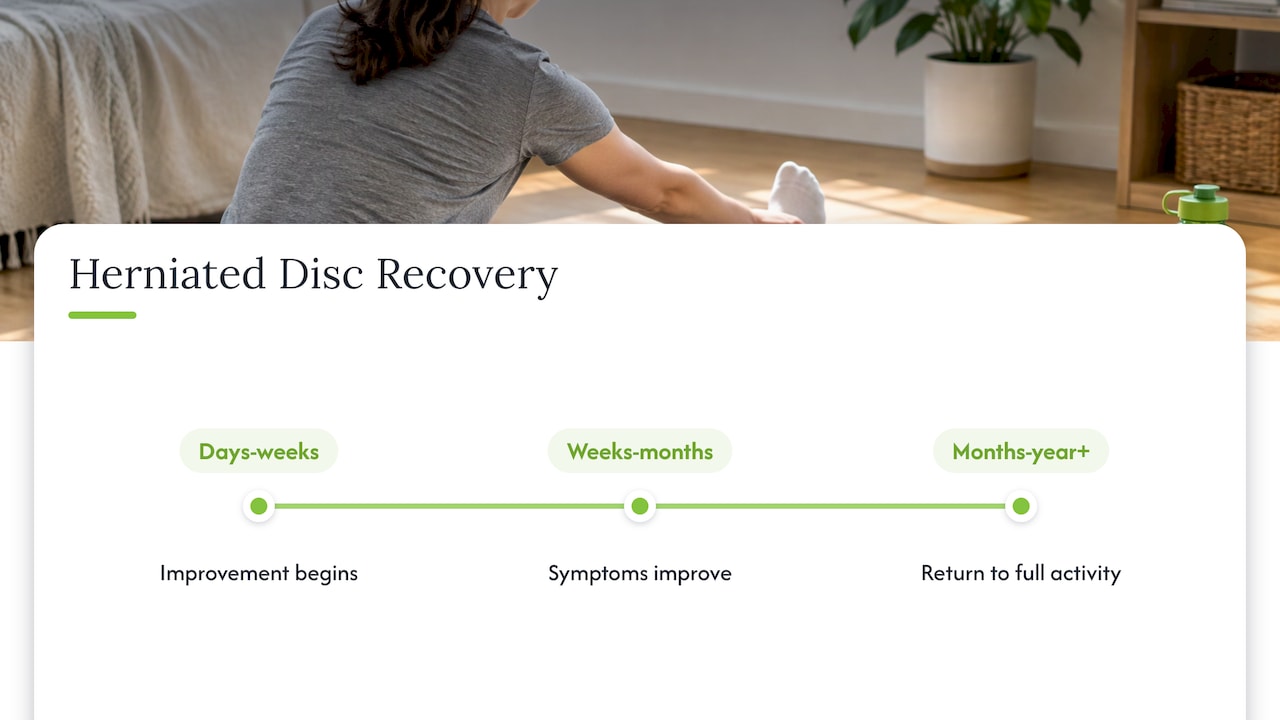
That range matters for planning. If you are two weeks in and still sore, you are inside the normal curve. If you are six weeks in and the leg pain is not easing, or it is getting worse, that is the point to stop waiting and get a proper evaluation.
The World Federation of Neurosurgical Societies Spine Committee reached a similar conclusion in its 2024 recommendations: when there is no cauda equina syndrome, significant weakness or other serious neurologic deficit, conservative treatment should be the first-line approach for lumbar disc herniation.
The first weeks: what to do and what to avoid
The early guidance is simpler than most people expect.
- Limit aggravating activity for two to three days, then keep moving. The AANS advises walking as tolerated and notes that bed rest is not recommended. A review of treatment guidelines in e-Neurospine found that bed rest scored zero across guidelines.
- Use an over-the-counter anti-inflammatory if it is safe for you. The American Academy of Pain Medicine lists a short course of OTC NSAIDs and low-impact activity among its recommendations for acute low back pain, and also advises against opioids as an initial treatment. If you have kidney disease, stomach ulcers, or take blood thinners, ask your physician before taking NSAIDs.
- Try heat. Superficial heat is part of the same AAPM guidance and costs nothing.
- Skip early imaging unless there is a reason. The American Academy of Pain Medicine notes that routine early imaging does not improve pain, function or recovery in uncomplicated acute low back pain. The AANS adds that the American College of Radiology does not recommend MRI unless symptoms have lasted six weeks.
- Book a spine specialist if symptoms last beyond four weeks. That is the AANS threshold for referral.
Symptoms that should not wait
Go to an emergency department the same day if you have significant weakness in a leg or arm, numbness in the genital or rectal area, loss of control of urine or stool, or neurologic symptoms that are getting steadily worse. The AANS lists these as reasons for urgent evaluation. They can signal serious nerve compression that needs prompt treatment. Our guide to the warning signs of spine problems covers the broader picture.
Physical therapy: the backbone of non-surgical care
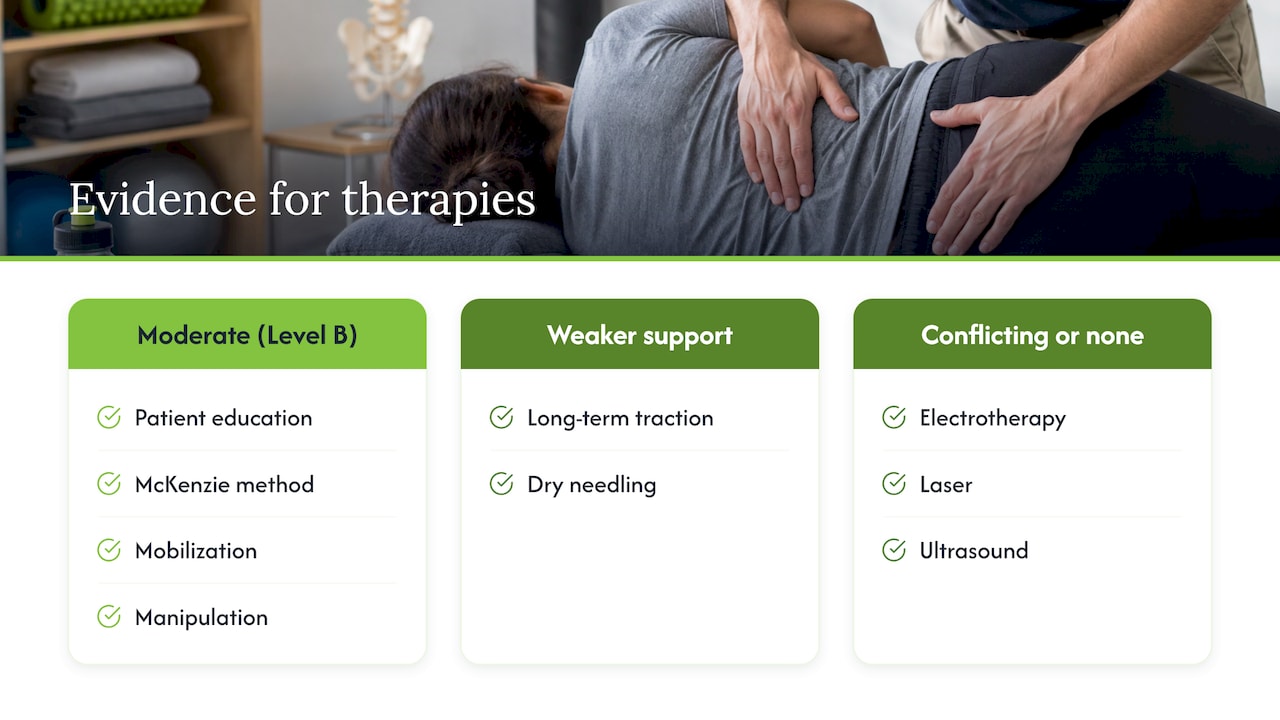
Exercise-based care has the best-supported role after the first few days. A 2024 review by El Melhat and colleagues rated moderate (Level B) evidence for patient education, the McKenzie method, mobilization and manipulation, exercise therapy, short-term traction, neural mobilization and epidural injections in lumbar disc herniation with radiculopathy. Long-term traction and dry needling received weaker support, and electrotherapy, laser and ultrasound had conflicting or no supportive evidence in that review.
The McKenzie approach deserves a quick explanation. It uses repeated back-extension movements and posture changes, and the WFNS recommendations note these can improve low back pain by shifting disc material forward, away from the nerve. The same source cautions that repeated flexion, such as deep forward bending and sit-ups, may aggravate disc-related pain. This is why generic “back stretches” from the internet sometimes make a herniation worse: the right movement depends on which direction your symptoms respond to.
That is the practical argument for supervised rehabilitation. A therapist can test your response movement by movement, adjust the program as the nerve calms down, and progress you from pain control to strength and endurance. Our physical therapy program is part of the same clinic as our injection and regenerative services, so your rehabilitation and procedural options are planned together.
What about massage, heat, ice and chiropractic care?
The 2024 American Family Physician review of chronic low back pain lists counseling, exercise, spinal manipulation, massage, heat, acupuncture and physical therapy among first-line nonpharmacologic options. Massage can ease muscle guarding around a painful disc and help you tolerate movement. It does not move a herniation back into place, so treat it as a comfort measure that supports your rehabilitation, not as the whole plan.
Heat relaxes tight muscles. Ice can take the edge off a flare. Neither changes the disc itself, but both help you stay active, which is what the evidence favors. Traction is one to approach carefully: the WFNS notes that it improves pain only temporarily and carries risks such as nerve injury in some cases, so it should be supervised and used selectively.
Medication: what helps and what does not
For disc-related pain, anti-inflammatory drugs are the usual starting point. The WFNS states that NSAIDs may significantly improve acute low back and sciatic pain caused by disc herniation. The 2026 American Family Physician review of acute low back pain also lists NSAIDs as first-line, and says benzodiazepines, gabapentin, pregabalin, opioids and acetaminophen should not routinely be used for acute low back pain.
Oral steroids are a common request, but the evidence is not supportive: AFP rated systemic steroids as no better than placebo for acute lumbar disk herniation. If you have been given one or more medications and still hurt, that is useful information for your physician, because it points toward treatments that act directly at the nerve.
Epidural steroid injections: when they make sense
An epidural steroid injection places anti-inflammatory medication near the irritated nerve root, in the space around the spinal sac. It is aimed at leg or arm pain from a pinched nerve, and it is designed to quiet inflammation so you can participate in rehabilitation.
Here is what the evidence says, in plain terms:
- A June 2025 systematic review of treatment guidelines found short-term transforaminal, caudal and interlaminar epidural steroid injections strongly recommended across guidelines, while long-term repeated use was not recommended.
- AFP reports that these injections modestly improve short-term pain and that radiologic guidance improves effectiveness compared with unguided injections.
- The WFNS describes injections as beneficial in selected patients and useful for people with significant comorbidities or who wish to avoid surgery.
So the realistic expectation is a window of relief, often measured in weeks to months, during which the nerve settles and therapy becomes easier. It is not a one-shot cure, and we would not describe it as one.
Insurers usually have criteria. One national plan’s policy requires radicular pain unresponsive to at least four weeks of conservative treatment, plus imaging or electrodiagnostic evidence of nerve root involvement before it considers an epidural steroid injection medically necessary. Plans differ, so confirm yours.
Safe-use notes
In April 2014 the FDA warned that corticosteroid injection into the epidural space may result in rare but serious adverse events, including loss of vision, stroke, paralysis and death, and that corticosteroids are not FDA-approved for epidural use. Tell your physician about any blood thinners, active infection, pregnancy, diabetes, or prior reactions to steroids or contrast dye before an injection. Our pages on steroid injection side effects and what to know about epidural steroid injections explain what to expect afterward.
We perform lumbar transforaminal, caudal and cervical epidural steroid injections, so the approach can be matched to where your disc is herniated.
PRP and regenerative options for disc-related pain
Platelet-rich plasma (PRP) is made from a sample of your own blood, concentrated so that it holds a higher proportion of platelets, which carry growth factors involved in tissue repair. Because the material is autologous, meaning it comes from you, it is a natural fit for people who want to avoid both surgery and repeated steroid exposure.
A January 2025 review in the Journal of Clinical Medicine summarized the regenerative literature. A randomized controlled study it describes found no differences between PRP and steroid groups over one year in pain scores, disability index and physical function, suggesting PRP as a possible safer alternative. The same review notes that a meta-analysis of randomized trials, covering 131 patients, found PRP significantly reduced pain scores and improved satisfaction without an increase in adverse events. The authors also call for a unified, standardized protocol as the field matures, which is a reasonable goal and one reason technique and patient selection matter.
At Nortex, PRP therapy, PRP for chronic back pain and stem cell therapy for spinal discs are part of our regenerative medicine services. These are generally considered after the early conservative steps, for people whose pain persists or keeps returning.
Choosing your next step
Use the table as a rough guide for the conversation with your physician. It is not a substitute for an exam.
| Where you are | Reasonable focus |
|---|---|
| First days of pain, no red flags | Relative rest for 2 to 3 days, walking, NSAIDs if safe, heat |
| Weeks 2 to 4, improving | Supervised exercise, posture and movement changes |
| Beyond 4 weeks, leg or arm pain persists | Spine specialist evaluation, imaging when indicated, consider epidural injection |
| Pain keeps returning, or steroids are a poor fit | Discuss PRP or other regenerative options alongside rehabilitation |
| Progressive weakness or bladder or bowel changes | Emergency care the same day |
If your pain has lasted beyond three months, the question changes. Chronic low back pain, defined as pain lasting 12 weeks or more, affects about 13% of U.S. adults according to the American Family Physician review, and the same review notes that most patients will not require surgery. Chronic cases usually benefit from a combined plan: movement, targeted procedures and attention to what keeps aggravating the problem.
Our perspective
Many people arrive at our clinic after trying several things: a round of anti-inflammatories, a few weeks of stretching from a video, perhaps one injection. They are often discouraged, and they often assume the only remaining choice is surgery.
What we try to do first is slow the conversation down. We look at where the pain travels, how the nerve responds on exam, what the imaging shows, and what you want to be able to do again. Then we sequence care: rehabilitation that fits your disc, an image-guided injection when a nerve is clearly inflamed, and regenerative options such as PRP when we are aiming at longer-term improvement rather than a short window of relief.
We set expectations honestly. Disc healing takes weeks to months, injections are most useful as part of a plan, and no treatment suits everyone. Our physicians are board-certified and Harvard fellowship-trained, and our aim is a customized non-surgical plan aimed at the cause of your pain, not only the symptom.
Felix
Where to start in North Dallas
If your symptoms have lasted more than a month, or you have already tried medication and exercise without lasting relief, a consultation is the practical next step. We evaluate your history and exam, review any imaging, and walk through the options that fit you, from back pain therapy to injections and regenerative care. Our treatments are paid through cash, insurance or motor vehicle accident claims, and you can see the full range on our treatments page. You can also read about our approach to lumbar radiculopathy and sciatica.
FAQ
Is there a way to heal a herniated disc without surgery?
For most people, yes. The AANS reports that symptoms improve in about 9 out of 10 people without surgery, usually over days to weeks, and MedlinePlus describes full return to activity as sometimes taking several months to a year. Staying gently active, short-term anti-inflammatory medication and guided physical therapy are the usual foundation.
Can I live with a bulging disc?
Often you can. Bulging and herniated discs show up on imaging in many people who have little or no pain, so treatment depends on your symptoms and exam. If you have persistent leg or arm pain, numbness or weakness, have it evaluated, and seek urgent care for loss of bladder or bowel control or worsening weakness.
Can massage help with a herniated disc?
Massage is listed among first-line nonpharmacologic options for chronic low back pain in the 2024 American Family Physician review. It can ease muscle tension and make movement more comfortable, but it works best alongside an exercise program that addresses the disc itself.
How do I fix a herniated disc in the lower back?
Start with staying active within comfort, heat, and an NSAID if it is safe for you, then add supervised exercise. If leg pain continues beyond about four weeks, see a spine specialist, who can consider imaging and options such as an epidural steroid injection. Surgery is considered mainly when there is serious neurologic loss or when conservative care fails.
Sources
- Herniated Disc, AANS
- Herniated disk, MedlinePlus Medical Encyclopedia
- The role of conservative treatment in lumbar disc herniation, WFNS Spine Committee, 2024
- Non-Surgical Approaches to the Management of Lumbar Disc Herniation, El Melhat et al., 2024
- Review of Recent Treatment Strategies for Lumbar Disc Herniation, J Clin Med, 2025
- A Systematic Review of Treatment Guidelines for Lumbar Disc Herniation, e-Neurospine, 2025
- Acute Low Back Pain, American Academy of Pain Medicine
- Acute Low Back Pain: Diagnosis and Management, American Family Physician
- Chronic Low Back Pain in Adults, American Family Physician, 2024
- Acute Lumbar Disk Pain: Navigating Evaluation and Treatment, American Family Physician, 2008
- Epidural Steroid Injections for Spinal Pain medical policy, UnitedHealthcare Surest