
Back stem cell therapy remains investigational: no regenerative cell product is FDA approved for treating orthopedic conditions like disc degeneration or chronic back pain. Some patients access it through registered clinical trials, others through clinics offering it outside that framework, and the distinction matters for safety and legal protection. Early trial data shows promise for select patients, but evidence remains mixed and most insurers, including Medicare, do not cover it.
TL;DR:
- Most stem cell treatments for back pain are experimental and not approved by the FDA, with safety and efficacy still under investigation.
- Trials that select patients with specific conditions like early disc degeneration tend to show better results than broader patient groups.
- The evidence remains inconclusive, with conflicting results from small, inconsistent studies, and no insurance coverage for most treatments.
- Procedures involve harvesting autologous cells or using donor cells, with injection targets varying based on the source of pain or structural damage.
- Patients should seek treatments only within registered clinical trials, verify FDA status, and find providers transparent about regulatory and safety issues.
Table of Contents
- What Back Stem Cell Therapy Involves and How It Is Delivered
- Clinical Evidence: What Trials and Reviews Actually Show
- Safety Concerns, FDA Guidance, and Insurance Coverage Realities
- Who Is a Candidate and What to Realistically Expect
- Where Regenerative Options Fit Among Standard Back Pain Treatments
- How Nortex Spine and Joint Approaches Regenerative Consultations
- The Real Gap Between Regenerative Marketing and Regenerative Evidence
- Scheduling a Consultation to Discuss Your Options
- Where to Verify the Claims in This Article
- Sources
- FAQ
What Back Stem Cell Therapy Involves and How It Is Delivered
When patients ask about stem cell therapy for back pain, they are usually describing one of two cell sources. Autologous cells come from the patient’s own body, typically harvested from bone marrow or adipose tissue and reinjected the same day. Allogeneic products come from a donor, often marketed as umbilical cord or placental derived material. The FDA has flagged this second category repeatedly because manufacturing and manipulation standards vary widely, which affects both safety and how a product is regulated.
Delivery method depends on where the suspected problem sits. Intradiscal injection places cells directly into a damaged disc and is the approach used in most of the disc degeneration trials. Peri-foraminal or epidural delivery targets nerve root irritation rather than the disc itself, and facet joint injections address the small stabilizing joints along the spine. Many patients come in having already tried an epidural steroid injection, so understanding that these are different targets, not interchangeable versions of the same treatment, helps set expectations early.
A typical visit follows a predictable sequence:
- Consultation and review of prior imaging to confirm the pain source matches a pattern these therapies have been studied for
- Bone marrow or adipose harvest under local anesthesia if using autologous cells
- Laboratory processing to concentrate the cell sample, which takes time and varies by clinic and equipment
- Image-guided injection, usually with fluoroscopy or ultrasound, to place cells precisely at the target site
- A short observation period before discharge, with most patients going home the same day
Activity restrictions after the procedure are usually modest, often light movement for a few days followed by a gradual return to normal activity, though this varies by delivery site and by clinic protocol.
Clinical Evidence: What Trials and Reviews Actually Show
The honest answer is that the evidence base is still forming. Recent systematic reviews and randomized trials often report conflicting or low certainty results for stem cell interventions in back pain, and the reasons are consistent across the literature: small sample sizes, inconsistent cell preparation methods, and trials that are difficult to blind because the procedure itself is invasive.
That said, not every signal is negative. A Phase I/II randomized trial of injectable disc progenitor cells reported clinically meaningful pain and function improvements at one year in the high-dose group, with benefits that held up at two years. This is the kind of result that keeps researchers interested in intradiscal cell therapy for a specific population, patients with early to moderate single-level disc degeneration, rather than the broader population of people with nonspecific low back pain.
One ongoing study worth watching: Clinicaltrials evaluating intradiscal cell therapy in patients with mild to moderate lumbar degenerative disc disease, a study that could shift the regulatory conversation if the results hold up under controlled conditions.
A few patterns show up across the research that are worth understanding before you weigh in on whether this treatment is right for you:
- Trials that select patients carefully, matching a specific diagnosis like discogenic pain rather than general low back pain, tend to report better outcomes
- Studies with longer follow-up periods, one to two years rather than a few weeks, give a more honest picture of whether benefits last
- Results comparing active treatment to a sham injection are the most informative, and also the ones most likely to narrow initial claims of benefit
- Variability in how cells are harvested, processed, and dosed makes it difficult to compare results across different studies directly
I tell patients that the field is at an interesting but unfinished stage. There is enough early data to justify continued research, including Phase III work, but not enough consistency yet to call this a standard of care. If the ongoing intradiscal cell therapy trials confirm earlier findings, that could change how payers and regulators view this category within the next several years. Until then, the responsible position is cautious interest rather than confident recommendation.
Safety Concerns, FDA Guidance, and Insurance Coverage Realities
The FDA has been direct about this. As of 2026, no regenerative medicine product, including stem cells, amniotic fluid, or umbilical cord derived material, is approved for treating orthopedic conditions such as back pain. Use outside of an FDA-authorized clinical trial falls outside approved practice, and the agency has issued warning letters to clinics and manufacturers marketing unapproved products, sometimes citing manufacturing or safety lapses.
Reported harms from unregulated treatments are not hypothetical. The FDA has documented serious adverse events tied to unapproved stem cell injections, including infections and vision loss in patients who received products outside proper clinical oversight. These outcomes tend to cluster around clinics using poorly regulated, minimally screened cell products rather than trials conducted under an Investigational New Drug application.
Coverage is another area where expectations often need adjusting. Medicare and many private insurers generally classify these biologics as investigational for musculoskeletal conditions, and most maintain noncoverage policies because the evidence has not yet met the threshold they require.
A few practical checks before moving forward:
- Ask whether the treatment is being offered under an IRB-approved, IND-based clinical trial, which requires safety monitoring and standardized protocols
- Request the specific FDA regulatory status of the cell product being used, not a general reassurance that it is “natural” or “your own cells”
- Be cautious of clinics that guarantee results or downplay the investigational nature of the treatment
Pro Tip: Before scheduling any regenerative procedure, ask the clinic directly whether the product has an active IND number and where you can verify it, a legitimate provider will have a clear answer.
Who Is a Candidate and What to Realistically Expect
Most trials and clinics evaluating stem cell therapy for back pain use fairly specific criteria, not a general “tried everything else” standard. Understanding these helps you assess your own situation honestly before pursuing a consult.
- Failed conservative care first. Most protocols require a documented trial of physical therapy, medication, or targeted injections, often three months or longer, before considering an investigational biologic.
- Imaging that matches symptoms. Candidates typically show single-level disc degeneration or another specific finding on MRI that correlates with their reported pain pattern, not diffuse or nonspecific findings.
- No red flag conditions. Active infection, suspected fracture, cancer history, or progressive neurological deficits generally rule a patient out.
- Realistic timeline expectations. Most protocols use a single intradiscal injection rather than repeated dosing, and patients typically report noticing changes over weeks to months, not immediately.
- Outcome measurement matters. Studies typically track pain scores like the VAS and function scores like the Oswestry Disability Index, and asking your provider how they will measure your progress is a reasonable question to bring to a consult.
Given the current evidence, framing this as a possible option worth exploring, rather than a guaranteed fix, is the honest way to approach it. Many patients I see are hoping for a clear yes or no, and the truer answer sits somewhere in between: it may help a well-selected patient, but the data does not support treating it as a routine solution.
Where Regenerative Options Fit Among Standard Back Pain Treatments
Guideline-driven care for back pain still starts with conservative options, and that sequencing exists for good reason. Structured physical therapy and a supervised exercise program remain the foundation, often paired with weight management and, when appropriate, targeted injections such as epidural steroids or facet blocks. Behavioral strategies, including pacing and activity modification, also play a role that patients sometimes underestimate.
Regenerative injections occupy a different tier conceptually. PRP therapy uses a patient’s own concentrated platelets to support the body’s healing response and has a more established, though still evolving, evidence base than stem cell injections. Steroid injections work through a different, more immediate anti-inflammatory mechanism and carry decades of clinical use. Surgical approaches remain the option of last resort for structural problems that have not responded to anything else.
A few points worth keeping in mind:
- Conservative care is almost always the appropriate starting point, not a delay tactic
- Established injection therapies have a longer track record than stem cell products for most patients
- Investigational therapy is more reasonably considered after adequate conservative treatment has been tried and has not produced lasting relief
How Nortex Spine and Joint Approaches Regenerative Consultations
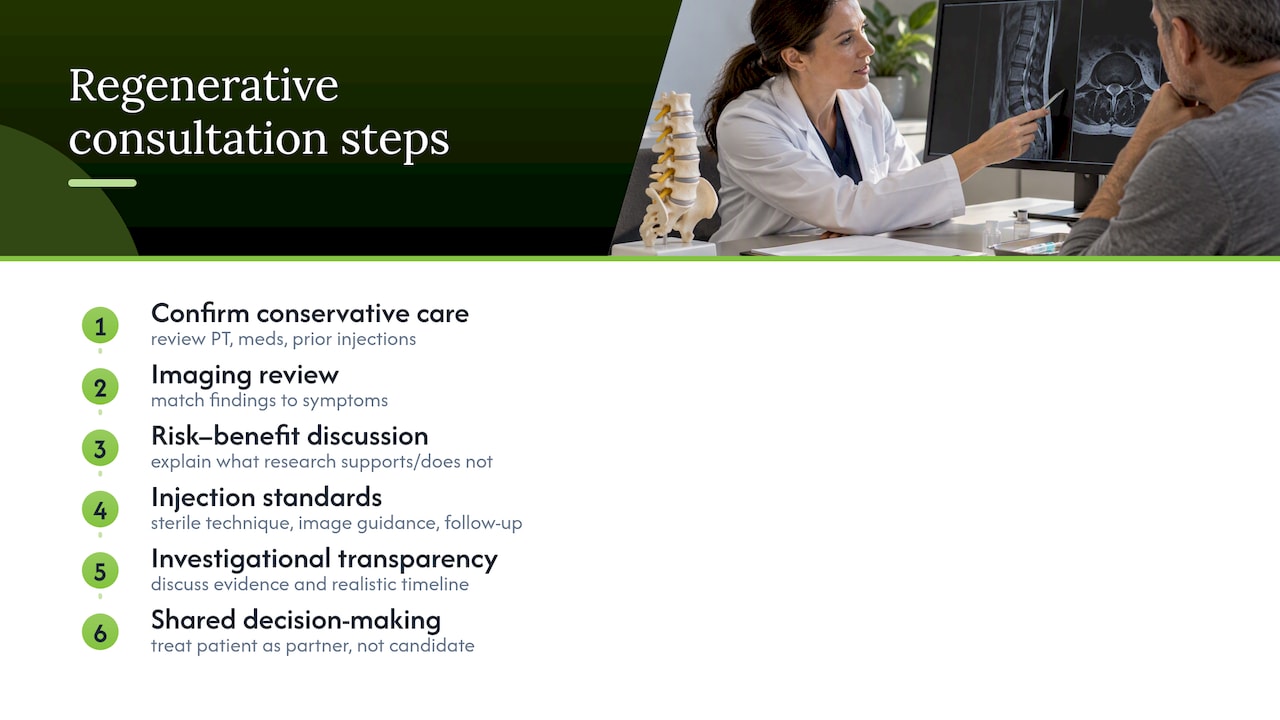
At Nortex Spine and Joint, evaluating a patient for any regenerative option starts with confirming that conservative care has genuinely been tried, not just mentioned in passing. That means reviewing prior physical therapy records, medication history, and any previous injections before discussing whether a biologic approach makes sense at all.
Imaging review is a consistent step. A physician looks for findings that correlate with the patient’s actual symptoms rather than treating an MRI report as a standalone diagnosis. From there, the conversation shifts to a individualized risk and benefit discussion, one that includes what the current research does and does not support, rather than a general sales pitch about regenerative medicine.
Sterile technique, image guidance during injections, and scheduled follow-up visits are standard parts of how the clinic approaches any injection-based treatment. If a patient is a candidate for an investigational stem cell approach, that also means being transparent about where the evidence stands and what a realistic timeline for improvement looks like, an approach detailed further in the clinic’s own review of stem cell therapy timelines. Patients considering this path deserve a conversation that treats them as partners in the decision, not just candidates for a procedure.
The Real Gap Between Regenerative Marketing and Regenerative Evidence
The biggest problem with how stem cell therapy for back pain gets discussed publicly is not that the science is bad, it is that the marketing has outrun the science by years. Clinics advertising it as a routine alternative to surgery are making a claim the current data does not support, and patients deserve to know that before they pay out of pocket for something insurance will not touch.
What gets underappreciated is how much the diagnosis matters. Stem cell therapy is not being studied as a treatment for “back pain” broadly, it is being studied for specific conditions like single-level disc degeneration in carefully selected patients. A treatment that shows promise in that narrow group says nothing about whether it will help someone with a different pain generator entirely.
If you are considering this route, prioritize getting an accurate diagnosis before you shop for a provider. A clear MRI finding that matches your symptoms, combined with an honest conservative care trial, tells you more about your likely candidacy than any clinic’s marketing claims will.
— Felix
Scheduling a Consultation to Discuss Your Options
If you are weighing whether an investigational option makes sense for your back pain, the most useful first step is a consultation that reviews your imaging and treatment history honestly, rather than jumping straight to a procedure. Nortex Spine and Joint’s regenerative medicine evaluation looks at your specific diagnosis and prior care before recommending anything, and the clinic’s stem cell therapy page outlines its current approach to these treatments for patients in the North Dallas area.
Bring the following to your first visit:
- Recent MRI or imaging reports, ideally within the last 12 months
- A list of prior treatments tried, including physical therapy, medications, and injections
- Current medications and any relevant medical history
- Questions about cost, since these treatments are rarely covered by insurance and pricing varies significantly by clinic
At your first visit, expect a review of your imaging and history, a discussion of whether conservative options like physical therapy or back pain therapy should be tried first, and if regenerative options are appropriate, a candid conversation about regulatory status and realistic outcomes. If a clinic offers you a stem cell product, it is reasonable to ask directly whether it is being provided under an FDA-authorized trial, and to get a clear answer on cost before moving forward.
Where to Verify the Claims in This Article
A few primary sources are worth bookmarking if you want to check regulatory status or trial progress yourself:
- The FDA’s consumer guidance on regenerative medicine explains current approval status and how to spot unapproved marketing claims.
- CMS coverage policy documentation details how Medicare classifies biologic treatments for musculoskeletal conditions.
- The WFNS spine committee recommendations summarize current evidence quality across invasive back pain interventions.
- Clinicaltrials lists the ongoing Phase III intradiscal cell therapy trial and its recruitment status.
This article is general information, not a substitute for advice from a qualified doctor. Consult a qualified healthcare professional about your own circumstances before acting on anything here.
Sources
- Important Patient and Consumer Information About Regenerative Medicine Therapies | FDA
- Medicare coverage determinations (CMS) — coverage and policy statements
- Acute back pain: Clinical and radiologic diagnosis: WFNS spine committee recommendations
- Clinicaltrials
FAQ
Does stem cell therapy actually work for back pain?
Evidence is mixed: some trials on carefully selected patients, particularly those with early disc degeneration, show meaningful pain and function improvement, while broader reviews report low certainty or conflicting results. The treatment is not FDA approved for back pain, and outcomes vary widely depending on diagnosis and cell preparation method.
How much does a stem cell cost for back?
Pricing varies significantly by clinic, cell source, and geographic location, and most insurers do not cover it since it is considered investigational. For a general sense of typical ranges and what drives cost differences, see this clinic breakdown of stem cell therapy costs.
How many stem cell treatments are needed for back pain?
Most clinical trials and clinic protocols use a single intradiscal injection rather than a repeated series, unlike some other injection therapies. Patients typically need weeks to months to notice meaningful change, and repeat treatment is not standard practice based on current evidence.
What are the drawbacks to stem cell therapy?
The main drawbacks are the lack of FDA approval for orthopedic use, inconsistent evidence across studies, and typical noncoverage by insurance, which means significant out-of-pocket cost. Reported risks from unregulated products have included infection and, in rare documented cases, vision loss, which is why verifying a clinic’s regulatory status matters before treatment.