
EMTT, or extracorporeal magnetotransduction therapy, is a non-invasive treatment that uses pulsed electromagnetic fields to reach the tissues around a painful knee. Early research suggests it may reduce pain in knee osteoarthritis, but the evidence is still developing, and it works best as one part of a broader plan rather than a stand-alone fix. Below, we explain how it differs from the magnets sold at drugstores, what a session feels like, what the studies do and do not show, and how to decide whether it belongs in your care.
TL;DR
- EMTT is a powered, high-energy electromagnetic therapy. It is not the same as static magnets or a magnetic knee wrap.
- A session usually lasts 5 to 20 minutes, and a typical cycle includes 4 to 8 sessions over several weeks, individualized to the patient.
- Research shows a pain benefit in knee osteoarthritis, but the overall evidence is mixed and the studies are small.
- Pacemakers, insulin pumps, and other implanted devices are a reason to talk to a physician first, and EMTT should never replace a proper diagnosis.
- It tends to work best alongside rehabilitation and, when appropriate, other treatments, not instead of them.
Table of Contents
- What EMTT stands for and how it differs from other magnet therapy
- How EMTT is applied to the knee
- How many sessions, and when might you notice a change?
- What the research shows for knee pain
- Who EMTT may suit, and who should be cautious
- EMTT compared with other knee options
- Our perspective on EMTT
- Questions to ask before you start
- Seeing us in North Dallas
- FAQ
- Sources
What EMTT stands for and how it differs from other magnet therapy
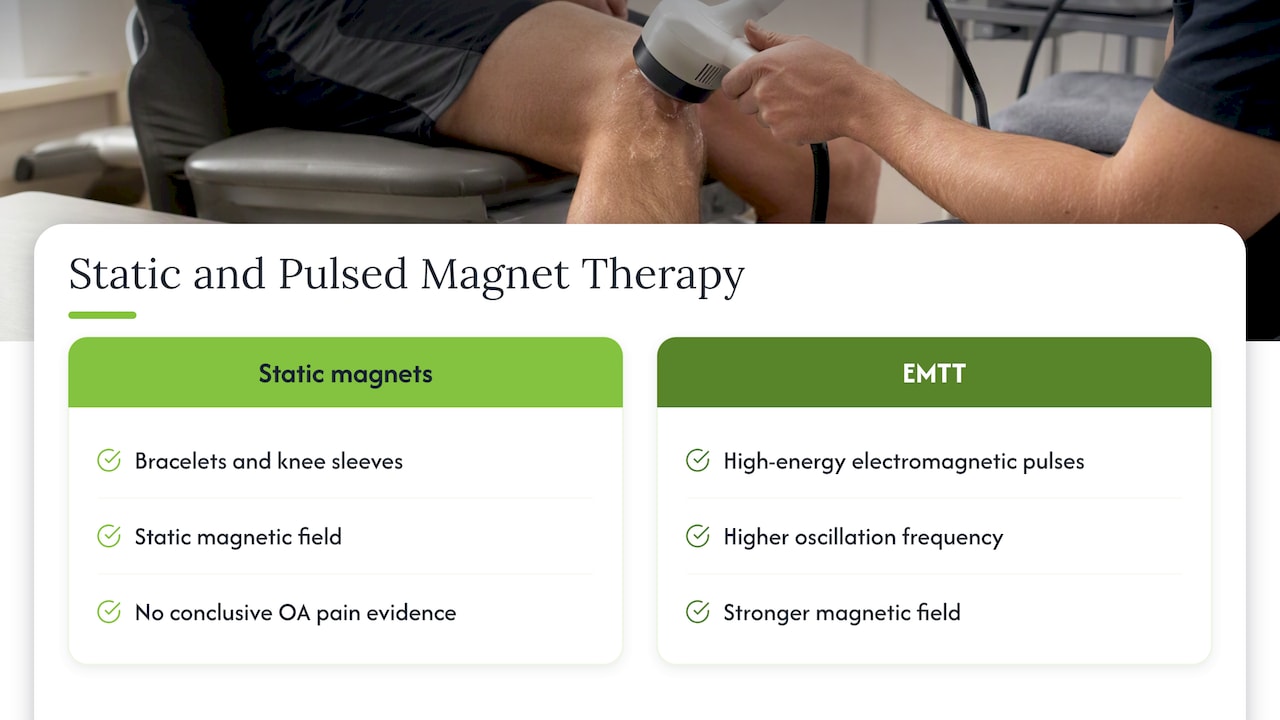
EMTT stands for extracorporeal magnetotransduction therapy. STORZ Medical, which makes one of the devices used for it, describes it as high-energy electromagnetic pulses that induce a weak electric current in tissue. Compared with general magnetic-field therapy or PEMF (pulsed electromagnetic field therapy), it uses a higher oscillation frequency and a stronger magnetic field.
That distinction matters, because many patients tell us they have already tried a magnetic bracelet or knee sleeve. Those are static magnets, a different category entirely. The National Center for Complementary and Integrative Health (NCCIH) says there is no conclusive evidence that static magnet therapy helps osteoarthritis pain. A failed trial of a refrigerator-style magnet tells you very little about a clinical device that produces a pulsed field.
So when people search for magnet therapy for knee pain, there are really two questions. The first is whether static magnets help, and the best current answer is that nobody has shown they do. The second is whether a powered, pulsed field delivered in a clinic helps, which is the subject of the rest of this article.
How EMTT is applied to the knee
The treatment is outpatient and non-invasive. According to STORZ Medical’s patient guide, it can be delivered through clothing without direct skin contact, and during the pulses you may feel mild tingling or a pulsation.
In practice, a session looks like this:
- You sit or lie comfortably with the knee positioned within the applicator.
- The clinician sets the intensity and frequency based on the condition being treated and how you tolerate it.
- The pulses are delivered for the session length, which the same guide puts at roughly 5 to 20 minutes.
- You walk out afterward and can usually return to normal activity.
Because nothing touches the joint, there is no needle, no incision, and no recovery period in the surgical sense. That is part of the appeal for patients who are wary of injections or who cannot take anti-inflammatory medications.
How many sessions, and when might you notice a change?
The same patient guide says a treatment cycle commonly includes 4 to 8 sessions over several weeks, although the plan is individualized. We would add a realistic note from clinical experience: osteoarthritis pain has built up over years, and it rarely responds in a single visit. Some patients report a change after a few sessions, and others notice little. We would rather tell you that up front than promise a timeline.
A sensible approach is to agree on a measurable goal before starting, such as how far you can walk, how many stairs you can climb comfortably, or your pain score on a 0 to 10 scale. Then reassess partway through the cycle. If nothing has moved by the end, that is useful information, and it is a good moment to discuss other options rather than repeat the same treatment.
What the research shows for knee pain
The honest summary is that the signal is encouraging but not settled. Here is what the main sources say.
Reviews of electromagnetic therapy in osteoarthritis
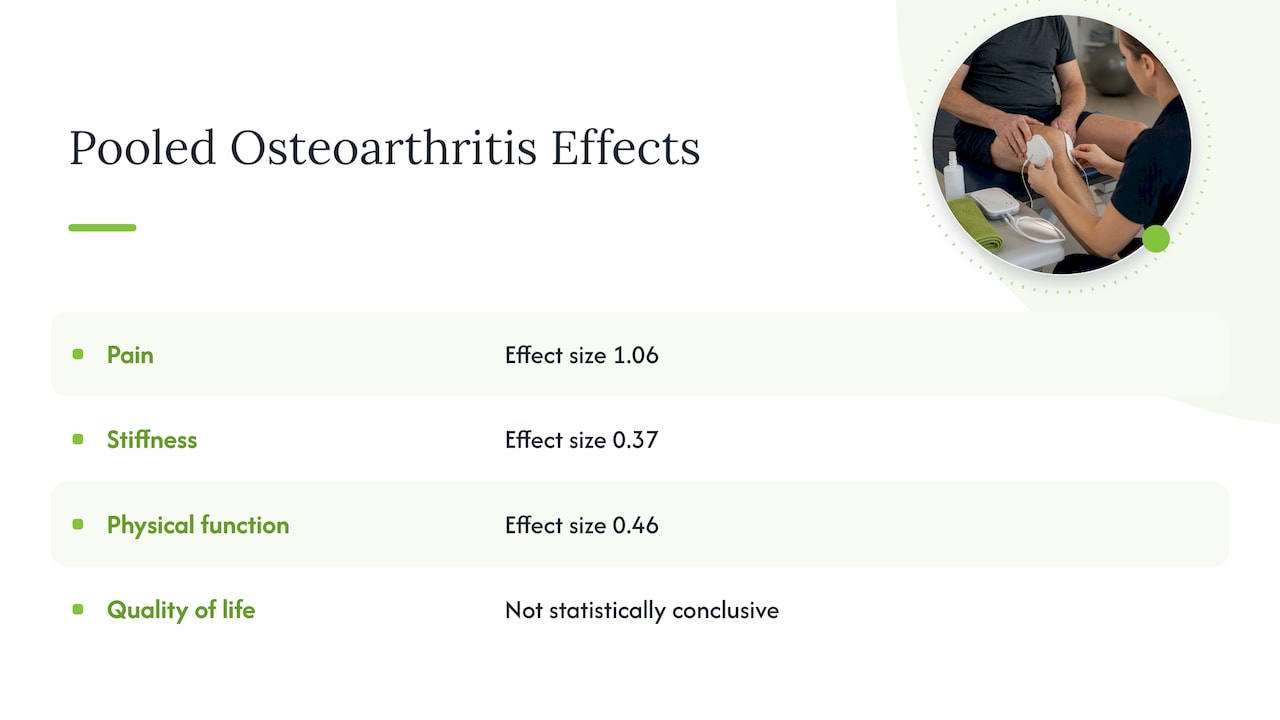
NCCIH says the evidence for electromagnetic therapy in osteoarthritis is mixed. It cites a 2020 review of 15 studies with 985 participants that found reduced pain and improved stiffness and physical function, but no improvement in overall quality of life. That review is the 2020 systematic review and meta-analysis in Physical Therapy, which included 16 randomized studies and found PEMF better than placebo for osteoarthritis pain, stiffness, and function. The pooled effect sizes were 1.06 for pain, 0.37 for stiffness, and 0.46 for function, and the quality-of-life estimate was not statistically conclusive.
Note that this evidence covers pulsed electromagnetic fields broadly. EMTT is a higher-energy form, so the findings are relevant but not a direct measure of EMTT itself.
A caution from insurers
Coverage decisions reflect how cautious the field is. A 2022 Blue Cross policy review concluded that the evidence for pulsed electrical or electromagnetic stimulation in arthritis was insufficient to establish improved net health outcomes. It pointed to small studies, inconsistent results, and methodological limitations. Its reading of the same 2020 meta-analysis was that pain improved but stiffness, function, and quality of life did not improve to a clinically significant degree.
That is worth knowing, because it tells you what to expect from an insurance conversation. Many plans do not cover EMTT, and you should ask about cost before you begin. We cover that in more detail in our guide to what EMTT costs in Dallas and what to ask a clinic.
A placebo-controlled EMTT trial
A more recent double-blind, placebo-controlled randomized trial of EMTT enrolled 126 patients who had more than six weeks of pain from knee osteoarthritis, rotator cuff enthesopathy, or lumbar spondyloarthrosis. It is a single-center study, so we treat it as promising rather than definitive. For a wider look at the data, see our write-up of what the clinical evidence actually shows for EMTT.
The regulatory picture
STORZ Medical reported that the FDA cleared its MAGNETOLITH device as a class II device on May 3, 2021. The clearance announcement lists indications such as muscle-spasm relaxation, preventing or slowing disuse atrophy, increasing local blood circulation, muscle re-education, and maintaining or increasing range of motion. Knee osteoarthritis is not among the listed indications.
That does not mean the treatment is unsafe or useless. It means that when a clinic uses EMTT for a knee, it is working outside the labeled indications, and the patient deserves to hear that plainly during the consultation.
Who EMTT may suit, and who should be cautious
In our experience, the patients most likely to consider EMTT fall into a few groups:
- Adults with mild to moderate knee osteoarthritis who have had limited relief from anti-inflammatory medication, bracing, or activity changes.
- Active people with overuse-type knee pain who want to keep training while they rebuild strength.
- Patients who prefer to avoid or delay injections and surgery, and who understand that the benefit is uncertain.
There are also situations where we would pause. NCCIH notes that studies of magnetic therapy generally report minimal or no adverse effects, but magnets and magnetic devices can interfere with pacemakers, insulin pumps, and other medical devices. If you have an implanted device, are pregnant, or have another significant health condition, speak with your physician before any magnetic treatment. NCCIH also advises removing magnetic devices before an MRI.
One more point deserves emphasis. NCCIH warns against using magnets to put off evaluation of pain or another medical problem. A knee that is swollen, locking, giving way, hot, or painful at night needs a proper examination and, often, imaging first. Persistent pain is rarely a single-track problem, and it helps to read about integrated approaches to chronic pain to see why a device alone seldom addresses everything a long-standing condition involves.
EMTT compared with other knee options
Many patients arrive after trying several things. A typical sequence is over-the-counter pain relievers, then a steroid injection, then a brace, and finally a conversation about replacement. EMTT sits somewhere in the middle of that ladder.
| Option | What it is | What to weigh |
|---|---|---|
| Physical therapy | Supervised strengthening, mobility, and gait work | Foundation of care for most knee problems; requires consistency |
| EMTT | Pulsed electromagnetic field, non-invasive | Evidence is mixed; usually self-pay; no needle or downtime |
| Hyaluronic acid or steroid injection | Injection into the joint | Can give short-term relief; effect varies by person |
| PRP (platelet-rich plasma) | Your own concentrated platelets injected into the joint | Autologous, so it uses your own blood; evidence is still evolving; typically self-pay |
| Surgery | Arthroscopy or joint replacement | Reserved for advanced structural damage or failure of other care |
We do not see these as rivals. A patient might use EMTT to calm symptoms while physical therapy rebuilds the muscles that support the knee. Another might move from EMTT to PRP if relief is partial. If you want to understand your own diagnosis first, our overview of the causes of chronic knee pain and of knee osteoarthritis symptoms, causes, and treatment are good starting points.
Our perspective on EMTT
We offer EMTT at Nortex Spine and Joint, and we want to be candid about where it fits. The technology is interesting, the safety profile appears favorable, and many patients like that it is gentle. But the research is not yet strong enough for us to call it a cure for knee osteoarthritis, and we do not.
What we see in clinic is that the best results come when treatment follows a clear diagnosis. A knee with bone-on-bone arthritis, a meniscal tear, and a patellar tendon problem are three different conditions, and they do not respond to the same therapy. That is why we start with an examination, review of imaging, and a conversation about what you have already tried and what you want to get back to doing.
We pair EMTT with physical rehabilitation whenever we can, because strength and movement quality are what protect a knee over the long term. If EMTT does not help you, we will say so and discuss regenerative options such as PRP, or other approaches, based on your anatomy and goals. Our aim is a plan you understand, with realistic expectations about outcomes and timelines.
— Felix
Questions to ask before you start
A good consultation should leave you able to answer these:
- What is the diagnosis in my knee, and was it confirmed by examination or imaging?
- Is EMTT being used within its labeled indications, and what is the evidence for my condition?
- How many sessions are planned, and how will we decide whether it is working?
- What will it cost in total, and is any of it covered by insurance?
- Do I have any implanted device or condition that makes magnetic therapy a poor choice?
- What is the next step if it does not help?
A clinic that answers these without hesitation is one you can trust. One that guarantees results is not.
Seeing us in North Dallas
If you are living with chronic knee pain and want a clear assessment, our physicians can examine the joint, explain whether EMTT therapy is a reasonable option, and outline alternatives such as PRP for the knee or physical therapy. Our treatment plans are individualized and non-surgical wherever that is medically appropriate. You can learn more about our services on the Nortex Spine and Joint website and request a consultation there.
FAQ
Does EMTT work for knee pain?
It may reduce pain in some people with knee osteoarthritis, but the evidence is mixed. Reviews of electromagnetic therapy have found pain benefits over placebo, while insurer reviews call the overall evidence insufficient. Expect a possible reduction in symptoms, not a repair of worn cartilage.
Is EMTT the same as magnet therapy?
No. Static magnets such as bracelets and wraps have no conclusive evidence for osteoarthritis pain, according to NCCIH. EMTT uses a powered device that emits high-energy pulses, and it is studied separately.
Does EMTT hurt?
Most people describe it as mild tingling or a pulsing sensation. It can be delivered through clothing, there is no needle, and you can usually resume normal activity afterward.
How many EMTT sessions will I need?
A cycle commonly includes 4 to 8 sessions over several weeks, with each session lasting about 5 to 20 minutes. Your clinician should individualize the plan and reassess your progress partway through.
Who should not have EMTT?
People with pacemakers, insulin pumps, or other implanted devices should consult a physician first, as should anyone who is pregnant or has a significant health condition. Anyone with new swelling, locking, fever, or severe night pain needs a medical evaluation before trying any device.
Sources
- STORZ Medical: MAGNETOLITH and EMTT overview
- NCCIH: Magnets for Pain, What You Need to Know
- STORZ Medical: EMTT treatment procedure
- Physical Therapy: Effects of Pulsed Electromagnetic Field Therapy on Pain, Stiffness, Function, and Quality of Life in Osteoarthritis (2020)
- Blue Cross policy review: Electrical Stimulation for Treatment of Arthritis (2022)
- Double-blind, placebo-controlled randomized trial of EMTT for musculoskeletal disorders
- STORZ Medical: FDA 510(k) clearance for MAGNETOLITH (2021)
- Integrated chronic pain treatment guide