

If your pain follows a new injury or you notice swelling, start with cold. If stiffness or a chronic ache is the main problem, heat usually works better. When you are not sure which applies, start with cold for the first day or two, and check in with a clinician if pain is severe or getting worse.
TL;DR:
- Wrap a cold pack in a thin towel, apply it for 15 to 20 minutes, and repeat every 2 to 3 hours while awake.
- Switch to heat after swelling has decreased and the area no longer feels warmer than nearby skin, especially when stiffness replaces throbbing pain.
- Keep heat below 113°F and limit sessions to 15 to 20 minutes; avoid it over swelling, open wounds, or skin with reduced sensation.
- People with neuropathy, poor circulation, vascular disease, Raynaud’s phenomenon, or cold urticaria should avoid thermal therapy at home unless medically supervised.
- Seek prompt medical care for worsening swelling or pain, numbness, fever, or a joint that cannot bear weight, rather than relying on thermal care.
Table of Contents
- When to use ice for a new injury or swelling
- How to apply ice safely at home
- When heat helps more than ice
- How to apply heat without risking a burn
- Switching from ice to heat as healing progresses
- When to avoid heat or ice and when to see a clinician
- How we think about thermal care in a conservative treatment plan
- When home care isn’t enough: next steps to consider
- FAQ
- Sources
When to use ice for a new injury or swelling
Cold works by narrowing blood vessels near the skin, which slows blood flow to the area and limits swelling. It also dulls nerve signals, which is part of why it provides fairly quick pain relief after a fresh injury. We see this play out often in patients who come in within a day or two of twisting an ankle or straining a muscle during exercise: the area is warm, puffy, and tender, and cold is the right first move.
Ice tends to help most in these situations:
- A fresh sprain or strain, especially within the first 24 to 72 hours
- Visible bruising or swelling after a bump or fall
- A flare-up of pain and puffiness right after activity
Cold also fits into the RICE approach, rest, ice, compression, and elevation, which the Mayo Clinic recommends as initial care for sprains. Applied early, ice is one piece of a broader first-aid response, not a stand-alone fix.
How to apply ice safely at home
Getting the technique right matters as much as choosing ice in the first place. A few simple steps protect your skin while still giving you the benefit.
- Wrap your cold source (ice pack, bag of frozen vegetables, or an ice cube for massage) in a thin towel before it touches your skin.
- Apply it for 15 to 20 minutes, then remove it, following the interval Mayo Clinic outlines for sprain care.
- Repeat every 2 to 3 hours while you are awake for the first few days after injury.
- Keep the area elevated and lightly compressed between sessions when swelling is present.
Pro Tip: Set a timer when icing. Numbness, aching, or skin that turns white or blotchy means it’s time to stop and check the area before continuing.
When heat helps more than ice
Once swelling has settled, or when the problem is stiffness rather than active inflammation, heat tends to be the better tool. Warmth widens blood vessels, which increases circulation to the area, and it relaxes muscles that have tightened up protectively around a painful joint. It also loosens connective tissue, making stretching and movement easier.
Heat is typically the right call for:
- Ongoing muscle tightness or tension, like a stiff lower back
- Stiffness from osteoarthritis, particularly before activity
- Warming up muscles before exercise or physical therapy
- Subacute injuries once swelling has resolved
The evidence for heat is modest but real. A systematic review of heat wrap therapy found short-term functional benefits in some patients with acute or subacute low-back pain, particularly when heat was paired with exercise rather than used alone. That pattern matches what we see clinically: heat tends to work best as a complement to movement, not a replacement for it. Our musculoskeletal wellness guide covers how thermal therapy fits alongside rehab exercises in more detail.
How to apply heat without risking a burn
Safe heat use comes down to temperature control and timing. A comfortably warm sensation is the goal, not intense heat.
- Keep surface temperatures below about 113°F, since higher temperatures raise the risk of pain and burns, according to Harvard Health’s guidance on safe heat use.
- Use moist heat, like a warm, damp towel, when you can. Harvard Health notes that moist heat transfers warmth more efficiently than dry heat, which means you may need less time to get the same effect.
- Apply heat for 15 to 20 minutes, checking your skin a few minutes in and again before removing it.
- Skip heat over swollen areas, open wounds, or skin with reduced sensation.
Switching from ice to heat as healing progresses
The general pattern we recommend is cold during the active inflammatory phase, roughly the first 24 to 72 hours after injury, then a shift to heat once swelling has gone down and stiffness becomes the dominant complaint. This progression lines up with the sequence Cleveland Clinic describes: ice for initial inflammation, heat for the stiffness and restricted motion that often follows.
A few signs tell you it’s time to make the switch:
- Visible swelling has noticeably decreased
- The area no longer feels warm to the touch compared to surrounding skin
- Throbbing pain has eased, leaving more of a dull stiffness
Some clinicians use contrast therapy, short alternating rounds of heat and cold, for subacute symptoms, though the evidence base for this approach is weaker than for either modality used on its own. We tend to reserve it for patients who have already improved with single-modality treatment and want a more active transition strategy.
When to avoid heat or ice and when to see a clinician
Both modalities are safe for most people, but a few conditions change that calculus. The CASRAI clinical selection guide notes that using the wrong modality, or using either one on the wrong patient, can slow recovery or cause skin injury.
Avoid home heat or cold therapy, or use it only under medical supervision, if you have:
- Impaired sensation or neuropathy, poor circulation, or a diagnosed vascular condition
- A history of Raynaud’s phenomenon or cold urticaria
- Suspected blood clot, active infection, or a known tumor in the area
Seek prompt medical attention if you notice worsening swelling, increasing pain, numbness, fever, or a joint that won’t bear weight. Ice and heat are supportive tools, not definitive treatment for a serious injury, and when something feels off, it’s worth having it checked rather than waiting it out.
How we think about thermal care in a conservative treatment plan
Most patients try ice or heat on their own before ever booking an appointment, and that’s usually a reasonable first step. When someone comes in, we assess sensation, circulation, and how much the pain is actually limiting daily function before deciding what comes next. For many conditions, including arthritis flare-ups and muscle spasms, thermal therapy stays part of the plan even after treatment begins, with adjunctive options like red light therapy for arthritis sometimes incorporated. Our blog post on arthritis and temperature therapy goes into more detail on condition-specific patterns. Heat and ice manage symptoms well, but they don’t address a torn ligament, degenerated disc, or an inflamed joint at its source. That’s usually where physical therapy or a more targeted intervention comes in.
— Felix
When home care isn’t enough: next steps to consider
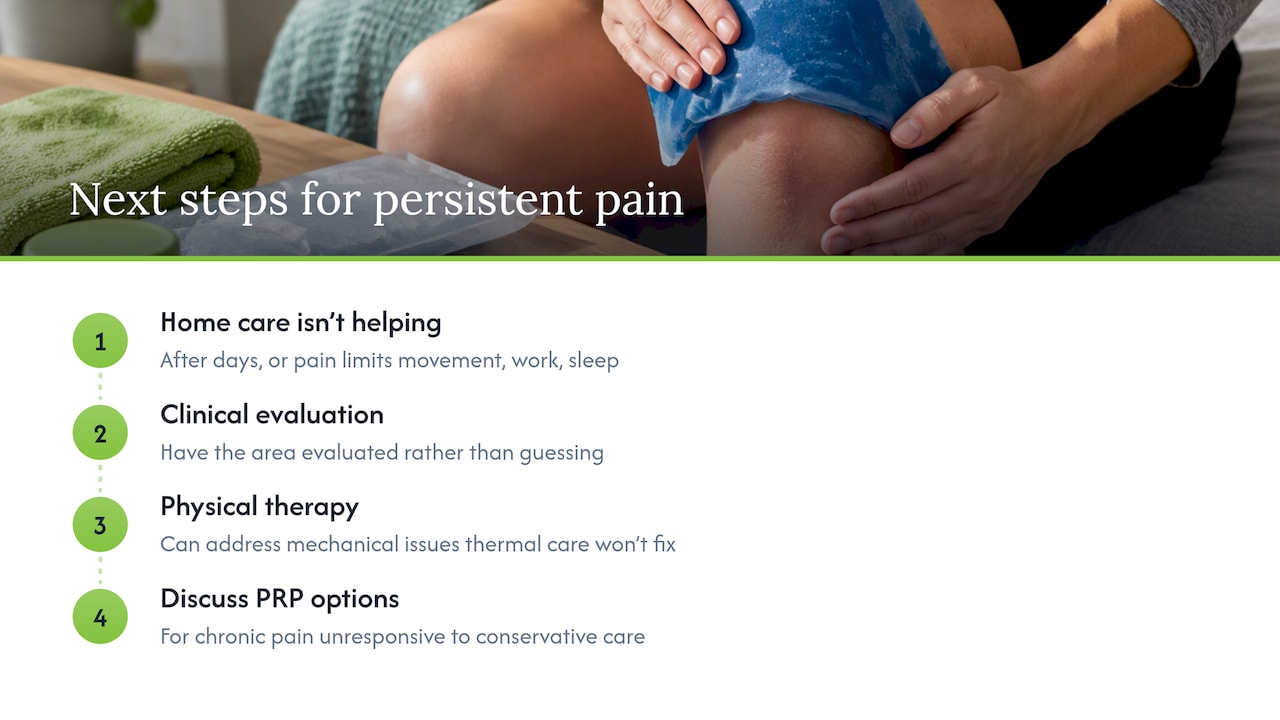
If ice or heat hasn’t meaningfully helped after a few days, or if pain is limiting your ability to move, work, or sleep, it’s worth having the area evaluated rather than continuing to guess. Physical therapy can address the mechanical issues that thermal care alone won’t fix, and for chronic joint or spine pain that hasn’t responded to conservative measures, regenerative medicine options like PRP therapy are worth discussing with a provider. These are options to explore, not guaranteed fixes, and the right fit depends on your diagnosis. If you’re ready to talk through what’s causing your pain, you can schedule an evaluation with us to review your options.
This article is general information, not a substitute for advice from a qualified doctor. Consult a qualified healthcare professional about your own circumstances before acting on anything here.
FAQ
When should you use heat instead of ice?
Use heat once swelling has gone down and stiffness, rather than inflammation, is the main issue, such as with chronic muscle tightness or arthritis-related stiffness. Cleveland Clinic recommends starting with ice for fresh injuries and switching to heat as the area heals and stiffness sets in.
How do you use an ice bag correctly?
Wrap the ice bag in a thin towel so it doesn’t sit directly on your skin, then apply it for 15 to 20 minutes at a time. Mayo Clinic advises repeating this every 2 to 3 hours during the first few days after a sprain or strain.
Is ice still recommended for injuries?
Ice is still widely used for acute injuries, though researchers note that the overall evidence behind it is limited rather than absent. Harvard Health points out that cold still helps control pain and swelling early on, even though high-quality research on exact protocols remains thin.
Should you use ice or heat for a swollen ankle?
Use ice for a swollen ankle, especially within the first 24 to 72 hours after the injury. Cold slows blood flow to the area and helps control swelling, which fits the first-aid approach Mayo Clinic outlines for sprains before shifting to heat once swelling subsides.
Sources
- Sprains — Mayo Clinic
- Cold versus heat for pain relief — Harvard Health
- Should you use ice or heat for pain? — Cleveland Clinic
- Systematic review: heat and cold for low-back pain — PMC
- Hot-cold therapy clinical selection protocol guide — CASRAI