
Chronic joint pain can transform simple, everyday activities into exhausting challenges. Getting out of bed, climbing stairs, or enjoying a morning walk in North Dallas become reminders of how much pain controls your life. The good news is that a growing body of evidence supports practical, non-surgical strategies that genuinely reduce pain, restore function, and help you move with greater confidence. This guide walks through the full spectrum of those options, from foundational lifestyle changes to advanced regenerative therapies like platelet-rich plasma (PRP) and stem cell injections, so you can make informed decisions about your care.
Table of Contents
- Start here: Foundations of joint pain relief
- How to implement safe, effective exercise for joint relief
- Advanced options: PRP and stem cell therapies explained
- Red flags and when to seek medical guidance
- A fresh perspective: Why foundational changes matter more than quick fixes
- Explore advanced relief options in North Dallas
- Frequently asked questions
Key Takeaways
| Point | Details |
|---|---|
| Build on proven basics | Exercise, weight management, and self-care are the foundation for long-term joint pain relief. |
| Explore advanced therapies wisely | PRP and stem cell injections offer new options but require careful selection and understanding of protocols. |
| Personalize your plan | Success comes from combining the right strategies for your specific symptoms, risks, and goals. |
| Know when to seek help | Certain symptoms mean DIY fixes aren’t enough—see a specialist for a tailored evaluation. |
Start here: Foundations of joint pain relief
Every effective joint pain management program begins with the same building blocks, regardless of how severe your symptoms are or whether you plan to pursue advanced treatments later. Skipping these steps in favor of a quick procedure often leads to disappointing outcomes, because the underlying conditions that drive joint deterioration remain unaddressed.
Treatments for osteoarthritis confirm that the best-supported first-line approach for chronic joint pain related to osteoarthritis is a multimodal plan centered on therapeutic exercise and weight management, supplemented by education, self-management strategies, and symptom-relief medications when necessary. This is not a suggestion, it is the standard of care endorsed by major rheumatology and orthopedic organizations worldwide.
What does that multimodal plan look like in practice?
- Therapeutic exercise: Regular, structured movement that strengthens the muscles surrounding a joint, reducing the mechanical load on cartilage and bone.
- Weight management: For individuals who are overweight or obese, each pound of body weight adds approximately four pounds of force across the knee joint during walking. Reducing excess weight meaningfully lowers joint stress.
- Patient education: Understanding your diagnosis, realistic expectations, and self-management techniques empowers you to make better daily decisions.
- Symptom-relief options: Topical anti-inflammatories, acetaminophen, and other medications can provide short-term relief while the foundational strategies take hold.
- Activity modifications: Adapting how you perform certain tasks, such as using supportive footwear or avoiding prolonged standing on hard surfaces, reduces cumulative joint stress.
It is equally important to be honest about what these foundations can and cannot achieve. As treatment for osteoarthritis explains, osteoarthritis is managed to relieve symptoms and improve function because there is no current cure. Treatment plans combine lifestyle measures, symptom-relief options, and occasionally surgery when conservative management proves ineffective over time. That realistic framing matters because it helps you avoid the trap of either over-relying on lifestyle changes alone or dismissing them prematurely.
“The goal of joint pain management is not just symptom suppression but preserving and improving your ability to do what matters most to you, whether that’s gardening, playing golf, or keeping up with your grandchildren.”
Pro Tip: Before investigating the costs and benefits of PRP or any advanced injection therapy, spend at least six to twelve weeks fully committing to a supervised exercise program. Providers will evaluate your adherence to conservative care before recommending biologic treatments, and your outcomes will likely be better if your supporting musculature is already stronger.
How to implement safe, effective exercise for joint relief
Once you have committed to the foundational plan, the next question becomes practical: which exercises are right for you, and how do you start safely without aggravating the very joint you are trying to protect?
Exercise and arthritis outlines four specific categories of movement that are recommended for people managing arthritis, each targeting a different aspect of joint health:
-
Flexibility exercises: Gentle stretching and range-of-motion work, such as ankle circles, shoulder rolls, and seated hamstring stretches, maintain and improve the degree to which a joint can move. Aim for 5 to 10 minutes of flexibility work daily, ideally after warming up.
-
Strengthening exercises: Resistance training using bodyweight, resistance bands, or light weights builds the muscles that support and protect joints. For knee osteoarthritis, quadriceps-strengthening exercises like seated leg raises and wall sits are particularly well-supported. Start with two sessions per week and progress gradually.
-
Aerobic conditioning: Low-impact cardiovascular activities reduce systemic inflammation, support weight management, and improve overall joint tolerance. Walking, swimming, cycling, and using an elliptical machine are all appropriate starting points for most adults with joint pain.
-
Mindful movement practices: Tai chi and yoga combine gentle mobility, balance training, and breath awareness. Both have demonstrated reductions in pain scores and improvements in physical function for adults with chronic joint conditions. These practices also address psychological dimensions of chronic pain, including anxiety and low confidence in movement.
The following table outlines a practical starting framework for adults with mild to moderate joint pain:
| Exercise type | Example activities | Starting frequency | Key benefit |
|---|---|---|---|
| Flexibility | Seated stretches, range-of-motion drills | Daily, 5-10 minutes | Maintains joint mobility |
| Strengthening | Leg raises, resistance bands, wall sits | 2-3 times per week | Reduces joint load |
| Aerobic | Walking, swimming, cycling | 3-5 times per week, 20-30 min | Improves endurance and weight control |
| Mindful movement | Tai chi, gentle yoga | 2-3 times per week | Pain reduction and balance |
Pro Tip: If you are unsure how to begin, a licensed physical therapist can design a program specifically matched to your affected joints, fitness level, and any movement compensations you may have developed from guarding painful areas. This individualized approach is far more effective than generic online workout videos.
Consistency matters more than intensity in the early stages. Research consistently shows that moderate, regular exercise over weeks and months produces better outcomes than sporadic high-effort sessions. Track your pain levels and functional improvements, not just your workout numbers. If a particular exercise consistently causes sharp pain during or immediately after the session, modify the movement or consult your care team.

Advanced options: PRP and stem cell therapies explained
If you have genuinely committed to foundational care for several months but continue experiencing significant pain and functional limitation, regenerative injection therapies represent a scientifically grounded next step. These treatments are neither experimental curiosities nor guaranteed cures. Understanding what they are and how they work helps you set appropriate expectations.
PRP (platelet-rich plasma) therapy involves drawing a small sample of your own blood, processing it in a centrifuge to concentrate the platelet fraction, and injecting that concentrated plasma directly into the affected joint. Platelets are small blood cells packed with growth factors, including transforming growth factor beta (TGF-b), vascular endothelial growth factor (VEGF), and platelet-derived growth factor (PDGF). These growth factors signal tissue repair and modulate the inflammatory environment within the joint. Because PRP is autologous, meaning derived from your own blood, immunological rejection is not a concern.
Stem cell therapy, more precisely described as mesenchymal stem cell (MSC) or bone marrow concentrate therapy, involves harvesting cells with regenerative potential from sources such as bone marrow or adipose (fat) tissue. These cells are then processed and injected into the target joint. MSCs can differentiate into various tissue types and secrete anti-inflammatory signals that may support cartilage repair and slow degeneration.
The evidence for both therapies is encouraging but nuanced. A narrative review of PRP and comparators found that PRP for knee osteoarthritis shows generally favorable outcomes for pain and function, but effectiveness varies substantially depending on preparation technique, specifically whether the formulation is leukocyte-poor or leukocyte-rich, and the specific injection protocol used. Long-term benefits are less consistent across trials.
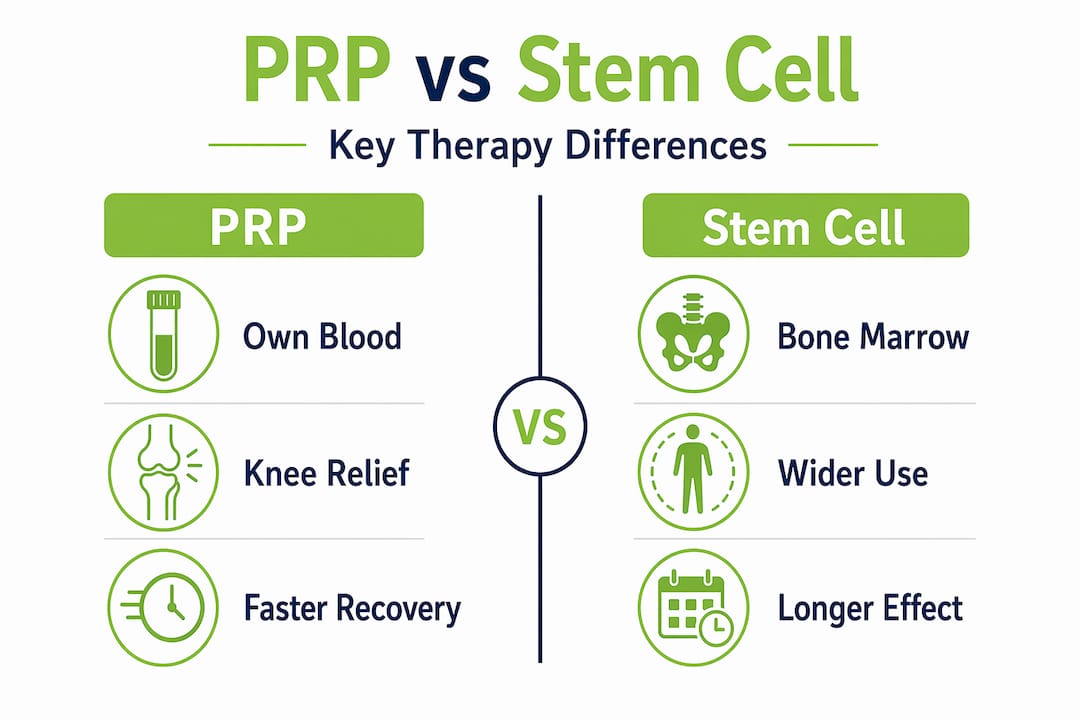
| Feature | PRP therapy | MSC (stem cell) therapy |
|---|---|---|
| Source | Patient’s own blood | Bone marrow or adipose tissue |
| Main active component | Concentrated growth factors | Regenerative cells with differentiation capacity |
| Evidence level | Moderate, generally favorable for knee OA | Emerging, promising but variable |
| Protocol standardization | Varies by provider and preparation method | Limited, no universal standard |
| Typical sessions | 1-3 injections | 1-2 injections |
| Ideal candidates | Mild to moderate OA, joint injuries | Moderate OA, failed conservative care |
On the stem cell side, a PMC review of MSC therapies in orthopedics confirms that while cell-based injections for musculoskeletal conditions report potential improvements, the field is still limited by protocol variability, inconsistent evidence quality, and a lack of standardized preparation, dosing, and activation methods. More prospective, standardized trials are needed before definitive efficacy conclusions can be drawn.
Key questions to ask any provider offering these treatments:
- What is the leukocyte content of your PRP preparation, and why do you use that formulation?
- What cell source and processing method do you use for stem cell therapy?
- How many injections are included in the protocol?
- What outcomes does your patient data support?
- How do you integrate these treatments with a broader rehabilitation plan?
You can review more detail about PRP injections for knee pain or explore the effectiveness of PRP for arthritis to better understand how these therapies are applied clinically.
Statistic callout: Studies suggest that PRP may provide statistically significant pain reduction compared to hyaluronic acid injections for knee osteoarthritis at 6 to 12 months, but results depend heavily on patient selection and preparation technique.
Red flags and when to seek medical guidance
Understanding when self-management is not enough may be the most important section of this entire guide. Not every joint pain is osteoarthritis, and treating the wrong condition with the wrong approach can delay proper care and allow the underlying problem to worsen.
A thorough arthritis overview from NCBI clarifies that chronic joint pain is not always osteoarthritis. When the pain pattern, duration, systemic symptoms, or joint involvement suggests inflammatory arthritis or another cause, treatment and investigation should be clinician-led, not limited to osteoarthritis-style exercise and biologics. This distinction is clinically significant because inflammatory arthritis, including rheumatoid arthritis, psoriatic arthritis, and gout, requires disease-modifying medications that work very differently from regenerative treatments.
Warning signs that require prompt medical evaluation:
- Unexplained swelling, redness, or warmth in one or more joints, especially if acute or severe
- Fever accompanying joint pain, which may indicate septic arthritis or a systemic inflammatory condition
- Pain and swelling affecting multiple joints simultaneously, particularly if symmetrical
- Rapid progression of symptoms over days rather than weeks
- Morning stiffness lasting more than 45 to 60 minutes, which is a hallmark of inflammatory rather than mechanical joint disease
- New joint deformities or visible changes in joint shape
- Joint pain following trauma, which may indicate fracture, ligament rupture, or internal joint damage
“If your joint pain is accompanied by fever, fatigue, rash, or swelling in joints throughout the body, do not assume it is simple wear-and-tear arthritis. A rheumatologist or orthopedic specialist can identify the correct diagnosis and prevent unnecessary delays in appropriate treatment.”
Seeing the right specialist at the right time is not an admission that your condition is beyond help. It is the most efficient path to an accurate diagnosis and a targeted treatment plan that actually addresses what is causing your pain.
A fresh perspective: Why foundational changes matter more than quick fixes
Here is what years of working with patients who have chronic joint pain reveals consistently: the appeal of a single injection that resolves everything is powerful, and understandably so. Pain is exhausting, and the desire for relief is completely rational. But the patients who achieve the most durable improvements are not the ones who skip straight to PRP or stem cells. They are the ones who do the less glamorous work first.
That work includes losing 10 to 15 pounds when indicated, committing to a physical therapy program even on days when motivation is low, and learning how their joint responds to different activities. When those patients then receive a regenerative treatment, the effect is amplified because the joint environment has been optimized. The muscles are stronger, inflammation is lower, and the body is primed to respond to growth factor signaling.
Reviewing the PRP injection pros and cons makes this point clearly. PRP works within a biological context, and that context is shaped by everything else you are or are not doing for your joint health. Expecting a biologic injection to compensate for a sedentary lifestyle, persistent excess weight, or untreated muscle weakness is unrealistic, and no credible provider would frame it otherwise.
This perspective is not meant to discourage you from pursuing advanced therapies. It is the opposite. It is meant to help you extract maximum value from them by being genuinely prepared. Advanced regenerative treatments are most powerful as part of a comprehensive, individualized plan, not as a replacement for one.
Explore advanced relief options in North Dallas
If foundational strategies have made meaningful progress but you still need more, or if you are ready to integrate a regenerative approach into your existing care plan, Nortex Spine and Joint offers precisely that kind of expert-guided path. The clinic specializes in non-surgical solutions with a patient-first philosophy, combining evidence-based protocols with individualized attention to your specific diagnosis, anatomy, and goals.
You can explore advanced PRP therapy options designed for adults with chronic joint and musculoskeletal conditions, or learn about stem cell treatments for joint pain using current regenerative protocols. The full scope of regenerative medicine solutions available at Nortex reflects a commitment to treating the root cause of pain, not just managing symptoms. Schedule a consultation to receive a personalized plan that considers your full picture, from lifestyle factors to the most advanced biologic interventions available in North Dallas.
Frequently asked questions
What is the fastest way to relieve joint pain at home?
Gentle exercise, ice or heat therapy, and over-the-counter pain relievers can provide short-term relief, but lasting improvement requires a sustained multimodal program including therapeutic movement and weight management.
Does PRP therapy work for all types of joint pain?
PRP shows the strongest evidence for knee osteoarthritis and certain joint injuries, but outcomes vary substantially depending on the condition being treated, the preparation method used, and the injection protocol.
Are there risks with PRP or stem cell therapies?
Both therapies are generally well-tolerated with low risk, but temporary pain, swelling, or, rarely, infection are possible. Protocol variability in MSC therapies means provider expertise and standardized preparation are critical factors in minimizing risk.
When should I see a doctor about joint pain?
Seek medical evaluation if you have swelling, heat, fever, pain in multiple joints, rapid symptom progression, or morning stiffness lasting over an hour, since these patterns may indicate inflammatory arthritis or other conditions requiring targeted clinical management.
Recommended
- Non-Opioid Pain Relief: Effective Options for Chronic Pain
- What is the Best Non-Surgical Treatment for Arthritis Pain? A Comprehensive Guide – Nortex | Pain Management | Allen, Garland, McKinney & Plano Texas
- How Can I Stop Arthritis Pain Fast? Expert Solutions Revealed – Nortex | Pain Management | Allen, Garland, McKinney & Plano Texas
- How Can I Manage Arthritis Pain at Home? Top Doctor-Recommended Tips – Nortex | Pain Management | Allen, Garland, McKinney & Plano Texas