

Most patients pay somewhere between $138 and $1,368 for a nerve block, depending on insurance status, facility type, and location, with cash/self-pay rates often landing near $509 for a common sympathetic block. Before you schedule anything, ask the clinic for a Good Faith Estimate that lists the CPT codes and confirm whether the procedure happens in an office, an ambulatory surgical center, or a hospital outpatient department, since that single detail moves the price more than almost anything else.
TL;DR:
- The payment for nerve blocks varies widely depending on setting, from $559 in a physician’s office to over $5,700 in a hospital outpatient department.
- Patients should clarify whether quotes refer to billed charges, allowed amounts, or out-of-pocket costs to avoid misunderstandings and sticker shock.
- The procedure’s location significantly impacts the cost, with office procedures skipping facility fees and hospital settings adding substantial charges.
- Medicare typically covers nerve blocks with 20% coinsurance, but coverage restrictions apply for repeated treatments at the same site.
- Confirming insurance network, prior authorization, and getting a detailed Good Faith Estimate can prevent unexpected bills and help plan financially.
Table of Contents
- Typical U.S. cost ranges by common nerve block type
- How the setting and your state change the price
- What Medicare and commercial insurance actually cover
- What adds to the bill beyond the injection itself
- Getting an accurate estimate before you schedule
- Nortex clinical perspective on documentation and realistic expectations
- How Nortex helps you plan for nerve block costs
- Where to verify these numbers yourself
- Sources
- FAQ
Typical U.S. cost ranges by common nerve block type
Patients often come to us after seeing a wide spread of quoted prices online, and the confusion usually traces back to one thing: nobody clarified whether the number was a billed charge, an allowed amount, or an actual out-of-pocket cost. Those are three different figures, and mixing them up leads to sticker shock.
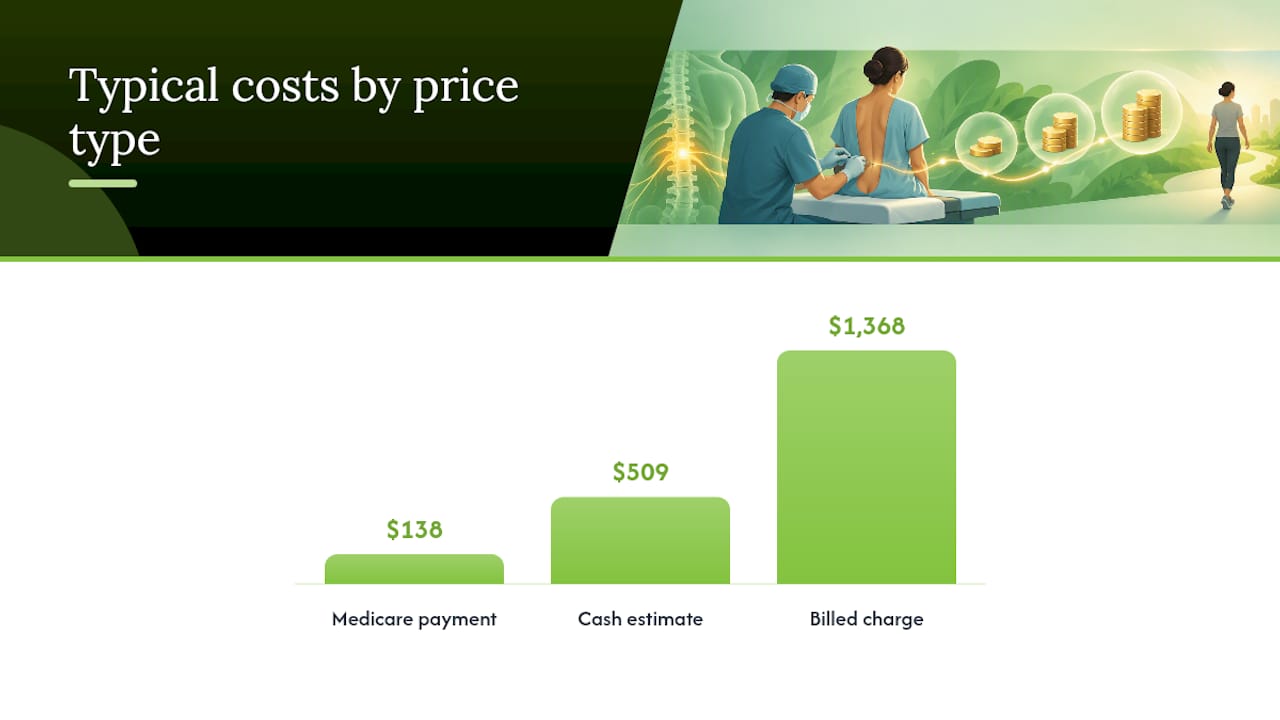
Take CPT 64510, an injection into the sympathetic nerve bundle used for certain chronic pain conditions. National data shows a Medicare average payment of about $138.26, while the average billed charge runs much higher, and estimated commercial and cash rates fall in between, according to a procedure-level cost analysis. That gap between what a clinic bills and what insurance actually pays explains most of the confusion patients bring into a consultation.
Peripheral nerve blocks show similar variation across providers and regions on healthcare marketplace platforms.
One CPT code, three prices: For 64510, national figures show Medicare paying around $138 on average, with billed charges averaging far more, roughly $1,368, and cash-pay estimates near $509. Knowing which figure a quote refers to keeps you from comparing apples to oranges.
- A billed charge is the clinic’s list price before any adjustment.
- The Medicare allowed amount reflects what the program actually pays after its fee schedule applies.
- A commercial estimate falls somewhere in between, depending on your plan’s negotiated rate.
- A cash or self-pay rate is often discounted below the billed charge, especially when negotiated upfront.
How the setting and your state change the price
Where the procedure happens matters as much as what procedure it is. A block performed in a physician’s office typically costs far less than the same code billed from a hospital outpatient department, because hospitals add facility fees that offices do not charge.
Research from health policy analysts found average total prices for comparable nerve injection services were roughly $5,700 in a hospital outpatient department, $2,368 in an ambulatory surgical center, and $559 in a physician’s office, according to a site-of-service pricing analysis. That’s roughly a tenfold spread for the identical CPT code, driven almost entirely by the building the procedure happens in rather than the skill involved.
- Office-based procedures skip the added facility fee altogether.
- Ambulatory surgical centers charge a facility fee but usually less than a hospital.
- Hospital outpatient departments layer in the highest facility charges and often more ancillary services.
- State-level Medicare payment also varies because of local wage indexes and practice-expense adjustments built into the fee schedule.
If your clinic offers the block in an office setting, ask directly. Many patients we see never realized they had a choice.
What Medicare and commercial insurance actually cover
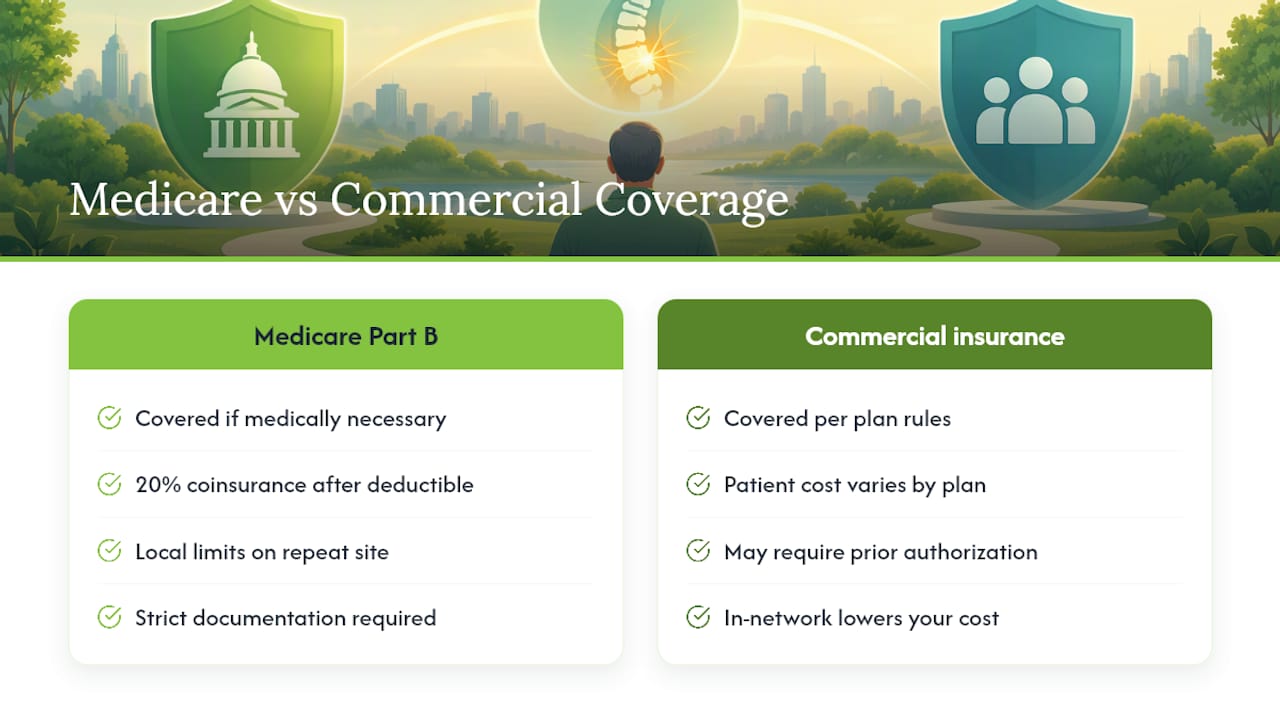
Medicare Part B generally covers nerve blocks when documentation supports medical necessity, but coverage comes with real limits. Local coverage guidance allows use for both diagnostic and therapeutic purposes while restricting how often the same anatomic site can be treated within a given period, according to Medicare’s local coverage determination for peripheral nerve blocks.
For most Medicare beneficiaries, that means a standard 20% coinsurance on the physician service after the annual Part B deductible is met, along with documentation and utilization rules that must be satisfied before the claim pays, according to Medicare’s coverage guidance on pain management. Skip a documentation requirement and the claim can be denied, leaving the patient responsible for the full charge.
Coinsurance is only part of the picture: Medicare typically requires 20% coinsurance after the deductible, but repeat blocks at the same site within a short window may not be covered at all under the local coverage rules.
Commercial insurance behaves differently. Negotiated rates with private payers often land at a multiple of what Medicare pays, which is part of why billed charges look so alarming and why the actual allowed amount matters more than the sticker price. Before scheduling, confirm the provider is in-network, ask whether prior authorization is required, and request an estimate of your specific patient responsibility. Our guide to insurance considerations for back pain treatment walks through the questions worth asking before you commit to a date.
What adds to the bill beyond the injection itself
A nerve block quote rarely tells the whole story. Several add-ons commonly appear on the final bill, and knowing what to ask about ahead of time prevents surprises.
- Imaging guidance, typically fluoroscopy or ultrasound, is billed separately from the injection itself and helps the physician confirm needle placement, which we discuss on our suprascapular nerve block page.
- Facility fees apply whenever the procedure happens in an ASC or hospital outpatient setting, even when the physician’s fee stays the same.
- Pre-procedure labs or an EKG may be required depending on your health history and the sedation plan.
- Multiple blocks performed in one visit or bilateral procedures are usually reduced by insurer modifier rules rather than paid in full for each site.
Modifiers matter more than most patients realize. A second block billed alongside the primary one is commonly reduced under a multiple-procedure modifier, and bilateral procedures follow their own separate rule, according to billing and coding guidance for interventional nerve blocks. Precise documentation of the localization technique used at each site supports the claim and reduces the odds of a denial.
Pro Tip: Ask the clinic to list every CPT code they plan to bill, including imaging and any ancillary services, before your procedure date, not after.
Getting an accurate estimate before you schedule
The single best tool for avoiding a surprise bill is the Good Faith Estimate required under the No Surprises Act. Uninsured and self-pay patients are entitled to a written, itemized estimate before the procedure, and asking for one in writing gives you something concrete to compare against the final bill.
- Request the Good Faith Estimate in writing and confirm it lists every CPT code along with anticipated ancillary fees like imaging or facility charges.
- Ask directly whether the procedure will happen in an office, an ASC, or a hospital outpatient department, and whether the quoted price already includes facility and imaging fees.
- Ask about cash or self-pay discounts, whether payment plans exist, and what your financial responsibility looks like if the insurer denies the claim.
Our insurance navigation guide covers the exact phrasing patients have found useful when calling both the clinic and the insurer to confirm these details ahead of time.
Nortex clinical perspective on documentation and realistic expectations
Documentation is where coverage decisions are won or lost, and it’s the part patients almost never see. When we perform a nerve block, the record includes the referring diagnosis, the specific pain code, and the localization technique used, whether that’s fluoroscopic or ultrasound guidance. That level of detail is exactly what payers look for when deciding whether a claim meets medical necessity, and it’s the difference between a smooth reimbursement and a denial that lands on the patient’s desk months later.
We also talk through setting with patients directly. An office-based block is often the lower-cost path when it’s clinically appropriate, though not every case allows for it. Relief timelines vary by block type and by the underlying condition, and our realistic timeline resource gives a grounded picture of what to expect rather than a promise. Some patients find that regenerative options offer a longer-term path once diagnostic blocks have done their job.
— Felix
How Nortex helps you plan for nerve block costs
Getting a straight answer on price shouldn’t require a runaround, and that’s the standard we hold ourselves to. When you schedule a consultation, the clinic team can walk you through a Good Faith Estimate, confirm which CPT codes apply to your specific case, and explain whether your procedure fits an office or facility setting before you commit to anything.
Have your insurance card, referring diagnosis, and any prior imaging ready when you call. That information speeds up both the estimate and the prior authorization process if your plan requires one.
- Financial counseling is available to review self-pay options alongside insurance-based care.
- Our PRP therapy and regenerative medicine programs are often discussed as longer-term alternatives when a block is meant to be diagnostic rather than a permanent fix.
- Physical therapy is frequently paired with injection-based care to extend results.
If you’re weighing a nerve block against other paths to relief, book a consultation with Nortex Spine and Joint and get a clear, written estimate before you decide.
Where to verify these numbers yourself
For the coverage rules behind Medicare payment, review the local coverage determination for peripheral nerve blocks and Medicare’s pain management coverage page. For site-of-service pricing differences, the BCBSA issue brief lays out the underlying data. Our medial branch block page explains one common block type in more clinical detail.
This article is general information, not a substitute for advice from a qualified doctor. Consult a qualified healthcare professional about your own circumstances before acting on anything here.
Sources
- Medicare Local Coverage Determination: Peripheral Nerve Blocks (LCDId=33933)
- Injection Of Anesthetic Agent Into Sympathetic Nerve Bundle (64510) Cost — PlainProcedure
- BCBSA issue brief: Site of service price differences (December 2023)
- Medicare
FAQ
How much does a nerve block usually cost?
Cost depends heavily on setting and insurance status: Medicare pays an average of about $138 for CPT 64510, while billed charges and cash rates run higher. Site of service, insurance coverage, and any imaging or facility fees all shift the final number.
What’s the longest a nerve block can last?
Duration varies by block type and the condition being treated, ranging from hours for a purely diagnostic block to months for some therapeutic injections. Our timeline resource breaks down realistic expectations by block type.
Are nerve block injections worth it?
For many patients, a nerve block offers meaningful short-term relief and useful diagnostic information about where pain originates, though results and duration vary by individual and condition. It’s often one step in a broader plan rather than a standalone fix, which is why physicians frequently pair it with physical therapy or regenerative options.
Is nerve block covered by insurance?
Medicare Part B typically covers nerve blocks that meet documented medical necessity, usually with a 20% coinsurance after the deductible and limits on how often the same site can be treated. Commercial coverage varies by plan, so confirming network status and prior authorization requirements beforehand is the safest approach.