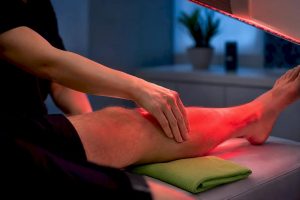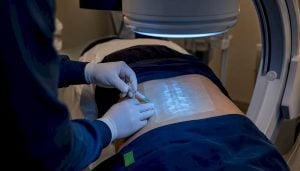

In-clinic red and near-infrared photobiomodulation is low-risk when it’s dosed correctly and delivered by a trained provider. Most reactions are mild and temporary, warmth, tingling, or a short-lived uptick in soreness, and serious harm like burns or allergic reactions is rare. If you’re considering it for chronic joint, spine, or muscle pain, the practical next step is asking your clinic how it screens patients and calibrates dosing before your first session.
TL;DR:
- Serious adverse events from red and near-infrared photobiomodulation are extremely rare, with most side effects being mild and fully reversible.
- Common sensations during treatment include warmth, tingling, or mild soreness, which typically resolve within hours or a day, with burns almost exclusively linked to device misuse.
- Risks may be higher for pregnant individuals, those with active cancer, on photosensitizing medications, or with open wounds or implants near the treatment site, requiring careful screening.
- Proper dosing and calibration by trained providers are essential to prevent burns and ensure safety, with clinic-based care offering personalized adjustments over at-home devices.
- Patients should report any signs of skin damage, systemic illness, or worsening symptoms immediately and follow protocols for discontinuation and medical consultation.
Table of Contents
- Red Light Therapy Side Effects You’re Likely to Notice
- How Often Do Side Effects Actually Happen?
- Why Side Effects Happen and How Clinics Prevent Them
- Who Should Avoid PBM or Take Extra Precautions
- What a PBM Session Actually Feels Like
- When to Stop Treatment and Call Your Clinician
- A Clinical Take on Where PBM Fits in Pain Care
- Getting Started With Supervised PBM at Nortex
- Sources
- FAQ
Red Light Therapy Side Effects You’re Likely to Notice
Most patients feel very little during a session, and what they do feel usually fades within hours. The most commonly reported sensations across clinical trials are local warmth, mild tingling, and occasionally a brief increase in soreness at the treatment site, sometimes described as a “biting” feeling. None of this indicates tissue damage. It’s your nerve endings and local blood flow responding to light exposure, not a sign the treatment went wrong.
A 2025 multicenter RCT on lateral epicondylitis found that a small percentage of patients in the active treatment group reported this heating or biting sensation, and it resolved on its own without any intervention. No major adverse events occurred in that trial.
What patients typically report:
- Mild warmth at the skin surface during treatment
- Tingling or a light “pins and needles” feeling
- Temporary soreness that settles within a day
- Rare, faint redness that clears without treatment
Blistering is not a standard PBM side effect. It shows up almost exclusively with high-intensity thermal lasers used incorrectly, not with the lower-power red and near-infrared light used for musculoskeletal pain. One detail that surprises a lot of patients: several trials found similar minor sensations in the sham (placebo) groups. That tells us some of what people feel is a non-specific response to being touched by a device or having expectations about treatment, not necessarily a direct effect of the light itself.
How Often Do Side Effects Actually Happen?
The honest answer is: not very often, and rarely anything serious. A systematic review and meta-analysis covering 48 trials of high-intensity laser therapy for musculoskeletal conditions found essentially no serious adverse events. Only one trial in the entire pool reported a single allergic reaction.
A separate Frontiers systematic review of photobiomodulation for chronic pain found that 13 of 14 included trials reported no adverse events at all. The minor side effects that did surface, such as warmth, mild discomfort, and tingling, resolved on their own.
Here’s where I want to be straight with you: adverse-event reporting across these trials isn’t consistent. Some studies track it closely; others barely mention it. That gap doesn’t mean risks are being hidden. It means:
- Rare complications may be underreported rather than nonexistent
- Certainty about very uncommon harms stays limited
- Clinic-level screening and monitoring matter more than trial data alone
I tell patients this directly: the evidence supports a strong safety profile, but “very safe” and “zero risk in every case” aren’t the same claim.
Why Side Effects Happen and How Clinics Prevent Them
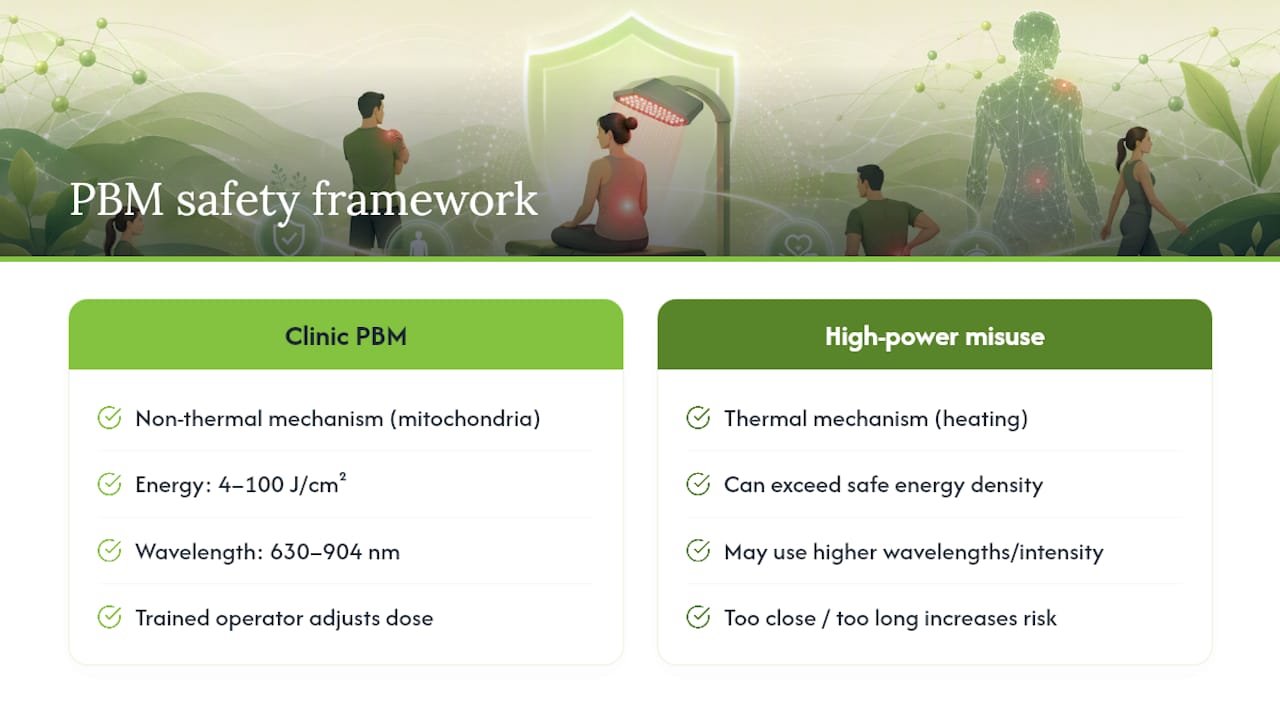
Therapeutic PBM doesn’t work by heating tissue. It works by modulating mitochondrial activity and peripheral nerve signaling, a non-thermal mechanism that’s the entire reason properly dosed treatment produces pain relief without burning skin. This is the detail that separates clinic-grade PBM from the high-power thermal lasers used for tissue ablation or aggressive deep-heating protocols. Those devices operate at intensities designed to generate heat on purpose. PBM devices used for chronic pain are calibrated to stay well below that threshold.
Burns and skin injury from red light therapy happen almost exclusively when devices are misused, run at excessive power, held too close, or applied for too long without proper calibration. That’s a device-and-protocol problem, not an inherent flaw in the therapy. Clinical protocols lean on validated ranges, typically 4 to 100 J/cm² of energy density and wavelengths between 630 and 904 nanometers, to balance how deep the light penetrates against how safe the exposure stays. A trained operator adjusting dose to your tissue depth and condition is doing real clinical work, not just pointing a light at you. If you’re weighing this against Class IV laser therapy, understand that the higher-power thermal lasers carry a different risk profile precisely because they’re built to generate heat.
Who Should Avoid PBM or Take Extra Precautions
Not every patient is a straightforward candidate, and a responsible clinic will ask about this before treating you, not after. The main areas of caution:
- Pregnancy — treatment over the abdomen or lower back during pregnancy is generally avoided as a precaution, even though direct harm data is limited.
- Active cancer near the treatment site — light-based stimulation of cell activity raises theoretical concerns near known or suspected malignancy.
- Photosensitizing medications — certain antibiotics, retinoids, and some psychiatric medications increase skin sensitivity to light exposure.
- Open wounds or active infection at the treatment site — these need separate management before PBM is appropriate.
- Implanted devices near the treatment area, including pacemakers, should be flagged and discussed with your provider.
Before your first visit, bring a full medication list, note any past skin reactions to light or heat, and mention any diagnosed skin conditions.
Pro Tip: Ask your clinic directly, “What energy density and wavelength are you using for my condition, and how do you adjust it for my tissue type?” A provider who can answer specifically, rather than vaguely, is one who’s actually individualizing your dose.
What a PBM Session Actually Feels Like
A typical in-clinic session runs somewhere in the range of 10 to 20 minutes, depending on the treatment area and your specific protocol. Most trial-based courses of care run two to three sessions per week for several weeks, though your clinician will adjust that based on how you respond. This isn’t a one-and-done treatment. It builds over a course of visits, similar to how physical therapy works cumulatively rather than instantly.
During the session, expect:
- Gentle warmth or tingling at the treatment site, nothing sharp or painful
- No downtime, you can typically return to normal activity right after
- Possible mild, brief soreness that settles within a day
Afterward, keep a simple note of anything unusual, timing, location, how long it lasted. That log matters if you need to describe a reaction to your provider later. Most patients notice nothing beyond mild warmth, but tracking your own response over a course of sessions helps your clinician fine-tune your dosing, especially if you’re also comparing costs between clinic-based and home-use devices.
When to Stop Treatment and Call Your Clinician
Most patients never hit this stage, but you should know the signs that mean stop and call, not wait and see:
- Blistering or skin breakdown at the treatment site
- Redness that’s spreading rather than fading
- Fever or any sign of systemic illness following treatment
- Drainage, unusual discharge, or new numbness and weakness
- Any symptom that’s getting worse instead of better over the following days
If any of these show up, stop treatment, photograph the area for reference, and contact your clinic promptly. If you notice systemic signs like fever or spreading infection, seek urgent medical care rather than waiting for your next scheduled visit. A well-run clinic documents these events formally, both for your chart and for the broader safety record of the treatment.
A Clinical Take on Where PBM Fits in Pain Care
I’ve treated enough chronic pain patients to know that the therapy itself is rarely the whole story. What matters more is whether it’s screened for, dosed for your specific tissue, and paired with the right supporting care. At Nortex Spine and Joint, we don’t treat PBM as a stand-alone fix. We screen for contraindications, document your history, and calibrate dosing to your condition, then often combine it with physical rehabilitation or regenerative treatments like PRP when your case calls for it. Patients who come in expecting instant, permanent relief from light alone are usually disappointed. Patients who understand it as one part of a broader plan tend to get more realistic, and more durable, results.
— Felix
Getting Started With Supervised PBM at Nortex
Unlike at-home devices, where dosing is a guess and monitoring is nonexistent, in-clinic red and near-infrared PBM is delivered under direct clinical supervision, with screening for contraindications and dosing calibrated to the patient’s specific condition. That’s the practical advantage of clinic-based care over a consumer device sitting in your living room: a trained provider adjusting your treatment in real time, not a fixed setting you’re left to interpret on your own.
Bring your current medication list, any prior imaging of the affected joint or spine region, and a simple timeline of your symptoms to your first visit. That information helps your provider decide whether PBM alone fits your case or whether it should be paired with something like PRP therapy or another regenerative option. If you’re ready to find out what an evidence-based, personalized plan looks like for your pain, schedule a consultation to explore Nortex’s regenerative medicine services.
Sources
This article draws on a meta-analysis of 48 laser therapy trials, a Frontiers systematic review of PBM in chronic pain, a 2025 RCT on lateral epicondylitis, and Cleveland Clinic’s patient guidance on red light therapy. For a patient-facing overview of who should avoid treatment, see this contraindications summary.
This article is general information, not a substitute for advice from a qualified doctor. Consult a qualified healthcare professional about your own circumstances before acting on anything here.
- High-Intensity Laser Therapy for Musculoskeletal Disorders: A Systematic Review and Meta-Analysis of Randomized Clinical Trials – PMC
- Photobiomodulation in chronic pain: a systematic review of randomized clinical trials – Frontiers (2026)
FAQ
Is Red Light Therapy Safe for Chronic Pain?
Yes, when delivered in a clinical setting with proper dosing, it carries a strong safety record, with systematic reviews finding essentially no serious adverse events across dozens of trials.
What Are the Most Common Red Light Therapy Side Effects?
Transient warmth, tingling, and occasional mild soreness are the most frequently reported reactions, and they typically resolve within hours to a day.
Can Red Light Therapy Cause Burns?
Standard clinic-grade PBM operates through non-thermal mechanisms and rarely causes burns; burns are associated with high-intensity thermal lasers or device misuse, not properly dosed PBM.
Who Shouldn’t Get Red Light Therapy?
People who are pregnant, have active cancer near the treatment site, take photosensitizing medications, or have open wounds or implanted devices near the area should discuss precautions with their provider first.
How Long Do Red Light Therapy Side Effects Last?
Most reported sensations, warmth, tingling, or mild soreness, resolve within a few hours and rarely persist beyond a day.
Does Nortex Spine and Joint Screen Patients Before PBM Treatment?
Yes, Nortex reviews medication history, medical conditions, and treatment goals before calibrating dosing, and often combines PBM with rehabilitation or regenerative therapies for a fuller treatment plan.