
Most patients in the Dallas area pay somewhere between $500 and $1,500 per PRP session, with a national mean near $707; for comparisons on pricing and alternative regenerative options, you can also refer to the PEMF therapy cost guide. Your actual cost depends on what joint or condition we’re treating and how many sessions your case needs. Before booking anywhere, ask the clinic exactly what’s included: the preparation kit, any imaging guidance, and the follow-up visit.
TL;DR:
- Osteoarthritis commonly calls for two to three injections, three to six weeks apart; three knee sessions at median rates total $2,100 to $2,400 before extras.
- Ultrasound guidance can explain a $300 to $500 quote gap for the same joint, so request written itemization of imaging, processing, syringes, and the follow up visit.
- Most commercial insurers and Medicare Advantage plans treat PRP as investigational for musculoskeletal conditions; verify coverage for your diagnosis and seek preauthorization before scheduling.
- Hip and spine injections often cost more because deeper placement requires imaging; clinics should price microneedling and other cosmetic procedures separately.
Table of Contents
- Typical Per-Session Price Ranges in the United States
- How Cost Varies by Treatment Area
- Key Factors That Determine What You’ll Pay for a PRP Session
- How Many Sessions You’ll Likely Need and What to Budget in Total
- Insurance, Coverage, and Billing for PRP
- How to Compare Clinic Quotes Before You Book
- Our Approach to Pricing and Patient Guidance
- Treatment Timeline: Session Length and Spacing
- Discounts and Financing Options for PRP in Dallas
- Dallas PRP Pricing Compared to Other U.S. Cities
- Common Misconceptions and Practical Shopping Advice
- How We Can Help You Plan Your PRP Treatment
- FAQ
- Sources
Typical Per-Session Price Ranges in the United States
When patients ask us what PRP “really costs,” we point them to the data rather than a guess. A national telephone survey of clinics found a mean PRP injection price of $707, with a standard deviation of $388, and a full range running from $175 up to $4,973. A separate survey of hospitals and clinics across metropolitan areas found median prices clustering between $700 and $800, with some quotes as low as $250 and others above $2,800 depending on the market and the provider.
In practice, three bands show up again and again:
- Budget tier ($250 to $500): Often a single-spin kit with no imaging, common at high-volume med spas.
- Mid tier ($500 to $1,500): The range most Dallas patients report, usually including ultrasound guidance for joint injections.
- Premium tier ($1,500 to $2,500 or higher): Reserved for multi-site treatment, higher-concentration kits, or combination therapies.
A national pricing study found that PRP injections vary widely, from $175 to nearly $5,000, with regional and income-related factors driving much of the spread. That gap is exactly why we tell patients to compare quotes line by line instead of shopping on a single advertised number.
How Cost Varies by Treatment Area
The joint or tissue we’re treating changes the price more than almost any other factor. Spine and hip injections typically run higher because they require ultrasound or fluoroscopic guidance to place the needle accurately near deep structures. Knee and shoulder injections are often less complex and tend to land in the middle of the pricing range. Cosmetic applications, like PRP for hair restoration or facial rejuvenation, follow a different pricing logic entirely, often tied to the number of syringes and whether we’re pairing PRP with microneedling.
- Knee or shoulder PRP: Usually mid-range, often one syringe and one injection site.
- Hip or spine-related PRP: Typically higher, due to the imaging guidance needed for accurate placement.
- PRP for hair restoration: Priced per session or per package, frequently combined with microneedling for better distribution.
- Facial PRP (the “vampire facial”): Priced similarly to hair restoration, with cost tied to syringe count and add-on treatments.
Combining PRP with microneedling or another cosmetic procedure adds a separate charge for that second treatment. A clinic quoting one flat number for “PRP plus microneedling” should be able to break that number into its two parts if you ask.
Key Factors That Determine What You’ll Pay for a PRP Session
In our consultations, we walk patients through the same handful of variables every time, because these are what actually move the price up or down, not the marketing on a clinic’s website.
- Preparation kit and spin protocol. A single-spin kit is less expensive to run than a double-spin system that concentrates platelets further, and that difference in overhead gets passed to the patient.
- Clinician credentials and setting. A board-certified physician working in a dedicated pain management or orthopedic clinic typically prices differently than a med spa or a general wellness center.
- Imaging guidance. Ultrasound-guided injections add precision and cost more than a “blind” injection based on anatomical landmarks alone.
- Number of syringes and sites. Treating two knees or multiple spinal levels in one visit costs more than a single-site injection.
- Anesthesia or adjunct therapy. Local anesthetic, a nerve block, or a same-day adjunct treatment adds a separate line item.
- Geography and clinic overhead. Research on orthobiologic pricing has linked regional cost differences partly to local population income, with the South averaging around $654 and the West around $778 per injection.
Pro Tip: Ask every clinic you call whether their quote includes imaging guidance. That single question often explains a $300 to $500 difference between two quotes for the same joint.
How Many Sessions You’ll Likely Need and What to Budget in Total
A single PRP session rarely tells the whole financial story. Most orthopedic conditions, like knee or shoulder osteoarthritis, respond better to a short series rather than one injection, and many patients come in expecting a one-time fix when the realistic plan is two or three sessions spaced a few weeks apart.
- One session: Sometimes sufficient for mild tendon irritation or as a trial before committing to a series.
- Two to three sessions: The common protocol for knee, shoulder, or hip osteoarthritis, spaced three to six weeks apart.
- Maintenance sessions: Some patients return for a single booster injection six to twelve months later if symptoms recur.
A three-session knee protocol priced at the reported median of roughly $700 to $800 per session lands in the $2,100 to $2,400 range total, before any imaging or adjunct fees. Package pricing can offer modest savings, but it’s only a good value if you’re confident you’ll need every session included.
Insurance, Coverage, and Billing for PRP
This is where we see the most confusion, and understandably so. Most commercial insurers and Medicare Advantage plans classify PRP as experimental or investigational for the majority of orthopedic indications, which means out-of-pocket payment is the norm rather than the exception. Medical policy documents from major payers commonly cite this investigational status and reference specific billing codes, including G0460, G0465, and P9020, that clinics use when processing claims.
- Ask your insurer directly whether PRP is covered for your specific diagnosis, not just in general.
- Request a predetermination or preauthorization letter before scheduling, since approval (when available) is rarely automatic.
- Ask the clinic for an itemized bill listing the HCPCS or CPT codes used, so you can see exactly what was billed.
Payer medical policies generally list PRP as experimental or investigational for most musculoskeletal conditions, which is the primary reason most patients pay directly rather than through insurance. If you want to understand your specific plan’s stance before booking, our guide to which insurance companies cover PRP injections walks through how to verify benefits ahead of time.
How to Compare Clinic Quotes Before You Book
Shopping for PRP by price alone is a mistake we see often, usually from patients who called one clinic, got a number, and booked without asking what that number actually covers. A better approach takes fifteen minutes on the phone with two or three clinics.
- Ask what the quote includes. Confirm whether the consult, blood draw, processing, and injection are bundled or billed separately.
- Ask about the kit and platelet concentration. A clinic that can tell you its platelet concentration figures is typically using a more rigorous protocol.
- Ask whether imaging guidance is used. For joint injections, ultrasound guidance is a meaningful quality marker, not just an upcharge.
- Ask how many syringes or sites are covered. Multi-joint cases should have a clear per-site breakdown.
- Ask about the follow-up plan. A documented recovery check-in, like the guidance in our PRP knee recovery timeline, should be part of the price, not an extra visit fee.
- Request a written, itemized estimate. A clinic confident in its pricing will put it in writing without hesitation.
A quote that’s unusually low with no explanation of the kit or imaging is a signal to ask more questions, not necessarily a reason to book immediately.
Our Approach to Pricing and Patient Guidance
When we quote PRP therapy, the estimate typically covers the consultation, blood draw, processing, the injection itself, and a follow-up visit to track your response. We’ve found that patients make better decisions when they understand that cost upfront rather than discovering add-on fees later. Part of our process includes helping you check what your insurance plan actually covers for your diagnosis before you commit to a treatment plan.
Realistic outcomes also matter here. Most patients notice gradual improvement over four to six weeks, not overnight, and we set that expectation clearly during the first visit rather than after treatment begins.
Treatment Timeline: Session Length and Spacing
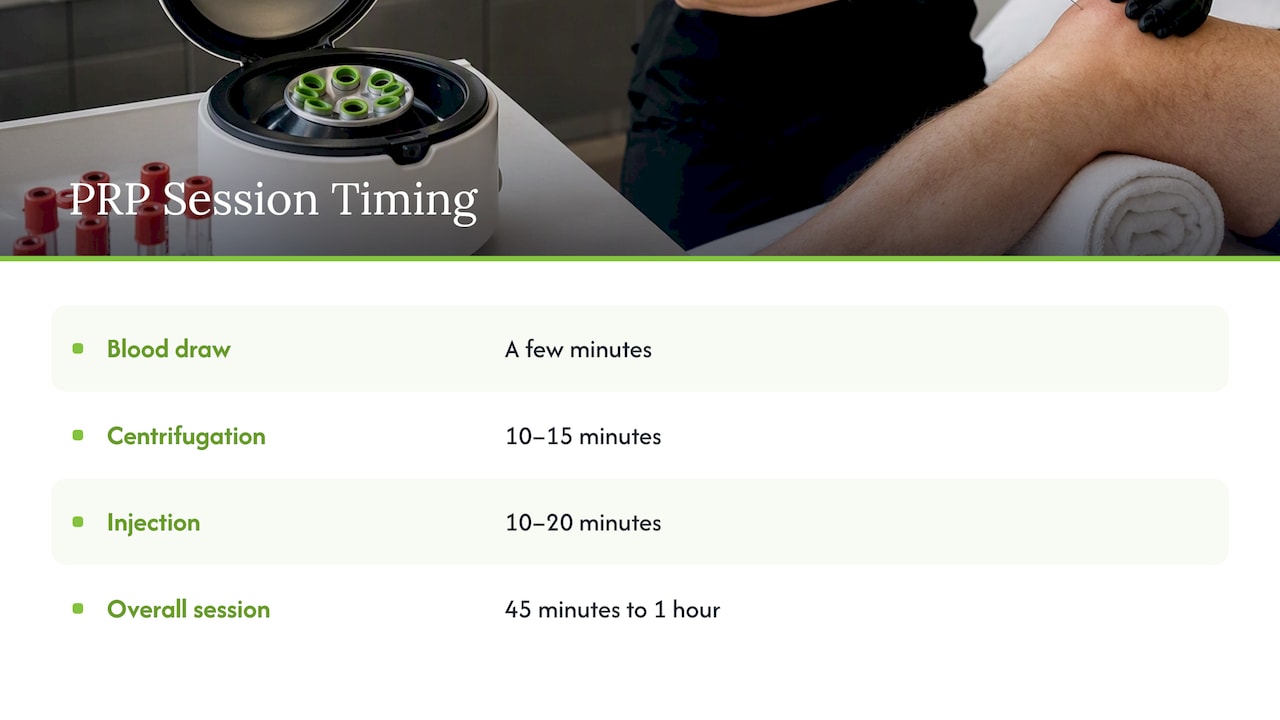
A single PRP session typically takes 45 minutes to an hour from blood draw to injection. The blood draw itself takes just a few minutes, but the centrifugation process that separates and concentrates platelets adds another 10 to 15 minutes before we’re ready to inject. The injection portion, especially with ultrasound guidance for a knee, hip, or shoulder, usually takes 10 to 20 minutes.
For orthopedic conditions, we generally space sessions three to six weeks apart when a series is recommended. That interval gives the tissue time to respond to the first injection’s growth factor activity before we assess whether a second round is warranted. Rushing the schedule doesn’t speed healing. It just adds cost without added benefit.
Most patients see initial changes in pain or function within four to six weeks of a session, though full benefit for conditions like knee osteoarthritis can take two to three months to become apparent. This is one of the most common points of confusion we address in consultations: patients expect PRP to work like a cortisone shot, with fast relief, when it actually works more gradually by supporting the body’s own repair process. Setting that expectation early prevents disappointment and helps patients judge, realistically, whether a second session is worth scheduling.
Discounts and Financing Options for PRP in Dallas
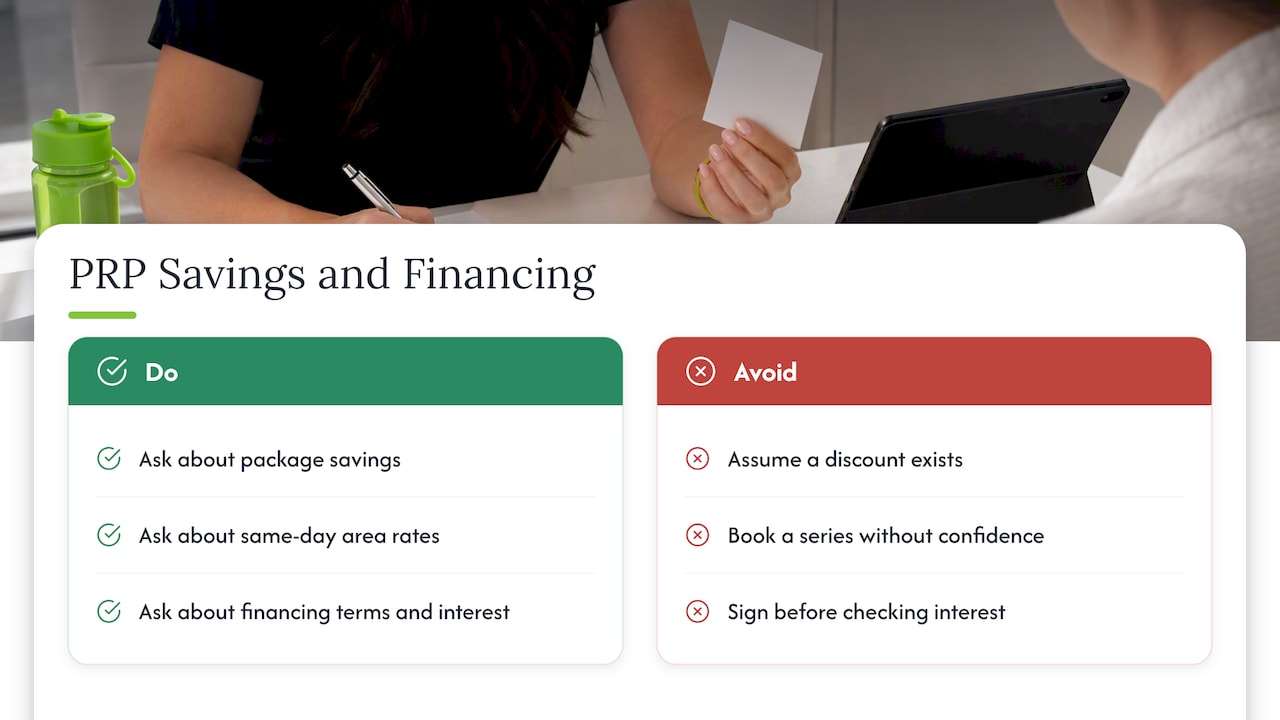
Dallas-area clinics vary in how they structure savings on PRP, and it’s worth asking directly rather than assuming a discount exists. Some practices offer a modest reduction for booking a multi-session package upfront, though that only makes financial sense if you’re confident you’ll need the full series. Others offer a reduced rate for a second treatment area done the same day, since the blood draw and processing overhead is shared.
Financing arrangements through third-party medical credit providers are common across pain management and regenerative medicine clinics, allowing patients to spread the cost of a session or package over several months. If cost is a barrier, ask specifically whether financing is available and what the terms are, including any interest charged, before you sign anything. A clinic that’s transparent about financing terms over the phone is usually just as transparent about its treatment pricing.
Dallas PRP Pricing Compared to Other U.S. Cities
Regional pricing studies have found that PRP costs vary by part of the country, with the South averaging around $654 per injection compared to about $778 in the West. Dallas, as a major Texas metro, tends to sit near or slightly below that Southern regional average, reflecting a lower cost of living and clinic overhead compared to coastal metros like Los Angeles, San Francisco, or New York, where PRP quotes often skew toward the higher end of the national range.
So while Dallas as a market tends to run moderate compared to the coasts, your actual price still depends far more on the specific clinic, kit, and protocol than on the city itself. Calling two or three Dallas-area clinics and comparing itemized quotes will tell you more than any regional average.
Common Misconceptions and Practical Shopping Advice
The biggest misconception we encounter is patients shopping purely on the lowest advertised number, then finding imaging, follow-up, or a second syringe billed separately. Package deals can trap patients into paying for sessions they don’t end up needing. Our advice stays the same: prioritize transparency and the clinician’s experience over the sticker price alone. A clear, itemized quote from an experienced provider is worth more than a vague discount.
— Felix
How We Can Help You Plan Your PRP Treatment
We provide itemized PRP quotes that cover your consultation, processing, injection, and follow-up visit, so there are no surprise line items. Our physicians are board-certified, and we’ll help you check your insurance before you commit to a plan. To get a personalized estimate, visit our PRP therapy page or explore our full range of regenerative medicine options and schedule a consultation.
This article is general information, not a substitute for advice from a qualified doctor. Consult a qualified healthcare professional about your own circumstances before acting on anything here.
FAQ
Does PRP cost a lot?
PRP costs more than a standard cortisone injection but less than surgery, with a national mean around $707 per session. Whether that feels like a lot depends on how many sessions your condition needs and whether insurance applies, which is uncommon for most indications.
How much does microneedling cost in Dallas, TX?
Microneedling pricing varies by provider and whether it’s combined with PRP, and clinics typically quote it as a separate line item from the PRP injection itself. When paired with PRP for hair or facial treatments, ask the clinic to break down each component so you can see what you’re paying for each part.
Can PRP regrow hair permanently?
PRP can support existing hair follicles and has shown benefit in some patients, but clinical evidence on orthobiologic treatments generally shows inconsistent results across different protocols and conditions. Most patients need maintenance sessions over time rather than a single permanent fix.
Is it worth doing PRP with microneedling?
Combining PRP with microneedling may improve how the plasma distributes into the skin or scalp, but this adds to your total cost since it’s billed as an additional procedure. Whether it’s worth it depends on your goals and budget, so ask your clinic for separate pricing on each component before deciding.
Will my insurance cover any part of PRP treatment?
Most commercial insurers and Medicare Advantage plans classify PRP as experimental or investigational for the majority of musculoskeletal conditions, so coverage is the exception rather than the rule. Checking your specific plan and requesting preauthorization before treatment is the only reliable way to know your coverage status.
Sources
- The cost variability of orthobiologics: an analysis of PRP and stem cell injection pricing
- Price transparency and variability for platelet-rich plasma injections across metropolitan areas
- Medicare Advantage medical policy: Platelet Rich Plasma Therapies