
Rest the treated area for the first 24 to 72 hours, skip NSAIDs if you can, and start gentle motion between days 4 and 14. From there, progressive strengthening usually begins around two weeks and builds toward heavier loading by weeks 6 to 12. You return to full activity, including sport or manual labor, once a clinical exam shows minimal pain and your function tests match your uninjured side, rather than relying solely on the passage of time.
TL;DR:
- Rest for 24 to 72 hours after PRP, avoiding NSAIDs and high-impact activities to support the inflammatory healing process.
- Progressively resume gentle motion between days 4 and 14, with strengthening typically starting around two weeks post-treatment.
- Return to full activity is based on clinical assessment of pain, strength symmetry, and functional tests, not just time elapsed.
- Most healing and functional improvements occur within 6 to 8 weeks, with tissue remodeling continuing for several months afterward.
- A second PRP injection is generally considered only after at least three months, once initial improvements plateau and rehab has been given ample time.
Table of Contents
- What Should You Do in the First Week After PRP?
- How Does the Phased Rehab Timeline Progress From Weeks to Months?
- How Do You Adjust Rehab for Tendons, Joints, and Spine Injections?
- What Pain Medication and Local Care Support Healing After PRP?
- When Are You Cleared to Return to Full Activity?
- When Should You Follow Up, and When Is a Second PRP Injection Worth Considering?
- How Does Post-PRP Rehab and Clinic Follow-Up Typically Work?
- What Nutrition and Lifestyle Habits Support Healing After PRP?
- What Adjunct Therapies Complement PRP Rehabilitation?
- How Do You Stay Motivated Through a Slow Recovery?
- A Clinician’s View on Common Post-PRP Setbacks
- Ready to Build a Structured Recovery Plan?
- Sources
- FAQ
What Should You Do in the First Week After PRP?
You’re not just recovering from a needle stick. PRP works by triggering a controlled inflammatory response in the treated tissue, and that inflammation is the mechanism, not a side effect to suppress. Growth factors released from concentrated platelets recruit repair cells and stimulate collagen production, and this process depends on some early inflammatory signaling to get started. That’s the biological reason we ask patients to hold off on anti-inflammatory medication and aggressive cooling in the first days after treatment.
Many patients come in expecting to feel better immediately, the way they might after a cortisone shot. PRP doesn’t work that way. It’s common to feel more soreness in the first two to three days than you did before treatment, and that flare is often a sign the biological process is underway, not evidence that something went wrong.
In the first 72 hours, here’s what to do:
- Keep the treated area relatively at rest. Avoid heavy lifting, running, or any loading that reproduces significant pain in the injected joint or tendon.
- Walk normally and continue light activities of daily living. Complete immobilization isn’t necessary and can slow recovery in its own way.
- Use acetaminophen for pain control if needed. It doesn’t interfere with the inflammatory cascade the way NSAIDs can.
- Apply heat cautiously if it feels comfortable; avoid deep tissue massage or aggressive ice packing directly over the injection site.
- Elevate and use light compression if your clinician recommends it, particularly for knee or ankle injections with swelling.
What to avoid during days 0–7:
- NSAIDs such as ibuprofen, naproxen, or high-dose aspirin. Clinical guidance consistently flags these as something to avoid in the immediate window after PRP treatment for chronic tendinopathy, since blunting the inflammatory response can blunt the treatment’s intended effect.
- High-impact exercise, heavy resistance training, or any movement that causes sharp, escalating pain rather than the dull ache of normal postprocedure soreness.
- Deep massage, aggressive stretching, or chiropractic manipulation directly over the treated joint or tendon within the first week.
- Alcohol in excess, which can amplify swelling and interfere with sleep quality during the early healing window.
Pro Tip: Keep a simple daily log of your pain on a 0 to 10 scale for the first two weeks. It sounds tedious, but when you come back for follow-up, “it’s been getting better since day 4, mostly stiff in the mornings” gives your clinician far more useful information than “it still hurts sometimes.”
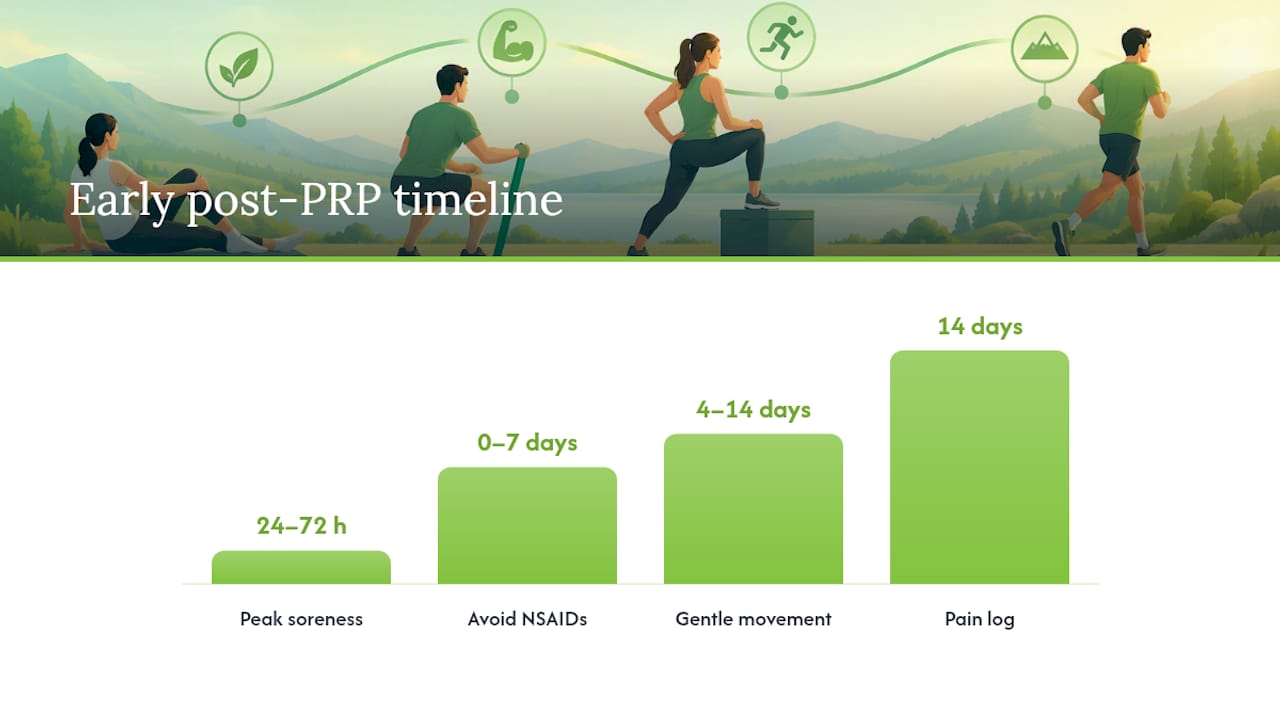
Most clinics that track week-by-week recovery describe a fairly consistent early pattern: soreness peaks in the first 24 to 72 hours, then gradually eases as gentle movement resumes around days 4 through 14, according to a clinic-based recovery timeline resource. If you’re three or four days out and still sore, that generally tracks with what’s expected, not a red flag.
Contact your clinician promptly if you notice: fever or chills, spreading redness or warmth well beyond the injection site, drainage that looks infected, new numbness or weakness in the limb, or pain that keeps escalating instead of leveling off after the third day. These aren’t part of the normal PRP recovery process, and they warrant a same-day call rather than a wait-and-see approach.
How Does the Phased Rehab Timeline Progress From Weeks to Months?
Rehabilitation after PRP isn’t a single prescription. It’s a sequence, and the sequence matters almost as much as the injection itself. A systematic review of PRP rehabilitation timing found that initial rest typically runs for several days, strengthening usually starts after about two weeks, and return to activity often occurs around six to eight weeks, though the exact window shifts depending on which tissue was treated and how you’re responding. Here’s how that plays out day by day.
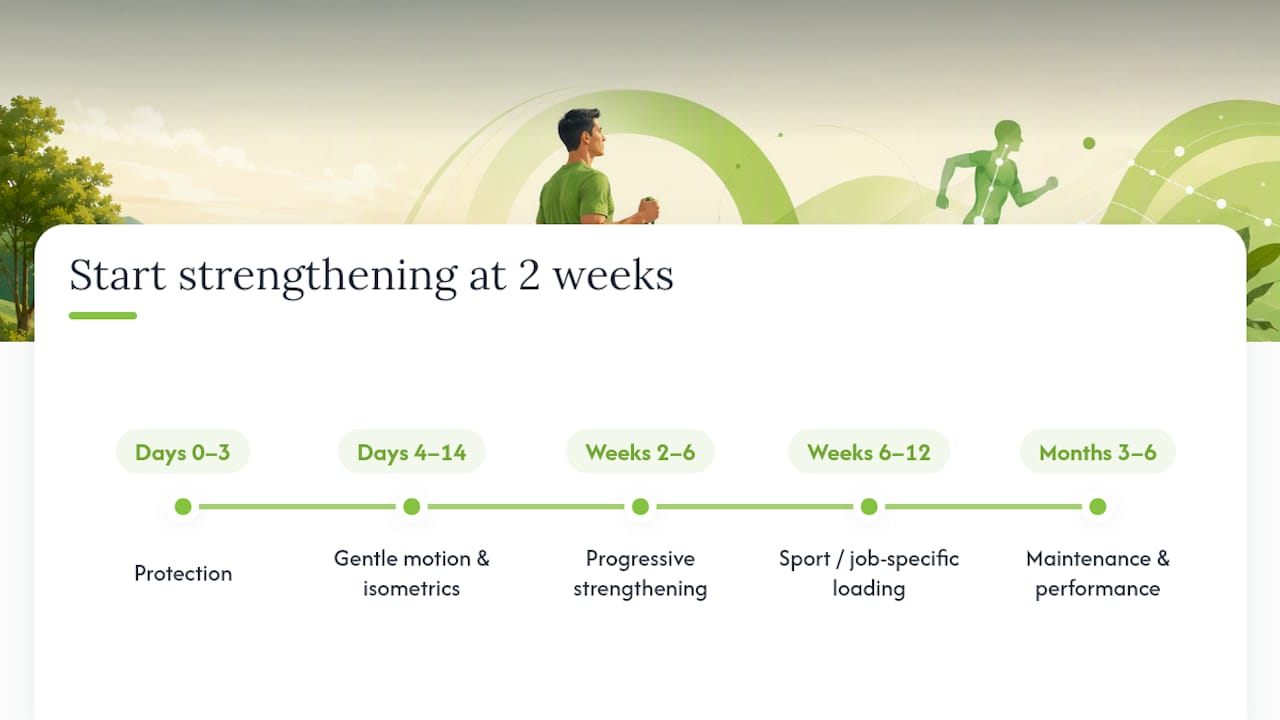
Phase 1: Days 0–3, protection
The goal here is simple: protect the treated area while allowing normal, low-load movement. You’re not trying to strengthen anything yet. Permitted movements include walking, light household tasks, and passive range of motion within a pain-free arc. If you had a knee injection, gentle bending and straightening while seated is fine. If it was a shoulder, pendulum swings without resistance are usually well tolerated. What you’re avoiding is any loaded movement, resisted exercise, or activity that produces more than mild discomfort.
Phase 2: Days 4–14, gentle motion and isometrics
This is where rehab actually begins. International expert panels, including the Delphi and GRIIP consensus groups, recommend starting structured tendon rehabilitation within 5 to 10 days of injection, built around subpainful isometric holds. “Subpainful” here has a specific meaning: pain during and after the exercise should stay at or below 3 out of 10 on a standard pain scale (VAS ≤3/10).
A typical isometric progression for a tendon injection, say a patellar or Achilles tendon, might look like this:
- Start with pain-free isometric holds against light resistance, three to five sets of 30 to 45 seconds, once or twice daily.
- Add gentle active range of motion between isometric sessions, staying within a comfortable arc.
- Check your 24-hour response. If pain the next morning is worse than it was the day before, scale back the load or hold duration.
- Progress hold intensity gradually over the second week as tolerance allows, always guided by that VAS ≤3/10 threshold rather than a fixed date.
For joint injections (hip or knee arthritis, for example), this phase looks a bit different. Instead of isometric holds, you’re typically doing gentle range-of-motion work, stationary cycling with no resistance, and pool-based movement if available. The tissue biology is different from a tendon, so the emphasis shifts toward restoring mobility and avoiding stiffness rather than isolated strength holds.
Phase 3: Weeks 2–6, progressive strengthening
This is the longest and most consequential phase, and it’s where most rehab plans succeed or stall. The sequence generally moves from isometric to concentric to eccentric loading, each stage building on the tolerance established in the last.
A sample weekly template during weeks 3 to 5 for a knee PRP patient might include:
- Monday/Thursday: Concentric strengthening, three sets of 10 to 12 reps, moderate resistance, focusing on quadriceps and hip stabilizers.
- Tuesday/Friday: Low-impact cardio conditioning, stationary bike or elliptical, 15 to 20 minutes at a comfortable pace.
- Wednesday: Active recovery, mobility work, light stretching, walking.
- Weekend: Rest or very light activity, monitoring for any delayed soreness.
For tendon cases, eccentric loading, the controlled lengthening of a muscle under tension, is usually introduced later in this window, often not until the fifth or sixth week, once concentric strength and pain control are established. Eccentric work is more provocative to healing tendon tissue, and rushing it is one of the more common setbacks I see in patients who feel good early and push too fast.
Throughout this phase, the 24-hour rule still applies: any exercise session that leaves you noticeably worse the next day gets scaled back, not abandoned. Progress isn’t measured by the calendar. It’s measured by how your tissue responds to load.
Phase 4: Weeks 6–12, sport and job-specific loading
By this point, most patients have rebuilt a meaningful base of strength and can tolerate higher demands. This phase introduces movement patterns specific to your job or sport: for a manual laborer, that might mean graduated lifting drills; for a runner, it means a structured return-to-run program starting with run/walk intervals; for an overhead athlete, it means progressive throwing or serving volume.
Plyometric work, jumping, cutting, rapid direction changes, gets introduced here if your tissue and goals call for it, and only once basic strength benchmarks are met.
Phase 5: Months 3–6, return to performance and maintenance
Tissue remodeling after PRP continues well beyond the point where pain resolves. Most clinics report meaningful improvement between weeks 2 and 6, but the biological remodeling process, the actual maturation of new collagen and tissue architecture, can continue for several months afterward. This phase is about consolidating gains: maintaining strength gains, fine-tuning sport-specific mechanics, and gradually reducing the frequency of dedicated rehab sessions as the treated area becomes a normal part of your training or work routine again.
How Do You Adjust Rehab for Tendons, Joints, and Spine Injections?
Not every PRP injection heals on the same clock, and treating a rotator cuff tendon like a knee joint, or a lumbar disc like an ankle ligament, is one of the more common mistakes I see in self-directed rehab plans.
Tendinopathies (Achilles, patellar, rotator cuff, tennis elbow) remodel slowly. Tendon tissue has relatively poor blood supply compared to muscle, so the timeline stretches out, and eccentric loading, the phase that stresses tendon fibers most directly, often waits until week 5 or 6 rather than starting early. Rushing eccentric work in a tendon case is probably the single most common way patients set themselves back after PRP.
Joint injections for arthritis (knee, hip) generally tolerate earlier range-of-motion work and low-impact cardio conditioning, since the primary goal is reducing stiffness and supporting cartilage health rather than reloading a discrete structure. Stationary cycling, pool walking, and elliptical training are usually well tolerated from the second week onward, and patients with hip arthritis often do well starting a graduated walking program earlier than tendon patients would. If you had PRP for hip arthritis, your rehab plan will likely emphasize mobility and low-impact strengthening before it emphasizes heavier loading. Knee PRP patients follow a similar logic, and a detailed knee recovery timeline can help you map expectations week by week.
Ligament and stability concerns, think ankle or knee ligament laxity, shift the emphasis toward neuromuscular control rather than pure strength. Balance drills, proprioceptive training on unstable surfaces, and graduated stability work matter as much as, or more than, straight strengthening. A ligament that’s structurally sound but poorly controlled neuromuscularly is still a re-injury risk.
Intradiscal and spine-related injections deserve the most caution of the group, and I say that from years of watching patients try to rehab a spine issue the way they’d rehab a knee. Timelines run slower, core and postural conditioning gets introduced gradually rather than aggressively, and monitoring for neurologic red flags, new numbness, tingling that radiates down a limb, changes in bowel or bladder function, needs to happen at every stage, not just in the first week. Any new neurologic symptom after a spinal PRP procedure warrants an urgent call to your treating physician, not a wait-and-see approach.
Age and general health also shape how aggressively rehab progresses. A 60-year-old with well-controlled diabetes and moderate knee arthritis typically needs a slower strengthening ramp than a 30-year-old amateur athlete with an isolated tendon injury, even when both received the same injection. Comorbidities that affect tissue healing, uncontrolled diabetes, smoking, certain autoimmune conditions, are worth discussing with your clinician up front, since they may extend the expected timeline without necessarily changing the destination.
What Pain Medication and Local Care Support Healing After PRP?
The instinct to reach for ibuprofen when something hurts is deeply ingrained, and it’s one of the first habits we ask PRP patients to break, at least temporarily.
Expert recommendations consistently classify NSAID avoidance in the postprocedure period as appropriate care, not an overly cautious suggestion. The tendinopathy rehabilitation consensus and related clinical guidance both point in the same direction: because PRP depends on a functioning inflammatory cascade to trigger repair, medications that suppress that cascade can work against the treatment in the days and weeks immediately following injection.
For pain control after PRP, here’s the practical guidance most clinics follow:
- Acetaminophen (Tylenol) is generally the preferred option for pain relief in the first several days to weeks, since it doesn’t interfere with prostaglandin-mediated inflammation the way NSAIDs do.
- If you’re on a daily NSAID for another condition, such as a heart medication regimen involving low-dose aspirin, talk to your treating physician before stopping anything. There are situations where the risk of stopping outweighs the theoretical benefit to PRP healing, and that’s a conversation to have with your prescriber, not a decision to make alone.
- Most clinicians suggest holding NSAIDs for at least the first one to two weeks, with some extending that window depending on the treated tissue and how the patient is responding.
- Heat, applied gently and briefly, tends to be better tolerated than ice in the days following PRP, since aggressive cooling can theoretically dampen the same inflammatory signaling the treatment relies on. That said, mild icing for comfort in the first 24 hours is unlikely to cause harm and is reasonable if swelling is significant.
Escalate your pain control conversation with your clinician, rather than simply increasing your own medication, if pain is climbing rather than plateauing after day 3, if over-the-counter acetaminophen isn’t touching the discomfort, or if you’re losing sleep consistently because of pain. Those situations call for a phone call, not a higher dose taken on your own.
When Are You Cleared to Return to Full Activity?
The most common question I get around week 4 or 5 is some version of “am I ready?” The honest answer is that a calendar date is a poor way to decide. Expert consensus is explicit on this point: return-to-activity decisions should rest on clinical exam findings and functional testing, not imaging and not an arbitrary number of weeks.
Here’s the general framework clinicians use to clear patients for higher-demand movement:
- Pain threshold during activity. The activity in question, running, lifting, throwing, should produce pain at or below 3 out of 10 on a standard scale, both during the activity and in the 24 hours afterward.
- Strength symmetry. Many clinicians look for strength in the treated limb reaching somewhere close to the uninjured side, often assessed through simple comparative testing like single-leg press strength or grip dynamometry, before clearing higher-load activity.
- Functional movement tests. For lower-body injuries, a single-leg hop test or a controlled step-down assesses whether the limb can absorb and produce force safely. For shoulder injuries, overhead reaching and light overhead loading without pain or compensation patterns is the equivalent check.
- Absence of compensation patterns. If you’re limping, favoring the limb, or altering your normal movement mechanics to avoid discomfort, that’s a sign you’re not ready, regardless of how many weeks have passed.
- Sport or job-specific progression. Even after clearing general activity, a graduated return, easy runs before tempo runs, light lifting before max effort, is safer than jumping straight back to full intensity.
Imaging (ultrasound, MRI) generally isn’t necessary to make this call. Structural appearance on a scan doesn’t always match how tissue actually performs under load, and consensus guidance specifically notes that clinical exam takes priority over imaging findings when clearing patients for return to activity.
When Should You Follow Up, and When Is a Second PRP Injection Worth Considering?
Most rehab plans include a scheduled follow-up somewhere around 4 to 8 weeks after the injection, timed to catch you in the middle of the strengthening phase where meaningful improvement should be visible if the treatment and rehab are on track.
At that visit, your clinician is looking for measurable change: has your pain scale dropped, has your functional testing improved, are you tolerating the exercises in your current phase without excessive flare-ups. Consensus guidance suggests that if you’re sitting in that partial-improvement zone, a second PRP injection is reasonable, but only after waiting roughly three months and giving your rehab program adequate time to work.
That three-month rule matters more than patients usually expect. A second injection too early doesn’t give the first treatment, or your rehab effort, a fair chance to show its full effect. If you’re not improving at all by that point, or you’re getting worse, that’s a different conversation, one that might point toward reassessing the diagnosis rather than repeating the same treatment.
To make the most of your follow-up, bring documentation:
- A simple exercise log noting what you did each week and how your body responded.
- Daily or weekly pain scores (VAS 0 to 10), especially noting any flares and what triggered them.
- Notes on functional milestones, when you first walked without a limp, when you first tolerated a full workout, when a specific movement stopped hurting.
This kind of record turns a vague “I think I’m doing better” into something your clinician can actually use to guide the next decision, whether that’s continuing rehab, considering a second injection, or exploring an alternative approach if PRP isn’t delivering the response you’d hoped for.
How Does Post-PRP Rehab and Clinic Follow-Up Typically Work?
PRP treatment and rehabilitation aren’t handled as two separate events. The rehab plan is built around your specific injection, your tissue type, and your baseline function, and not a generic handout given to every PRP patient regardless of what was treated.
A Nortex post-PRP rehab pathway typically includes:
- An individualized rehab plan built around the specific joint, tendon, or structure treated, rather than a one-size-fits-all protocol.
- Functional testing at follow-up visits to track objective progress, not just a subjective “how’s it feeling” check-in.
- Physician oversight throughout the rehab window, so medication questions, pain flares, and progression decisions get answered by someone who knows your case, not a generic FAQ.
- Clear criteria for when home exercise is sufficient versus when supervised physical therapy adds real value, particularly for tendon and spine cases where technique errors during early loading can slow recovery.
Not every patient needs supervised physical therapy after PRP. Someone with a straightforward knee injection and good baseline strength might do well with a clearly explained home program and periodic check-ins. Someone recovering from a spine-related injection, or a complex shoulder case with pre-existing weakness, usually benefits from hands-on guidance, at least through the strengthening phase, where load progression needs to be precise rather than approximate.
Pro Tip: If you’re not sure which category you fall into, ask directly at your follow-up: “Based on my exam today, do I need supervised PT, or is my home program enough?” That’s a fair question, and a good clinician will give you a specific answer, not a hedge.
What Nutrition and Lifestyle Habits Support Healing After PRP?
Tissue repair is metabolically demanding, and what you eat and how you sleep in the weeks after PRP genuinely affects how well the biological process works.
Protein intake matters more than most patients realize. Collagen synthesis, the actual rebuilding of tendon and connective tissue, requires adequate amino acid availability, so a diet with consistent protein throughout the day, not just at dinner, supports the repair process better than sporadic high-protein meals. Adequate hydration also supports circulation and nutrient delivery to healing tissue, something easy to overlook when you’re focused on exercise timing.
Sleep deserves more attention than it usually gets in recovery conversations. Growth hormone release and much of the body’s tissue repair activity happen during deep sleep stages, so consistently cutting sleep short during your rehab window can slow the process you’re otherwise doing everything right to support.
Smoking is worth addressing directly if it applies to you. Nicotine constricts blood vessels and measurably impairs the microcirculation that delivers healing factors to injured tissue, making it one of the more significant modifiable factors in PRP outcomes. Alcohol in excess has a similar, if less dramatic, dampening effect on inflammation and sleep quality during the critical early weeks.
Weight management, where relevant, also plays a role, particularly for lower-body joint injections. Every extra pound of body weight translates to multiplied force through the knee or hip during walking and stairs, and that added load can slow the functional recovery of a joint still working through its healing timeline, independent of anything happening at the cellular level.
None of this needs to be extreme. Reasonable protein intake, consistent sleep, limited alcohol, and not smoking during your rehab window give the biological process the support it needs without turning recovery into another source of stress.
What Adjunct Therapies Complement PRP Rehabilitation?
PRP and rehab don’t work in isolation, and several adjunct therapies commonly support the process without competing with it.
Manual physical therapy, when timed appropriately (generally not directly over the injection site in the first week), can address compensatory movement patterns that developed before treatment, patterns that don’t automatically disappear just because the underlying tissue is healing. A physical therapist trained in post-PRP protocols will typically layer in modalities like blood flow restriction training for certain lower-body cases, or targeted soft tissue work on surrounding muscles that have been overcompensating.
Low-level laser therapy and similar modalities are sometimes used adjunctively to support tissue healing, though the evidence base for these as standalone tools is considerably thinner than for the core rehab progression itself, so they’re best viewed as a complement rather than a substitute for structured exercise.
Bracing or taping can play a short-term supportive role, particularly for joint injections where some external stability helps a patient tolerate early movement with more confidence. The goal is temporary support, not long-term dependence. Leaning on a brace indefinitely can actually delay the neuromuscular strengthening your rehab program is trying to build.
Dry needling or targeted soft tissue mobilization on adjacent, non-injected muscle groups sometimes helps address the secondary tightness that develops from weeks of altered movement patterns, particularly in patients who were compensating for pain before treatment even started.
The unifying principle across all of these: adjunct therapies work best when they support the phased rehab progression rather than replace it. If a therapy is being used instead of progressive loading, rather than alongside it, that’s worth a direct conversation with whoever is overseeing your recovery.
How Do You Stay Motivated Through a Slow Recovery?
The psychological side of PRP recovery gets less attention than the physical side, but it matters just as much, especially during weeks 3 through 6, when initial excitement has faded and full recovery still feels distant.
Patients who do best tend to set process goals rather than outcome goals. “Complete this week’s exercise plan” is more useful, day to day, than “be pain-free by next month,” because the first is entirely within your control and the second depends on biology that moves at its own pace. Tracking small functional wins, walking further without discomfort, sleeping through the night without pain waking you, matters more for morale than watching a pain score creep down by half a point.
Pain flares during the strengthening phase are common, and they tend to shake confidence more than they should. A setback after a good week doesn’t erase the progress that came before it; it usually means one session pushed slightly past what the tissue was ready for that day, which calls for a small adjustment, not a full restart. Patients who treat every flare as proof the treatment failed often disengage from rehab exactly when consistency matters most.
Having a specific person to report progress to, whether that’s a physical therapist, a treating physician, or even a structured log reviewed at follow-up, tends to improve adherence more than willpower alone. Accountability built into the process outperforms motivation you’re expected to generate on your own.
A Clinician’s View on Common Post-PRP Setbacks
The single biggest mismatch I see between expectation and reality is timeline. Patients picture a cortisone-shot experience: fast relief, quick return to normal. PRP is a slower, biological process, and improvement usually unfolds over weeks, sometimes months, not days. When I explain this clearly before treatment, patients handle the early flare and the slow middle stretch far better than when they discover it after the fact.
Pain flares during weeks 2 through 4 are common, and they’re rarely a sign the treatment failed. The instinct to stop exercising entirely after a bad day is understandable, but it’s usually the wrong move. Scaling back load for a session or two, then continuing, tends to serve patients better than abandoning the program and restarting from scratch weeks later.
If someone isn’t showing meaningful improvement by the eight-week mark, that’s when I start considering alternate or adjunctive approaches, whether that’s adjusting the rehab plan, reassessing the original diagnosis, or discussing a second injection once the three-month window has passed. Realistic timelines aren’t a way of managing expectations downward. They’re what actually lets patients stick with a program long enough for it to work.
— Felix
Ready to Build a Structured Recovery Plan?
Reading a rehab timeline is one thing. Having a clinician adjust it in real time, based on your exam findings and how your tissue is actually responding, is another. That’s the gap Nortex Spine and Joint is built to close: instead of guessing whether you’re ready to progress a phase or should hold back another week, you get an individualized plan and physician oversight through the entire post-PRP window.
If you’re weighing treatment or already scheduled, PRP therapy at Nortex integrates directly with a structured rehab plan rather than sending you home with a generic handout. And if you’re past the injection stage and working through strengthening now, our physical therapy team can pick up exactly where your home program leaves off, with functional testing to confirm you’re progressing safely rather than guessing. For readers exploring broader options, our regenerative medicine program covers how PRP fits alongside other non-surgical treatments. Call to schedule a consult and get a rehab timeline built around your actual exam findings, not a generic calendar.
Sources
- Systematic review and rehabilitation timing (PubMed entry)
- Rehabilitation and return to activity after platelet‑rich plasma injections in chronic tendinopathies: Consensus
This article is general information, not a substitute for advice from a qualified doctor. Consult a qualified healthcare professional about your own circumstances before acting on anything here.
FAQ
How many days should I rest after PRP?
Most guidance calls for relative rest of the treated area for 24 to 72 hours, with some cases extending to a full week depending on the tissue treated. A systematic review of PRP rehabilitation found initial rest periods commonly ranging from 2 to 7 days before gentle movement resumes.
Can PRP under the eyes go wrong?
Cosmetic PRP injections around the eyes carry the same general risks as any injection: bruising, swelling, and occasional asymmetry while healing settles. Choosing a qualified, experienced provider and following aftercare instructions closely reduces most avoidable complications, though individual results and healing time vary.
Is nerve damage a potential side effect of PRP injections?
Nerve injury from PRP is uncommon but not impossible, since the needle passes near nerve tissue during many injection sites, particularly spine-related procedures. Report any new numbness, tingling, or weakness after PRP to your treating physician promptly rather than waiting to see if it resolves on its own.
What are the potential complications associated with PRP therapy?
The most common complications are temporary pain flare, swelling, and bruising at the injection site, which typically resolve within the first week. Less common risks include infection, excessive bleeding in patients on blood thinners, and, rarely, nerve irritation, all of which warrant contacting your clinician if symptoms escalate rather than improve.
When should I consider a second PRP injection?
This three-month guideline gives the original treatment and your rehab program adequate time to show their full effect before repeating the procedure.