
PRP injections for knee osteoarthritis produce a clinically meaningful improvement in a majority of patients, though exact success rates vary based on definitions and follow-up duration. A large meta-analysis of 18 randomized controlled trials found statistically significant WOMAC and VAS improvements out to 12 months, and clinicians at Mayo Clinic report similar real-world ranges of about 60% to 70%. The exact number moves depending on platelet concentration, patient selection, and whether “success” means any improvement or a specific clinical threshold.
TL;DR:
- High-platelet PRP preparations show more durable pain relief at 3, 6, and 12 months compared to lower-concentration injections, affecting success rates.
- Overall effectiveness averages around 60% across studies, with success varying based on patient factors like osteoarthritis severity and joint alignment.
- Success rates differ widely due to heterogeneity in PRP preparation methods, injection techniques, and follow-up periods across trials.
- Candidates typically have mild to moderate osteoarthritis, good knee alignment, and are willing to participate in rehabilitation programs alongside the injections.
- PRP is generally safe with mild side effects, but it is less effective in advanced joint damage and heavily relies on proper preparation and patient selection.
Table of Contents
- Prp Success Rate Knee: What the High-Quality Evidence Shows
- What Factors Actually Change Your PRP Outcome?
- How Is PRP for the Knee Actually Done?
- What Are the Risks and Common Failure Points?
- How Should You Read a PRP Success Percentage?
- Are You a Good Candidate for Knee PRP?
- A Clinician’s Perspective on Setting Realistic Expectations
- What to Expect From a PRP Consultation at Nortex Spine and Joint
- Sources
- FAQ
Prp Success Rate Knee: What the High-Quality Evidence Shows
You want the number, but you also deserve to know where it comes from. That distinction separates a durable treatment decision from a hopeful guess.
The strongest evidence on PRP success rate for knee osteoarthritis comes from a meta-analysis pooling 18 randomized controlled trials covering 1,995 patients. This is the kind of study design that carries real weight, because it isn’t one clinic’s experience or one small trial’s fluke result. It’s a synthesis of controlled comparisons against placebo, run across different centers and patient populations.
The pooled data showed statistically and clinically significant WOMAC score improvements at 1, 3, 6, and 12 months following injection. That last data point matters more than people realize. A lot of injectable treatments for knee arthritis show a nice bump at six weeks that fades by month six. PRP, at least in the pooled analysis, held up through a full year in a meaningful subset of patients.
Here’s where the concept of MCID becomes essential, and where a lot of marketing claims get sloppy. MCID stands for minimal clinically important difference. It’s the smallest change in a pain or function score that a patient would actually notice and care about in daily life, not just a statistically significant blip on a chart. A treatment can produce a “statistically significant” result that’s clinically irrelevant, or a modest-sounding number that patients experience as a real difference in how their knee feels walking upstairs.
The meta-analysis found that PRP crossed the MCID threshold for pain and function at multiple time points, which is a stronger claim than simply saying “scores improved.” When you read a PRP study and it stops at “statistically significant,” ask whether it also reports MCID. If it doesn’t, you’re looking at half the picture.
Platelet concentration changed the story substantially. Patients who received high-platelet PRP preparations showed more durable pain relief at 3, 6, and 12 months compared to those who received lower-concentration preparations. This is one of the more useful findings in the entire body of PRP research, because it explains why success rates in the literature vary so widely from study to study. Two trials can both call their intervention “PRP” and get very different results because the actual product injected wasn’t the same.
A separate retrospective cohort study examining predictors of PRP effectiveness reported overall effectiveness near 60% in their patient population, with meaningfully better outcomes in certain subgroups. That number sits comfortably inside the range reported elsewhere, which is reassuring. When multiple independent research groups using different methods land in the same neighborhood, that consistency itself is a signal worth trusting.
A few numbers worth holding onto from the pooled evidence:
- Trials included: 18 randomized controlled trials, 1,995 patients total
- Significant WOMAC improvement reported at 1, 3, 6, and 12 months
- High-platelet PRP showed more durable pain relief specifically at 3, 6, and 12 month marks
- Independent cohort data put real-world effectiveness near 60%
- Clinician-reported practice ranges commonly cited at 60% to 70%
The honest caveat: heterogeneity across these trials is real. Different studies use different PRP preparation kits, different injection volumes, different definitions of “improvement,” and different follow-up windows. That’s why you’ll see the success rate quoted anywhere from the high 40s to the mid 70s depending on which paper you’re reading and which outcome measure they used. None of those numbers are wrong. They’re measuring somewhat different things.
What Factors Actually Change Your PRP Outcome?
The wide range in reported success rates isn’t a red flag. It’s a reflection of how many variables affect the outcome, and understanding them helps you evaluate your own likely response before you ever sit down in a consultation.
Platelet concentration is probably the single biggest lever. Subgroup analyses in the pooled RCT data used roughly 1,000,000 platelets per microliter as a cutoff between high and low concentration preparations, and the high-concentration group consistently showed more durable results. If a clinic can’t tell you roughly what concentration their PRP achieves, that’s worth asking about directly.
Leukocyte content and activation status add another layer of complexity. Leukocyte-rich PRP contains white blood cells that may drive inflammation in the short term, which some clinicians believe helps kick off a healing response and others worry may aggravate an already inflamed joint. A network meta-analysis on PRP composition found that activation status may influence outcomes on certain function measures, though the authors were careful to note the evidence is still evolving and more trials are needed. This is genuinely unsettled territory, not a solved question.
Patient-specific factors matter just as much as the product itself:
- Severity of osteoarthritis (mild to moderate tends to respond better than advanced, bone-on-bone disease)
- Knee alignment, since significant varus or valgus deformity changes the mechanical load PRP can’t fix on its own
- Age and baseline activity level
- Body mass index
- How many other treatments have already failed before PRP is tried
Procedural factors round out the picture. Ultrasound guidance during injection improves placement accuracy into the joint space compared to a landmark-based injection done blind. Operator experience and the volume of PRP injected also play a role, though these are harder to quantify across studies since reporting standards vary.
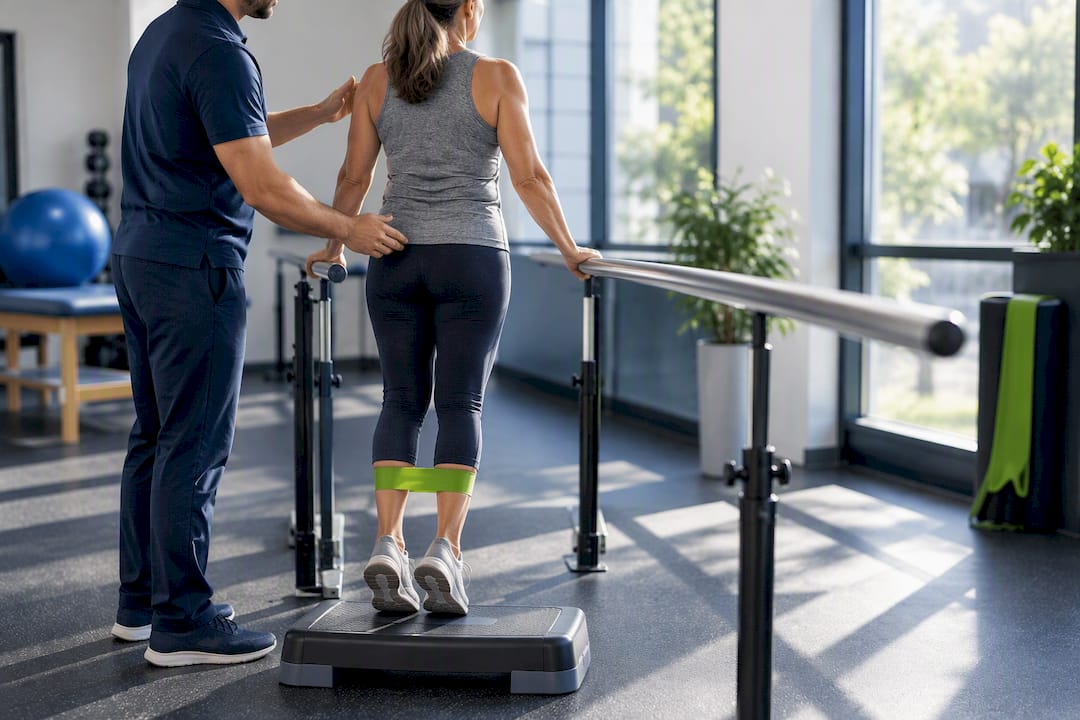
Pro Tip: Rehab isn’t an afterthought to PRP, it’s part of the treatment. Patients who pair the injection with a structured physical therapy plan tend to report better and more durable outcomes than those who get the shot and change nothing else about how they move.
How Is PRP for the Knee Actually Done?
Most patients picture something more complicated than it actually is. The procedure itself is fairly brief, typically completed in about an hour in an outpatient office setting.
- Blood draw. A clinician draws a small sample of your own blood, usually from the arm, just as with a routine lab test.
- Centrifuge processing. The sample is spun in a centrifuge to separate and concentrate the platelets from the rest of the blood components, producing the platelet-rich plasma that gets injected.
- Injection into the knee joint. This step is frequently done under ultrasound guidance to confirm accurate placement inside the joint capsule rather than the surrounding soft tissue.
- Recovery and activity guidance. You can typically resume routine activities quickly, though your clinician may recommend easing back into higher-impact exercise over a few days.
Protocols vary between clinics. Some use a single injection, while others recommend a series of two to three injections spaced roughly two to four weeks apart. There isn’t a single universally agreed-upon regimen, which is part of why comparing PRP outcomes across different providers can be genuinely confusing for patients trying to research options on their own.
On timeline, don’t expect overnight relief. Symptom improvement often appears somewhere between six weeks and three months after injection, with benefits typically peaking around the three to six month mark. In patients who received high-platelet preparations, some of that benefit persisted out to 12 months and beyond. This is slower than a steroid injection, which can work within days, and that difference in timeline is worth understanding going in.
What Are the Risks and Common Failure Points?
PRP carries a favorable safety profile because it uses your own blood, which Johns Hopkins Medicine notes substantially lowers the risk of allergic or immune reaction compared to synthetic injectable options. The most common side effects are soreness, swelling, and mild bruising at the injection site, usually resolving within a few days.
Serious adverse events are uncommon in the published literature, but PRP still fails to help some patients, and it’s worth knowing why:
- Advanced joint damage, particularly bone-on-bone arthritis, tends to respond poorly since PRP works best on tissue that still has some regenerative capacity
- Poor candidate selection, including patients whose pain is driven by a mechanical problem PRP can’t address
- Low platelet concentration in the prepared injection, sometimes due to processing method or an underlying patient factor
- Unaddressed biomechanical issues like significant malalignment that continue loading the joint the same way regardless of the injection
- Skipping rehab entirely, which appears to blunt the durability of results in several analyses
One more practical note: PRP is frequently an out-of-pocket expense, since insurance coverage remains inconsistent across providers and plans. It’s worth calling your insurer directly and asking about your specific policy before assuming either way.
How Should You Read a PRP Success Percentage?
A published success rate is not a promise about your knee specifically. It’s a summary of what happened, on average, across a group of people who may or may not resemble your case closely.
Here’s the distinction that trips people up: a study might report a mean improvement in WOMAC score of, say, 20 points. That’s an average across the entire study group. A “success rate,” by contrast, usually refers to the percentage of individual patients who crossed the MCID threshold, meaning they personally experienced a change large enough to notice in daily life. These are related numbers, but they’re not the same number, and headlines often blur them together.
Timing changes the headline figure too. A trial reporting outcomes at three months will often show a different percentage than the same trial reporting at 12 months, because some patients’ benefit fades while others’ holds steady or even improves as tissue remodeling continues. Reports that only give you a single number without specifying the follow-up window are giving you an incomplete answer.
Subgroup reporting shifts things further. If a study lumps high-platelet and low-platelet preparations into one overall percentage, that blended number understates how well the high-concentration group actually did and overstates the low-concentration group’s results. Whenever you can find subgroup data broken out by platelet dose, it’s more useful than the topline average.
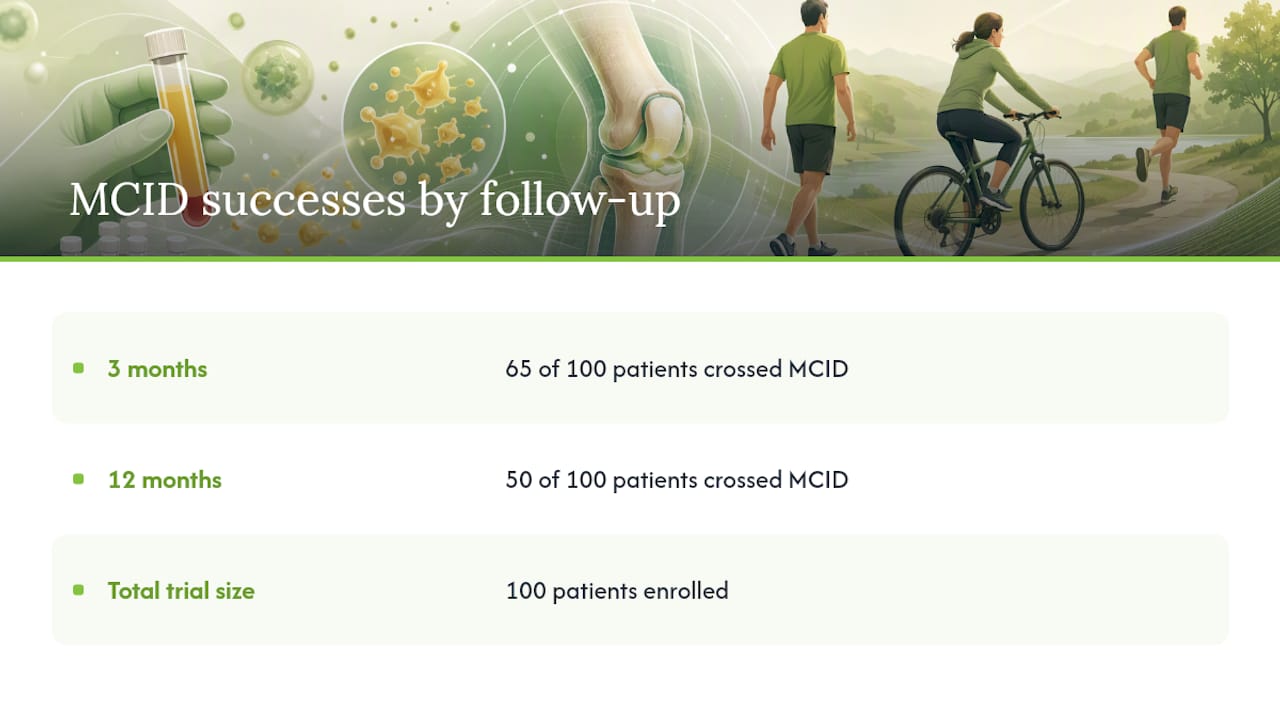
Here’s a worked example to make this concrete. Imagine a hypothetical trial of 100 patients where 65 cross the MCID threshold for pain relief at three months, but only 50 still show that same threshold-crossing improvement at 12 months. A clinic quoting you only the higher, earlier number without the follow-up caveat isn’t lying, but it isn’t giving you the full clinical picture either.
Are You a Good Candidate for Knee PRP?
Before you book anything, it helps to run through a short mental checklist, the same one a clinician should be running through with you during a consultation.
Good candidates for PRP tend to share a few traits:
- Mild to moderate osteoarthritis rather than advanced bone-on-bone disease
- Reasonably intact knee alignment, or alignment issues that are being addressed alongside the injection
- Realistic expectations about a gradual, months-long response rather than immediate relief
- Willingness to commit to a rehab or physical therapy plan alongside the injection
- A history of trying more conservative measures first, such as activity modification, bracing, or anti-inflammatory medication
When you’re evaluating a clinic, ask direct questions rather than accepting vague reassurance. Ask what platelet concentration their processing system typically achieves. Ask whether their PRP is leukocyte-rich or leukocyte-poor, and why they chose that formulation for your case. Ask whether the injection is done under ultrasound guidance. Ask what specific outcome measures they track and at what follow-up intervals. A clinic that can answer these clearly is demonstrating that they understand the variables driving outcomes, not just performing a procedure.
Pro Tip: If a provider guarantees a specific result, skip imaging before recommending PRP, or hands you the injection with no rehab plan attached, treat that as a red flag rather than a selling point. Evidence-based care includes uncertainty, not promises.
There are cases where PRP simply isn’t the right first move. If imaging shows advanced structural damage, or if a mechanical problem like a torn meniscus or significant malalignment is driving your symptoms, a steroid injection for short-term flare control, hyaluronic acid for lubrication, or a surgical referral may be the more appropriate conversation. A good clinician will tell you that plainly rather than steering you toward the treatment they happen to sell.
A Clinician’s Perspective on Setting Realistic Expectations
Many patients come in after trying multiple treatments and want a single number. The honest answer is a range, not a guarantee, and it depends heavily on how advanced the arthritis is and whether rehab is part of the plan. What matters most in practice is matching the treatment to the joint you actually have, not the joint you wish you had.
— Felix
What to Expect From a PRP Consultation at Nortex Spine and Joint
If you’re weighing PRP against steroid injections, hyaluronic acid, or surgical referral, an advantage is a physician-led evaluation that looks at your imaging, your activity goals, and your prior treatment history before recommending anything, rather than defaulting to one product for every knee. Nortex offers PRP therapy for chronic knee pain alongside broader regenerative medicine options, and pairs injection-based care with structured physical therapy when rehab is likely to improve your odds of a durable result. If you’re also comparing PRP against related platelet-based approaches like PRF, it’s worth reading how other regenerative clinics describe the tradeoffs between the two before your consultation. The next step is simple: schedule an evaluation to find out whether your knee, your imaging, and your goals make you a reasonable candidate for PRP, or whether a different approach fits your situation better.
This article is general information, not a substitute for advice from a qualified doctor. Consult a qualified healthcare professional about your own circumstances before acting on anything here.
Sources
- PRP Injections for the Treatment of Knee Osteoarthritis: The Improvement Is Clinically Significant and Influenced by Platelet Concentration: A Meta-analysis of Randomized Controlled Trials – PMC
- PRP injection for knee osteoarthritis: Does it work? – Harvard Health
- Platelet-Rich Plasma (PRP) treatment – Johns Hopkins Medicine
- Analyzing the performance of platelet-rich plasma and bone marrow aspirate concentrate injections for the treatment of knee osteoarthritis – Mayo Clinic
FAQ
Is PRP Worth It for Knee Pain?
For patients with mild to moderate osteoarthritis who haven’t responded fully to conservative care, PRP is often worth considering, with pooled trial data showing clinically meaningful improvement lasting up to 12 months in many patients. It’s less likely to help significantly in advanced, bone-on-bone arthritis.
What Causes PRP to Fail for Knee Pain?
PRP most commonly fails when the joint damage is too advanced for regenerative treatment, when the injection uses a low platelet concentration, or when biomechanical issues like malalignment go unaddressed. Skipping rehabilitation after the injection also appears to reduce the durability of results.
What Are the Downsides of PRP Injections in the Knee?
The main downsides are temporary soreness, swelling, and bruising at the injection site, along with a slower onset of relief compared to steroid injections. Cost is another factor, since PRP is often an out-of-pocket expense depending on your insurance plan.
Can PRP Regenerate Cartilage in the Knee?
The current evidence supports PRP’s role in reducing pain and improving function rather than proven cartilage regrowth in humans. The meta-analysis of RCTs documents functional and pain improvements, but cartilage regeneration specifically isn’t established as a confirmed mechanism.
How Many PRP Injections Does the Knee Typically Need?
Some patients receive a single injection, while others follow a series of two to three injections spaced a few weeks apart, depending on the clinic’s protocol and how you respond. You can review typical regimens in more detail on how many PRP injections are needed for knee pain relief.