
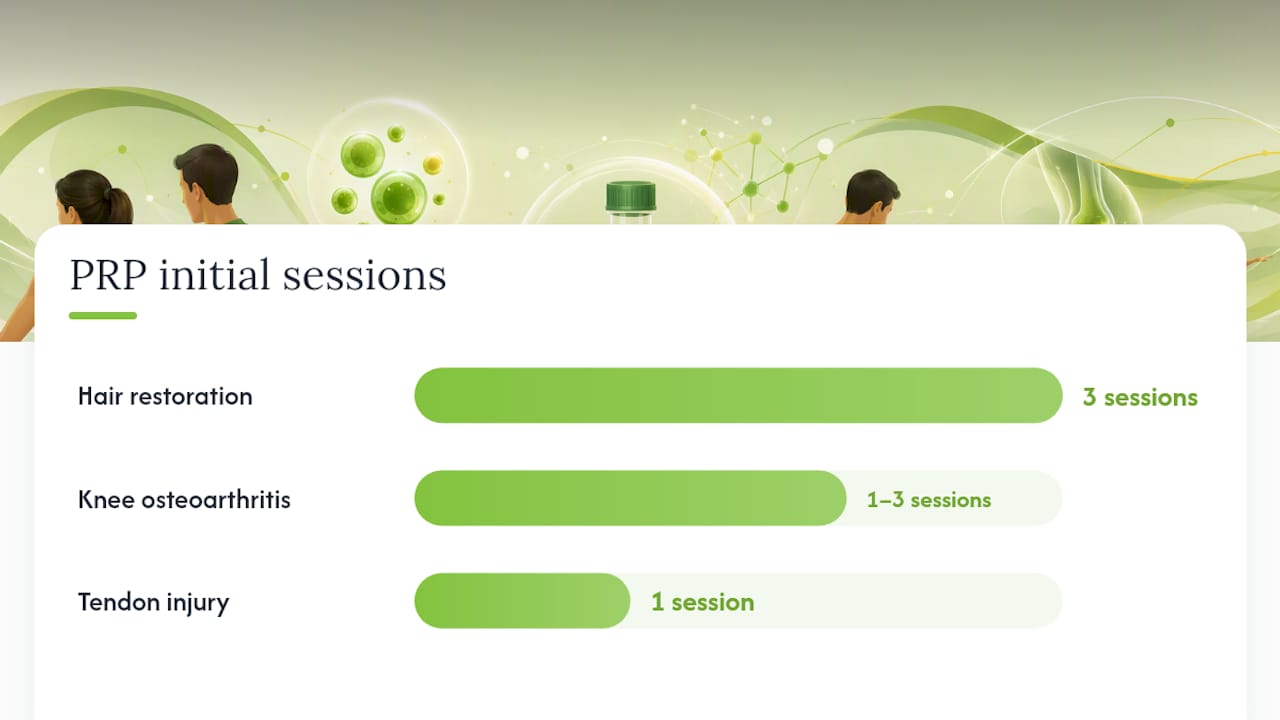
Short answer: PRP schedules differ by what you’re treating. Hair restoration typically uses three monthly sessions before results are judged. Knee osteoarthritis protocols range from one to three injections, with some trials favoring three for durability at one year. Tendon injuries carry the weakest evidence, and a single injection paired with rehab is often the more conservative starting point. Every plan should hinge on measurable progress, not a fixed calendar.
TL;DR:
- Multiple injections benefit early-stage knee osteoarthritis, with three injections spaced about two weeks apart showing better one-year outcomes than fewer doses.
- Hair restoration protocols typically involve three monthly PRP sessions, but the low quality of evidence means optimal spacing and number remain uncertain.
- Tendon injuries show no clear advantage for multiple PRP injections over a single dose, emphasizing conservative starts paired with rehab first.
- Objective assessment points, such as pain scores and functional measures, should guide decisions on repeating PRP rather than fixed calendar intervals.
- PRP’s effectiveness diminishes with advanced tissue damage, and real-world results depend heavily on preparation methods, condition severity, and combined therapies.
Table of Contents
- What Is the Recommended PRP Treatment Frequency by Condition?
- What Does the Research Actually Show About PRP Dosing?
- How Do Clinicians Decide When to Repeat PRP?
- What Does a Practical PRP Schedule Look Like?
- What Are the Risks and Realistic Expectations for PRP?
- How Nortex Spine and Joint Builds an Individualized PRP Schedule
- Ready to Talk Through Your PRP Options?
- What Should You Take Away From the Research?
- Sources
- FAQ
What Is the Recommended PRP Treatment Frequency by Condition?
You won’t find one PRP treatment frequency that applies across the board, and that’s not an oversight in the research. It reflects real biological differences between a joint, a tendon, and a scalp. Each tissue heals on its own timeline, responds to platelet concentration differently, and has been studied with different protocols. Understanding why the schedules diverge helps you evaluate what your own clinician recommends, instead of just accepting a number.
Hair restoration protocols. Most published hair-loss trials use monthly PRP sessions, often around three in a row, before evaluating results. A 2024 systematic review found that many hair-PRP studies followed this monthly pattern, though the evidence quality across those trials was rated low because of inconsistent protocols and study design. That doesn’t mean the treatment doesn’t work. It means researchers haven’t agreed on the ideal spacing, concentration, or number of sessions, so clinics extrapolate from the studies that exist. A separate meta-analysis covering 27 controlled trials and over a thousand participants found PRP increased hair density compared to saline in the medium term, but again flagged the evidence as low to very low quality due to heterogeneity. Scalp tissue also just moves slowly. Follicles cycle over months, not weeks, which is why trials typically don’t check results until well after the final injection.
Knee osteoarthritis protocols. This is where the dosing question gets more interesting, because a well-designed trial actually compared different numbers of injections head to head. A randomized, single-blind trial of knees tested one, two, or three PRP injections spaced about two weeks apart in patients with early-stage osteoarthritis. The three-injection group showed superior outcomes at the one-year mark compared to the single or double-dose groups, whose benefits tended to fade after six months. That’s a meaningful data point, but it comes with a caveat: this was early-stage OA. Patients with more advanced joint damage don’t necessarily follow the same pattern, and stacking more injections onto a joint with significant cartilage loss rarely closes that gap.
Tendon and soft-tissue protocols. Here the picture gets murkier, and honestly, it’s where you should be most skeptical of confident promises. High-quality randomized trials on chronic Achilles tendinopathy found no significant difference between PRP and a sham injection at six months or one year, using validated function scores. That result held even in trials where PRP was paired with structured rehab, which tells you the injection itself wasn’t the variable driving improvement, rehab was doing the heavy lifting. Many patients come in asking for a series of tendon injections because they’ve read that “more is better.” In practice, the evidence supports the opposite: start conservatively, often with a single injection, and lean on progressive loading exercises before considering a repeat dose.
Shoulder and other joints. Protocols for shoulder pain, hip arthritis, and smaller joints borrow heavily from the knee OA literature since dedicated large trials are less common. Clinics typically apply similar spacing, one to three injections a few weeks apart, adjusted for the joint’s size and the severity of the underlying condition.
A few patterns emerge across all these tissues:
- PRP formulations vary widely between studies (platelet concentration, leukocyte content, injection volume), which limits how directly you can transfer one condition’s protocol to another.
- Early-stage or lower-severity cases in trials tended to respond better than advanced structural disease.
- Monthly spacing shows up repeatedly in hair studies, while two to four week spacing is more typical in joint studies.
- Maintenance dosing, often discussed as an injection every three to six months, is a clinical practice pattern rather than something backed by large randomized trials.
If you’re weighing PRP for a knee specifically, it helps to read through how clinicians frame PRP for knee pain in more detail, since the decision usually involves more than just picking a number of sessions.
What Does the Research Actually Show About PRP Dosing?
The strongest available evidence points in a consistent direction: more injections can help in certain populations, but nobody has proven a single “correct” schedule that applies to every patient. That distinction shapes how a responsible clinic should talk to you about frequency.
Start with the guideline bodies. The American Academy of Orthopaedic Surgeons states that PRP may reduce pain and improve function in knee osteoarthritis, but the evidence remains limited, and the guideline stops short of endorsing a universal injection schedule. Repeat dosing, in their framing, should be individualized rather than protocol-driven. That’s a notably cautious stance from an organization that doesn’t typically overstate emerging treatments, and it’s worth taking seriously.
On the hair side, the systematic review discussed earlier found that most protocols cluster around monthly sessions, commonly three, but the overall body of evidence carries real limitations. Studies differ in how they prepare the PRP, how they measure hair density, and how long they follow patients afterward. That inconsistency doesn’t invalidate the treatment. It just means the “three sessions” number is more of a common practice pattern than a scientifically optimized figure.
Knee osteoarthritis has somewhat stronger comparative data. Beyond the three-dose trial mentioned above, a broader meta-analysis pooling 14 randomized controlled trials found that multiple PRP injections produced lower pain and disability scores compared to multiple hyaluronic acid injections, with improvements holding at three, six, and twelve months. That’s a reasonably consistent signal across a decent number of trials, though the reviewers still noted that long-term safety and durability need larger studies to confirm.
Here’s where the evidence conflicts directly:
- Knee OA trials generally trend toward multiple injections outperforming a single dose, particularly in early-stage disease.
- Tendinopathy trials trend the opposite way, showing no clear advantage for PRP over sham injections regardless of dosing.
- Hair trials show a plausible benefit from monthly series, but the quality of that evidence is consistently rated low.
The evidence in numbers: A 180-knee randomized trial found three PRP injections spaced two weeks apart produced better one-year outcomes than one or two injections in early osteoarthritis, while a 14-trial meta-analysis found multiple PRP injections beat multiple hyaluronic acid injections on pain and function scores through 12 months.
Why do tendon trials disagree so sharply with joint trials? Part of it comes down to trial design and cointerventions. A knee joint is a relatively closed, well-vascularized space where injected platelets can concentrate their effect. A tendon, especially a chronically degenerated one, has poor blood supply and a different healing environment altogether. Rehab protocols in tendon trials also tend to be more standardized and aggressive, which may be doing more of the therapeutic work than the injection itself. That’s a distinction worth sitting with before you assume “PRP is PRP” regardless of where it’s injected.
How Do Clinicians Decide When to Repeat PRP?
You should never leave a repeat injection to guesswork or a generic calendar reminder. A responsible plan ties the decision to specific, measurable checkpoints, not a fixed number of months.
- Set a baseline before the first injection. For knees, that typically means validated scores like the WOMAC or IKDC, plus a simple pain rating and a functional task (stairs, walking distance, squat depth). For hair, it means standardized photos and, where available, trichoscopic imaging taken under consistent lighting and angle.
- Reassess on a fixed timeline, not a feeling. Joint injections are usually reevaluated at six to twelve weeks, since benefits typically become noticeable over several weeks rather than immediately. Scalp results take longer to judge, often three to six months, because hair growth cycles move slowly.
- Compare the reassessment data against the baseline. If pain scores dropped meaningfully, function improved, or hair density visibly increased, that’s your signal a repeat dose might extend the benefit. If nothing moved, repeating the same injection rarely changes the outcome.
- Factor in disease severity and history. Osteoarthritis grade, how long you’ve had symptoms, other health conditions, and how you responded to any prior PRP all shift the calculus. A patient with early-stage OA who responded well after six weeks is a very different case than someone with advanced joint collapse who saw no change.
Clinicians generally avoid scheduling automatic “booster” injections on a set interval without evidence of benefit. That guidance isn’t arbitrary. It follows directly from how PRP scheduling and assessment should be tied to objective measures rather than convenience.
Pro Tip: Ask your clinic to record your baseline scores in writing, not just in a chart note. Having your own copy of the numbers makes it much easier to judge, honestly, whether a follow-up injection is worth it.
What Does a Practical PRP Schedule Look Like?
Seeing an actual template tends to make this less abstract. These reflect common clinical patterns, adjusted to each patient’s response, not a rigid prescription.
Hair restoration template: Three sessions spaced roughly four weeks apart, followed by photo documentation at three and six months. If density has visibly improved, many clinics discuss maintenance sessions every three to six months going forward.
Knee osteoarthritis template: One to three injections spaced two to four weeks apart, with formal reassessment at six to twelve weeks using a function score and a pain rating. Patients with early-stage disease who respond well may repeat a limited series annually; those with advanced disease may need a broader conversation about other options.
Tendon template: A single injection paired with a structured, progressive loading rehab program, reassessed at six to twelve weeks. A second injection is considered only if there’s measurable improvement in function, not automatically.
Between visits, a short monitoring checklist keeps the process honest:
- Track pain on a consistent 0 to 10 scale at the same time of day.
- Take comparison photos under the same lighting for scalp or visible joint swelling.
- Note specific activity benchmarks, like stairs climbed without pain or walking distance before discomfort.
- Watch for swelling, increased pain, or fever in the days after injection, and report it promptly.
Cost is worth addressing directly, because it shapes real decisions. PRP is frequently billed out-of-pocket, since many insurers still classify it as investigational. Before committing to a series, get a written price estimate and ask whether your plan offers any partial coverage. Reviewing what PRP for knee pain typically costs can help you budget realistically before your first visit.
Get the most out of any of these plans by pairing injections with supervised rehab, documenting your numbers honestly, and comparing objective results before agreeing to repeat anything.
What Are the Risks and Realistic Expectations for PRP?
PRP is generally well tolerated, but it’s not without downsides, and you deserve a straight answer on both fronts. Short-term side effects mostly involve injection-site soreness, mild swelling, and temporary stiffness that typically resolves within a few days. Because PRP uses your own blood, allergic reactions are rare. Infection risk exists with any injection but is low when proper technique is used. Rare complications, like nerve irritation from injection near a sensitive area, are uncommon but worth discussing with your provider beforehand.
Durability varies more than most marketing materials suggest. Joint benefits in several trials lasted somewhere in the six-to-twelve-month range, with the strongest data showing that three-injection protocols may extend that window closer to a year in early-stage knee OA. Scalp improvements tend to plateau and require maintenance sessions to sustain density gains. Neither tissue responds indefinitely to a single course.
Part of why nobody can hand you a universal schedule comes down to how inconsistent the underlying research is. PRP preparation methods, platelet concentrations, injection volumes, and companion treatments like rehab or bracing all vary from study to study, which limits how confidently anyone can generalize one trial’s results to your specific case.
PRP is also less likely to help in certain situations. Advanced structural joint damage, where cartilage loss is severe, tends to respond poorly regardless of how many injections you add. And for several tendon conditions, well-designed trials have shown no benefit over a sham injection at all, which is exactly why a conservative, rehab-first approach makes more sense than repeating an injection that hasn’t demonstrated measurable improvement.
Reviewing realistic PRP success rates for knees and hair loss before you start treatment can help set expectations that match what the research actually supports, rather than what you might hope for.
How Nortex Spine and Joint Builds an Individualized PRP Schedule
We don’t hand every patient the same injection calendar, because the evidence doesn’t support that approach and neither does clinical experience. The workflow starts with a thorough assessment: a review of your diagnosis, imaging if you have it, prior treatments you’ve tried, and specific functional goals, whether that’s returning to running, climbing stairs without pain, or slowing hair thinning.
From there, we establish objective baseline measures before the first injection. That might be a validated pain and function score for a joint, or standardized photos for a scalp case. The initial series is tailored to your specific condition and its severity, drawing on the same evidence-weighted patterns discussed above rather than a one-size-fits-all protocol.
Reassessment is scheduled deliberately, not left open-ended, and results are reviewed against your baseline before any decision about repeating treatment. When appropriate, PRP is integrated with a structured rehab program through physical therapy, since the tendon research makes clear that rehab often drives as much of the improvement as the injection itself.
If you’re preparing for a consultation, bring:
- Any prior imaging (X-rays, MRI reports) related to the joint or area in question.
- A clear list of treatments you’ve already tried, including physical therapy, medications, or prior injections.
- Specific activity goals, so your plan can be measured against something concrete.
Ready to Talk Through Your PRP Options?
If the studies above tell you anything, it’s that a good PRP plan is never a generic calendar. It’s built around your diagnosis, your response, and objective checkpoints, not a fixed number pulled from someone else’s trial. This clinic takes an evidence-weighted approach for patients dealing with knee, hip, shoulder, or back pain, building a plan around your specific condition rather than applying a standard series to everyone who walks in.
A consultation starts with a review of your history, imaging if available, and current symptoms, then walks through whether PRP fits your case and what a realistic schedule would look like for your specific diagnosis. You’ll leave with a plan grounded in your own baseline measures, not a one-size-fits-all timeline. Explore the PRP therapy program or browse the broader regenerative medicine options to see where PRP fits alongside other non-surgical paths, and schedule a consultation when you’re ready to get a plan built around your own numbers.
What Should You Take Away From the Research?
If there’s one habit worth building before you commit to a PRP series, it’s insisting on objective triggers for repeat dosing instead of a preset calendar. Ask your clinician three things: what specific diagnosis is driving the recommendation, what measurable goal defines success, and when exactly your progress will be reassessed. Document your baseline numbers yourself. A repeat injection should follow evidence of improvement, not simply the passage of time.
— Felix
This article is general information, not a substitute for advice from a qualified doctor. Consult a qualified healthcare professional about your own circumstances before acting on anything here.
Sources
- Management of Osteoarthritis of the Knee (Non-Arthroplasty) — AAOS
- Systematic review of PRP for female hair loss — PMC (2024)
- Single versus multi-dose intra-articular injection of platelet rich plasma in early stages of osteoarthritis of the knee — PubMed (2021)
- Platelet-Rich Plasma (PRP) Injections — Johns Hopkins Medicine
- Randomized clinical trial of PRP vs sham for midportion Achilles tendinopathy — PubMed (2021)
FAQ
How Often Should You Get a PRP Shot?
It depends entirely on the condition being treated. Hair restoration commonly uses three sessions about four weeks apart, while knee osteoarthritis protocols typically involve one to three injections spaced two to four weeks apart, with reassessment before any repeat dose.
Can PRP Work on a 50-Year-Old?
Age alone doesn’t rule PRP out for either joint or hair treatment, though the severity and duration of the underlying condition matter more than age itself. Patients with earlier-stage joint damage tend to respond better than those with advanced structural changes, regardless of age.
Is a Second PRP Injection Worth It?
A second injection is worth considering only when the first one produced a measurable improvement, whether that’s a better pain score, improved function, or visible hair density change. Repeating an injection without evidence of benefit from the first, particularly for tendon conditions, rarely changes the outcome.
How Much Do Three Sessions of PRP Cost?
Pricing varies by clinic, region, and the area being treated, and PRP is often billed out-of-pocket since many insurers consider it investigational. Nortex Spine and Joint’s current pricing information is available directly on its treatment pages, and a consultation can provide a specific estimate for your situation.