
Most patients with a rotator cuff tear can improve without an operation. Pooled data from meta-analyses and cohort studies put success rates for structured nonoperative care around three-quarters, with noticeable gains by three to six months and functional levels typically stabilizing by twelve. Surgery still belongs in the conversation for acute traumatic tears, progressive weakness, or when a genuine trial of conservative care fails to move the needle.
TL;DR:
- Most patients with full-thickness rotator cuff tears experience successful outcomes through structured nonoperative care, with noticeable improvements within three to six months.
- Physical therapy remains the cornerstone of treatment, focusing on scapular mechanics and muscle strengthening, with success rates around 75% for those who stay consistent over two years.
- Imaging is most useful when it will influence treatment decisions, such as confirming a tear before considering surgery or guiding injections, rather than as a routine for every shoulder pain.
- Patients with smaller tears, lower activity demands, early treatment initiation, and good adherence tend to respond better to conservative management.
- If there is no significant progress after three to six months of supervised physical therapy, or in the presence of red flags like pseudoparalysis, surgery should be considered as a next step.
Table of Contents
- What Does the Evidence Say About a Rotator Cuff Without Surgery?
- Nonsurgical Treatments: PT, Injections, Medications, and Modalities
- What Does a Staged Rotator Cuff Exercise Program Look Like?
- When Should You Get Imaging for a Rotator Cuff Tear?
- Who Tends to Succeed With Non-Surgical Rotator Cuff Care?
- When Should You Consider Surgery Instead?
- How Do You Monitor a Rotator Cuff Tear Over Time?
- Nortex’s Clinical Perspective on Non-Surgical Rotator Cuff Care
- What Should You Actually Do Next?
- How Nortex Approaches Non-Surgical Shoulder Care
- Sources
- FAQ
What Does the Evidence Say About a Rotator Cuff Without Surgery?
Patients ask me some version of the same question almost every week: does skipping surgery mean living with a bad shoulder forever? The research says no, for a meaningful majority.
Most patients with full-thickness rotator cuff tears report successful outcomes with structured nonoperative management, according to pooled data from cohort studies. Success in these studies is not defined as a healed tendon on a follow-up scan. It is defined by pain scores, range of motion, and validated function measures like the Constant score and the Western Ontario Rotator Cuff (WORC) index. Those measures often improve substantially within three to six months of consistent care, and gains tend to hold at the one and two-year marks for patients who stay engaged with their program.
That last point catches people off guard. A rotator cuff tear can remain visible on imaging while the shoulder itself works fine. Function and structure are not the same story, and chasing a “healed” MRI is often the wrong goal.
The evidence has real limits worth naming honestly:
- Study populations vary widely in tear size, chronicity, and baseline activity level, which makes pooled percentages a useful average rather than a personal guarantee.
- Long-term, high-quality randomized trials comparing surgery against conservative care beyond a few years are still limited.
- Some longer-term data on small to medium tears favor surgery in specific patient groups, according to a systematic review and meta-analysis of randomized trials, which is why this is never a one-size-fits-all decision.
- Fatty infiltration and tear size at baseline can predict whether symptoms progress even when initial treatment goes well.
I tell patients the honest version: the odds favor a good functional outcome without surgery, but “good odds” still means a meaningful share of people do not respond adequately and need a different plan.
Nonsurgical Treatments: PT, Injections, Medications, and Modalities
Nonsurgical care for a rotator cuff tear is rarely one intervention. It is a sequence, and the order matters as much as the components.
Physical therapy is the foundation, not an afterthought. A structured program targets scapular mechanics, rotator cuff and deltoid strength, and posture patterns that overload an already compromised tendon. Large prospective cohorts following standardized three-month PT programs report success rates near 75%, with outcomes holding at two years for patients who stay consistent. That consistency piece is where most failures actually happen. Many patients come in after trying a few sessions somewhere else, feeling a little better, and quietly stopping before the strengthening phase ever starts.
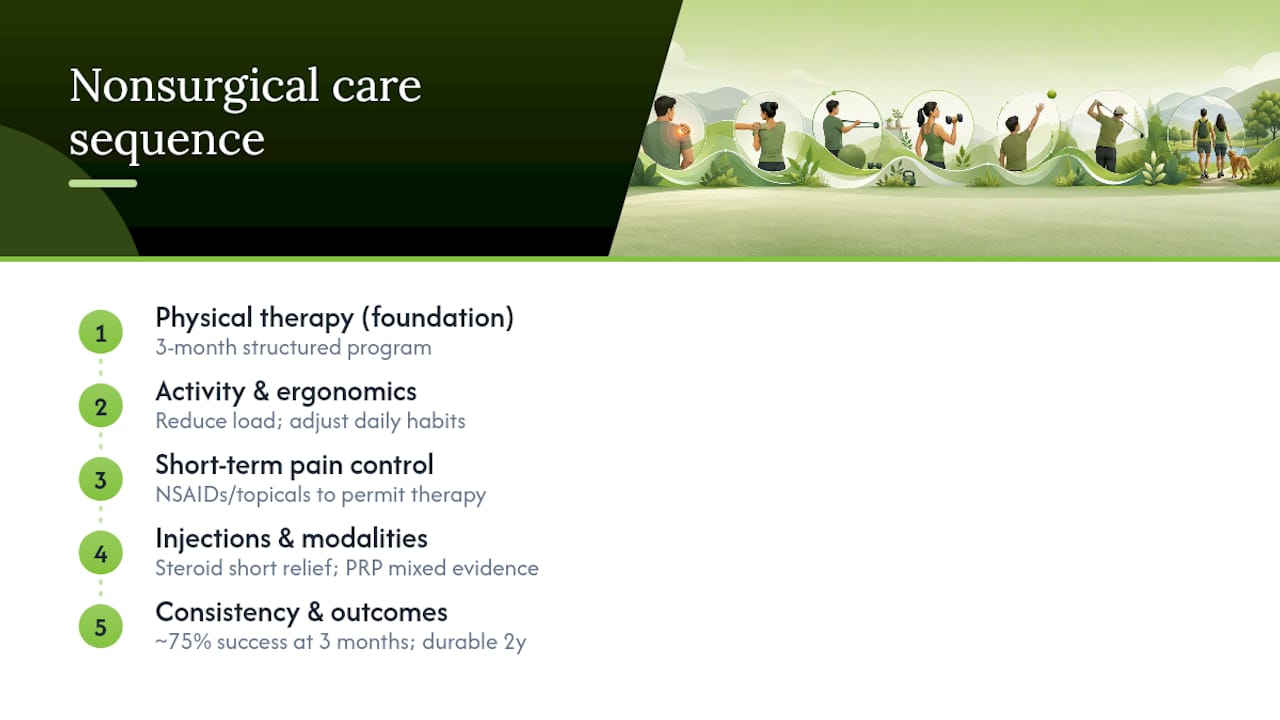
Activity modification and ergonomics reduce load without demanding total rest. Reaching overhead repeatedly, sleeping on the affected side, or carrying heavy bags on that shoulder all keep irritating a tendon that needs time to settle. Adjusting those habits, rather than eliminating all shoulder use, keeps the tissue calm while therapy builds capacity underneath it. Our guide on reducing shoulder pain non-surgically covers the specific adjustments that make the biggest difference day to day.
NSAIDs and topical analgesics have a role, but a narrow one. They can quiet acute inflammatory pain enough to tolerate therapy, which is genuinely valuable early on. They do not change the tendon’s structure or its healing trajectory, and long-term daily use carries gastrointestinal and cardiovascular risks that deserve real conversation, not a shrug.
Corticosteroid injections deliver short-term relief but not tendon repair. They can be useful for breaking a pain cycle that is blocking progress in PT. The trade-off is real: repeated injections show diminishing returns and there is legitimate concern about tendon quality with frequent use over time. I generally limit these to a supporting role, not a repeated crutch.
Regenerative injections, including platelet-rich plasma, show promising but mixed evidence. Some studies report improved pain and function compared to controls; others remain inconclusive, largely because study designs and injection protocols differ so much across the literature. I frame PRP as a reasonable option for the right patient with realistic expectations, not a guaranteed fix. Our page on PRP therapy for shoulder pain walks through where it tends to help most.
Other modalities, like shockwave therapy or Class IV laser, sit at a lower evidence tier but can support pain relief when paired with active rehab. Shockwave therapy for a rotator cuff has more supporting data for calcific tendinopathy specifically than for general tears. TENS units offer temporary symptomatic relief many patients find useful for daily comfort, though nobody should mistake it for a treatment that changes the underlying pathology.
Pro Tip: If an injection provides relief, use that window deliberately. Schedule your hardest strengthening sessions in the days after, while pain is lowest, instead of resting through the relief and losing the opportunity.
What Does a Staged Rotator Cuff Exercise Program Look Like?
Rehabilitation for a rotator cuff tear moves through phases, and jumping ahead is the single most common mistake I see. Rushing strength work before the shoulder tolerates basic motion usually sets a patient back weeks.
- Pain control and early motion. Pendulum swings and passive range-of-motion work keep the joint moving without asking the injured tendon to generate force. This phase typically lasts one to two weeks, guided by pain response rather than a fixed calendar.
- Active-assisted motion. Wall slides and table slides introduce controlled active movement with support, rebuilding confidence and joint mechanics before true loading begins.
- Scapular and rotator cuff activation. Scapular squeezes and low-load isometrics wake up the stabilizing muscles around the shoulder blade, which often get lazy after weeks of guarding a painful shoulder.
- Progressive strengthening. Theraband external and internal rotation exercises, along with prone rows, build the rotator cuff and surrounding musculature under gradually increasing resistance.
- Return-to-activity training. Sport-specific or job-specific movement patterns get reintroduced last, once strength and endurance approach the level the activity actually demands.
Progression between phases should be earned, not scheduled by the calendar alone. A patient advances when pain during exercise stays mild and resolves quickly, when strength testing shows measurable gains, and when specific function milestones, like reaching a shelf overhead without compensating, become reliable rather than occasional.
Watch for warning signs that mean pausing, not pushing through. Sharp pain, night pain that worsens, or a sudden loss of strength are signals to back off and check in with your physical therapist rather than assume more repetitions will fix it. Standardized programs tend to run around three months for a full cycle, though timelines shift based on tear size and starting function. Our piece on whether physical therapy can prevent surgery breaks down how clinicians decide a program is working versus stalling.
Pro Tip: Track function, not just pain. A shoulder that hurts less but still cannot reach behind your back to fasten a bra or tuck in a shirt has not actually recovered yet, even if it feels quieter day to day.
When Should You Get Imaging for a Rotator Cuff Tear?
A physical exam tells us most of what we need before any scan gets ordered. Range of motion testing, manual strength testing of specific rotator cuff muscles, and special tests like the empty can or lift-off maneuver point toward which structures are likely involved and how severely.
Imaging adds value when it changes the plan, not as a routine first step for every shoulder complaint. Contemporary clinical guidance specifically cautions against reflexive early MRI for tendinopathy and general shoulder pain, since it rarely changes initial treatment and can trigger unnecessary anxiety over incidental findings that would never have caused symptoms.
- X-rays rule out fracture, significant arthritis, or calcific deposits, and they are fast and inexpensive.
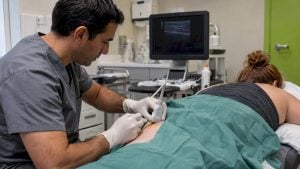
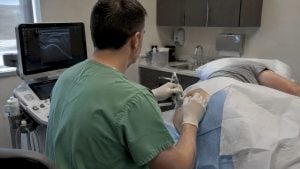
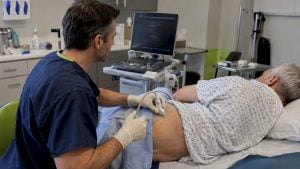
- Ultrasound visualizes tendon tears dynamically and in real time, useful for confirming a suspected full-thickness tear or guiding an injection.
- MRI offers the most detailed look at tear size, retraction, and fatty infiltration, and becomes genuinely useful when surgery is a realistic consideration or when conservative care has stalled without an obvious explanation.
The goal is matching the scan to the decision it will actually inform, rather than collecting images out of habit.
Who Tends to Succeed With Non-Surgical Rotator Cuff Care?
Not every shoulder responds the same way to conservative treatment, and recognizing the difference early saves patients months of frustration.
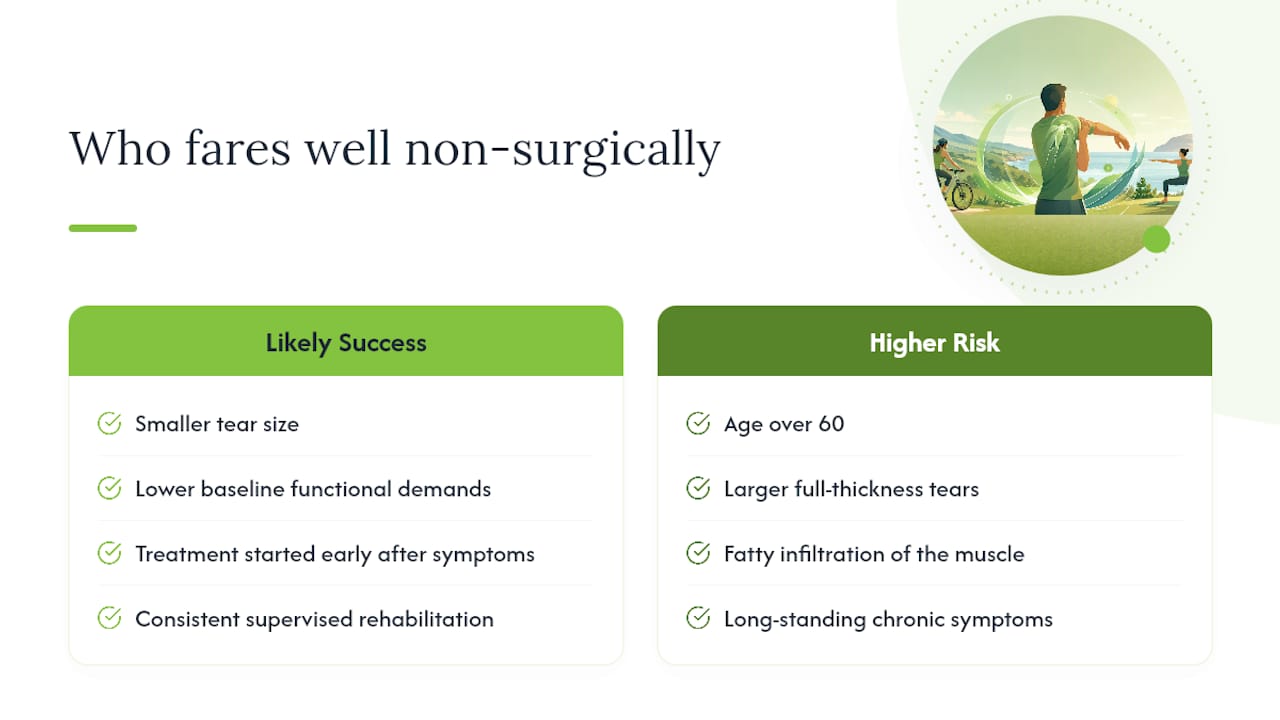
Patients who tend to do well share a few traits: smaller tear size, lower baseline functional demands, treatment started relatively early after symptoms appear, and consistent adherence to a supervised rehabilitation program. Baseline function itself is predictive; patients starting with lower demands on the shoulder often do best, though active, higher-demand patients can still succeed with a properly tailored strengthening progression.
On the other side, several factors raise the odds of a rougher course. Age over 60, larger full-thickness tears, fatty infiltration of the muscle, and long-standing chronic symptoms all correlate with higher rates of progression or eventual surgical referral. None of these factors is disqualifying on its own. They shift probability, and clinicians weigh them together during shared decision-making rather than using any single one as a hard cutoff.
In practice, I use these predictors as a conversation starter, not a verdict. A 65-year-old with a moderate tear and strong motivation to rehab can still do well; the risk factors just mean we monitor more closely and set the surgical conversation up sooner if progress stalls.
When Should You Consider Surgery Instead?
A conservative trial deserves a real chance, but it also deserves a defined endpoint. Open-ended “keep trying PT” advice without a checkpoint helps nobody.
- Give supervised PT an adequate trial first, generally six to twelve weeks at minimum and often extending to three to six months, with objective progress checks along the way rather than a vague sense of “some improvement.”
- Watch for urgent red flags that shortcut the timeline, including pseudoparalysis (an inability to lift the arm actively despite passive motion being preserved), rapidly progressing weakness, or a sudden severe loss of range of motion. These warrant prompt evaluation, not a wait-and-see approach.
- Recognize which patients need a shorter trial from the start. Younger patients with acute, traumatic tears (a fall or sudden forceful injury rather than gradual degeneration) tend to have better surgical outcomes when addressed sooner rather than after months of delay.
If a patient hits the three-month mark of genuinely consistent, supervised therapy without meaningful gains in strength or function, that is the point to have a serious conversation about surgical evaluation rather than extending the trial indefinitely.
How Do You Monitor a Rotator Cuff Tear Over Time?
A good initial response to conservative care is not the finish line. Periodic re-evaluation matters because tear progression or new fatty infiltration can develop quietly, even in a shoulder that currently feels fine.
A reasonable follow-up rhythm looks like a check-in at six weeks, another at three months, and then periodic reassessment through the first year, sooner if symptoms change. New or worsening weakness, a fresh onset of night pain, or a sudden drop in overhead function all warrant a call to your clinician rather than waiting for the next scheduled visit.
- Avoid repetitive overhead loading in work or recreational activities once symptoms have settled, since this is the most common way a quiet shoulder gets re-irritated.
- Keep strengthening work going even after pain resolves. Stopping too early is one of the most common reasons for relapse.
- Modify sleep position if side-sleeping on the affected shoulder keeps flaring symptoms overnight.
Our shoulder pain prevention guide covers longer-term habit changes that reduce recurrence risk once the acute phase settles down.
Pro Tip: Keep a simple log for the first three months: pain level, sleep quality, and one functional task (reaching a shelf, carrying groceries). Patterns over weeks tell you more than how any single day feels.
Nortex’s Clinical Perspective on Non-Surgical Rotator Cuff Care
Patients typically arrive after trying a mix of rest, over-the-counter pain relievers, and maybe a few physical therapy sessions elsewhere that did not fully stick. The triage question we ask first is not “does this need surgery,” but “has this shoulder actually had a fair, structured trial of conservative care yet.” Often it has not.
When PRP is part of the plan, it is sequenced after a documented trial of targeted physical therapy, and only once inflammatory contributors and modifiable movement patterns have been addressed. That order matters. A biologic injection is far more likely to meaningfully affect symptoms when the shoulder mechanics around it are already being retrained, rather than asking one injection to compensate for months of unaddressed movement dysfunction.
We combine supervised rehab, targeted injections when indicated, and regenerative options like PRP for appropriate candidates. Outcomes vary by patient, and we do not promise a specific result. What we do promise is an honest assessment of where a given shoulder sits on the odds we discussed earlier, and a plan that keeps surgery available as a fallback rather than a first resort.
What Should You Actually Do Next?
The evidence supports a clear starting point: most rotator cuff tears respond to structured, supervised nonoperative care, with real gains visible by three to six months for a majority of patients. Start with physical therapy, manage pain deliberately rather than just enduring it, and set a genuine review point around three to six months rather than drifting indefinitely.
Shared decision-making matters more than any single statistic. Your tear size, age, activity goals, and response to early treatment all shape what “success” should look like for you specifically. Bring these questions to your clinician directly, and treat the conservative trial as a defined experiment with checkpoints, not an open-ended waiting game.
— Felix
How Nortex Approaches Non-Surgical Shoulder Care
If you have been cycling through rest, ice, and over-the-counter pain relievers without a structured plan behind them, that is usually the gap. A sequenced program around your specific tear and function level is preferable to defaulting straight to a surgical referral or, at the other extreme, generic advice to “just do some stretches.”
An initial evaluation at Nortexspineandjoint includes a hands-on exam of strength and range of motion, a review of prior imaging if you have it, and honest triage about whether you are a strong candidate for conservative care or should be moving toward a surgical consult sooner. From there, care may include supervised rehabilitation, targeted injections, or regenerative medicine options such as PRP for patients who have already built a solid rehab foundation. If you want a clear, individualized read on your shoulder rather than another round of guesswork, schedule an evaluation for PRP therapy and get a plan built around your actual tear, not a generic protocol.
This article is general information, not a substitute for advice from a qualified doctor. Consult a qualified healthcare professional about your own circumstances before acting on anything here.
Sources
- Non-Operative Management of Rotator Cuff Tears
- Clinical guideline: conservative management priorities for rotator cuff tendinopathy
FAQ
Can You Still Use Your Shoulder With a Torn Rotator Cuff?
Yes, many patients maintain good functional use of the shoulder with a torn rotator cuff, especially with smaller or partial tears. Function often improves substantially with structured therapy even when the tear itself remains visible on imaging.
How Do You Know You Tore Your Rotator Cuff?
Common signs include shoulder pain that worsens with overhead reaching, weakness lifting or rotating the arm, and night pain that disrupts sleep. A clinical exam with strength testing and special maneuvers, sometimes followed by ultrasound or MRI, confirms the diagnosis.
What Are the Alternative Treatments for a Torn Rotator Cuff?
Alternatives to surgery include supervised physical therapy, activity modification, NSAIDs, corticosteroid injections, and regenerative options like PRP, often combined in a sequenced plan rather than used alone.
Can You Live Without a Rotator Cuff?
Yes, though shoulder strength and overhead function typically decline without an intact rotator cuff. Many people adapt reasonably well with compensatory muscle patterns and modified activity, though significant tears usually benefit from some form of treatment.
Can a Rotator Cuff Heal Naturally Without Treatment?
Full structural healing of a torn tendon on its own is uncommon, particularly for full-thickness tears, but functional improvement without surgery is common with structured rehabilitation. The distinction between structural healing and functional recovery matters more than most people realize.