
Most patients complete a short course of shockwave therapy, commonly 3 to 4 sessions for tendon and fascia problems, spaced about one to two weeks apart. Some joint or spine conditions call for more, sometimes up to 10 sessions. Each visit runs 5 to 30 minutes, and the exact count depends on your diagnosis, how long you’ve had symptoms, and how you respond to the first few treatments.
TL;DR:
- Trial protocols average three sessions, but courses range from 3 to 10, with 1,000 to 4,000 impulses per visit and weekly or twice weekly schedules.
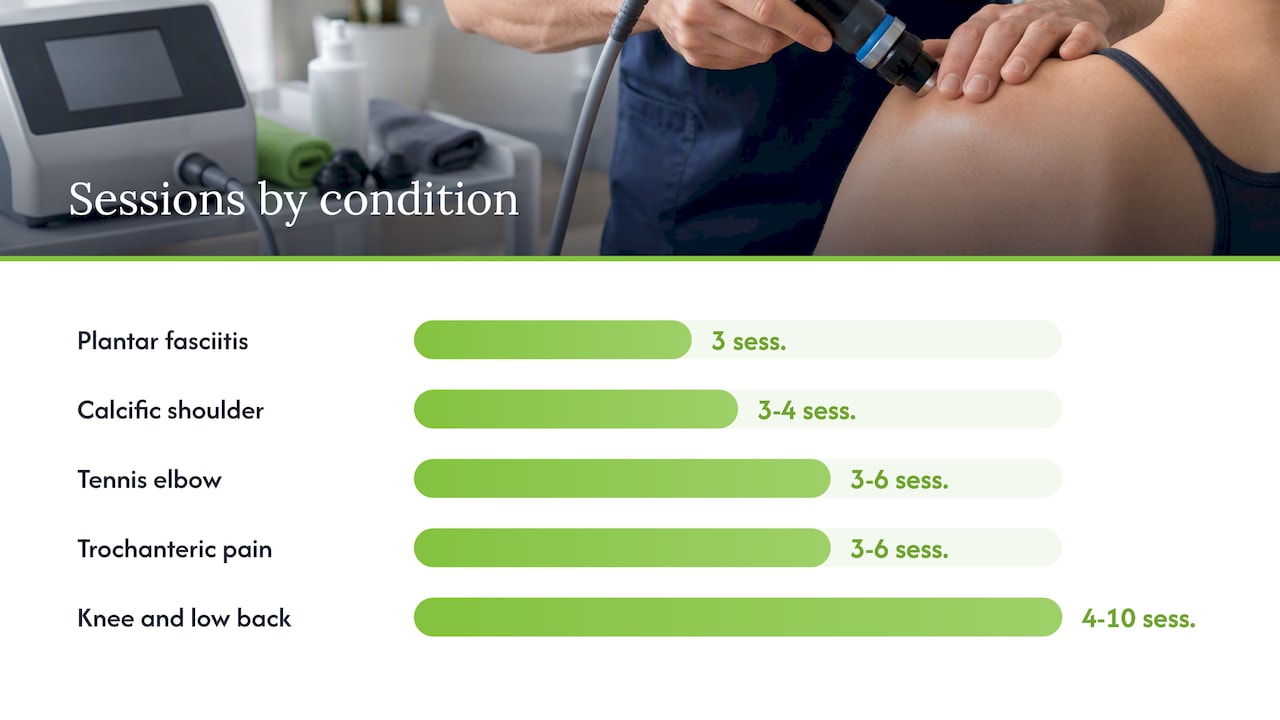
- Plantar fasciitis and tennis elbow often use three sessions; calcific shoulder tendinitis uses 3 to 4, while knee or back conditions may need up to 10.
- A trial for greater trochanteric pain found no added benefit from three full dose sessions over minimal dosing, supporting reassessment instead of automatic escalation.
- Early relief can appear after one to three visits, but trials commonly assess outcomes at 12 weeks; clinicians often wait 8 to 12 weeks before judging success.
- Disclose pregnancy, implanted devices, infection, suspected cancer in the treatment area, and blood thinner use before treatment; light activity for about 48 hours is commonly advised afterward.
Table of Contents
- Common Evidence-Backed Shockwave Protocols
- What Happens During a Shockwave Therapy Session
- How Many Sessions You’ll Need by Condition
- When to Expect Results From Shockwave Therapy
- Safety, Side Effects, and Who Should Avoid Shockwave Therapy
- Aftercare: What to Do Between Sessions
- How We Decide How Many Sessions You Actually Need
- When Shockwave Therapy Makes Sense as a Next Step
- Scheduling a Shockwave Therapy Evaluation With Us
- FAQ
- Sources
Common Evidence-Backed Shockwave Protocols
When we talk with patients about what the research actually shows, the honest answer is that protocols vary more than most marketing material suggests. A pooled analysis of randomized trials found the average number of treatment sessions was close to three, with a common recommendation of about 2,000 impulses per session delivered at the highest energy the patient can tolerate.
The average RCT protocol uses about 3 sessions spaced roughly one week apart, with around 2,000 impulses per session, according to a review of trials listed in the PEDro database. That single data point explains why you’ll hear “three sessions” so often when you research this treatment, but it’s an average, not a rule.
Other studied regimens stretch the range considerably:
- Session counts anywhere from 3 to 10 depending on the condition and research protocol.
- Frequencies ranging from once weekly to twice weekly.
- Impulses per session ranging from 1,000 to 4,000, depending on the treatment head and target tissue.
Energy flux density, the amount of energy delivered per pulse, along with whether the device is radial or focused, changes both how the treatment feels and how it performs. Radial devices spread energy over a broader area and are generally better tolerated; focused devices concentrate energy more precisely and are often used for deeper or more localized lesions like calcific deposits. Some protocols favor fewer sessions at higher energy, aiming to deliver a strong total dose quickly. Others use more frequent, lower-intensity sessions to build tolerance gradually, particularly with patients who are sensitive to the sharp, pulsing sensation of treatment. Neither approach is universally superior. The choice usually comes down to the tissue being treated and how you handle the first session.
What Happens During a Shockwave Therapy Session
Walking into your first session, it helps to know what the hour actually involves, because the unknowns tend to worry patients more than the treatment itself.
- Screening first. We review your medical history, confirm you’re not pregnant, check for pacemakers or other implanted devices, and ask directly about anticoagulant use, since full disclosure here matters for safety planning.
- Positioning and localization. We position the treatment area, apply a coupling gel, and locate the precise target either by palpation or with ultrasound guidance.
- Gradual ramp-up. Treatment typically starts at a lower energy setting and increases gradually as you tolerate it, rather than starting at full intensity.
- Delivery. A treatment head delivers a set number of impulses, usually taking 5 to 30 minutes depending on the area and protocol. You’ll feel sharp, rhythmic pulses that many patients describe as uncomfortable rather than unbearable. Local anesthesia is used sparingly, since numbing the area can blunt the treatment’s effect in some protocols.
- Monitoring. We watch how you respond throughout, and in the first one or two sessions in particular, we’re paying close attention to your tolerance before deciding whether to increase energy at the next visit.
Mild soreness after the session is common and usually settles within a day or two.
Pro Tip: Tell your provider immediately if a particular pulse feels sharper than the rest. It’s easier to adjust energy mid-session than to push through discomfort that doesn’t add any extra benefit.
How Many Sessions You’ll Need by Condition
Session counts differ by diagnosis because tendons, fascia, and joints respond to mechanical stimulation on different timelines. Here’s what the evidence and common clinical protocols suggest for frequently treated conditions:
- Plantar fasciitis: Commonly 3 sessions, often spaced one to two weeks apart; this protocol was used in the device approval trial for the EMS Swiss DolorClast, which delivered up to 2,500 impulses per visit across three visits spaced two weeks apart.
- Shoulder calcific tendinitis: Often 3 to 4 higher-energy sessions, spaced one to two weeks apart, since calcific deposits generally need a stronger mechanical stimulus to break down.
- Lateral epicondylitis (tennis elbow) and greater trochanteric pain syndrome: Typically 3 sessions, though some trials extend to 3 to 6 depending on symptom severity and chronicity.
- Knee osteoarthritis and chronic low back pain: Protocols vary more widely here, often ranging from 4 to 10 sessions, reflecting the more complex, multi-tissue nature of joint and spine conditions.
A multicenter, placebo-controlled trial of the plantar fasciitis protocol described above reported significantly greater pain reduction at 12 weeks compared to sham treatment, with about 23% of treated patients reporting pain during the procedure itself.
Beyond diagnosis, we weigh how long you’ve had symptoms, what you’ve already tried, whether the problem is tendon, fascia, or joint tissue, and how your body tolerates the first session or two. Two patients with the same diagnosis can end up on slightly different schedules for exactly these reasons. If you’re dealing with shoulder calcific tendinitis specifically, our focused shockwave guide for calcific tendinitis walks through protocol specifics and common questions in more depth.
Not every trial supports adding sessions or increasing dose automatically. A double-blind randomized trial in greater trochanteric pain syndrome found no measurable benefit from a recommended three-session, full-dose regimen compared to a minimal-dose version. That finding is a useful reminder that more isn’t automatically better, and it’s part of why we reassess rather than assume.
When to Expect Results From Shockwave Therapy
Patients often ask how quickly they’ll feel a difference, and the honest answer is that timelines vary by tissue type and by person. Some people notice early pain reduction after just one to three sessions. Others need the full course before any meaningful change shows up.
Most clinical trials assess primary outcomes at 12 weeks, not immediately after the final session, because tissue remodeling takes time. Studies typically track pain using scales like the VAS, and for knee osteoarthritis, function indices such as the WOMAC. Many report meaningful improvement in that 4 to 12 week window, with benefits in some studies persisting out to 6 to 12 months.
A few practical points worth keeping in mind:
- Early soreness or mild discomfort after a session does not predict whether the treatment is working.
- A partial response after 2 to 3 sessions is often enough reason to continue the planned course rather than stop early.
- Individual biology, activity level, and whether you’re also doing rehab all affect how fast you respond.
We generally wait until the 8 to 12 week mark before judging whether a course has succeeded, since judging too early can lead to stopping a treatment that simply needed more time to work.
Safety, Side Effects, and Who Should Avoid Shockwave Therapy
The most common thing you’ll feel during treatment is discomfort, not a lasting problem. Transient soreness, mild swelling, bruising, or localized numbness can follow a session, but these typically resolve within a day or two. Serious device-related complications are uncommon in both device approval summaries and randomized trial safety data.
That said, certain situations call for caution, and full disclosure during screening protects you:
- Pregnancy is a standard exclusion for shockwave treatment.
- Active infection or suspected malignancy in the treatment area rules out treatment there.
- Certain implanted devices, including some pacemakers, require evaluation before treatment near that area.
- Anticoagulant use should always be disclosed, since it affects how we plan treatment and monitor for bruising.
When a session is more uncomfortable than expected, we reduce the energy level, slow the ramp-up, or pause altogether rather than pushing through. Our patient safety checklist for shockwave therapy covers these screening points in more detail if you want to review them before your first visit.
Aftercare: What to Do Between Sessions
What you do in the days after each session matters almost as much as the treatment itself.
- Keep activity light for about 48 hours after your first sessions, since this is when we’re still learning how your tissue responds.
- Manage soreness with ice and acetaminophen, and follow your clinician’s guidance on NSAIDs, since some protocols prefer avoiding them during the active treatment window.
- Stay on your rehab plan. Shockwave therapy works best paired with guided physical therapy, not as a standalone fix, and skipping prescribed exercises can blunt your results.
- Watch for red flags, including signs of infection, progressive numbness or weakness, or pain that feels disproportionate to a normal post-treatment ache, and contact us if any of these appear.
Pro Tip: Keep a simple pain log between sessions, rating your discomfort daily on a 0 to 10 scale. It gives us something concrete to evaluate at your next visit instead of relying on memory alone.
How We Decide How Many Sessions You Actually Need
Rather than committing you to a fixed number of sessions on day one, we favor a response-guided approach: we adjust the count and the energy level based on how you’re actually doing, not an arbitrary protocol pulled from a textbook. Many patients come in after trying rest, over-the-counter pain relief, and sometimes a round of physical therapy on their own, without durable relief, and the goal from that point is to build a plan around your specific tissue and tolerance.
In practice, this means a few things:
- We aim for the highest energy level you can comfortably tolerate rather than simply adding more sessions.
- We screen carefully for safety factors before the first treatment.
- We pair shockwave sessions with targeted rehab exercises, since tissue remodeling responds better to mechanical stimulation plus guided movement than to either alone.
- We reassess after your first two to three sessions and adjust intensity, frequency, or total course length based on your measured response.
This personalization is also why two patients with the same diagnosis can leave with different session plans. The research gives us ranges to work from, not a prescription that fits everyone the same way.
When Shockwave Therapy Makes Sense as a Next Step
We typically bring up shockwave therapy after you’ve already tried standard conservative care, things like targeted exercise, manual therapy, or simply time, without lasting improvement, often alongside adjunctive modalities like PEMF therapy benefits for improved recovery. It’s rarely our first recommendation on day one of a new injury, since many musculoskeletal issues resolve with simpler measures.
Once we start treatment, we set clear, shared goals upfront and reassess honestly after the first two to three sessions. If you’re responding, we continue the planned course. If you’re not seeing meaningful change by that point, we say so directly and talk through other options, including adjunctive regenerative treatments, rather than continuing a course that isn’t earning its place in your care. That honesty matters more to us than filling a treatment slot.
— Felix
Scheduling a Shockwave Therapy Evaluation With Us
If you’re weighing shockwave therapy against other options, we offer it as part of our broader regenerative medicine services, with plans built around your specific diagnosis rather than a one-size protocol. Many of our patients combine shockwave sessions with physical therapy for better, more durable results than either approach alone tends to produce.
To get started:
- Review our shockwave therapy page to see how we structure evaluations and treatment.
- Bring your relevant medical records and a current list of medications, including any anticoagulants, to your first visit.
- Ask about payment and insurance options during scheduling, since coverage and billing vary by case.
Schedule a consultation with us to get a session plan built around your diagnosis, not a generic protocol.
This article is general information, not a substitute for advice from a qualified doctor. Consult a qualified healthcare professional about your own circumstances before acting on anything here.
FAQ
How many sessions of shockwave therapy can you do?
Most courses run 3 to 6 sessions, though some conditions call for up to 10 depending on the protocol and how you respond. Your provider typically reassesses after the first two to three sessions before confirming the total count.
Is there a downside to shockwave therapy?
The main downside is discomfort during treatment, which about 23% of patients report in trial data, along with possible transient soreness, bruising, or swelling afterward. Serious complications are uncommon, but certain people, including those who are pregnant or have specific implanted devices, should be screened before treatment.
Is one session of shockwave therapy enough?
A single session can occasionally bring early relief, but most research protocols use multiple sessions because tissue remodeling develops over several treatments. Clinical trials usually measure real outcomes at 12 weeks, well after a full course is complete, not after one visit.
How many days should I rest after shockwave therapy?
Light activity for about 48 hours after a session is a common recommendation, especially during your first few treatments. After that window, most patients gradually return to normal activity while continuing any prescribed rehab exercises.
Sources
- Extracorporeal Shock Wave Therapy for the Treatment of Musculoskeletal Pain: A Narrative Review
- Summary of Safety and Effectiveness — EMS Swiss DolorClast®
- Three Sessions of Radial Extracorporeal Shockwave Therapy Gives No Additional Benefit Over ‘Minimal-Dose’ Radial ESWT for Chronic GTPS