
Shockwave therapy is a reasonable option for chronic, treatment-resistant tennis elbow once conservative care, physical therapy, activity changes, and anti-inflammatory measures have not resolved symptoms after several months. The evidence base is mixed rather than definitive: several trials and pooled analyses show more patients reaching meaningful pain relief at 12 weeks with shockwave than with placebo, even when average pain scores across all patients do not move much. We will walk through the mechanism, the research, who tends to respond, what a treatment series involves, the risks, and how shockwave stacks up against steroid injections, PRP, and physical therapy.
TL;DR:
- Shockwave therapy shows benefit mainly for patients with chronic, treatment-resistant tennis elbow lasting longer than six months who have failed conservative care.
- Devices used include focused shockwave for deeper tissue and radial shockwave for superficial pain; FDA approval is limited to specific indications like lateral epicondylitis.
- Risks are minor but include temporary soreness, redness, or bruising, with contraindications such as blood thinners, pregnancy, infection, or malignancy near the treatment site.
Table of Contents
- How shockwave therapy works and device types
- What the research shows: RCTs, meta-analyses, and systematic reviews
- Who is the best candidate for shockwave therapy
- What a typical treatment series looks like and what to expect
- Risks, side effects, and contraindications
- How shockwave compares to steroid injection, PRP, and continued physical therapy
- Costs, insurance, and questions to ask a clinic
- Nortex clinical perspective: how we evaluate and integrate shockwave into care
- Clinician takeaway: realistic expectations and shared decision-making
- How Nortex can help with tennis elbow that won’t resolve on its own
- FAQ
- Sources
How shockwave therapy works and device types
When you come in with elbow pain that has outlasted a few rounds of rest, bracing, and stretching, we explain shockwave therapy the same way every time: it delivers controlled pulses of mechanical energy into the tendon tissue at the lateral epicondyle. That energy causes small, deliberate microtrauma. The idea is not to damage the tendon further but to restart a healing response that has stalled, triggering a local inflammatory cascade, encouraging new blood vessel growth into the chronically degenerated tissue, and prompting the kind of collagen remodeling that a tendon needs to repair itself.
Two broad categories of devices exist, and the distinction matters when you’re choosing where to be treated.
- Focused shockwave (ESWT) concentrates energy at a specific depth and point, which is the technology used in most of the pivotal clinical trials for lateral epicondylitis.
- Radial shockwave disperses energy more broadly near the skin surface, is generally gentler, and is often used for more superficial or diffuse soft tissue complaints.
Regulatory status also varies by device. The Siemens SONOCUR Basic, for example, carries an FDA premarket approval specifically for chronic lateral epicondylitis in patients who have already failed conservative treatment, which is a narrower and more clinically meaningful label than a general wellness device claim. When a clinic can tell you which device they use and what it is actually cleared for, that is useful information, not a formality.
What the research shows: RCTs, meta-analyses, and systematic reviews
Patients often ask us for a simple yes or no on whether shockwave works, and the honest answer is that the research does not give a clean one. A 2020 meta-analysis of randomized controlled trials found that extracorporeal shockwave therapy did not significantly change average pain scores across the full study population, but it did increase the proportion of patients who achieved a clinically meaningful pain reduction, along with measurable improvements in grip strength at 12 weeks. That distinction, between average scores and the share of people who get real relief, is the crux of why shockwave research looks contradictory at first glance.
One widely cited meta-analysis found that 60.7% of patients treated with an FDA-approved shockwave device achieved at least 50% pain reduction at 12 weeks, compared with 29.3% in the placebo group, a difference that held up under the controlled conditions of a pivotal device trial. That is a meaningful separation between active treatment and placebo, even though it does not mean every patient responds.
Other reviews are less encouraging. An older systematic review pooling nine placebo-controlled trials reported conflicting results overall, with little or no clear benefit for shockwave over placebo across the combined data, and one comparison within that pooled analysis suggested steroid injection outperformed shockwave at the three-month mark. A more recent systematic review of chronic lateral elbow tendinopathy echoed that mixed picture, finding that while some individual trials show benefit, pooled analyses often fail to reach statistical significance for mean pain improvement, with high variability between studies.
Why the disagreement? A few patterns show up consistently:
- Trials that enroll only chronic, treatment-resistant patients, rather than mixing in people with recent-onset symptoms, tend to show more consistent benefit.
- Protocol differences, energy level, number of sessions, and precise localization of the treatment area, account for much of the inconsistency between studies.
- Pooled mean pain scores can look neutral even when a meaningful subgroup of patients is improving substantially, which is why patient-level outcomes like a 50% pain reduction threshold or grip strength gains matter more clinically than an average.
The clinical takeaway we give patients is this: shockwave is not a guaranteed fix, but for the right candidate, chronic symptoms, prior failed conservative care, it has a reasonable chance of producing a meaningful reduction in pain and improved grip strength by around 12 weeks. We set that expectation up front rather than after the fact.
Who is the best candidate for shockwave therapy
Not every elbow that hurts is a good match for shockwave, and part of our job in a consult is figuring out whether you are likely to be one of the patients the trials actually studied.
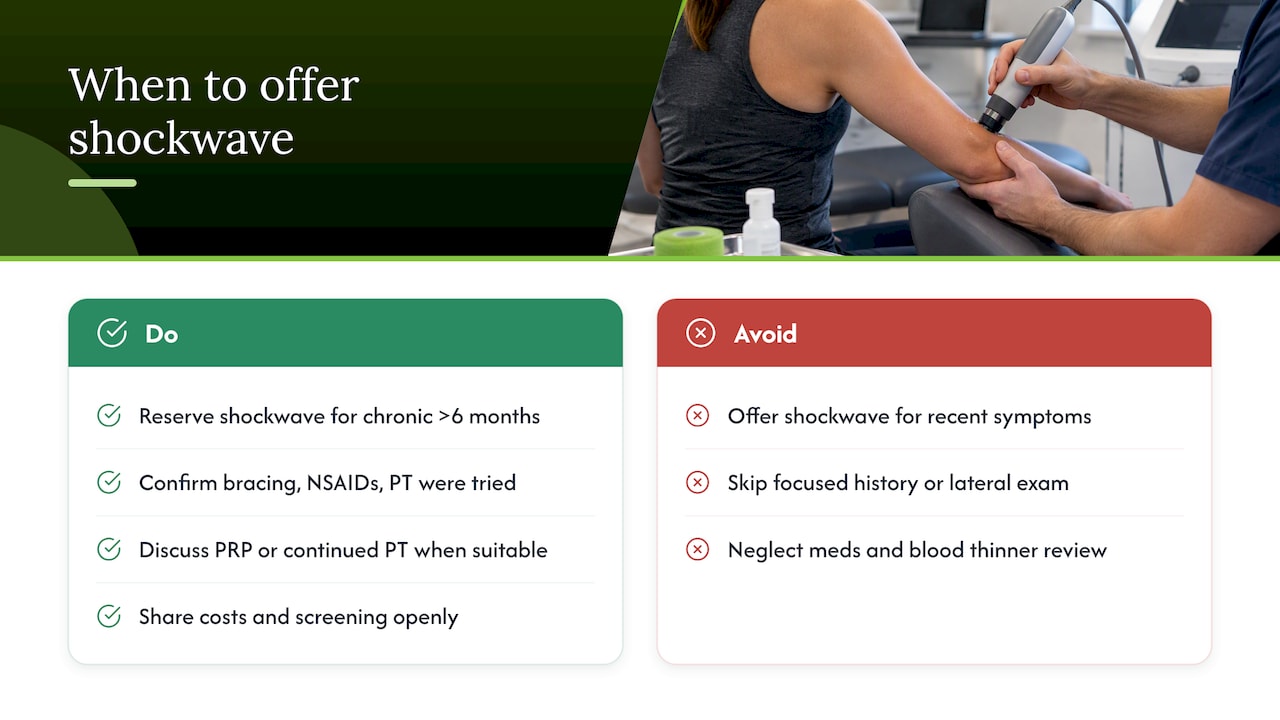
- Symptom duration of six months or longer is a common threshold in pivotal trials, since shockwave is designed for tendon tissue that has stopped healing on its own, not an acute strain.
- Documented failure of conservative treatment, including physical therapy, bracing, activity modification, and a trial of NSAIDs, is typically required before shockwave is considered a reasonable next step.
- Positive provocation findings on exam, such as pain with resisted wrist extension or tenderness directly over the lateral epicondyle, help confirm the diagnosis rather than a mimicking condition like radial tunnel syndrome.
- Absence of relative exclusions, including active anticoagulant therapy, pregnancy, local infection, or malignancy near the treatment site, which we screen for before scheduling.
Many patients come in after trying a brace, a cortisone shot, and a round of physical therapy, frustrated that nothing has stuck. That history is actually useful. It tells us the tendon has had a fair chance to heal through standard means and is a plausible candidate for a treatment aimed at restarting that process. Bring a timeline of what you’ve tried, when symptoms started, and any imaging you’ve had. We confirm candidacy through history, a focused physical exam, and selective imaging when the diagnosis is not clear-cut, rather than ordering an MRI for every elbow.
What a typical treatment series looks like and what to expect
Most published protocols, including the one used in the pivotal SONOCUR Basic trial, scheduled three sessions once weekly, with a predefined number of impulses and energy level per visit, and assessed results at the 12-week mark rather than immediately after treatment. That timeline matters: shockwave triggers a biological repair process, not an instant fix, so the earliest meaningful changes often lag behind the final session by several weeks.
- Sessions typically run 5 to 15 minutes depending on the device and treatment area.
- Most patients describe a sensation of pressure or a brief, sharp discomfort during the pulses, which eases once the session ends.
- Mild soreness or aching for a day or two afterward is common and usually resolves without specific treatment.
- Strengthening exercises and activity modification alongside shockwave sessions tend to produce better outcomes than shockwave alone; for more on effective rehabilitation tools, see When PEMF beats EMS and when EMS wins for rehab.
Pro Tip: Keep doing your prescribed eccentric wrist extensor exercises between sessions. Shockwave stimulates tissue repair, but strength and loading tolerance still have to be rebuilt through rehab.
Before your first session, disclose any blood thinners, recent steroid injections, or pregnancy, wear short sleeves or clothing that allows easy access to the elbow, and plan for mild post-session soreness rather than needing someone to drive you home.
Risks, side effects, and contraindications
Shockwave therapy has a favorable safety profile compared with more invasive procedures, but it is not risk-free, and we walk through this honestly before anyone schedules.
- Temporary pain during and immediately after treatment is the most common side effect, typically resolving within a day or two.
- Mild redness, bruising, or swelling at the treatment site can occur and usually settles on its own.
- Serious complications are rare in the published literature, and clinics reduce risk further through proper device calibration and accurate localization of the treatment area.
- Active anticoagulant therapy, pregnancy, local skin infection, and malignancy near the treatment site are standard reasons to postpone or avoid treatment.
If you’re on blood thinners or have a bleeding disorder, that needs to be part of the conversation before any session is scheduled, not an afterthought. Our safety checklist for shockwave patients walks through exactly what to disclose and why.
How shockwave compares to steroid injection, PRP, and continued physical therapy
Patients frequently ask which option is “best,” and the honest answer depends on timeline, prior treatment, and how much risk you’re willing to accept for how much relief.
- Steroid injection often provides faster short-term relief, and one older pooled analysis found it outperformed shockwave at the three-month mark, but repeated steroid use raises concerns about tendon weakening and higher recurrence rates over time.
- PRP (platelet-rich plasma) works through a different mechanism, delivering concentrated growth factors directly into the degenerated tendon tissue, and shows promise for chronic tendinopathy, though study designs and preparation methods vary enough that comparing trials directly is difficult.
- Physical therapy remains the foundation of tennis elbow treatment for most patients, and shockwave is typically most useful as an adjunct once a structured PT program has plateaued rather than as a first-line replacement for it.
We generally recommend giving physical therapy a genuine trial first, reserving shockwave for patients whose progress has stalled, and considering PRP or shockwave as parallel, not competing, options depending on your specific presentation. For readers managing a related shoulder issue, our overview of shockwave for calcific tendinitis covers similar trial-level comparisons in more depth.
Costs, insurance, and questions to ask a clinic
Shockwave therapy is often billed as a cash-pay or partially covered service, since insurance coverage for tennis elbow treatment varies considerably and many plans classify it as not medically necessary outside specific criteria. Published session costs typically fall between $100 and $500, with the range driven by device type, provider expertise, and regional pricing differences.
Before committing to a series, we’d suggest asking:
- What device is used, and does it carry FDA clearance or approval for lateral epicondylitis specifically?
- How many sessions does the clinician typically recommend, and at what interval?
- What happens at the 12-week follow-up if pain and grip strength haven’t improved?
- Is there a written cost estimate, and what is the cancellation or refund policy if the series is not completed?
Getting these answers in writing before your first visit avoids surprises later, both clinical and financial.
Nortex clinical perspective: how we evaluate and integrate shockwave into care
We don’t offer shockwave therapy to every patient who walks in with elbow pain. Our evidence-first approach means we reserve it for the chronic, conservative-care-resistant cases the research actually supports, rather than positioning it as a universal fix. When a patient’s history and exam point to a six-month-plus history of lateral epicondylitis that hasn’t responded to bracing, NSAIDs, and a real course of physical therapy, shockwave becomes a reasonable next conversation. When symptoms are more recent or an exam suggests a different diagnosis, we typically steer toward continued rehab or, in select chronic cases, discuss PRP therapy as an alternative mechanism worth considering.
Our shockwave therapy service page lays out what a treatment series looks like in practice, and we keep our cost estimates and safety screening questions posted publicly rather than behind a consult wall. A typical first visit includes a focused history, a physical exam targeting the lateral epicondyle and surrounding structures, a review of what you’ve already tried, and a direct conversation about whether shockwave, PRP, or continued physical therapy fits your situation best. Bring a list of prior treatments, current medications including any blood thinners, and a sense of your activity goals so we can set a realistic timeline together.
Clinician takeaway: realistic expectations and shared decision-making
If you have chronic tennis elbow that hasn’t responded to a genuine course of physical therapy and activity changes, shockwave is a reasonable option worth discussing, and 12 weeks is the realistic window for judging whether it’s working. It is not a standalone cure. The patients who do best combine it with ongoing strengthening and activity modification rather than treating the sessions as a substitute for rehab. Before scheduling, bring your treatment history, ask about device type and expected session count, and have a direct conversation about what happens if the 12-week mark arrives without meaningful change. That conversation, more than the treatment itself, is what sets expectations correctly from the start.
— Felix
How Nortex can help with tennis elbow that won’t resolve on its own
If conservative care has stalled, we offer a direct path forward rather than another round of guesswork: a focused consult where we examine your elbow, review what you’ve already tried, and discuss whether shockwave therapy fits the pattern the research supports, or whether PRP therapy or continued physical therapy makes more sense for your case. We build each plan around your specific exam findings rather than a one-size approach. Cost information and session details are posted on our site so you can plan ahead. If chronic elbow pain has outlasted rest, bracing, and a round of physical therapy, schedule a consult with our team to find out what’s actually driving it and what your realistic options are.
This article is general information, not a substitute for advice from a qualified doctor. Consult a qualified healthcare professional about your own circumstances before acting on anything here.
FAQ
Does shockwave therapy work for tennis elbow?
For chronic, treatment-resistant cases, shockwave has shown benefit in several trials, with one pivotal study finding 60.7% of treated patients achieved at least 50% pain reduction at 12 weeks versus 29.3% with placebo. Results are less consistent for acute or recent-onset cases, so candidacy and symptom duration matter.
What are the drawbacks of shockwave therapy?
The main drawbacks are temporary pain during and after sessions, inconsistent results across the broader research base, and a treatment timeline of several weeks before benefits become clear. Pooled reviews show that not every patient responds, and average pain-score improvements across trial populations are often modest.
What is the fastest way to improve tennis elbow pain?
There is no single fast fix; steroid injections tend to offer the quickest short-term relief, with one pooled analysis showing an advantage over shockwave at three months, but recurrence and tendon health concerns limit repeated use. A combination of activity modification, targeted physical therapy, and time usually produces the most durable improvement.
Is shockwave therapy better than a cortisone injection?
Neither option is universally better. Cortisone can relieve pain faster in the short term, but shockwave avoids the tendon-weakening concerns associated with repeated steroid use, making the right choice dependent on your symptom duration, prior treatments, and how your provider weighs those trade-offs with you.
Sources
- PubMed: Shockwave therapy meta-analysis (pubmed id 33813913)
- Extracorporeal Shock Wave Therapy in Chronic Lateral Elbow Tendinopathy: A Systematic Review (PMC)
- FDA PMA: SONOCUR Basic approval (P010039B)
- Effectiveness of extracorporeal shock wave therapy in patients with tennis elbow: A meta-analysis of randomized controlled trials
- Systematic review of the efficacy and safety of shock wave therapy for lateral elbow pain (PubMed)