
Most people with shoulder impingement do not need an operation. The approach with the strongest support is a structured rehabilitation program, with injections or regenerative options added for the right patient once the shoulder is moving well. At Nortex Spine and Joint, our shoulder impingement page and our PRP therapy for shoulder pain offer a path for patients who want a non-surgical plan built around the cause of the pain, not only the symptom.
Many patients arrive after trying rest, anti-inflammatories and one or two injections. That pattern is common, and it usually means the shoulder mechanics were never fully addressed. The sections below explain what impingement is, what a sound non-surgical plan looks like, how long it takes, and when to move to the next step.
TL;DR
- Active rehabilitation is the recommended first treatment, and a 2025 Canadian guideline gives it its highest grade.
- Most symptoms respond within about three months, according to a 2025 British care pathway.
- Corticosteroid injections can calm pain for weeks, but they work best as a bridge into rehabilitation, not as the whole plan.
- PRP is considered an add-on for selected patients with chronic tendon problems, alongside rehabilitation.
- If you are not improving after about 12 weeks of appropriate care, it is time for a specialist evaluation.
Table of Contents
- What shoulder impingement actually is
- Why surgery is usually not the first answer
- The non-surgical plan, step by step
- How long recovery takes
- What to avoid while it heals
- When to get a specialist evaluation
- Care for shoulders in North Dallas
- FAQ
- Sources
What shoulder impingement actually is
The rotator cuff is a group of four tendons that stabilize and lift the arm. They pass through a narrow space beneath a bony roof at the top of the shoulder, called the acromion. In impingement, also described as subacromial pain, the tendons and the cushioning bursa in that space become irritated and painful, especially when you reach overhead, lift to the side or sleep on that shoulder.
The cause is rarely a single event. Repetitive overhead work, weak or poorly timed shoulder blade muscles, a stiff upper back, and age-related tendon changes all contribute. This is why two people with the same label can need different plans.
Why surgery is usually not the first answer
Surgery to shave the bone (decompression) was once routine. The British Elbow and Shoulder Society pathway now notes that studies show no evidence of benefit over sham surgery for this operation. That does not mean every shoulder problem avoids the operating room. A full-thickness tear or a locked, severely stiff shoulder is a different situation. But for classic impingement, a well-run non-surgical course is the standard starting point.
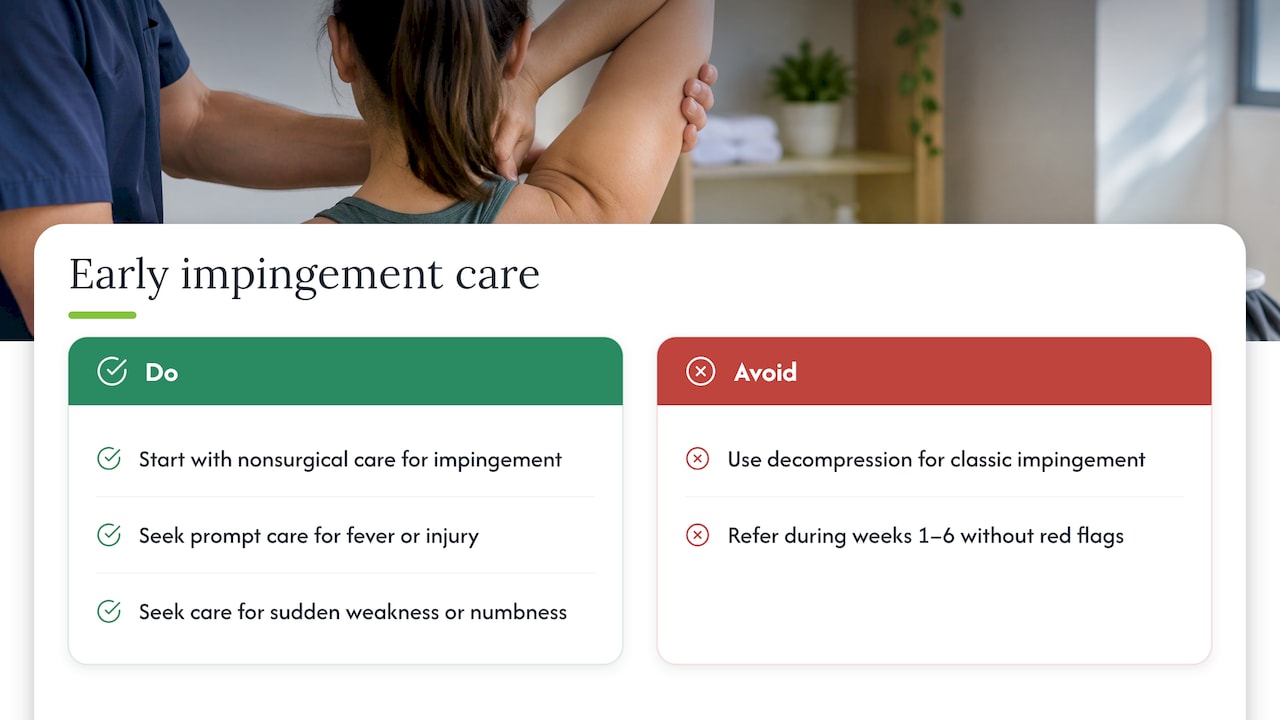
U.S. guidance points the same way on early care. The ACOEM shoulder guideline, as published in California’s August 2025 evidence-based update, notes that in the first 4 to 6 weeks, the absence of red flags largely rules out the need for special studies or referral. Red flags include a fever, a significant injury, sudden weakness or numbness, so those still warrant prompt medical attention.
The non-surgical plan, step by step
1. Calm the shoulder without stopping movement
The goal in the first weeks is to reduce irritation while keeping the shoulder moving. In a published case series of exercise-based care, patients were taught to keep the arm below shoulder level, keep loads close to the body, and avoid positions that provoke symptoms. Any exercise that caused lasting or significant pain was modified or dropped.
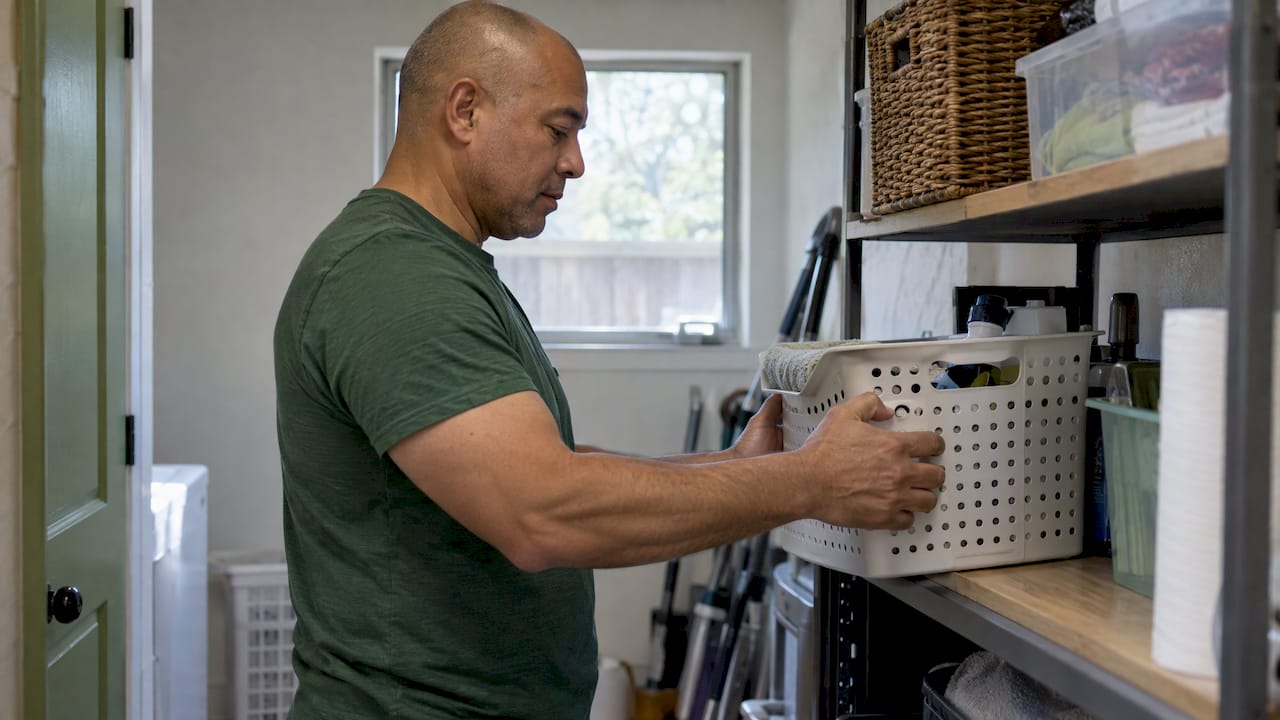
In practice, that means pausing overhead presses, upright rows and long reaching tasks for a while, not resting the arm completely. Complete rest tends to stiffen the shoulder and weaken the muscles you need.
2. Start structured rehabilitation
A December 2025 narrative review of non-operative shoulder care reports that programs built on scapular stabilization, motor control and gradual rotator cuff and shoulder blade strengthening produce consistent pain and function improvements within roughly 12 weeks. The key word is structured. Generic stretching rarely delivers the same result, because the exercises must match what your shoulder is doing wrong, and they must progress as you tolerate them.
This is where an individualized program matters. Our physical therapy program is part of how we treat shoulder patients, so rehabilitation and any procedural care are planned together rather than in separate offices.
3. Consider an injection if progress stalls
The British pathway says one subacromial steroid injection can be considered if there is no improvement by 6 to 8 weeks. The Canadian guideline says corticosteroid injections may reduce pain and short-term disability, but should not be first-line. The narrative review above puts the benefit at weeks, up to about 8 to 12, and warns that repeated dosing may affect tendon health.
The practical use is a window: when pain drops, you can exercise harder and more consistently. An injection without rehabilitation behind it often wears off with nothing changed.
4. Discuss regenerative options for persistent tendon pain
Platelet-rich plasma (PRP) is made from a sample of your own blood, concentrated to contain more platelets and growth factors, then injected near the injured tendon. The research is mixed but promising in specific groups:
- A 2025 scoping review cites a meta-analysis finding that PRP did less well than corticosteroid in the first two months, but better at 2 to 6 months and beyond 6 months.
- A 2023 review reports significant long-term pain relief beyond 24 weeks across randomized trials, and a 51-patient double-blind trial in which PRP and corticosteroid both improved patients at 3 and 6 months.
- A 2022 randomized trial of 90 patients with partial-thickness rotator cuff injuries found ultrasound-confirmed regeneration in most patients across all three PRP-based groups, with no significant harms reported.
- The December 2025 review recommends PRP as an adjunct, chosen patient by patient and paired with structured rehabilitation, for chronic tendinopathy or partial tears.
That last point matches how we use it. PRP is a tool for a shoulder that has not settled with good rehabilitation, and the benefit tends to build over months, not days. You can read more in our article on how effective PRP injections are for shoulder pain.
Stem cell therapy follows similar logic, with more variability. The 2025 scoping review notes that research often blends cultured stem cells with minimally manipulated cell preparations, which makes results hard to compare. Our overview of shoulder stem cell therapy and the evidence explains how we think about candidacy.
How long recovery takes
Plan in blocks of weeks, not days:
| Timeframe | What usually happens |
|---|---|
| Weeks 0 to 6 | Pain settles with activity changes and early exercises |
| Weeks 6 to 8 | If there is little change, an injection may be considered |
| Weeks 8 to 12 | Strength and control build; most symptoms respond within about three months |
| After 12 weeks | Persistent pain or weakness calls for specialist reassessment |
Sources for these timelines are the British pathway and the Canadian guideline cited above, which also advises referral to a musculoskeletal specialist after a maximum of 12 weeks of appropriate non-surgical care without adequate progress. Individual timelines vary with how long the problem has been present, your job and sport, and how consistently you do the program.
What to avoid while it heals
- Repeated overhead lifting or pressing that reproduces sharp pain.
- Carrying loads away from your body.
- Sleeping on the painful shoulder for long stretches. A pillow hugged to the chest supports the arm.
- Pushing through pain that lingers after exercise. Mild soreness that fades is one thing; pain that lasts or worsens means the exercise needs adjusting.
Our shoulder pain prevention tips cover habits that protect the shoulder once it improves.
When to get a specialist evaluation
If 12 weeks of well-done care has not helped, the question changes from what to try next to what exactly is wrong. A physician exam, often with ultrasound or MRI, can show whether you have a partial tear, calcific deposits, a neck-related source of pain or something else. Imaging is read by radiologists, and for musculoskeletal MRI interpretation subspecialty expertise helps make the report precise. Seek care sooner for sudden weakness, an inability to lift the arm, numbness, fever, or pain after a significant injury.
What we have learned treating shoulders
Many patients come to us after months of medication and a repeat injection, and the shoulder is no stronger than when it started. In our experience the best outcomes come from sequencing: reduce irritation, rebuild how the shoulder blade and cuff work together, and only then add a biologic such as PRP where the tendon needs support. We are physicians who also run rehabilitation, so each step is chosen for the individual shoulder. We set honest expectations: improvement usually builds over weeks to months, and not every shoulder needs a procedure.
Felix
Care for shoulders in North Dallas
Our board-certified, Harvard fellowship-trained physicians build customized non-surgical plans for shoulder, spine and joint pain. If you are in the North Dallas area and want an evaluation, you can start with our PRP therapy for shoulder pain page, learn about our regenerative medicine services, or contact us through the Nortex Spine and Joint site to schedule a consultation.
FAQ
How long does shoulder impingement take to recover without surgery?
Most symptoms respond within about three months of appropriate care, according to the British pathway. Some people feel better in weeks, while longer-standing cases take more time. If you are not improving by 12 weeks, a specialist evaluation is the next step.
What exercises should I avoid with shoulder impingement?
Avoid movements that reproduce sharp pain, especially repeated overhead pressing, upright rows and reaching with heavy loads far from your body. Keep the arm below shoulder height early on and keep objects close to you. Your therapist can tell you when to reintroduce overhead work.
Does PRP help shoulder impingement?
Research suggests PRP may provide medium- to long-term benefit for chronic rotator cuff tendon problems, usually as an add-on to rehabilitation. Candidates are chosen individually. A physician exam is the way to find out whether it fits your shoulder.
Is a cortisone shot a good first step?
Guidelines recommend active rehabilitation first. A steroid injection may be considered if you have not improved after 6 to 8 weeks, and it works best when paired with an exercise program that continues after the pain eases.
Sources
- BESS Patient Care Pathway: Subacromial Pain, 2025
- Rotator Cuff Tendinopathy clinical practice guideline, Canada, 2025
- Current Non-operative Management of Shoulder Pathologies, PMC, 2025
- Rationale and methodology for injection therapy to treat rotator cuff disease, PMC, 2025
- Role of platelet-rich plasma in the treatment of rotator cuff tendinopathy, PMC, 2023
- Collagen and platelet-rich plasma in partial-thickness rotator cuff injuries, PMC, 2022
- Comprehensive Impairment-Based Exercise and Manual Therapy, JOSPT, 2010
- ACOEM Shoulder Disorders guideline, California DWC, August 2025