
Exercise is defined in clinical pain management as a first-line, non-pharmacological intervention that modulates pain through neurological, physiological, and psychological pathways. The role of exercise in pain relief extends well beyond muscle strengthening. It actively changes how your nervous system processes and responds to pain signals. Scotland’s Quality Prescribing guide for 2026 to 2029 recommends physical activity as a core component of person-centered chronic pain care, placing it alongside other non-pharmacological approaches. The American College of Sports Medicine (ACSM) and recent 2026 systematic reviews reinforce this position, showing that structured movement programs reduce pain intensity, improve function, and support mental health in adults with persistent musculoskeletal conditions.
How does exercise biologically alleviate pain?
Exercise-induced hypoalgesia is the clinical term for the reduction in pain sensitivity that follows physical activity. This phenomenon occurs because movement activates descending inhibitory pathways in the central nervous system, which suppress incoming pain signals before they reach conscious awareness. The process involves the release of endogenous opioids and endocannabinoids, the body’s own analgesic compounds, which bind to the same receptors targeted by pharmaceutical pain medications.
The biological picture is more complex than a simple endorphin release. Exercise modulates neuroimmune signaling, meaning it reduces the inflammatory activity of immune cells within the nervous system. This matters because central sensitization, a state where the spinal cord and brain become hypersensitive to pain input, is a defining feature of many chronic pain conditions including fibromyalgia, chronic low back pain, and osteoarthritis. Structured exercise suppresses neuroinflammation and restores inhibitory neurotransmission, directly countering this sensitization process.
Exercise also interacts with the body’s stress regulation systems. The hypothalamic-pituitary-adrenal (HPA) axis, which governs cortisol release and the stress response, is recalibrated through regular physical activity. Chronic pain and chronic stress share overlapping neural circuits, so improving stress regulation through movement has a direct secondary effect on pain perception. This multisystem adaptation explains why personalized exercise protocols, rather than generic fitness routines, tend to produce the most meaningful pain relief outcomes.
Pro Tip: If you notice that pain temporarily increases during the first one to two weeks of a new exercise program, this is often a normal adaptation response, not a sign of injury. Discuss this pattern with your clinician before stopping activity.
What types and doses of exercise work best for chronic pain?
Exercise type and dose both determine whether physical activity produces meaningful pain relief or minimal benefit. The ACSM provides structured dosing guidelines that, when followed consistently, produce measurable reductions in pain and disability. A 2026 Frontiers meta-analysis found that high adherence to ACSM dosing, defined as 75% or greater compliance with prescribed protocols, significantly decreased pain and disability in patients with non-specific low back pain compared to low-adherence groups. This finding shifts the clinical conversation from “what exercise” to “how consistently and at what dose.”
The same review found that higher-intensity aerobic training may produce greater pain relief and functional improvement than moderate-intensity exercise for low back pain, which challenges the common assumption that gentle movement is always the safest starting point for chronic pain patients. The appropriate intensity depends on your baseline fitness, pain phenotype, and any comorbid conditions, which is why individualized prescription matters.
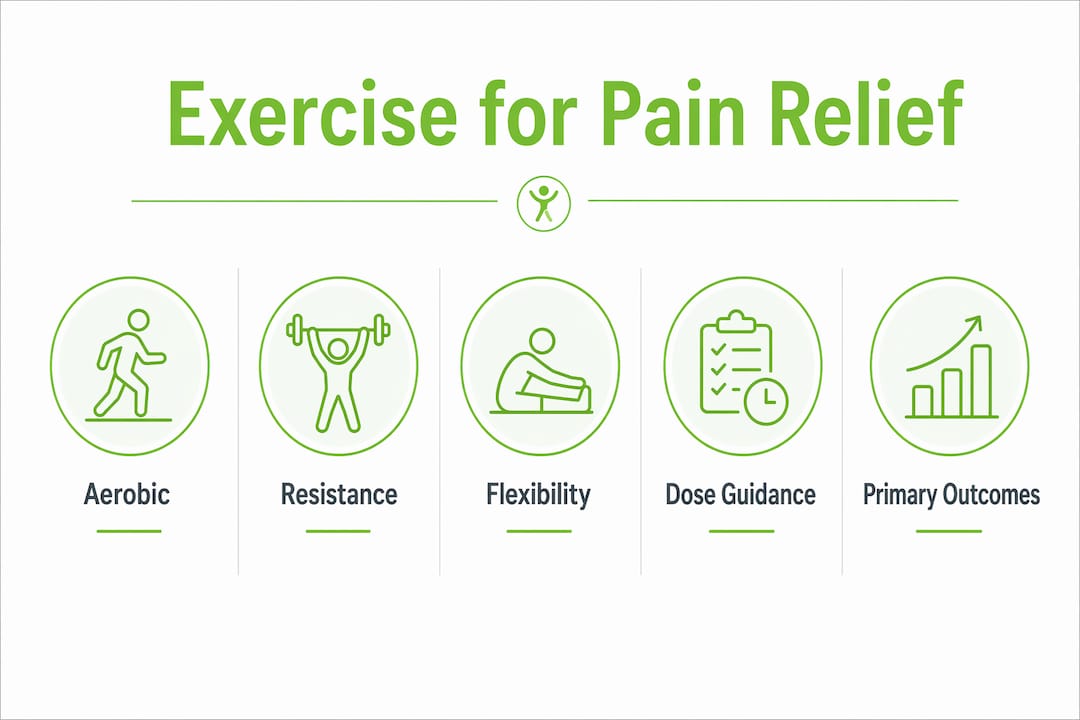
The table below summarizes the three primary exercise categories used in exercise therapy for pain, along with ACSM-aligned dosing parameters and their expected pain relief outcomes.
| Exercise type | ACSM dose guidance | Primary pain relief outcome |
|---|---|---|
| Aerobic (walking, cycling, swimming) | 150 min/week moderate or 75 min/week vigorous intensity | Reduces central sensitization and systemic inflammation |
| Resistance training | 2 to 3 sessions/week, 8 to 12 reps, progressive overload | Improves joint stability, reduces mechanical pain |
| Flexibility and mobility (yoga, stretching) | Daily or 5 days/week, 10 to 30 seconds per stretch | Reduces stiffness, improves range of motion and function |
Underdosing is one of the most common reasons exercise programs fail to produce results. Many patients perform activity at an intensity or frequency that is too low to trigger the neurological adaptations responsible for pain relief. Tracking actual exercise dose and adjusting progression based on adherence metrics aligns treatment with physiological adaptation and avoids the plateau effect that discourages many patients from continuing.
Pro Tip: Keep a simple weekly log of your exercise sessions, noting duration, intensity, and pain levels before and after. Sharing this with your clinician allows for precise dose adjustments rather than guesswork.
For patients managing lower back pain specifically, the combination of aerobic conditioning and targeted resistance work tends to outperform either modality alone.
How does combining exercise with CBT improve pain outcomes?
Cognitive-behavioral therapy (CBT) addresses the psychological dimension of chronic pain that exercise alone cannot fully resolve. Pain catastrophizing, fear-avoidance beliefs, and maladaptive thought patterns about movement all reduce a person’s willingness to exercise consistently, which directly limits the physical benefits they can achieve. CBT targets these barriers by restructuring how patients interpret pain signals and respond to activity-related discomfort.
A 2026 meta-analysis found that CBT combined with exercise produces small-to-moderate improvements in pain intensity and functional disability that exceed the results of exercise alone. These benefits were sustained at both short-term and mid-term follow-up, making the combined approach more durable than physical activity in isolation. The psychological component appears to act as a multiplier, increasing the likelihood that patients will adhere to their exercise programs and maintain gains over time.
The practical benefits of this combined approach include:
- Reduced pain catastrophizing: Patients learn to reframe pain as a manageable signal rather than a sign of damage, which reduces avoidance behaviors.
- Improved exercise adherence: CBT-based goal setting and behavioral activation techniques increase the consistency of physical activity.
- Better functional disability outcomes: Patients report greater ability to perform daily activities when psychological barriers are addressed alongside physical deconditioning.
- Mental health improvements: Anxiety and depression, which frequently co-occur with chronic pain, show measurable improvement with combined therapy.
One important limitation deserves honest acknowledgment. The same meta-analysis found that long-term maintenance of psychological benefits from CBT and exercise combined tends to attenuate beyond 12 months without ongoing intervention. This means that periodic reinforcement, whether through booster CBT sessions, supervised exercise, or structured check-ins, is necessary to sustain the full benefit of this approach.
How to safely start and maintain exercise when you have chronic pain
Starting an exercise program when you are already in pain requires a different approach than standard fitness advice. The goal in the early phase is not performance. It is consistency and tolerance building. UNC Health advises beginning with 5 to 10 minute sessions of low-impact activity such as walking, swimming, or cycling, with the explicit expectation that symptoms may feel more pronounced initially as the body adapts. This is normal and does not mean the activity is harmful.
The following steps provide a practical framework for initiating and progressing exercise safely:
- Choose low-impact entry points. Walking, water-based exercise, and stationary cycling place minimal stress on joints while still activating the pain-modulating pathways described earlier. These are the most accessible starting points for most adults with chronic musculoskeletal pain.
- Start with duration, not intensity. Begin with 5 to 10 minutes of continuous movement per session. Add 2 to 5 minutes per week as tolerance improves. Intensity increases come later, once consistency is established.
- Prioritize consistency over performance. Three to four sessions per week of modest activity produces more neurological adaptation than one intense session followed by days of rest. Regularity is the mechanism.
- Address fear of movement directly. Scotland’s Quality Prescribing guide recommends reframing exercise as “movement” or “physical activity” for patients who associate the word “exercise” with pain or injury. Language matters when building new behavioral patterns.
- Use supervised sessions when possible. Working with a physical therapist or supervised rehabilitation program improves adherence and allows for real-time dose adjustments. Accountability partners, whether a clinician, coach, or peer, also increase long-term follow-through.
- Manage flare patterns proactively. Overly aggressive progression during a pain flare reduces adherence and can set back progress by weeks. Having a pre-agreed flare management plan with your clinician prevents the boom-and-bust cycle that derails many patients.
For a broader view of how movement fits within a non-opioid pain management strategy, combining exercise with other conservative therapies often produces the most durable outcomes.
Key takeaways
Exercise relieves chronic pain by modulating central sensitization, reducing neuroinflammation, and improving physical function, with outcomes determined primarily by adherence to structured dosing protocols.
| Point | Details |
|---|---|
| Exercise modulates pain biology | Movement activates descending inhibitory pathways and reduces neuroinflammation, not just endorphin release. |
| Dose and adherence drive outcomes | Reaching 75% or greater compliance with ACSM guidelines significantly reduces pain and disability. |
| CBT amplifies exercise benefits | Combining cognitive-behavioral therapy with exercise produces greater and more durable pain relief than exercise alone. |
| Start small, build consistently | Begin with 5 to 10 minute low-impact sessions and prioritize frequency over intensity in the early phase. |
| Fear of movement must be addressed | Reframing activity and managing boom-and-bust patterns are as important as the exercise itself. |
What I have observed after years of treating chronic pain patients
Many patients arrive at Nortexspineandjoint after months or years of trying treatments that addressed symptoms without addressing function. They have often been told to rest, to avoid certain movements, or to wait for the pain to subside before becoming active. In my clinical experience, this advice frequently makes things worse. Deconditioning accelerates central sensitization, and prolonged inactivity reinforces the fear-avoidance cycle that keeps patients stuck.
What I find consistently is that the patients who improve most are not necessarily the ones who exercise hardest. They are the ones who exercise most consistently, at a dose that is calibrated to their current capacity and adjusted over time. Generic exercise advice, such as “stay active” or “try yoga,” rarely produces the outcomes that a structured, individualized prescription does. The difference between a patient who improves and one who plateaus often comes down to whether their program was designed for their specific pain phenotype or borrowed from a general fitness template.
The combination of physical and psychological approaches is where I see the most meaningful long-term gains. Patients who engage with CBT principles alongside their movement program tend to sustain their progress because they have addressed the beliefs that were limiting their activity in the first place. That said, I am realistic with patients about the timeline. Meaningful improvement in chronic pain through exercise typically takes eight to twelve weeks of consistent effort, and psychological benefits require ongoing reinforcement beyond the initial treatment period.
For patients whose pain has not responded adequately to exercise and conservative care alone, regenerative options such as PRP therapy can complement a movement-based program by addressing the underlying tissue pathology that limits full recovery. The goal is always to help patients do more, not less.
— Felix
Personalized pain care at Nortex Spine and Joint
At Nortexspineandjoint, exercise-based rehabilitation is integrated into every chronic pain treatment plan, not offered as a standalone suggestion. For patients whose pain persists despite structured movement programs, our team combines physical activity guidance with advanced regenerative options. Platelet-rich plasma (PRP) therapy, for example, targets the tissue-level pathology in joints and spinal structures that can limit how fully a patient responds to exercise alone. Our personalized PRP treatment plans are designed to work alongside rehabilitation, not replace it. If you are managing chronic joint or back pain and want a treatment approach grounded in evidence and tailored to your specific condition, we invite you to schedule a consultation with our North Dallas team.
FAQ
What is the role of exercise in pain relief?
Exercise reduces chronic pain by activating the body’s descending inhibitory pain pathways, releasing endogenous opioids and endocannabinoids, and suppressing neuroinflammation. These biological changes lower pain sensitivity and improve physical function over time.
How long does it take for exercise to reduce chronic pain?
Most patients begin to notice measurable improvements in pain and function after eight to twelve weeks of consistent, structured exercise. Initial sessions may temporarily increase discomfort as the body adapts, which is a normal part of the process.
Can exercise reduce inflammation in chronic pain conditions?
Yes. Structured exercise modulates neuroimmune signaling and suppresses the neuroinflammatory processes that drive central sensitization in conditions such as fibromyalgia, chronic low back pain, and osteoarthritis.
What types of exercises are most effective for chronic pain relief?
Aerobic exercise, resistance training, and flexibility work each contribute to pain relief through different mechanisms. The most effective approach combines all three modalities, dosed according to ACSM guidelines and adjusted based on individual adherence and response.
Does exercise work better when combined with other treatments?
Research confirms that combining CBT with exercise produces greater improvements in pain intensity and disability than exercise alone. For patients with persistent tissue-level pathology, regenerative therapies such as PRP can further support the gains made through physical activity.