

Opioid painkillers are defined as a class of medications that bind to opioid receptors in the brain and spinal cord to reduce pain signals, but their long-term use for chronic pain carries risks that consistently outweigh their benefits. Many patients arrive at a pain clinic after months or years on opioids, still hurting and now dealing with new problems: constipation, mental fog, and a body that has grown dependent on medication that no longer works as well as it once did. Understanding why avoid opioid painkillers for chronic pain is not about dismissing your suffering. It is about recognizing that the science, including a major 2026 meta-analysis, shows these medications offer little advantage over placebo beyond 12 weeks, while safer, evidence-based alternatives exist and are increasingly accessible.
Why opioid painkillers fail for long-term pain management
Opioids provide meaningful short-term relief, but long-term trials show that opioid recipients were no more likely to respond than those on placebos, with a relative risk of 0.91 (95% CI 0.73 to 1.14) at 12 weeks or beyond. That number tells a clear story: after three months, opioids and placebo perform essentially the same for chronic pain. The short-term benefit that feels so convincing in the first weeks does not hold.
Two biological mechanisms explain this failure. The first is opioid tolerance, where the nervous system adapts to the drug and requires higher doses to achieve the same effect. The second is opioid-induced hyperalgesia (OIH), a paradoxical condition where continued opioid use actually increases the nervous system’s sensitivity to pain. Patients experiencing OIH often believe their underlying condition is worsening, when the medication itself is amplifying their pain signals.

Misinterpreting OIH leads to a damaging cycle. Patients and sometimes clinicians increase the dose, which deepens the sensitization and produces more side effects. Breaking that cycle requires reducing or eliminating opioids, not escalating them. Recognizing this pattern early is one of the most clinically important steps in chronic pain care.
Pro Tip: If your pain has been getting worse despite increasing opioid doses, ask your provider specifically about opioid-induced hyperalgesia. It is more common than most patients realize, and identifying it changes the entire treatment approach.
What are the real risks of long-term opioid use?
The dangers of opioid medication extend well beyond the risk of addiction, though addiction is real and significant. Constipation affects up to 40% of patients on long-term opioids. That figure matters because opioid-induced constipation does not resolve with tolerance the way some other side effects do. It persists and often requires its own treatment.
The broader risk profile includes:
- Cognitive impairment: Opioids reduce mental clarity, affecting memory, concentration, and decision-making. This is particularly concerning for patients who work or care for others.
- Drowsiness and falls: Sedation increases fall risk, especially in adults over 65. Falls in older adults frequently lead to fractures and a sharp decline in independence.
- Opioid use disorder: Long-term opioid use leads to opioid use disorder in 3–6% of patients. That range may sound small, but it represents a significant number of people when applied to the millions prescribed these medications annually.
- Withdrawal symptoms: Stopping opioids abruptly after long-term use causes nausea, sweating, anxiety, and severe discomfort. Withdrawal is not life-threatening in most cases, but it is unpleasant enough to trap many patients in continued use.
- Hormonal disruption: Chronic opioid use suppresses testosterone and other hormones, affecting energy, mood, and sexual function in both men and women.
Older adults face compounded risks from opioids because drowsiness and impaired balance combine with age-related vulnerability. For this population, the case for non-opioid approaches is especially strong. The goal is to preserve function and independence, not trade pain for a different set of limitations.
What non-opioid alternatives work for chronic pain?
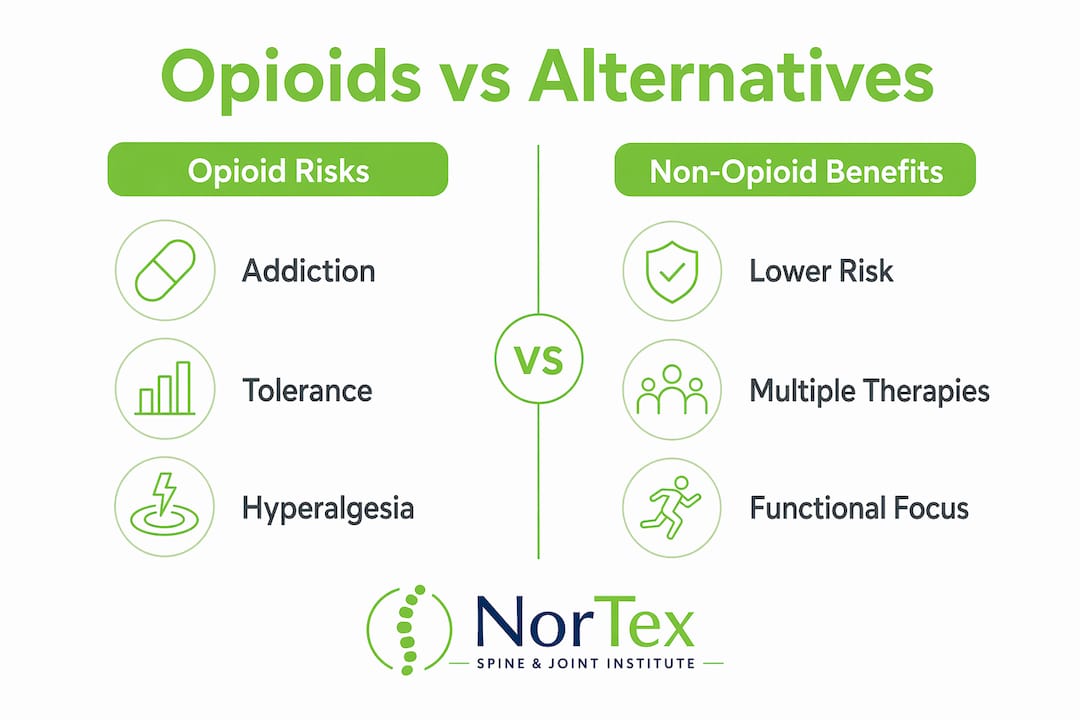
Effective non-opioid pain relief options now span pharmacologic, physical, behavioral, and interventional categories. The evidence supporting these approaches has grown substantially, and clinical guidelines increasingly position them as first-line treatments rather than fallback options.
Pharmacologic options
NSAIDs such as naproxen and ibuprofen remain effective for inflammatory pain when used appropriately. Gabapentinoids like gabapentin and pregabalin address nerve-related pain by calming overactive pain signals. In january 2025, the FDA approved suzetrigine, a selective sodium channel inhibitor that blocks pain transmission without the addiction risk associated with opioids. That approval marks a meaningful shift in what is available for patients who need medication-based relief.
Physical and behavioral therapies
Physical therapy builds strength, corrects movement patterns, and reduces mechanical stress on painful joints and tissues. Cognitive behavioral therapy (CBT) addresses the psychological dimension of chronic pain, which is not imaginary but neurologically real. Pain catastrophizing, fear-avoidance behavior, and sleep disruption all amplify pain perception, and CBT directly targets these patterns. Acupuncture has demonstrated benefit for several chronic pain conditions, including low back pain and osteoarthritis, in multiple controlled trials.
Multimodal treatment protocols
| Treatment category | Examples | Primary benefit |
|---|---|---|
| Pharmacologic | NSAIDs, gabapentinoids, suzetrigine | Reduces pain signals with lower addiction risk |
| Physical | Physical therapy, exercise programs | Restores function and reduces mechanical pain |
| Behavioral | CBT, mindfulness, sleep therapy | Addresses psychological amplifiers of pain |
| Interventional | PRP therapy, nerve blocks, spinal cord stimulation | Targets specific pain sources directly |
| Complementary | Acupuncture, massage therapy | Supports overall pain reduction and wellbeing |
Multimodal protocols that combine pharmacological, behavioral, and interventional therapies produce outcomes comparable or superior to opioids with a significantly better safety profile. The key insight is that chronic pain is multifactorial. No single drug or therapy addresses all of its dimensions.
Shifting the treatment goal from “eliminate pain” to “restore function” also matters clinically. Measuring success by improvements in walking, sleeping, and daily activities gives both patient and provider a more accurate picture of progress than pain scores alone. You may not reach zero pain, but returning to activities you value is a realistic and meaningful outcome.
Pro Tip: When evaluating a new treatment, track functional milestones alongside pain scores. Ask yourself: Am I sleeping better? Walking farther? Returning to activities I had given up? These measures often show progress before pain scores change.
For patients exploring alternative approaches to chronic pain, resources reviewing alternative treatment methods can provide additional context on what the evidence supports across different therapy types.
How to safely transition away from opioids
Transitioning off opioids requires a structured, individualized plan. Stopping abruptly is not safe or effective. A gradual taper, guided by a clinician who understands your history and functional goals, is the standard approach.
- Establish your baseline. Before reducing doses, document your current pain levels, sleep quality, and daily function. This gives you and your provider a reference point to measure progress and catch problems early.
- Work with a specialist. A pain management physician or your primary care provider can design a taper schedule matched to how long you have been on opioids. Long-term users need slower tapers than short-term users to avoid severe withdrawal.
- Introduce non-opioid therapies before or during the taper. Starting physical therapy, CBT, or an appropriate medication before reducing opioids gives your nervous system alternative pain management tools. This parallel approach reduces the discomfort of dose reduction.
- Set functional goals, not just dose targets. Clinicians use functional improvement as a guide for dosing decisions. The aim is the lowest dose that supports your daily activities, not necessarily complete elimination of medication.
- Monitor and adjust. Tapering is not linear. Some weeks will be harder than others. Regular check-ins with your provider allow for adjustments that keep the process manageable and safe.
Many patients who complete a supervised taper report that their pain is no better or only slightly worse than it was on opioids, while their mental clarity, energy, and overall function improve noticeably. That outcome reflects what the evidence predicts: opioids were not providing the relief patients assumed they were.
My perspective on opioids and chronic pain
A clinician’s honest view on opioid dependence in chronic pain
The pattern I see most often is a patient who started opioids after an injury or surgery, found genuine relief in the first weeks, and then stayed on them because stopping felt impossible. By the time they arrive at a pain clinic, they are often on doses that would have seemed extreme at the start, and their pain is no better controlled than it was at a lower dose. That trajectory is not a personal failure. It is a predictable pharmacological outcome.
What concerns me most is the misconception that higher pain scores justify higher doses. Pain intensity is a poor guide to opioid prescribing in chronic conditions. Function is a far better metric. A patient who rates their pain at 7 out of 10 but walks two miles a day and sleeps through the night is doing better than a patient who rates pain at 4 but cannot get off the couch. Opioids often improve the number without improving the life.
The patients I have seen make the most progress are those who commit to a multimodal plan with realistic expectations. They accept that the goal is not zero pain but a life they can live fully. That shift in perspective, combined with the right combination of therapies, produces outcomes that opioids alone never could. The evidence supports this approach, and so does the clinical experience of watching patients reclaim their daily lives.
— Felix
Non-opioid pain care at Nortexspineandjoint
Nortexspineandjoint specializes in non-surgical, non-opioid pain management for patients with chronic joint, spine, and musculoskeletal conditions in North Dallas. The clinic’s approach centers on identifying the root cause of pain and addressing it directly through regenerative and interventional therapies. Platelet-rich plasma (PRP) therapy, for example, uses your own blood’s growth factors to reduce inflammation and support tissue repair in conditions affecting the knee, hip, shoulder, and spine. Patients who have been managing pain with opioids and want a different path can explore personalized PRP treatment options alongside other evidence-based therapies. Nortexspineandjoint also offers regenerative medicine programs including stem cell therapy for patients seeking longer-term structural repair. A consultation with the Nortexspineandjoint team is the first step toward a treatment plan built around your function and your goals.
FAQ
Why avoid opioid painkillers for chronic pain specifically?
Opioids show no significant benefit over placebo in trials lasting 12 weeks or longer, while carrying serious risks including addiction, cognitive impairment, and opioid-induced hyperalgesia. For chronic pain, non-opioid therapies address the underlying mechanisms more safely.
What is opioid-induced hyperalgesia?
Opioid-induced hyperalgesia is a condition where continued opioid use makes the nervous system more sensitive to pain, paradoxically worsening the problem the medication was meant to treat. It is often mistaken for disease progression, leading to unnecessary dose increases.
What are the safest alternatives to opioid painkillers?
FDA-approved options like suzetrigine, NSAIDs, and gabapentinoids offer pharmacologic relief with lower addiction risk. Physical therapy, CBT, acupuncture, and interventional therapies like PRP injections provide additional non-opioid options suited to different pain types.
How do you safely stop taking opioids after long-term use?
Safe tapering requires a gradual, individualized dose reduction plan supervised by a clinician. Long-term users need slower tapers than short-term users, and introducing non-opioid therapies during the taper significantly improves outcomes.
Do opioids ever have a role in pain management?
Opioids remain appropriate for short-term use after surgery or injury, and for certain cancer-related or end-of-life pain. For chronic non-cancer pain, clinical guidance supports reserving them for cases where non-opioid options have failed or are contraindicated, with close monitoring.
Key takeaways
Opioid painkillers offer no proven advantage over placebo for chronic pain beyond 12 weeks, while non-opioid therapies including physical therapy, CBT, PRP, and FDA-approved medications provide safer and comparably effective relief.
| Point | Details |
|---|---|
| Limited long-term efficacy | Clinical trials show opioids perform no better than placebo for chronic pain after 12 weeks. |
| Opioid-induced hyperalgesia | Continued opioid use can paradoxically increase pain sensitivity, worsening the condition. |
| Significant side effect burden | Constipation affects up to 40% of long-term users; opioid use disorder occurs in 3–6%. |
| Effective non-opioid options exist | Suzetrigine, physical therapy, CBT, and PRP therapy offer evidence-based relief without addiction risk. |
| Tapering requires medical supervision | Individualized, gradual dose reduction with functional goal-setting produces the safest outcomes. |