
Musculoskeletal pain is defined as discomfort or pain affecting the muscles, bones, joints, ligaments, or tendons, and it can be either acute or chronic depending on how long it persists. Clinically, acute pain lasts fewer than 3 months, while chronic musculoskeletal pain continues at or beyond that threshold and often requires a different treatment approach entirely. Musculoskeletal disorders affect 40% of all U.S. adults, making them a leading driver of disability, lost productivity, and healthcare costs. Understanding the distinction between acute and chronic pain is not just reassuring. It is the first step toward getting the right care.
What is musculoskeletal pain, and what causes it?
Musculoskeletal pain originates in any of the body’s structural tissues: muscles, bones, cartilage, joints, ligaments, or tendons. The term “musculoskeletal disorder” is the standard clinical label used by physicians and physical therapists to describe this broad category of conditions. Causes range from a single traumatic event to years of cumulative wear.
The most common causes include:
- Acute injury: Fractures, sprains, strains, and dislocations from falls, sports, or accidents generate sudden, localized pain.
- Overuse: Repetitive motions in occupational or athletic settings cause microtrauma that accumulates over time, leading to conditions like tendonitis or stress fractures.
- Aging and degeneration: Cartilage thins and bone density decreases with age, contributing to osteoarthritis and degenerative disc disease.
- Poor posture: Sustained forward head posture or prolonged sitting places uneven mechanical load on the spine, hips, and shoulders.
- Systemic conditions: Rheumatoid arthritis and fibromyalgia involve immune or central nervous system dysfunction that produces widespread musculoskeletal pain without a single structural injury.
- Occupational hazards: Heavy lifting, vibration exposure, and static postures are well-documented risk factors in construction, nursing, and desk-based work.
- Psychological factors: Chronic stress, anxiety, and depression amplify pain perception through the central nervous system, making psychological health a genuine clinical variable, not a secondary concern.
Pathophysiologically, acute injury triggers local inflammation, which is a protective response. When that response fails to resolve, or when the nervous system becomes sensitized over time, pain persists beyond tissue healing. This is why two patients with identical MRI findings can report very different pain levels. The tissue damage tells only part of the story.
What symptoms of musculoskeletal pain should you watch for?

Common symptoms include aching, stiffness, limited range of motion, and fatigue, and these often disrupt sleep and daily functioning in ways that compound over time. Recognizing the full symptom picture helps you communicate more clearly with your care team and set realistic expectations for recovery.
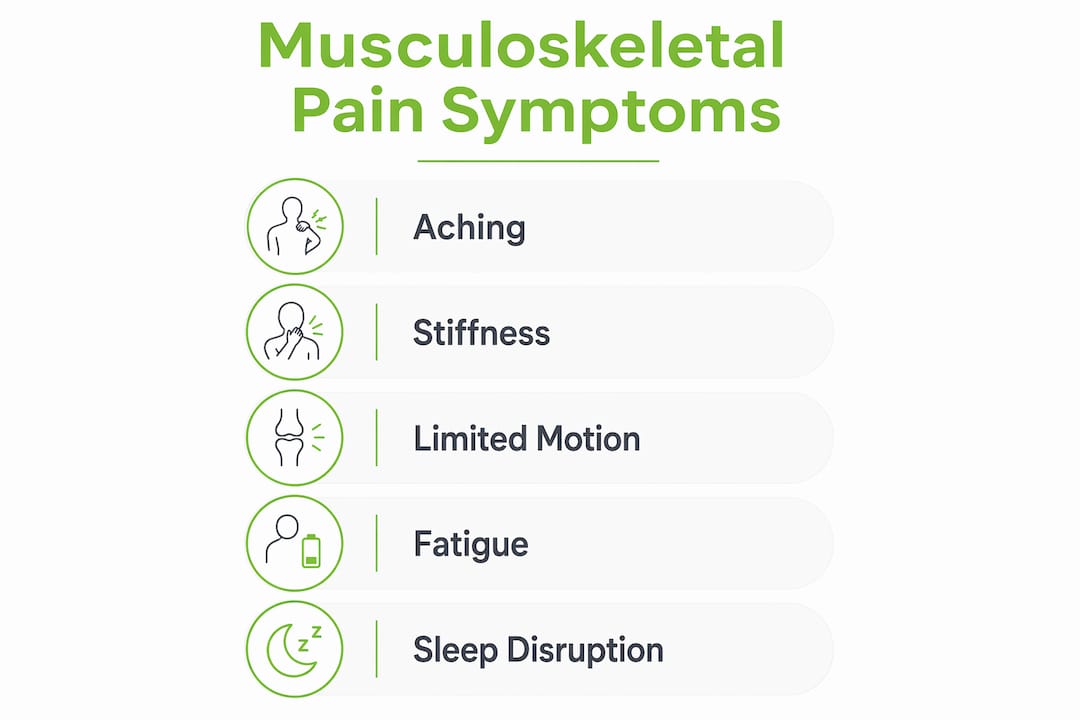
Typical symptoms fall into two broad categories:
Localized symptoms affect one specific area, such as a sore shoulder after overhead work or knee pain after a long run. These are usually tied to a clear mechanical cause and tend to respond well to targeted conservative care.
Widespread symptoms span multiple body regions simultaneously. Fibromyalgia is the most recognized example, producing diffuse aching, tender points, and profound fatigue without a single identifiable structural lesion.
Across both categories, patients commonly report:
- Dull, aching, or burning pain that worsens with activity or prolonged rest
- Morning stiffness that eases within 30 minutes of movement
- Muscle weakness or a sense of heaviness in the affected limb
- Reduced grip strength or difficulty with fine motor tasks
- Sleep disturbance due to positional pain or nighttime discomfort
- Fatigue that feels disproportionate to physical exertion
The psychological toll of chronic musculoskeletal pain includes depression, fatigue, and social isolation. This is not incidental. Persistent pain changes how people participate in work, relationships, and recreation, and those losses feed back into the pain experience itself.
Pro Tip: Keep a brief daily pain log for two weeks before your first appointment. Note the time of day, activity, pain intensity on a 0–10 scale, and what relieved or worsened it. This single habit gives your clinician far more useful data than memory alone.
What does diagnosis and assessment of musculoskeletal pain involve?
Diagnosing musculoskeletal pain is a structured clinical process, not a single test. The goal is to identify the tissue source, understand contributing factors, and rule out conditions that require urgent intervention.
A standard assessment typically follows these steps:
- Detailed medical history: Your clinician will ask about symptom onset, duration, location, quality, aggravating and relieving factors, prior treatments, and relevant medical history including prior injuries, surgeries, and systemic conditions.
- Physical examination: This includes range of motion testing, palpation of tender structures, neurological screening (reflexes, sensation, strength), and functional movement assessment to identify mechanical patterns.
- Imaging when indicated: X-rays identify bony changes, fractures, and joint space narrowing. MRI provides soft tissue detail for disc herniations, ligament tears, and cartilage damage. Imaging is not always the first step and should follow clinical reasoning.
- Patient-reported outcome measures: Validated tools such as the Oswestry Disability Index for back pain or the DASH questionnaire for upper limb function capture how pain affects your daily life, not just what appears on a scan.
- Ruling out red flags: Clinicians screen for signs of serious pathology including unexplained weight loss, night sweats, fever, or neurological deficits that would require urgent referral.
Chronic musculoskeletal pain presents a diagnostic challenge because acute and chronic pain are physiologically distinct. Chronic pain often reflects nervous system sensitization rather than ongoing tissue damage. That distinction matters because it changes the treatment target entirely.
Pro Tip: Bring a list of every treatment you have tried, including over-the-counter medications, physical therapy, injections, and any supplements. Knowing what has not worked is as clinically useful as knowing what has.
How to treat musculoskeletal pain without surgery
Non-surgical care combining physical therapy and therapeutic exercise is highly effective and produces meaningful cost savings compared to surgical intervention. For most patients, a well-structured conservative program addresses the root cause of pain rather than masking it.
The multimodal approach
Multimodal management is the recommended standard for chronic primary pain, including conditions like fibromyalgia. This means combining physical, psychological, and educational strategies rather than relying on a single modality. No single treatment works in isolation for complex musculoskeletal pain.
The core components of effective non-surgical musculoskeletal pain management include:
- Therapeutic exercise: Graded strengthening and flexibility programs rebuild tissue capacity and reduce load on painful structures. Exercise is the single most evidence-supported intervention across nearly all musculoskeletal conditions.
- Manual therapy: Hands-on techniques including joint mobilization and soft tissue work reduce pain and improve mobility, particularly in the early stages of care. Manual therapy in musculoskeletal recovery is most effective when paired with active exercise rather than used as a standalone treatment.
- Movement education: Teaching patients how to load tissues correctly, modify posture, and pace activity prevents re-injury and builds long-term resilience.
- Cognitive-behavioral strategies: Pain neuroscience education and cognitive-behavioral therapy reduce fear-avoidance behaviors and improve function. These are not optional add-ons. They are core components of effective chronic pain care.
- Adjunct instrumental therapies: Modalities such as TENS (transcutaneous electrical nerve stimulation), low-level laser therapy, and extracorporeal shock wave therapy (ESWT) serve as adjuncts within a broader program. Instrumental physical therapies are most effective as adjunctive treatments within a comprehensive rehabilitation plan, not as primary interventions.
Movement versus rest: what the evidence says
A persistent misconception in musculoskeletal pain management is that rest accelerates recovery. Prolonged immobility often worsens musculoskeletal pain. Muscle wasting, joint stiffness, and central sensitization all worsen with inactivity. Graded movement retraining, not bed rest, is the preferred clinical approach.
For patients with chronic low back pain specifically, combining shock wave therapy with conventional physical therapy produces high levels of pain relief and functional improvement. That combination ranks among the most effective non-surgical options currently available for this condition.
| Treatment approach | Best suited for | Key benefit |
|---|---|---|
| Therapeutic exercise | All musculoskeletal conditions | Builds tissue capacity and reduces recurrence |
| Manual therapy | Acute and subacute joint or soft tissue pain | Rapid pain reduction and mobility gains |
| ESWT + physical therapy | Chronic low back and tendon pain | High pain relief and functional improvement |
| Cognitive-behavioral therapy | Chronic pain with fear-avoidance or depression | Reduces disability and improves quality of life |
| PRP therapy | Chronic joint, tendon, or spine pain | Promotes tissue repair using the body’s own growth factors |
Pro Tip: If you have been told to “just rest” for more than two weeks without a structured return-to-movement plan, ask your clinician specifically about graded exercise therapy. Passive rest beyond the acute phase often delays recovery rather than supporting it.
For patients managing non-surgical lower back pain or shoulder conditions, the evidence consistently favors active rehabilitation over passive treatment alone.
Key Takeaways
Effective musculoskeletal pain management requires accurate diagnosis, a multimodal treatment plan, and active patient participation, not passive rest or surgery as a first response.
| Point | Details |
|---|---|
| Definition matters clinically | Pain lasting 3 months or more is chronic and requires a different treatment target than acute injury. |
| Causes are multifactorial | Injury, overuse, aging, posture, and psychological stress all contribute to musculoskeletal pain. |
| Symptoms extend beyond pain | Fatigue, sleep disruption, and depression are common and must be addressed in any treatment plan. |
| Movement beats rest | Graded exercise and movement retraining outperform prolonged immobility for most musculoskeletal conditions. |
| Multimodal care is the standard | Combining physical therapy, manual therapy, and cognitive strategies produces the best long-term outcomes. |
What I have learned from treating musculoskeletal pain conservatively
After years of evaluating patients with spine and joint conditions, one pattern stands out clearly: the patients who do best are the ones who understand their pain, not just the ones who receive the most treatments.
Many patients arrive after trying multiple interventions, often passive ones, without meaningful improvement. What changes outcomes is shifting from a passive “fix me” posture to an active role in recovery. That means following through with exercise programs between appointments, applying movement strategies at work and home, and engaging with the psychological dimensions of chronic pain rather than dismissing them.
The other thing I have seen consistently is that early conservative care prevents unnecessary surgery. Integrated non-surgical interventions often prevent unnecessary surgeries and reduce overall healthcare costs. Patients who commit to a structured rehabilitation program in the first three to six months of symptoms rarely need to consider surgical options. Those who delay or rely solely on pain medication often find themselves on a longer, harder road.
Realistic expectations matter too. Non-surgical care is not instant. A meaningful reduction in pain and improvement in function typically takes six to twelve weeks of consistent effort. That timeline is not a failure of the treatment. It reflects how tissue remodeling and nervous system adaptation actually work.
The role of therapy in chronic pain management is often underestimated by patients who expect a procedure to resolve what is fundamentally a complex, multifactorial condition. The most durable outcomes come from combining the right clinical interventions with an informed, engaged patient.
— Felix
Advanced non-surgical care at Nortexspineandjoint
Nortexspineandjoint specializes in non-surgical treatment for chronic joint, spine, and musculoskeletal conditions at its North Dallas clinics. For patients whose pain has not responded adequately to standard physical therapy, advanced regenerative options are available. PRP therapy for musculoskeletal pain uses platelet-rich plasma drawn from your own blood to deliver concentrated growth factors directly to damaged tissue, supporting repair in joints, tendons, and spinal structures. Nortexspineandjoint also offers stem cell therapy and customized rehabilitation programs, all designed to address the root cause of your pain. Personalized treatment plans are built around your specific diagnosis, functional goals, and medical history, not a one-size-fits-all protocol.
FAQ
What is musculoskeletal pain in simple terms?
Musculoskeletal pain is discomfort in any of the body’s structural tissues, including muscles, bones, joints, ligaments, or tendons. It can result from injury, overuse, aging, or systemic conditions like arthritis.
How long does musculoskeletal pain last?
Pain lasting fewer than 3 months is classified as acute; pain persisting at or beyond 3 months is considered chronic and typically requires a more comprehensive treatment approach.
What are the most effective non-surgical treatments?
Therapeutic exercise, manual therapy, and cognitive-behavioral strategies form the core of evidence-based non-surgical care. Adjunct modalities like ESWT and PRP therapy are effective additions for chronic or treatment-resistant cases.
Can musculoskeletal pain cause fatigue and sleep problems?
Chronic musculoskeletal pain commonly causes fatigue, sleep disturbance, and mood changes including depression. These symptoms are direct consequences of persistent pain and should be addressed as part of any treatment plan.
When should I see a specialist for musculoskeletal pain?
See a specialist if your pain has lasted more than six weeks, is worsening despite rest and over-the-counter treatment, or is accompanied by neurological symptoms such as numbness, tingling, or weakness.