
Osteoarthritis pain is defined as mechanical joint pain caused by the progressive degeneration of articular cartilage and the surrounding joint structures. It is the most common form of arthritis, affecting an estimated 240 million people worldwide, with prevalence rising sharply after age 75. Unlike inflammatory arthritis, osteoarthritis pain typically worsens with physical activity and improves with rest, at least in the early stages. Understanding what is osteoarthritis pain, how it develops, and what you can do about it is the first step toward managing it effectively and protecting your long-term mobility.
What causes osteoarthritis pain and how does it develop?
Osteoarthritis pain originates from the breakdown of articular cartilage, the smooth tissue that cushions the ends of bones inside a joint. When cartilage degrades, bones begin to contact each other more directly during movement, generating friction, inflammation, and pain signals. Over time, the joint responds by forming bone spurs (osteophytes), thickening the joint capsule, and producing excess synovial fluid, all of which contribute to stiffness, swelling, and discomfort.
Several factors accelerate this process. Aging is the most significant, since cartilage loses its ability to repair itself efficiently over time. Repetitive mechanical stress from occupational tasks or sports, prior joint injuries, obesity, and genetic predisposition all increase the rate of cartilage loss. Excess body weight is particularly impactful in weight-bearing joints like the knees and hips, since even modest weight gain multiplies the compressive load on cartilage with every step.

One detail that surprises many patients is that imaging findings do not always match pain levels. Radiographic evidence of osteoarthritis can appear years before symptoms emerge, and some individuals with significant structural changes on X-ray report minimal pain, while others with mild imaging findings experience severe discomfort. This disconnect underscores why clinical assessment must be individualized rather than driven by imaging alone.
The table below summarizes the primary contributing factors and their mechanisms:
| Contributing factor | Mechanism of joint damage |
|---|---|
| Aging | Reduced cartilage regeneration capacity |
| Obesity | Increased compressive load on weight-bearing joints |
| Prior joint trauma | Accelerated cartilage wear at injury site |
| Repetitive mechanical stress | Gradual erosion of cartilage surface |
| Genetic predisposition | Structural or metabolic cartilage vulnerabilities |
How does osteoarthritis pain feel and when does it occur?
Osteoarthritis pain is mechanical, meaning it worsens with weight-bearing activities and typically improves with rest. In the early stages, you may notice discomfort only after prolonged walking, climbing stairs, or rising from a chair. As the condition progresses, pain can become present at rest or even during sleep, signaling more advanced joint involvement.
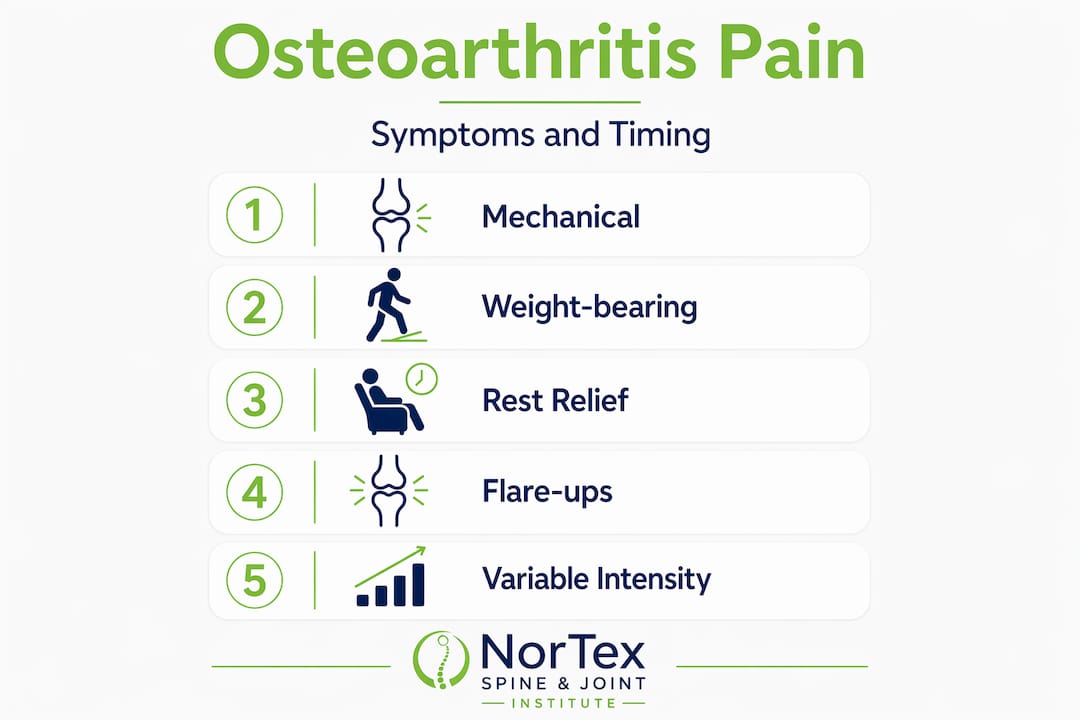
A key distinguishing feature is morning stiffness. Joint stiffness lasting under 30 minutes after waking or after a period of inactivity is characteristic of osteoarthritis. This is a clinically useful marker because inflammatory arthritis, such as rheumatoid arthritis, typically causes stiffness lasting more than an hour. If your joints loosen up quickly once you start moving, that pattern points toward osteoarthritis rather than an inflammatory process.
Common sensations and triggers associated with osteoarthritis pain include:
- Aching or deep soreness in the affected joint, often described as a dull, persistent throb
- Sharp pain with specific movements, such as pivoting, squatting, or bearing full weight
- Stiffness after sitting for extended periods, sometimes called the “gelling” phenomenon
- Crepitus, a grinding, clicking, or crackling sensation during joint movement
- Swelling around the joint, particularly after activity or at the end of the day
- Reduced range of motion, making everyday tasks like bending or gripping more difficult
Pain in osteoarthritis does not follow a perfectly linear path. Many patients describe flare periods followed by relative calm, which can make it tempting to delay treatment during quieter phases. Recognizing your personal pattern is clinically valuable.
Pro Tip: Keep a simple symptom diary for two to four weeks, noting pain intensity, time of day, activity level, and weather conditions. The Arthritis Foundation recommends symptom tracking as a practical tool for identifying individual triggers and improving the quality of conversations with your care team.
How can you manage and reduce osteoarthritis pain effectively?
Managing osteoarthritis pain requires a layered approach that addresses both the mechanical load on the joint and the body’s capacity to tolerate and recover from that load. Nonpharmacologic treatments such as weight loss, patient education, and joint protection are prioritized before medications, because long-term lifestyle changes produce more durable outcomes than short-term medication reliance alone.
Exercise and physical therapy
Low-impact aerobic exercise, including walking, swimming, and cycling, strengthens the muscles that support affected joints and reduces the compressive forces that accelerate cartilage wear. Physical therapy adds targeted strengthening, flexibility work, and movement retraining to address the specific biomechanical patterns driving your pain. Many patients who work with a physical therapist report meaningful improvements in function within six to eight weeks. You can learn more about physical therapy for arthritis and how it supports mobility without surgery.
Pharmacologic options
When lifestyle measures alone are insufficient, medications can provide meaningful relief. Over-the-counter NSAIDs such as ibuprofen and naproxen reduce both pain and joint inflammation. Topical agents, including diclofenac gel (sold as Voltaren), deliver anti-inflammatory medication directly to the joint surface with fewer systemic side effects, making them a preferred option for older adults or those with gastrointestinal concerns. Acetaminophen remains an option for mild pain, though its anti-inflammatory effect is limited.
Advanced and regenerative therapies
For patients who have not responded adequately to conservative care, regenerative options offer a different mechanism of action. Platelet-rich plasma (PRP) injections use a concentration of your own blood’s growth factors to reduce inflammation and support tissue repair within the joint. Corticosteroid injections provide faster but shorter-term relief and are typically used to manage acute flares. Hyaluronic acid injections aim to restore joint lubrication, though their evidence base is more variable.
The comparison table below outlines the main management options:
| Treatment option | Primary benefit | Key limitation |
|---|---|---|
| Weight loss and exercise | Reduces joint load, improves function | Requires sustained commitment |
| Physical therapy | Corrects movement patterns, builds support | Results take weeks to develop |
| Topical NSAIDs (Voltaren) | Localized pain relief, fewer side effects | Less effective for deep joints |
| Oral NSAIDs (ibuprofen, naproxen) | Broad pain and inflammation reduction | GI and cardiovascular risks with long-term use |
| PRP injections | Supports tissue repair, reduces inflammation | Variable insurance coverage |
| Corticosteroid injections | Rapid flare management | Short-term effect, limited repeat use |
Pro Tip: Consistency matters more than intensity. Patients who commit to daily low-impact movement and joint protection strategies tend to see gradual, sustained improvement rather than dramatic short-term gains. Set realistic expectations and measure progress over months, not days.
What are common misconceptions about osteoarthritis pain?
Several persistent misconceptions lead patients to manage their condition less effectively, sometimes making pain worse over time. Addressing these directly can change the trajectory of your care.
The most damaging misconception is that pain signals joint fragility requiring rest and immobilization. Avoiding physical activity due to fear of joint damage leads to muscle weakness and increased joint load, which worsens osteoarthritis pain over time. Active, low-impact movement is not just safe; it is one of the most effective treatments available. Walking, for example, maintains cartilage nutrition and reduces the mechanical stress that comes from weak supporting muscles. You can explore the evidence on walking and arthritis to understand how to balance activity safely.
Other common misconceptions worth correcting:
- “Crepitus means my joint is getting worse.” Crepitus results from cartilage surface changes and is not inherently a sign of worsening damage. It should not discourage movement or exercise.
- “My X-ray looks bad, so my pain must be severe.” Imaging findings and pain levels frequently do not align. Clinical symptoms, not imaging alone, guide treatment decisions.
- “Osteoarthritis is just wear and tear I have to live with.” While cartilage loss is not fully reversible, pain and function can improve significantly with the right treatment plan.
- “Supplements like glucosamine will repair my cartilage.” The evidence for glucosamine and chondroitin is mixed at best. They may offer modest symptom relief for some patients but do not reverse structural damage.
Warning signs that warrant prompt medical evaluation include sudden significant joint swelling, redness and warmth suggesting possible infection or inflammatory flare, severe pain after a minor injury, or symptoms that spread to multiple joints simultaneously. These presentations may indicate a condition other than osteoarthritis, such as gout, pseudogout, or rheumatoid arthritis, and require a different diagnostic and treatment approach. Reviewing the signs of joint inflammation can help you recognize when to seek care promptly.
Key takeaways
Osteoarthritis pain is mechanical in origin, worsens with activity, and responds best to a sustained combination of movement, weight management, and targeted medical treatment.
| Point | Details |
|---|---|
| Mechanical pain pattern | Osteoarthritis pain worsens with activity and improves with rest, especially in early stages. |
| Stiffness duration matters | Morning stiffness under 30 minutes distinguishes osteoarthritis from inflammatory arthritis. |
| Imaging does not equal pain | Structural changes on X-ray do not reliably predict pain severity; clinical assessment is essential. |
| Movement is treatment | Avoiding activity worsens muscle weakness and joint load; low-impact exercise is a core therapy. |
| Layered management works best | Combining lifestyle changes, physical therapy, and targeted interventions produces the best outcomes. |
What I have learned treating osteoarthritis pain over the years
After years of evaluating patients with osteoarthritis at Nortexspineandjoint, the pattern I see most often is not a lack of treatment options. It is a lack of accurate expectations. Patients frequently arrive having tried one or two things, found partial relief, and concluded that nothing will work. That conclusion is almost always premature.
What I have found is that osteoarthritis pain is highly variable, not just between patients, but within the same patient across months and seasons. A treatment that seems ineffective during a flare period may be doing meaningful work in the background. The patients who do best are those who commit to the process: consistent movement, honest symptom tracking, and open communication with their care team about what is and is not working.
The other thing I want to be direct about is the role of imaging. I have seen patients with severe X-ray findings who function remarkably well, and I have seen patients with mild imaging changes who are significantly limited. Pain is a clinical reality, not a radiographic one. If your imaging looks concerning but your function is good, that is a success worth protecting. If your imaging looks mild but your pain is real and limiting, that is a problem worth treating aggressively.
Regenerative options like PRP have added a meaningful tool to what we can offer, particularly for patients who want to avoid surgery or who have not responded to conventional care. They are not a cure, but for the right patient, they can shift the trajectory in a meaningful direction.
— Felix
Explore personalized osteoarthritis pain treatment at Nortexspineandjoint
If you are living with persistent joint pain that has not responded to rest, over-the-counter medications, or basic exercise, it may be time to consider a more targeted approach. At Nortexspineandjoint, we specialize in non-surgical pain management and regenerative medicine for patients with osteoarthritis across North Dallas. Our PRP therapy program uses your body’s own growth factors to reduce joint inflammation and support tissue repair, with treatment plans tailored to your specific joints, activity level, and goals. We also offer stem cell therapy and customized rehabilitation programs designed to address the root cause of your pain. Schedule a consultation to find out which approach fits your situation.
FAQ
What is osteoarthritis pain, exactly?
Osteoarthritis pain is mechanical joint pain caused by the degeneration of articular cartilage, leading to bone-on-bone friction, inflammation, and structural joint changes. It typically worsens with activity and improves with rest, particularly in the early stages of the disease.
How is osteoarthritis pain different from other arthritis pain?
Osteoarthritis pain is mechanical and activity-related, while inflammatory arthritis pain, such as that from rheumatoid arthritis, tends to be more constant and is associated with prolonged morning stiffness lasting over an hour. Joint stiffness under 30 minutes after inactivity is a hallmark of osteoarthritis.
What are the stages of osteoarthritis and how does pain change?
Osteoarthritis progresses through stages from minimal cartilage changes with intermittent pain to significant joint space narrowing with constant or rest pain. Early stages produce pain only with activity, while advanced stages can cause pain at night and during periods of inactivity.
Can osteoarthritis pain be managed without surgery?
Yes. The majority of patients manage osteoarthritis pain effectively through weight loss, low-impact exercise, physical therapy, topical or oral NSAIDs, and in some cases regenerative treatments like PRP injections. Surgery is typically considered only when conservative measures have been exhausted.
When should I see a doctor about joint pain?
You should seek medical evaluation if joint pain is accompanied by significant swelling, redness, warmth, or fever, or if pain develops suddenly after a minor injury. These signs may indicate infection, gout, or inflammatory arthritis rather than osteoarthritis, and require a different course of treatment.
Recommended
- Hip Osteoarthritis | Hip Pain Specialist in Texas
- Osteoarthritis of the Knee Symptoms, Causes and Treatment – Nortex Spine & Joint
- Can Yoga Help with Arthritis Pain? The Science of Gentle Movement – Nortex | Pain Management | Allen, Garland, McKinney & Plano Texas
- What Causes Arthritis Pain to Flare Up? How to Prevent Triggers – Nortex | Pain Management | Allen, Garland, McKinney & Plano Texas