
Most patients who go through Class IV laser therapy notice mild warmth or brief redness at the treatment site, and little else. Serious complications like eye injury or burns are possible, but when a clinic follows ANSI and OSHA-aligned safety protocols with a properly trained operator, they’re rare. If you feel something unexpected after a session, don’t wait, call your provider and describe exactly what you’re experiencing.
TL;DR:
- Serious risks like eye injury and burns are rare when clinics follow strict safety protocols, including protective eyewear and proper signage.
- Patients should expect only mild, temporary side effects such as warmth, redness, soreness, and occasional pain flares, which generally resolve within days.
- Proper operator training and individualized dosing are critical to maximizing safety and effectiveness, especially to avoid overexposure and tissue overheating.
- People with active cancer, pregnancy, open wounds, tattoos, or impaired sensation should avoid or carefully consider laser therapy with their provider.
- Most adverse events result from preventable errors like improper power settings or neglecting safety measures, not the laser technology itself.
Table of Contents
- What Are the Common Side Effects of Class IV Laser Therapy?
- What Serious Risks Come With Class IV Laser Therapy?
- Who Should Avoid Class IV Laser Therapy?
- What Safety Protocols Should a Clinic Follow?
- Why Do Dosimetry and Operator Skill Matter So Much?
- What Does the Clinical Evidence Say About Safety?
- What Happens During Treatment and Recovery?
- When Should You Call Your Provider After Treatment?
- Nortex Clinical Perspective: Screening, Dose Individualization, and Outcomes
- Considering Class IV Laser Therapy? Here’s How Nortex Approaches It
- Where to Learn More About Class IV Laser Safety
- Sources
- FAQ
What Are the Common Side Effects of Class IV Laser Therapy?
You should expect to feel warmth as the laser passes over your skin. That sensation comes from the light energy converting to heat as it penetrates tissue, and for most patients it’s genuinely pleasant, similar to a heating pad but more localized. Some patients describe a light tingling or pressure as the handpiece moves across the treatment area.
After the session, mild redness at the treatment site is common. It usually fades within a few hours. A smaller number of patients report brief soreness or tenderness in the treated area, sometimes lasting into the next day, and occasionally we hear about a short flare in pain before things settle down and improve. That flare tends to worry patients more than it should. It reflects increased blood flow and a temporary inflammatory response, the same biological chatter that happens when tissue starts actively repairing itself.
Here’s what typically shows up, and how long it tends to last:
- Warmth during treatment (resolves immediately after the session ends)
- Mild skin redness (a few hours, rarely more than a day)
- Soreness or tenderness at the site (hours to two or three days)
- Brief pain flare before improvement (usually within a couple of days)
For the first day or two, rest the area, use ice if soreness bothers you, and hold off on aggressive exercise or heavy lifting involving the treated region. Sham-controlled trials of high-intensity laser therapy report the same pattern of side effects, warmth, tingling, transient discomfort, which is reassuring because it means what you’re feeling matches what’s documented in controlled research, not something unusual to your case.
Pro Tip: If soreness after a session feels worse than what you felt before treatment, don’t assume it’s failure. Mention it at your next visit anyway. Trends matter more than any single day.
What Serious Risks Come With Class IV Laser Therapy?
Class IV lasers operate above the power threshold of 500 milliwatts, and that power level is exactly what makes them effective for deeper tissue penetration and exactly what makes them capable of causing real harm if mishandled. The ocular and skin hazards documented in laser safety literature are permanent risks, not theoretical ones, which is why we treat eyewear as non-negotiable for every person in the room, not just the patient.
The three failure modes worth understanding:
- Ocular injury: Direct or specular reflection off a shiny surface can direct laser energy into the eye, potentially causing permanent retinal or corneal damage.
- Thermal burns: Excessive power settings, letting the handpiece linger too long in one spot, or treating over tattoos and darker pigmentation without adjusting power can overheat tissue faster than it can dissipate that heat.
- Fire hazard: Flammable materials, alcohol-based solvents, or even reflective jewelry in the beam path can ignite or redirect energy unpredictably.
Industry guidance on Class 4 devices is direct on this point: PPE alone doesn’t eliminate the risk of severe ocular injury or fire. Engineering controls, like beam containment and proper signage, have to work alongside protective eyewear, not instead of it. Peer-reviewed evaluations of laser therapy have similarly catalogued epidermal side effects and ocular structure damage tied specifically to misuse or overexposure scenarios, underscoring that the device itself isn’t the variable that determines safety. How it’s used is.
Who Should Avoid Class IV Laser Therapy?
Certain patients need to sit this treatment out, or at least have a longer conversation with their provider before starting. In our experience, screening for these factors takes just a few minutes, but skipping that conversation is where problems start.
- Pregnancy: Avoid irradiation over the abdomen or lumbosacral region.
- Active cancer at the treatment site: Laser energy that increases local blood flow and cellular activity is not appropriate near malignant tissue.
- Children with open growth plates: Direct laser exposure over epiphyseal plates is avoided as a precaution.
- Open wounds over the intended treatment area.
- Photosensitizing medications (certain steroids and other photosensitizers) that heighten heat or light sensitivity.
- Tattoos or heavily pigmented skin, where pigment absorbs more energy and raises burn risk.
- Impaired sensation (from neuropathy, for example), since patients may not feel early warning signs of overheating.
- Implanted electrical devices, which require case-by-case clinical judgment.
For tattoos and pigmented skin specifically, clinical protocol guidance recommends increasing the distance between the handpiece and skin and moving faster across the area, reducing energy concentration without sacrificing therapeutic effect. None of these are automatic disqualifiers. They’re flags that change how, or whether, treatment proceeds.
What Safety Protocols Should a Clinic Follow?
Before you commit to a course of treatment, it’s fair, and frankly smart, to ask a clinic how they manage laser safety. A few specifics separate a well-run program from a risky one.
- Wavelength-specific protective eyewear for everyone in the treatment room, patient and staff alike, worn for the entire session.
- ANSI-compliant warning signage posted outside the treatment room whenever the laser is in use, along with control of what’s known as the Nominal Hazard Zone, the area where stray or reflected beam energy could still cause injury.
- Removal of reflective objects, including jewelry, watches, and anything metallic, before treatment begins.
- Documented device maintenance and calibration, plus a key-switch control system so the laser can’t be activated by anyone other than an authorized operator.
- No flammable materials (alcohol preps, certain topical solvents) in or near the treatment field.
- Clear operator qualifications and supervision, with a written treatment protocol that records the dose delivered at every session.
Institutional laser-safety training standards outline these administrative and engineering controls as baseline requirements, not optional extras. A clinic that can walk you through each of these without hesitation is one that treats safety as a system, not an afterthought.
Pro Tip: Ask specifically who calibrates the laser and how often. A vague answer tells you more than a confident one.
Why Do Dosimetry and Operator Skill Matter So Much?
Dosimetry is the math behind every laser session, power output, wavelength, energy delivered per square centimeter, beam size, and whether the laser fires continuously or in pulses. Get that math wrong and you either undertreat, wasting the visit, or overtreat, raising the odds of a burn or unnecessary discomfort.
Wavelength and target depth are linked directly. A nerve or joint sitting several centimeters below the skin needs a different wavelength and power combination than a superficial tendon just under the surface. Practitioner skill, more than the device’s maximum output, tends to determine both outcome and safety in day-to-day practice. A laser rated for high power doesn’t mean every session runs at maximum settings.
Common mistakes we see from less experienced operators include:
- Holding the handpiece stationary too long over one spot instead of keeping it moving
- Using a standard power setting regardless of skin tone, tissue depth, or patient sensitivity
- Skipping a small test area on new or unusually sensitive patients
A trained clinician moves the handpiece continuously, adjusts power based on tissue depth and pigmentation, and, when treating a new or particularly sensitive area, tests a small patch first before committing to a full session. That’s not caution for caution’s sake. It’s how you get consistent results without surprises.
What Does the Clinical Evidence Say About Safety?
The research on high-power and high-intensity laser therapy (often abbreviated HPLT or HILT) is more reassuring than alarming, provided you read past the headline. A 2024 randomized controlled trial found that HILT produced greater pain reduction with minimal reported adverse events compared to other therapies tested, which is a meaningful data point given how carefully RCTs track and report every side effect, however minor.
Documented serious adverse events in the literature tend to trace back to specific, preventable failures, most often inadequate protective eyewear or operator error, rather than the laser technology itself.
That distinction shows up consistently across the safety literature. When you look at where things went wrong in documented cases, it’s rarely the device malfunctioning. It’s a missed step: eyewear not worn correctly, power settings mismatched to the tissue being treated, or a reflective object left in the beam path.
Evidence gaps still exist, particularly for neuropathic conditions. Ongoing clinical trials investigating HPLT dosing for neuropathic pain are using staged dosing protocols and monitoring for expected side effects like warmth or transient discomfort, precisely because the ideal dose for nerve-related pain isn’t fully settled yet. If your condition falls into that category, it’s worth asking your provider directly how much evidence supports the specific protocol they’re recommending, and what a conservative starting dose looks like for your case.
What the evidence supports clearly:
- Low rates of adverse events when protocols are followed correctly
- Meaningful pain reduction in musculoskeletal conditions with RCT-level support
- A genuine, acknowledged gap in high-quality data for some neuropathic applications
What Happens During Treatment and Recovery?
A typical visit follows a predictable pattern, which is part of why it tends to feel low-stress even for first-time patients.
- Screening first. Your provider reviews your history, checks for contraindications, and confirms the treatment area.
- Protective eyewear goes on, and any jewelry or reflective items come off.
- Treatment itself runs 5 to 15 minutes depending on the area and condition, with the handpiece moving continuously across the skin.
- You’ll feel warmth, sometimes a light tingle, rarely anything more.
- A full course usually involves multiple short sessions spread over several weeks, not a single visit.
Immediately afterward, mild redness or soreness can linger for a few hours to a couple of days. Most patients return to normal activity the same day. Meaningful pain relief doesn’t always show up after session one. Many patients notice gradual improvement over the first two to three weeks of a treatment course, and the pace varies based on the condition being treated and how long it’s been present. If you’re weighing this against a longer course of physical therapy for lower back pain, the two approaches are often complementary rather than either/or.
When Should You Call Your Provider After Treatment?
Most post-treatment effects resolve on their own, but a few symptoms warrant a call, and a couple warrant urgent care the same day.
- Vision changes of any kind following possible eye exposure during a session
- Large blisters or skin that looks significantly burned rather than mildly reddened
- Rapidly expanding redness that spreads well beyond the original treatment area
- Fever or signs of infection, including pus, worsening pain, or red streaking
If something looks off, take a photo and note the time of your session along with any settings you remember being discussed. That information helps your provider assess what happened quickly. Report it to the clinic directly, and if the reaction is severe, don’t wait for a callback, seek evaluation the same day.
Nortex Clinical Perspective: Screening, Dose Individualization, and Outcomes
At Nortex, screening starts before the laser ever turns on. We review medical history, current medications, and the specific tissue depth we’re targeting, then walk through informed consent so you understand exactly what to expect. Dosimetry isn’t standardized across patients here; it’s individualized based on your condition, your tissue depth, and your goals for treatment.
Many patients come to us after months of conservative care, physical therapy, anti-inflammatories, rest, that plateaued short of real relief. Class IV laser therapy often becomes one piece of a broader plan rather than a standalone fix. Realistic outcomes matter more to us than optimistic ones: some patients respond within a few sessions, others need a full course before noticing meaningful change, and a smaller group finds laser therapy insufficient alone and benefits more from combining it with other Nortex modalities.
— Felix
Considering Class IV Laser Therapy? Here’s How Nortex Approaches It
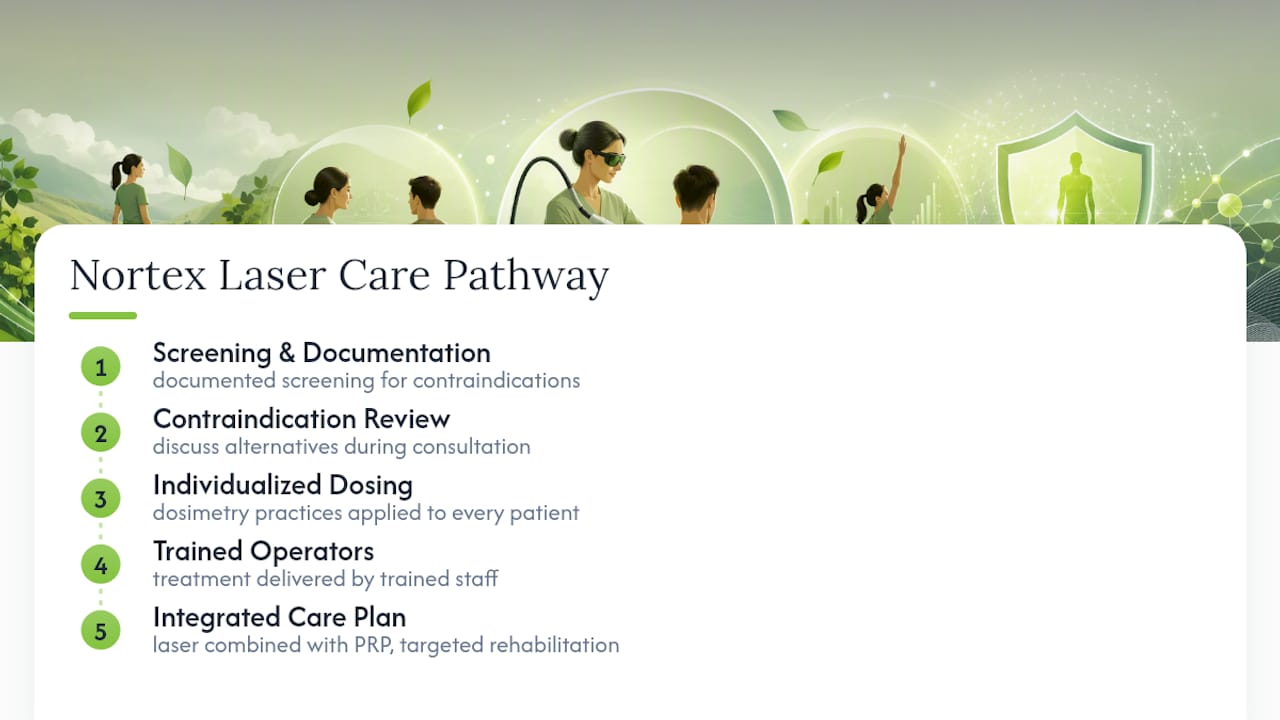
Nortex offers Class IV laser therapy as part of a broader regenerative medicine and pain-management program, not as an isolated treatment sold on its own. That matters because the safety protocols and dosimetry practices described throughout this article, individualized dosing, trained operators, documented screening, are the same standards applied to every patient who walks through our doors in North Dallas.
If contraindications like active cancer, certain medications, or specific skin conditions apply to you, we’ll walk through alternatives during your consultation rather than pushing forward with a treatment that isn’t the right fit. For many patients, laser therapy works best alongside other non-surgical options, from PRP to targeted rehabilitation. Explore Nortex’s regenerative medicine programs to see how Class IV laser fits into a personalized plan, or schedule a consultation to talk through your specific condition and get an honest read on whether it’s the right next step for you.
Where to Learn More About Class IV Laser Safety
The safety claims throughout this article draw from peer-reviewed clinical literature and established institutional guidance, including laser hazard reviews published on PubMed Central, Princeton’s laser safety training guide, and a 2024 randomized controlled trial on high-intensity laser therapy. For readers interested in dosing principles behind light-based therapies more broadly, this guide to red light therapy dosage offers useful additional context.
This article is general information, not a substitute for advice from a qualified doctor. Consult a qualified healthcare professional about your own circumstances before acting on anything here.
Sources
- High-intensity laser therapy randomized trial (PubMed ID 38630331) — 2024
- Clinical trial: HPLT for neuropathic pain (NCT07328360)
FAQ
Is Class IV laser therapy safe?
Yes, for most patients, when performed by a trained operator following ANSI and OSHA-aligned safety protocols. Serious complications like burns or eye injury are rare and almost always trace back to preventable errors like inadequate eyewear or improper power settings.
What are two drawbacks of laser therapy?
The most common drawbacks are mild, temporary side effects, warmth, redness, or brief soreness, and the fact that clinical evidence for certain conditions, particularly some neuropathic pain applications, is still developing through ongoing trials.
Can Class IV laser reverse neuropathy?
Class IV laser therapy can help manage nerve-related pain symptoms for some patients, but “reversing” neuropathy isn’t a claim current evidence supports. Ongoing trials are still evaluating optimal dosing for neuropathic conditions specifically.
How long does it take to recover from laser therapy?
Mild side effects like redness or soreness typically resolve within a few hours to two or three days. A full treatment course usually spans multiple short sessions over several weeks, with meaningful pain relief building gradually rather than appearing after a single visit.