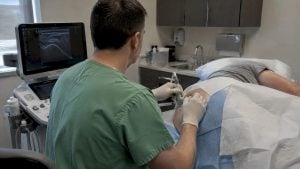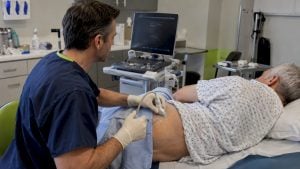

An ultrasound-guided hip injection is a shot of medicine, usually a local anesthetic with or without a corticosteroid, placed into or around the hip using live ultrasound images to steer the needle. The imaging lets the physician see the target and the needle at the same time. That matters for two reasons: the medicine lands where it is meant to, and your response tells us something about where your pain actually comes from. Below, we explain how the visit goes, what relief is realistic, how long it lasts, and where the injection fits next to physical therapy, regenerative options and surgery.
TL;DR
- An ultrasound-guided hip injection places medicine into the hip joint or a nearby structure, such as the bursa, while the physician watches the needle on a screen.
- The visit is short, often 30 to 60 minutes in total, and most people return to light activity the next day.
- For hip osteoarthritis, steroid injections tend to give meaningful relief in the first few months, then the benefit usually fades. They work best as part of a plan that includes rehabilitation.
- The injection is also a diagnostic test: if an accurately placed injection does not help, the pain may be coming from the lower back or soft tissues rather than the joint.
- Repeated steroid injections are generally limited because of possible cartilage and bone effects, so it is worth planning the next step before the first shot.
Table of Contents
- What an ultrasound-guided hip injection actually is
- Who tends to be a good candidate
- What happens during the visit
- The injection as a diagnostic test
- How long does relief last?
- Recovery and aftercare
- Risks and limitations
- Ultrasound or fluoroscopy?
- How injections fit into a larger plan
- Our perspective on hip injections
- Talking with us about your hip pain
- Questions people ask
- Sources
What an ultrasound-guided hip injection actually is
The hip is a deep ball-and-socket joint, surrounded by thick muscle and close to important nerves and blood vessels. Placing a needle there without imaging relies on surface landmarks, and the joint is simply not easy to find by feel. Ultrasound uses sound waves to show the joint capsule, the bone, nearby tendons and the needle as it advances, with no radiation involved.
According to MedlinePlus, a hip joint injection is a shot of medicine into the hip joint that can relieve pain and inflammation and can also help identify the source of hip pain. The medicine is typically a numbing agent, a corticosteroid, or both. Other injectables, including hyaluronic acid and platelet-rich plasma (PRP), are sometimes guided the same way, and we come back to those below.
The word hip covers several different pain generators, and the target changes with the diagnosis:
- The hip joint itself (intra-articular): typically for osteoarthritis, inflammation of the joint lining, or to test whether the joint is the pain source.
- The trochanteric bursa: the fluid-filled cushion on the outer side of the hip. Irritation here causes pain when lying on that side or climbing stairs. We discuss this on our page about hip bursitis.
- Tendons around the hip: the gluteal tendons on the outside, for example, are a frequent source of what patients describe as hip pain.
A physician who looks at your history and examination first will choose among these. The injection comes after the diagnosis, not instead of it.
Who tends to be a good candidate
Many patients come to us after trying several things already: anti-inflammatory pills, rest, a few weeks of stretching, and sometimes an unguided shot elsewhere that did not help. A guided hip injection is reasonable to consider when:
- Groin, buttock or outer hip pain has persisted despite activity changes and over-the-counter medication.
- Imaging or examination points to osteoarthritis, bursitis or tendon irritation.
- The pain limits walking, sleep or work, and you want relief enough to participate in rehabilitation.
- The source of the pain is uncertain and a diagnostic answer would change the plan.
It is less suited to someone with an active infection, uncontrolled blood sugar, a bleeding disorder or on blood thinners without a plan from the prescribing doctor, or someone with advanced bone-on-bone arthritis hoping for a lasting fix. Always tell the physician about every medication and any allergies before the procedure.
What happens during the visit
The sequence varies slightly between practices, but a typical visit looks like this:
- Review and examination. The physician confirms the pain pattern, checks hip motion and strength, and reviews X-rays or MRI if you have them.
- Positioning. For a joint injection you usually lie on your back with the hip in a neutral position. The 2016 review by Payne and colleagues is not the source for this step; ask your physician to explain the exact positioning for your case.
- Skin preparation and numbing. The skin is cleaned, and a small amount of local anesthetic is placed. This is usually the most uncomfortable part.
- Guided needle placement. The ultrasound probe is covered with a sterile sleeve. The physician watches the needle approach the joint capsule or bursa and confirms its position before injecting.
- Injection. The medicine is delivered slowly. Some patients feel pressure or fullness in the hip.
- Brief monitoring. You rest for a short period, and a bandage goes on the site.
The research notes that the whole office visit generally takes 30 to 60 minutes, and that patients are often observed for a few minutes afterward, as described by MedlinePlus. The needle part itself is quick.
What it feels like
Patients often describe pressure and a deep ache rather than sharp pain. If the numbing medicine reaches the joint, you may notice your usual pain easing within minutes. That is useful information, and we ask you to pay attention to it, which brings us to the diagnostic side.
The injection as a diagnostic test
This is the part many patients do not expect. When the medicine is confirmed to be inside the joint and your pain disappears or drops substantially for the hours the anesthetic lasts, it strongly suggests the joint is a main source. When it does not change anything, the pain may originate elsewhere, such as the lumbar spine, the sacroiliac joint or surrounding soft tissues. The American Academy of Orthopaedic Surgeons describes this logic in its overview of cortisone shots.
In our experience, hip pain that is really coming from the back is one of the most common reasons people go through months of treatment that was aimed at the wrong place. A clean, accurately placed injection that does not help is not a failure. It redirects the workup. Depending on your examination, the next step might be evaluation of the lumbar spine, a sacroiliac joint injection, or a look at facet joints.
For a broader explanation of how hip and spine measurements relate in other health contexts, such as bone density, there is a useful explainer on hip T scores and bone health. That is a separate question from injection response, but patients with hip pain and osteopenia often ask about both.
How long does relief last?
This is the question we hear most, and the honest answer is: weeks to a few months, and it depends on the cause.
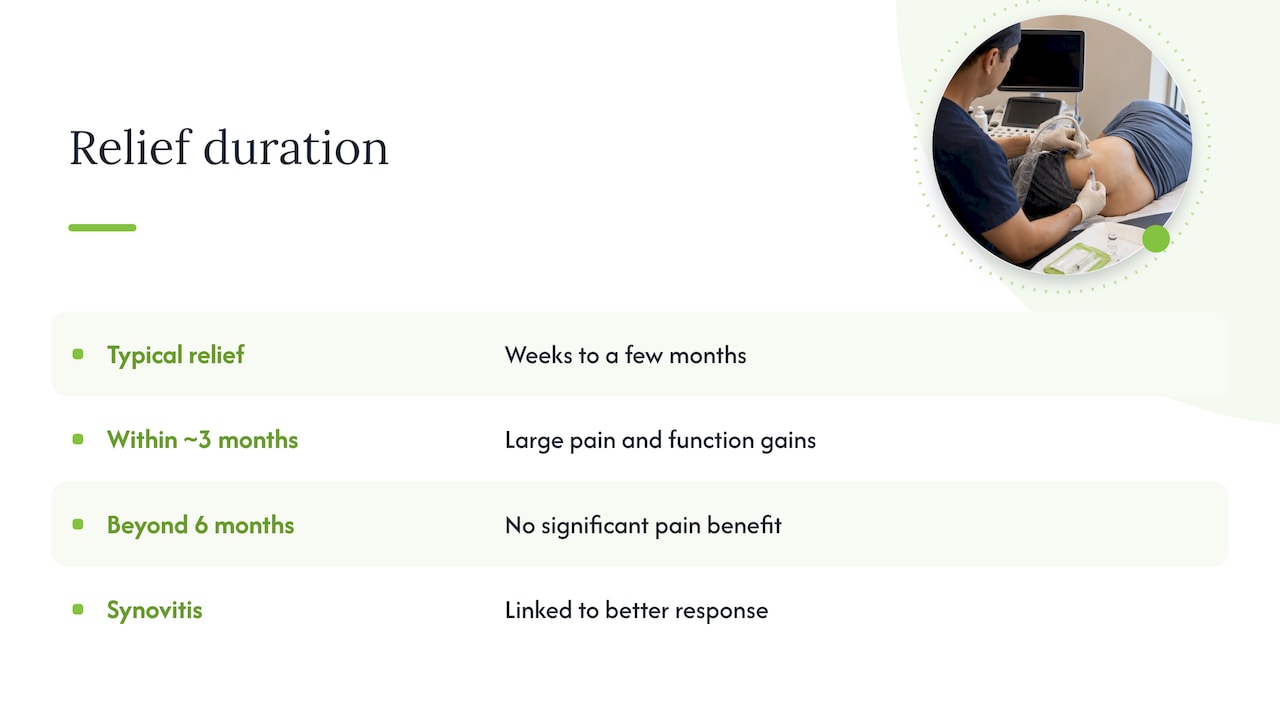
A 2026 systematic review and meta-analysis of intra-articular corticosteroid injections for hip osteoarthritis reported large short-term improvements in pain and function within about three months, and no significant benefit for pain beyond six months. The authors’ framing is that these injections work best as time-limited additions to a broader management plan, such as physical therapy. The same review points to ultrasound-confirmed synovitis, meaning inflammation of the joint lining, as a factor linked to a better response. In practice, that means someone with a swollen, inflamed hip joint may respond more predictably than someone whose joint is mostly worn down.
A randomized trial, the HIT trial, compared a single ultrasound-guided corticosteroid and local anesthetic injection added to advice and education against advice and education alone in adults with hip osteoarthritis. If you want to read how researchers measured the benefit, the abstract is a good place to start.
Timeline of a typical response
| Time after injection | What many patients notice |
|---|---|
| First hours | Relief from the numbing medicine, which wears off. Some patients feel sore as it fades. |
| Days 1 to 2 | Mild soreness at the site. Pain may temporarily return to baseline. |
| Days 2 to 7 | The anti-inflammatory effect of the steroid builds, according to MedlinePlus. |
| Weeks 2 to 12 | The usual window of benefit, which is the best time to build strength and motion. |
| After about 3 months | Relief often fades, particularly with advanced arthritis. |
Individual responses vary a lot. Treat these timelines as a range, not a promise.
Recovery and aftercare
Most people go home the same day. Recovery after a hip injection is brief. MedlinePlus notes that you can usually return to most normal, non-strenuous activity the next day, while providers often advise avoiding strenuous activity and heavy lifting for 24 to 48 hours. Ice on the site as needed can ease soreness.
Things to do:
- Have someone drive you if your leg feels numb or weak after the procedure.
- Walk normally and keep moving gently. Prolonged bed rest does not help.
- Start or resume your rehabilitation program as directed, since the window of reduced pain is when exercise is easiest.
- If you have diabetes, check blood sugar more often for several days, since steroids can raise it temporarily. Ask your doctor for specifics.
Call the clinic promptly, or seek urgent care, if you develop fever, increasing redness or warmth, or severe pain or swelling that lasts beyond 48 hours. Those can be signs of infection, which MedlinePlus lists as needing immediate medical attention. Sudden inability to bear weight, new numbness or loss of bladder or bowel control also needs emergency care.
Risks and limitations
Hip injections are widely used and generally well tolerated, but they are not risk-free. Possible effects include temporary soreness, a flare of pain for a day or two, facial flushing, a rise in blood sugar and, rarely, infection, bleeding or nerve irritation. Our article on steroid injection side effects covers these in more detail.
The larger limitation is the ceiling on repetition. Clinical evidence summarized in the 2026 review above supports relief that is mostly short-lived, and clinicians avoid frequent repeat steroid injections because of concerns about cartilage damage and weakening of nearby bone over time. A common planning rule is to limit the number of steroid injections into the same joint per year, but the right number depends on you, so discuss it with your physician rather than adopting a general figure. If you want to weigh benefits against drawbacks, see are steroid injections good for arthritis.
Ultrasound or fluoroscopy?
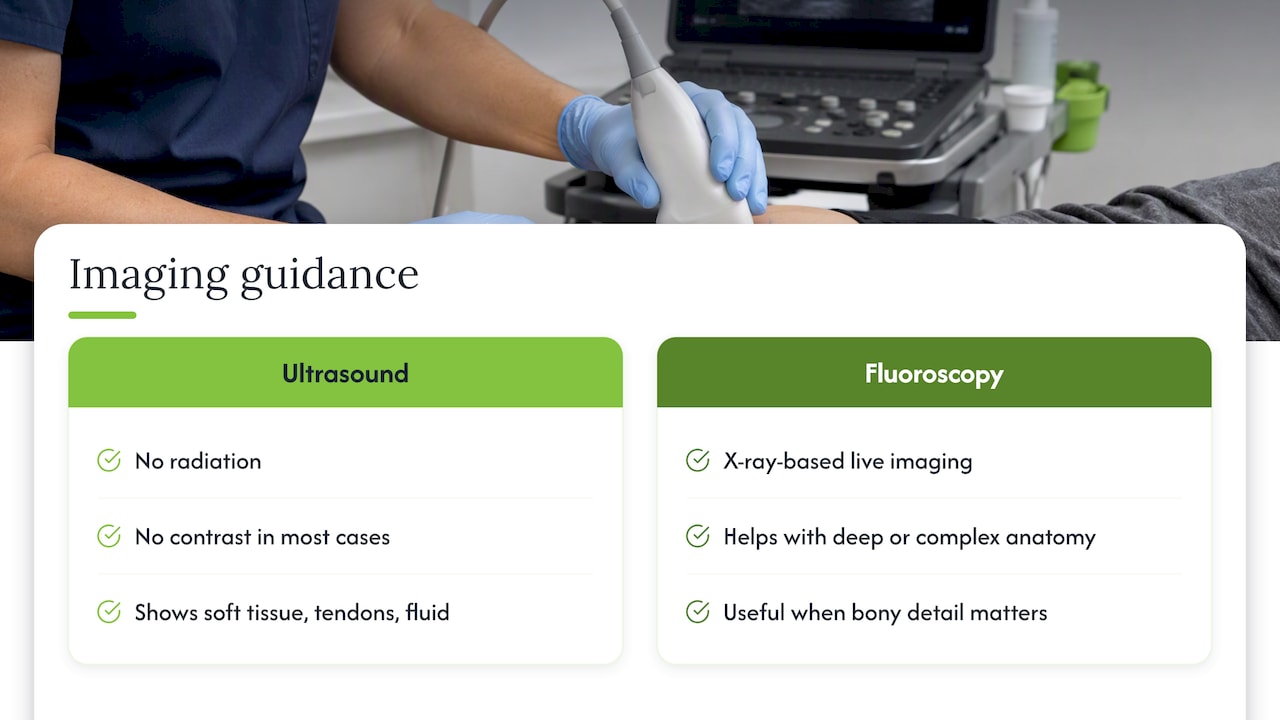
Both methods can reach the hip joint accurately. A 2026 study comparing ultrasound-guided and fluoroscopy-guided steroid injections in hip osteoarthritis looked at pain and function between the two approaches. Ultrasound has practical advantages: no radiation, no contrast dye for most cases, and the ability to see soft tissue, tendons and fluid around the joint. Fluoroscopy, an X-ray-based live imaging method, can be helpful for deep or complex anatomy or when bony detail matters. Which one is used depends on your anatomy, the target and the physician’s training, and neither is automatically better for every patient.
It is also worth knowing that guidance has been studied in different settings. A pilot study looked at ultrasound-guided hip injections performed by emergency physicians for chronic hip pain in an outpatient clinic. The point for you is simple: ask who performs the injection, how often they perform it, and what imaging they use.
How injections fit into a larger plan
A single injection rarely solves a chronic hip problem. The most durable results usually come when pain relief is used to make something else possible.
- Rehabilitation. Strengthening the hip abductors and core, improving mobility and correcting gait often determine whether relief lasts. Our physical therapy program is built around this idea.
- Activity and weight management. Even modest changes reduce load on a painful hip.
- Other injectables. Some patients prefer to avoid repeated steroids. For hip osteoarthritis, PRP therapy for hip arthritis is one regenerative option we offer. PRP is made from your own blood, which is processed to concentrate platelets, as the AAOS explains. The evidence base for PRP is still developing, and results vary, so we discuss expectations candidly.
- Surgery. For advanced arthritis with severe limitation, total hip replacement is an established option, and the AAOS lists it among treatments when conservative care no longer controls symptoms. We would rather you make that decision with full information than be pushed toward it too early or avoid it when it is the right choice.
Comparing conservative care and injections
| Approach | Typical role | Main limitation |
|---|---|---|
| Physical therapy and activity changes | Foundation for nearly every hip plan | Takes weeks, and needs consistency |
| Anti-inflammatory medication | Short-term symptom control | Stomach, kidney and heart considerations |
| Ultrasound-guided steroid injection | Short-term relief and diagnosis | Benefit tends to fade, with limits on repeats |
| PRP | Option for some arthritic joints | Variable results, evolving evidence |
| Hip replacement | Advanced, disabling arthritis | Major surgery with rehabilitation |
Our perspective on hip injections
We see hip pain that has been labeled as arthritis when it was bursitis, and back pain that was treated as a hip problem for a year. For that reason, we treat any hip injection as both a treatment and a question we are asking your body. If the answer is clear, we build the plan around it. If it is not, we keep looking.
We also try to be straightforward about what steroids can and cannot do. They calm inflammation, often well, and often for a few months. They do not rebuild cartilage. Patients do best when they have a plan for the weeks after the shot, which usually means rehabilitation, and a plan for what happens if relief fades. Our approach to non-surgical care aims at the underlying cause of pain, not only the symptoms, and that is why we spend time on the examination before recommending any needle.
If you have already had two or three injections and the benefit keeps getting shorter, that is a signal to change the strategy, not to repeat the same one.
— Felix
Talking with us about your hip pain
If you live in North Dallas and have hip pain that has not responded to the usual first steps, we can examine you and talk through whether an injection, rehabilitation, a regenerative option or further testing makes the most sense. You can see the full range of what we offer on our treatments page, or learn more about regenerative medicine at Nortex Spine and Joint. Schedule a consultation through our website so we can look at your history and imaging together.
Questions people ask
How long does an ultrasound-guided steroid injection last?
Relief commonly lasts from several weeks to about three months, and often fades after that, particularly in advanced arthritis. A 2026 meta-analysis found large short-term benefit for hip osteoarthritis but no significant benefit for pain beyond six months. Your result depends on the diagnosis and how inflamed the joint is.
How long do hip injections take?
The needle placement takes only a few minutes, but plan on 30 to 60 minutes for the whole visit, including examination, preparation and a short observation period. You can usually go home right afterward.
How long does recovery take after a trochanteric bursitis injection?
Most people resume light activity the next day and avoid heavy lifting or strenuous exercise for 24 to 48 hours. Soreness is common for a day or two. Steroid effects build over several days, so judge the result after about a week, not the first afternoon.
Does it hurt, and what if it does not help?
Expect a pinch from the numbing medicine and some pressure during the injection. If an accurately placed injection gives no relief at all, that is useful information: it suggests the pain may come from the lower back or soft tissues, and your physician can redirect the evaluation.
Sources
- Hip joint injection, MedlinePlus Medical Encyclopedia
- Cortisone Shot (Steroid Injection), OrthoInfo, AAOS
- Efficacy of Intra-Articular Corticosteroid Injection for Hip Osteoarthritis: A Systematic Review With Meta-Analysis, PubMed
- HIT trial: one ultrasound guided corticosteroid and local anaesthetic injection for hip osteoarthritis, PubMed
- Comparison of ultrasound- and fluoroscopy-guided intra-articular corticosteroid injections for hip osteoarthritis, PubMed
- Pilot study of ultrasound-guided corticosteroid hip injections by emergency physicians, PubMed
- Platelet-Rich Plasma (PRP), OrthoInfo, AAOS
- Hip Osteoarthritis, OrthoInfo, AAOS