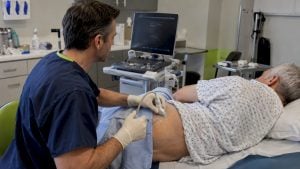

Platelet-rich plasma (PRP) is an injection made from your own blood, and it is one of the more common non-surgical options people ask about for an arthritic hip. The honest summary is this: studies show a real but time-limited pain benefit for some patients with mild to moderate hip osteoarthritis, the evidence is still maturing, and major arthritis guidelines have not endorsed it. This guide explains what PRP does, who tends to benefit, what to expect, and where stem cell therapy fits in.
TL;DR
- PRP uses a concentrate of your own platelets, injected into the hip joint under imaging guidance, to try to calm pain and inflammation.
- A 2022 systematic review found the clearest pain improvement at 1 to 2 months, with long-term benefit beyond 12 months still unproven.
- The 2019 American College of Rheumatology/Arthritis Foundation guideline recommends against PRP for hip and knee osteoarthritis, largely because preparations are not standardized.
- PRP is usually paid out of pocket, and exercise, physical therapy and weight management remain the foundation of care.
Table of Contents
- What PRP does inside an arthritic hip
- What the research says
- Why guidelines do not endorse it
- Who is a reasonable candidate
- What the procedure involves
- Recovery and timeline
- Does PRP last?
- PRP compared with other options
- Stem cell therapy for hip arthritis
- What PRP costs and whether insurance pays
- Our perspective
- Talk with us about your hip
- FAQ
- Sources
What PRP does inside an arthritic hip
Hip osteoarthritis is the gradual thinning of the cartilage that cushions the ball-and-socket joint, usually with some inflammation of the joint lining and changes in the underlying bone. People typically feel it as groin or buttock pain, stiffness after sitting, and difficulty with stairs, socks and shoes, or getting in and out of a car.
A PRP injection involves isolating platelets from your own blood and injecting them at the treatment site, as Harvard Health explains. Platelets carry growth factors, which is why the treatment is called regenerative. The same source notes that the exact mechanism of pain relief is not completely understood. In practical terms, we describe PRP as an attempt to change the biology of an irritated joint, not as a way to regrow a hip that has worn down to bone.
That distinction matters for expectations. PRP is not a cartilage transplant, and it does not reverse advanced arthritis.
What the research says
The hip has far less published research than the knee, so it helps to read the studies carefully.
- Pain relief: The 2022 systematic review and meta-analysis reported a significant reduction in pain, with the most notable improvement in the 1 to 2 month window. Function also improved, but benefit beyond 12 months remains an open question.
- PRP versus hyaluronic acid: A meta-analysis of randomized trials found PRP reduced pain scores more than hyaluronic acid at 2 months, but not at 6 or 12 months, and function scores did not differ significantly at 12 months. Only four trials were included.
- Ultrasound-guided injection: A randomized controlled study compared PRP and hyaluronic acid, separately and combined, in hip osteoarthritis, noting that little evidence of PRP efficacy in the hip existed beforehand.
- Mixed conclusions overall: Another systematic review and meta-analysis opens by noting that the effectiveness of PRP for osteoarthritis is still controversial.
Put together, the pattern is consistent: a short-to-medium-term pain benefit in some patients, small trials, and no proof that PRP changes the long-term course of the disease.
Why guidelines do not endorse it
You should hear this from your physician before you hear it from a brochure. The ACR/Arthritis Foundation guideline recommends against PRP for hip and knee osteoarthritis. The core challenge is that PRP is not one standardized product. Because it is made from your own blood, platelet concentration, growth factor content and white blood cell content vary between patients and between clinics, which makes a uniform result hard to promise.
The same guideline gives a strong recommendation for exercise in knee and hip osteoarthritis, according to the guideline PDF hosted by the Arthritis Foundation. Many clinicians still offer PRP to patients with mild to moderate disease who have not responded to conservative care, and we think the right approach is to present it as an option with limits, not a proven cure.
Who is a reasonable candidate
According to Dr. Joanne Borg Stein of Mass General Brigham, quoted by Harvard Health, the best candidates are active patients with mild to moderate osteoarthritis who still have symptoms despite physical therapy, weight management and standard conservative care. PRP is meant to support an active life, not replace the work of exercise and movement.
In our experience, people who consider PRP for the hip tend to fall into a few groups:
- Active adults whose hip pain limits walking, golf, running or training, and who have already done a reasonable course of therapy.
- Patients who have had cortisone or other injections that helped briefly and want something different.
- People with early arthritis who are not yet candidates for a hip replacement but whose symptoms are real.
- Patients who want to delay or avoid surgery and understand that delay is not guaranteed.
PRP is a poor fit when the joint is bone on bone, when the pain actually comes from the lower back, the sacroiliac joint or the tendons around the hip, or when someone expects a guaranteed result. That is why the first visit is about diagnosis. Hip pain is often referred from elsewhere, and imaging, a physical exam and sometimes a diagnostic injection help sort out the true source.
What the procedure involves
- Evaluation. Your physician reviews your history, prior treatments, examination findings and imaging, and discusses whether PRP is appropriate.
- Blood draw. A small sample of your blood is taken in the office.
- Preparation. The blood is spun in a centrifuge to concentrate the platelets.
- Guided injection. The PRP is injected into the hip joint with ultrasound guidance, because the hip sits deep and a blind injection can miss the joint. Harvard Health lists a blood draw, centrifugation and ultrasound-guided injection as the typical sequence.
- Activity limits. Patients are often asked to limit activity for up to two weeks afterward, per the same source.
Soreness for a few days is common because the treatment can cause a temporary inflammatory response. Because it uses your own blood, the risk of an allergic reaction to the material is low, but any injection carries risks such as infection or bleeding, and your physician should review them with you.
Recovery and timeline
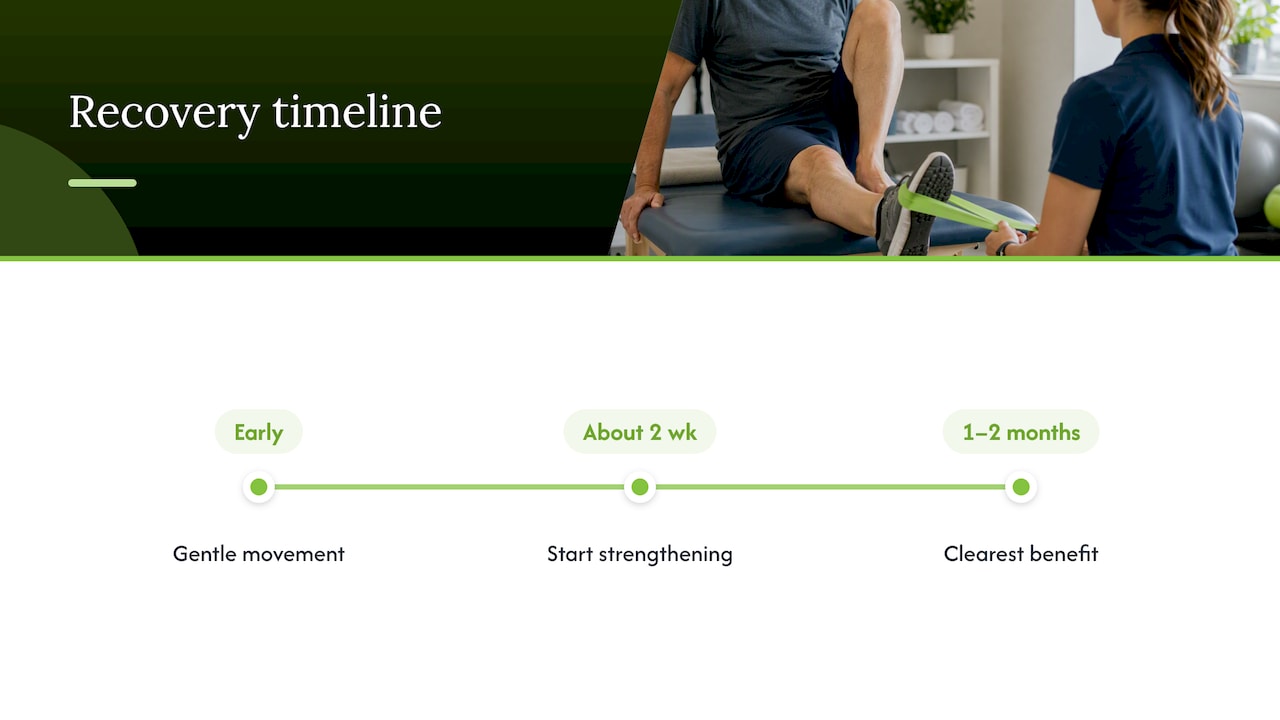
Most patients should expect gradual change, not an overnight difference. The research above found the clearest benefit at one to two months, which fits what we tell patients: judge the result after several weeks, not several days.
Rehabilitation matters as much as the injection. We generally encourage gentle movement early, then progressive strengthening of the hip and core once the initial irritation settles. Our article on post-PRP rehabilitation walks through starting strengthening at about two weeks, and the same principles apply to the hip. Our knee-focused recovery timeline is a useful picture of what the first weeks look like.
If you are in the postmenopausal years, remember that bone strength around the hip is a separate question from cartilage. Some people explore nutrition and bone density approaches alongside medical care, which is worth raising with your physician.
Does PRP last?
This is the question we hear most. The evidence says pain relief often peaks in the first couple of months and the benefit beyond a year is unsettled. Some patients do well for many months and some get little. Others repeat a treatment when symptoms return, though repeat protocols have not been standardized in hip studies. We would rather you plan on a meaningful but not permanent improvement and use it as a window to build strength than expect the arthritis to disappear.
PRP compared with other options
| Option | What it does | Typical considerations |
|---|---|---|
| Exercise and physical therapy | Strengthens muscles that support the hip, improves mobility | Strongly recommended by guidelines; takes consistent effort |
| Weight management | Reduces load across the joint | Gradual; benefits other joints too |
| Corticosteroid injection | Reduces inflammation quickly | Often short-lived; not meant for frequent repetition |
| Hyaluronic acid injection | Adds lubricating fluid | Evidence in the hip is limited; comparable function results to PRP at 12 months in one meta-analysis |
| PRP | Autologous growth factor concentrate | Usually out of pocket; benefit strongest at 1 to 2 months; not standardized |
| Hip replacement | Replaces the joint | Reliable for advanced disease; major surgery with recovery |
The Arthritis Foundation overview of osteoarthritis treatments outlines the broader range of options, from topicals and pills to injectables and physical therapies. The right sequence depends on how advanced your arthritis is and what you have already tried.
Stem cell therapy for hip arthritis
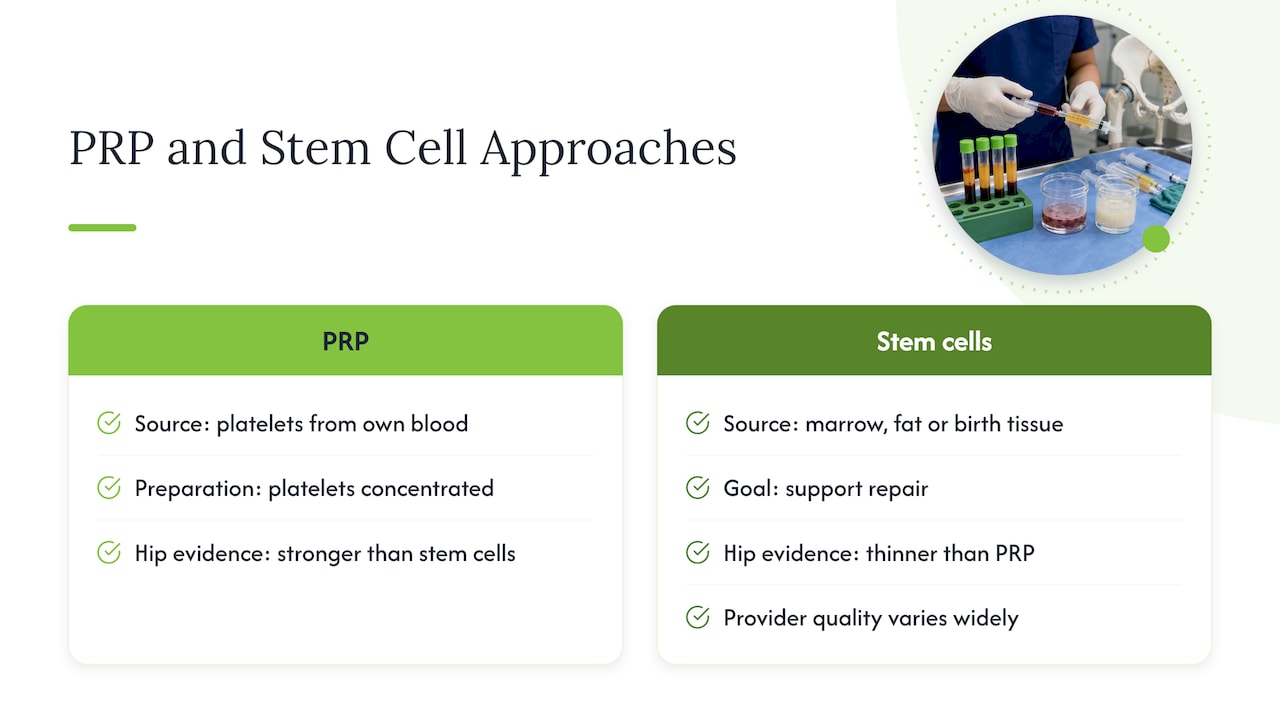
Many readers asking about PRP are also asking about stem cell therapy, so a direct comparison is useful. PRP concentrates platelets from your blood. Stem cell approaches use cells, typically from bone marrow, fat or birth tissue, with the goal of supporting repair. Evidence in the hip is thinner than for PRP, and quality varies widely among providers.
Be cautious about any clinic promising cartilage regrowth. The FDA has warned consumers that very few stem cell products are approved, and that marketing of unapproved products for arthritis has been a concern. Ask any provider what exactly is being injected, where it comes from, how it is regulated, and what evidence supports its use for your joint. You can read about our approach on our stem cell page and our broader regenerative medicine program.
What PRP costs and whether insurance pays
In the U.S., PRP is typically an out-of-pocket expense because most insurance plans do not cover it. Harvard Health reports costs generally ranging from $500 to $2,500 per injection. We do not publish a fixed fee for hip PRP, because the plan depends on your evaluation. Coverage questions are common, and our post on which insurers cover PRP injections explains how to ask your plan.
Our perspective
Many patients come to us after trying several things: anti-inflammatories, a cortisone shot, a few weeks of therapy they did not stick with, sometimes all of it. They are rarely looking for a miracle. They want to keep walking, working and playing without jumping straight to a joint replacement.
Here is how we think about PRP for the hip. We treat it as one tool within a plan, never as the plan. We start by confirming the hip is actually the source of pain, because we see back and sacroiliac problems mistaken for hip arthritis often. We use image guidance, because accuracy in a deep joint matters. And we talk plainly about the guideline position and the limits of the studies, since you deserve to make the decision with the full picture.
We also think platelet dose and preparation matter, which is why standardization is such a fair criticism of the field. Our write-up on platelet dose and PRP success in knee pain discusses why, and the same reasoning guides how we think about the hip. If PRP is not right for you, we will say so and discuss other paths, including therapy, other injections or a referral for surgical evaluation.
— Felix
Talk with us about your hip
If you live in North Dallas and hip pain is limiting your life, we can evaluate the source of your pain and tell you whether PRP is a sensible option. Start with our page on PRP therapy for hip arthritis, pair it with our physical therapy program, or see the full list of non-surgical treatments we offer. To understand the treatment more broadly, our PRP overview is a good place to begin.
FAQ
Can PRP heal hip osteoarthritis?
There is no good evidence that PRP reverses the cartilage loss of osteoarthritis. The research shows it may reduce pain and improve function for some patients, with the clearest effect in the first one to two months. Think of it as symptom relief that may create room for rehabilitation, not a cure.
Is PRP better than a cortisone shot for the hip?
They do different things. Cortisone works quickly on inflammation but often wears off, while PRP is slower and aims to change the joint environment. Head-to-head evidence in the hip is limited, so the choice depends on your symptoms, history and goals, and is best made with a physician who has examined you.
Is stem cell therapy better than PRP for hip arthritis?
Not necessarily. The hip evidence for stem cell products is thinner, and the FDA has warned about marketing of unapproved products. Ask any provider exactly what is being injected and what supports its use before you pay for it.
Does insurance cover PRP for hip arthritis?
Usually not. Most U.S. plans treat PRP as out of pocket, with costs commonly quoted between $500 and $2,500 per injection. Check with your plan and ask for a written estimate before treatment.
How long before I know whether it worked?
Most studies see the benefit emerge over the first one to two months, so give it several weeks while you follow your rehabilitation plan. If you have no change by then, tell your physician so the next step can be planned.
Sources
- 2022 systematic review of intra-articular PRP for hip osteoarthritis
- 2019 ACR/Arthritis Foundation osteoarthritis guideline
- ACR/Arthritis Foundation guideline PDF
- Harvard Health: PRP injection for knee osteoarthritis
- PRP versus hyaluronic acid in hip osteoarthritis, meta-analysis
- Randomized study of PRP and hyaluronic acid for hip osteoarthritis
- Effectiveness of PRP in hip osteoarthritis, systematic review
- Arthritis Foundation: medical treatment for osteoarthritis pain
- CGTLive: FDA action on unapproved regenerative medicines