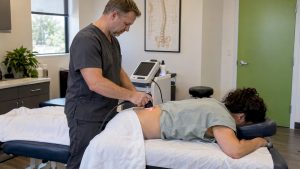

Most people with spinal stenosis are first treated without surgery, and many get meaningful relief that way. The usual approach combines a supervised exercise and physical therapy program, activity changes, medication where appropriate, and targeted injections or procedures matched to the exact source of your pain. The American Academy of Family Physicians (AFP) 2024 review advises starting with nonoperative care unless there are findings that call for urgent surgical evaluation. At Nortex Spine and Joint in North Dallas, our physicians build that plan around a precise diagnosis, and for some patients it includes regenerative options such as PRP.
TL;DR
- Spinal stenosis is a narrowing of the spaces in the spine, usually from age-related change. It most often affects the lower back and neck.
- Current U.S. guidance puts nonoperative care first. Surgery is considered when that care is not working or when there are urgent findings.
- A structured program of exercise, manual therapy and education is the foundation. Injections and procedures can then target the pain generator so you can keep moving.
- Research on PRP for lumbar nerve-root and facet-joint pain is encouraging. It is not the same thing as proven stenosis reversal, and we say so plainly.
- Leg weakness that is getting worse, or new bladder or bowel changes, needs emergency care the same day.
Table of Contents
- What spinal stenosis is, and why it hurts
- Why diagnosis comes before any treatment
- What to expect without surgery
- The foundation: exercise, physical therapy and education
- Medications and other conservative options
- Injections and procedures that target the pain source
- Where PRP and regenerative medicine fit
- Living with stenosis day to day
- Symptoms that need urgent care
- When surgery enters the conversation
- Our perspective
- Take the next step
- FAQ
- Sources
What spinal stenosis is, and why it hurts
The National Institute of Arthritis and Musculoskeletal and Skin Diseases (NIAMS) explains that spinal stenosis happens when spaces within the spine narrow and put pressure on the spinal cord or nearby nerves. It is most common in the lower back and neck. The usual causes are age-related changes: thickened ligaments, bone spurs, herniated disks, enlarged facet joints and slipped vertebrae (spondylolisthesis).
In the lower back, the classic pattern is aching, burning or cramping that spreads into the buttocks and legs. It builds with standing or walking and eases when you sit or lean forward, which is why many people find a shopping cart comfortable. The Journal of Pain guideline calls this pattern neurogenic claudication, meaning nerve-related leg symptoms triggered by upright activity. Numbness, tingling and leg or foot weakness can come with it. In the neck, stenosis can cause neck pain, tingling or numbness running down the arms into the hands, and weakness in a hand, arm or fingers.
It is common. A 2022 JAMA review puts the prevalence of the clinical syndrome in U.S. adults at about 11%, rising with age. The AFP review gives a mean patient age of 64, so if you are in your late 30s or 40s with these symptoms, the cause deserves a careful look rather than an assumption.
Why diagnosis comes before any treatment
A stenosis diagnosis rests on two things: your history and your imaging. The JAMA review describes the typical history as back and leg pain provoked by arching backward and relieved by bending forward, confirmed with CT or MRI. The AFP review names MRI as the study of choice for lumbar stenosis.
Imaging alone can mislead, though. A narrowed canal on an MRI does not always explain your pain, and pain can come from a facet joint, a disc, a pinched nerve root or a combination. That is why the exam matters: where the pain travels, what position changes it, and what your strength and reflexes show. A treatment aimed at the wrong structure will disappoint, however good the treatment is. Getting that match right is the first thing we do in a consultation.
What to expect without surgery
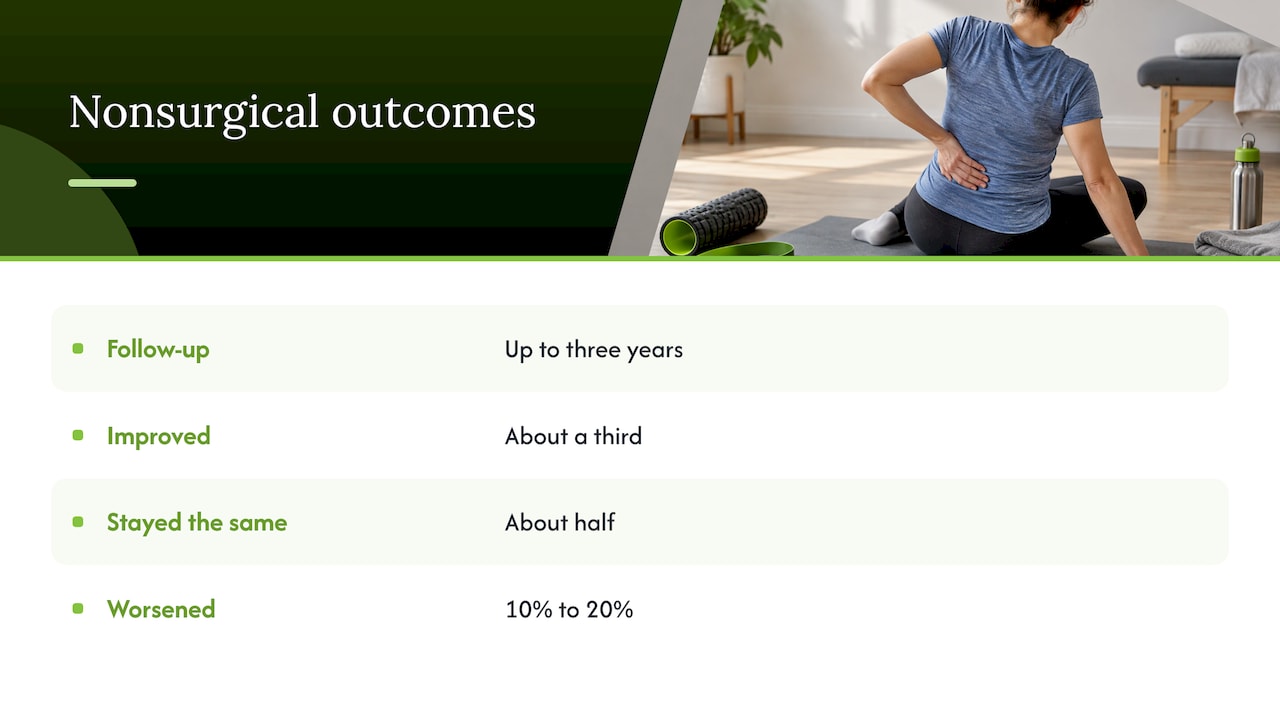
The honest picture helps you plan. In a series of patients followed for up to three years without surgery, as reported in the JAMA review, about a third improved, about half stayed the same, and 10% to 20% got worse in back pain, leg pain or walking. Stenosis is a structural condition, and no nonsurgical option reliably makes the narrowing itself go away.
The goal of nonsurgical care is therefore functional: less pain, longer walking distance, better sleep, and a spine that tolerates the activities you care about. Many people reach that goal with a combination of approaches over several weeks to months, rather than a single treatment. It also helps to know that the guidance itself is cautious. The AFP review notes that few nonsurgical treatments have high-quality randomized trials behind them, which is one reason we match treatments to your specific findings instead of running everyone through the same protocol.
The foundation: exercise, physical therapy and education
Every major guideline begins here. The Journal of Pain panel recommends multimodal nonpharmacological care: education, lifestyle advice, home exercise, manual therapy and rehabilitation. An American Journal of Physical Medicine & Rehabilitation physiatry guideline for chronic low back pain also gives priority to exercise and physical therapy, with moderate-quality evidence behind them.
A good program for stenosis usually includes:
- Flexion-friendly movement. Because leaning forward opens the spinal canal slightly, stationary cycling and incline walking are often easier than flat, upright walking.
- Core and hip strength. Stronger trunk and hip muscles take load off the lumbar spine.
- Hip and spinal flexibility. Tight hips force the lower back to arch more, which can aggravate symptoms.
- A progression you can keep. A 2025 review by Ammendolia describes a six-week supervised program in which new exercises are added at each visit and then become a lifelong home routine, done twice daily during the program and once daily afterward.
Exercise questions come up often. Tai chi, yoga and motor control exercise appear in the physiatry guideline as low-quality-evidence options for chronic low back pain, so they can be a reasonable addition if you enjoy them, but they work best alongside a program built for your findings. Our physical therapy team designs programs around your imaging, your exam and the activities you want back.
If your stenosis comes with a slipped vertebra, rehabilitation has its own sequence. A four-phase conservative rehab roadmap for spondylolisthesis shows how that progression can be structured.
Medications and other conservative options
The AFP review lists NSAIDs (non-steroidal anti-inflammatory drugs such as ibuprofen) as first-line treatment for chronic low back pain. The Journal of Pain guideline allows a trial of certain antidepressants (SNRIs or tricyclics) for neurogenic claudication, though it grades that evidence as very low quality. Medication choices depend on your kidneys, stomach, heart, blood pressure and other drugs you take, so they are worth reviewing with your physician rather than choosing by trial and error.
The same guideline suggests a trial of traditional acupuncture as part of multimodal care. If you are curious about it, acupuncture for sciatica is a related question with its own body of research. Chiropractic care, osteopathic manipulation and lifestyle changes are also named in the AFP review among nonsurgical options.
Injections and procedures that target the pain source
When exercise alone is not enough, or pain keeps you from doing the exercise, targeted procedures can open a window to progress. The right one depends on where your pain originates.
| Pain pattern | Procedure we may consider | What it is aimed at |
|---|---|---|
| Low back pain with leg symptoms from nerve irritation | Caudal epidural steroid injection, lumbar transforaminal epidural | Inflammation around irritated nerve roots |
| Neck pain with arm symptoms | Cervical epidural steroid injection | Inflammation around cervical nerve roots |
| Back pain driven by arthritic facet joints | Facet joint injections, radiofrequency neurotomy of the lumbar facets | The small joints at the back of the spine and the nerves that carry their pain signals |
| Knee or hip pain alongside back symptoms | Genicular nerve ablation, hyaluronic acid or PRP injections | Joint pain that limits walking and exercise |
Epidural steroid injections place anti-inflammatory medication near the irritated nerve. The AFP review says they can be considered for short-term treatment, with studies showing pain and function benefits at up to about three weeks. We use that window the way it is meant to be used: to calm symptoms enough for you to take part fully in rehabilitation.
Radiofrequency neurotomy (ablation) uses heat to quiet the small nerves that carry pain from arthritic facet joints. It suits the person whose pain is mainly in the back and is clearly facet-related, which is why diagnostic precision matters. You can see the full list of procedures on our treatments page.
For a small group with severe, leg-dominant pain that has not responded to other approaches, a spinal cord stimulator is a nonsurgical-pathway option that starts with a trial period, so you can judge the effect before any permanent implant.
Where PRP and regenerative medicine fit
Many people reading this have already tried pills and perhaps a steroid injection, and want to know whether regenerative medicine can offer something longer lasting. Platelet-rich plasma (PRP) is made from a small sample of your own blood. It is spun down to concentrate platelets, which release growth factors involved in tissue repair, and is then injected into the target area.
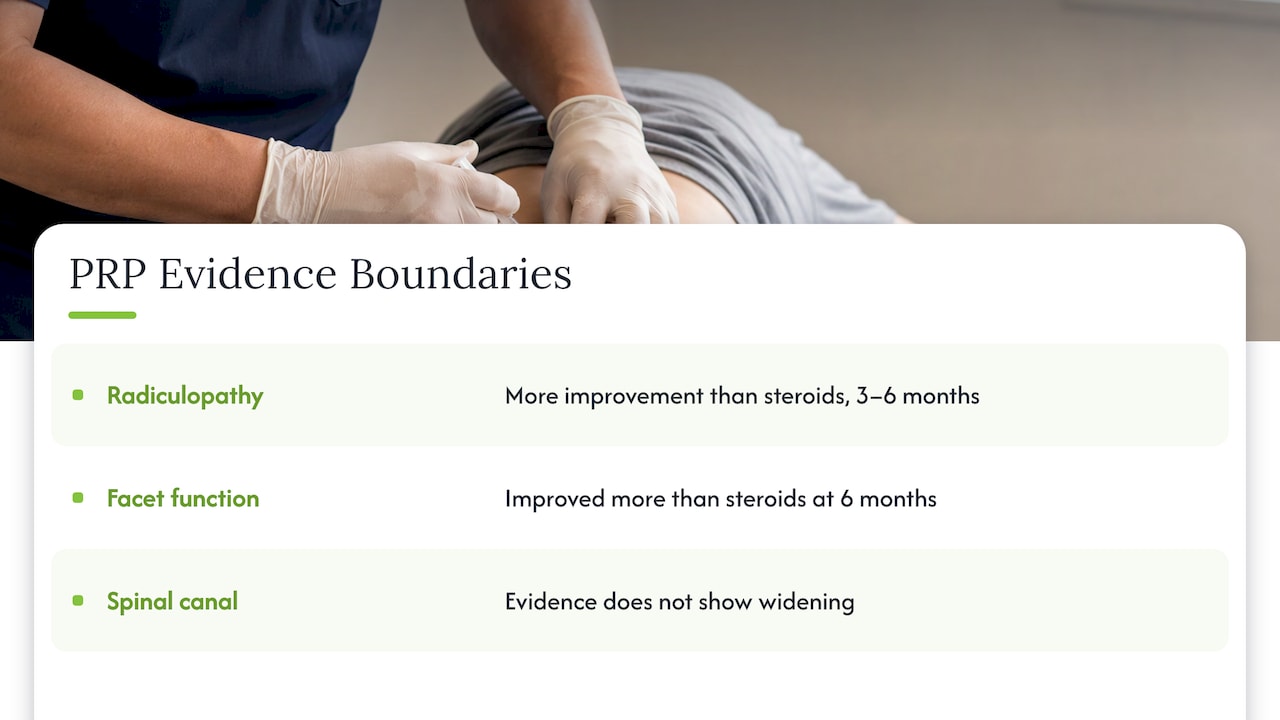
Here is what the evidence says, stated precisely. A May 2026 systematic review in the European Spine Journal of 13 randomized trials found PRP produced greater improvement than corticosteroids at 3 to 6 months for lumbar radiculopathy (pain from an irritated nerve root). Lumbar facet-joint PRP also improved function more than steroids at 6 months, and adverse events were few overall. The American Society of Interventional Pain Physicians guidelines on biologics state that regenerative therapy should be provided only after diagnostic evidence of need and thorough patient education, which is how we approach it.
Those findings concern nerve-root and facet-joint pain, two common contributors to stenosis symptoms. They do not show that PRP widens a narrowed canal, and we would not tell you it does. What PRP can offer is a way to treat a specific painful structure with your own biologic material, when your exam and imaging point to it. Our PRP therapy for chronic back pain page explains the process, and the regenerative medicine overview covers the wider options, including stem cell therapy.
Stenosis often travels with arthritis in other joints. If your hip, knee or shoulder is limiting your walking or exercise, treating it can improve your whole program. We offer PRP for the knee, hip and shoulder.
Living with stenosis day to day
The American College of Rheumatology notes that regular exercise and modifying painful activities help people live with the condition. In practice:
- Break up standing and walking. Short walks with seated or forward-leaning rests often go further than one long walk.
- Use a flexed posture to your advantage. A cart, a cane or a stationary bike lets you stay active without provoking symptoms.
- Keep the home program going. Gains from supervised therapy fade if the routine stops.
- Track what helps. Note walking distance, sleep and which positions ease pain. This gives your physician something concrete to adjust.
Symptoms that need urgent care
Most stenosis changes slowly. Some do not. Go to an emergency department or call 911 if you have new or rapidly worsening leg weakness, numbness in the groin or saddle area, or new trouble controlling your bladder or bowels. The American College of Rheumatology states that severe stenosis may cause partial or complete leg paralysis requiring emergency treatment, and MedlinePlus lists problems controlling urine or bowel movements among the more serious symptoms. Do not wait for a scheduled appointment in these situations.
When surgery enters the conversation
The AFP review says surgery may be considered if nonsurgical management is ineffective. Warning signs of progressive nerve damage are a separate matter and call for prompt surgical evaluation. A reasonable plan has checkpoints: for example, a defined trial of rehabilitation and targeted treatment, then a review of walking distance, pain and function. If you are not meeting the goals you set, that is the time to discuss next steps together, with your records and imaging in hand.
Our perspective
Patients rarely ask us whether stenosis is on their MRI. They ask whether they can get back to walking the dog, playing golf or standing through a workday. We think that is the right question, and it is why our plans start from function.
Our physicians are Harvard fellowship-trained and board-certified, and our approach is to find the structure that is actually generating pain before choosing a treatment. Sometimes that is a nerve root, sometimes a facet joint, sometimes a hip or knee that is changing how you move. Rehabilitation, injections, ablation and regenerative options such as PRP each have a role, and our treatment plans are customized rather than one-size-fits-all.
We set expectations plainly. Stenosis is a structural condition, results vary, and no treatment is a guarantee. What we can offer is a careful diagnosis, a plan you understand, and the range of non-surgical tools under one roof so your care is coordinated.
Felix
Take the next step
If you live in or near North Dallas and stenosis symptoms are limiting your walking, work or training, a consultation at Nortex Spine and Joint starts with your history, exam and imaging. From there we can discuss physical therapy, back pain therapy, and regenerative options such as PRP where they fit. You can browse every treatment on our treatments page.
FAQ
Can spinal stenosis improve without surgery?
For many people, symptoms become manageable with nonsurgical care. In the long-term follow-up reported in the JAMA review, about a third of untreated-by-surgery patients improved over up to three years. Structured exercise, activity changes and targeted treatments aim to raise that likelihood and keep you active.
What are the best exercises for spinal stenosis?
Exercises that favor a slightly flexed spine, such as stationary cycling, along with core, hip and leg strengthening, are the usual starting point. A 2025 review describes a six-week supervised program that becomes a lifelong home routine. Because the right exercises depend on your exam, have a physical therapist tailor the program.
Is tai chi good for spinal stenosis?
Tai chi is listed in the physiatry guideline among nonpharmacologic options for chronic low back pain, with low-quality evidence. It can complement a stenosis program if you enjoy it and it does not bring on leg symptoms. Check with your physician first if you have balance problems or leg weakness.
How is cervical spinal stenosis treated?
Neck stenosis is typically treated first with physical therapy, activity changes and medication, and sometimes a cervical epidural steroid injection to calm irritated nerve roots. Arm weakness, clumsy hands or balance changes call for prompt medical evaluation, since the spinal cord itself can be involved.
Can PRP or stem cell therapy treat spinal stenosis?
PRP has shown better results than corticosteroids at 3 to 6 months for lumbar radiculopathy in a 2026 systematic review, and facet-joint PRP improved function at 6 months. These are treatments for specific pain sources, not for the narrowing itself. A consultation can determine whether your pain pattern fits.
Sources
- Spinal Stenosis Symptoms, Causes, & Risk Factors, NIAMS
- Lumbar Spinal Stenosis: Diagnosis and Management, American Family Physician, 2024
- Diagnosis and Management of Lumbar Spinal Stenosis, JAMA, 2022
- Non-Surgical Interventions for Lumbar Spinal Stenosis, The Journal of Pain, 2021
- Evidence-Based Physiatry clinical practice guideline, American Journal of Physical Medicine & Rehabilitation, 2017
- Ammendolia, structured exercise for lumbar spinal stenosis, PMC, 2025
- Platelet-rich plasma and stem cell therapies, European Spine Journal, 2026
- Responsible, Safe, and Effective Use of Biologics in the Management of Low Back Pain, ASIPP guidelines, 2019
- Spinal Stenosis, American College of Rheumatology, 2025
- Spinal stenosis, MedlinePlus Medical Encyclopedia, 2024