
An ultrasound-guided injection is a needle injection in which the physician watches the needle on a live ultrasound image, so the medication is placed in the joint, tendon sheath, bursa or near the nerve that is causing your pain. It does not change what is injected. It changes how confidently the physician can put it in the right place. For many patients who come to us after an injection that “didn’t do much,” accuracy is the first question worth asking, and our physicians at Nortex Spine and Joint, who are Harvard fellowship-trained and board-certified, treat it that way.
This guide explains what the technique is, what it treats, what the visit feels like, what the risks are, and how to think about it if you have already tried an injection without lasting relief.
TL;DR
- Ultrasound lets the physician see the needle, the target and nearby nerves and vessels in real time, which improves placement accuracy.
- Accuracy is best documented for the hip and knee and for injections near nerves and tendons. Pain results in some studies are similar to blind injections, so the benefit is mainly precision and safety.
- Common targets include arthritic joints, bursae, tendon sheaths, trigger points and compressed nerves. Local infection, fracture or a serious allergy to the medication or anesthetic rules an injection out.
- Steroids, hyaluronic acid and platelet-rich plasma (PRP) can all be given under ultrasound. Each has a different purpose and risk profile.
- If a previous injection failed, it may have been placed imprecisely. Guidance is a reasonable thing to discuss before repeating it.
Table of Contents
- What an ultrasound-guided injection actually is
- Why placement matters
- What ultrasound-guided injections treat
- Who is a reasonable candidate
- What to expect: before, during and after
- Choosing what goes in the needle
- Risks and how to use injections safely
- If a previous injection did not work
- Talking with us about your pain
- FAQ
- Sources
What an ultrasound-guided injection actually is
Ultrasound uses sound waves to build a moving picture of soft tissue. A small handheld probe sits on the skin, and the screen shows tendons, joint spaces, fluid, nerves and blood vessels. The physician then advances the needle while watching it approach the target, and can see the medication spread once it is delivered. There is no radiation, which separates it from fluoroscopy (live X-ray) guidance.
The alternative is a “blind” or landmark-guided injection, where the physician relies on surface anatomy and feel. For a large, superficial joint this can work well. For deeper or smaller structures, or in patients whose anatomy has been altered by arthritis, swelling or earlier injections, it is less certain.
The American Academy of Family Physicians (AAFP) notes that point-of-care ultrasound guidance is more accurate than landmark guidance for intra-articular injections of the hip and knee. A 2019 overview of musculoskeletal injections went further and argued that image-guided injections should be preferred over blind injections in day-to-day practice, citing ease, efficacy and fewer post-procedural complications.
Why placement matters
There are three practical reasons.
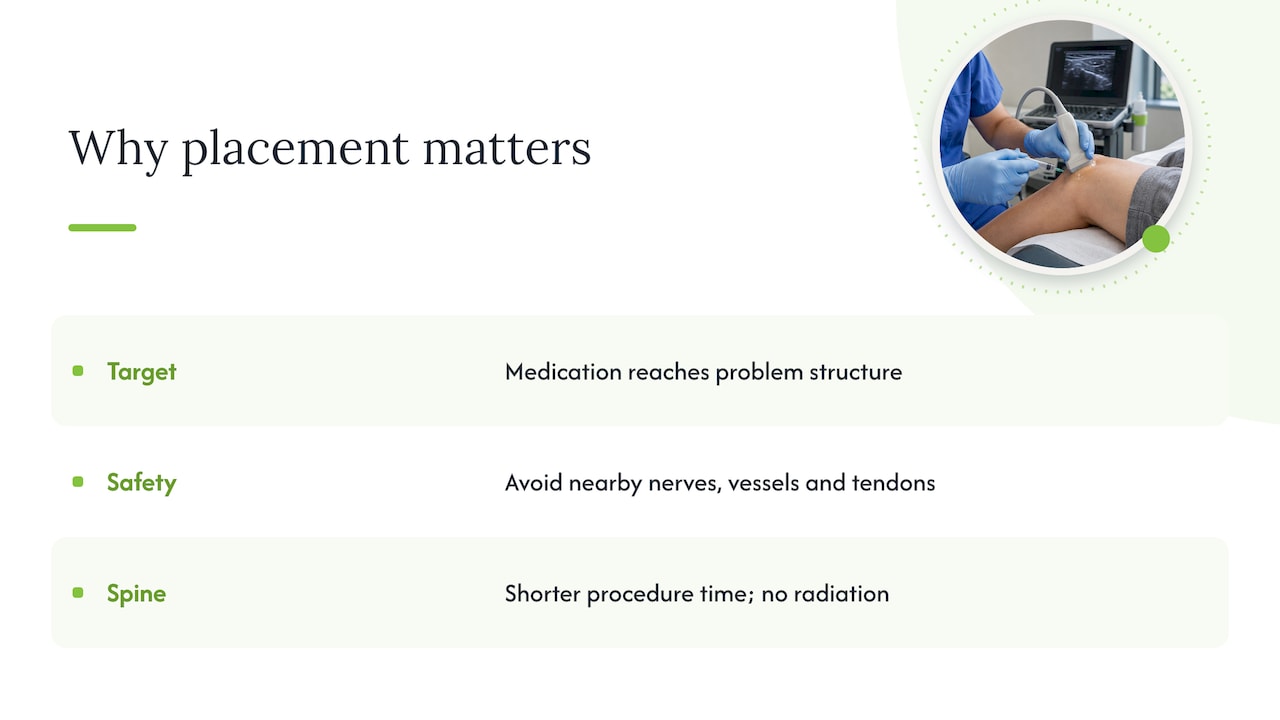
The medication reaches the structure causing the problem. A painful joint, an inflamed bursa and an irritated tendon sheath can sit within a centimeter or two of one another. Seeing the target removes guesswork.
It helps avoid structures you do not want to touch. AAFP’s 2026 foot and ankle review states that ultrasound guidance improves accuracy and may reduce neurovascular injury and inadvertent injection into a tendon. That matters because injecting a corticosteroid into a weight-bearing tendon such as the Achilles raises the risk of rupture.
It can shorten and simplify spine procedures. A 2024 scoping review of eight studies compared ultrasound-guided and fluoroscopy-guided epidural steroid injections. Success rates, pain scores and disability outcomes did not differ significantly, but ultrasound shortened needle-placement and total procedure time and removed radiation exposure.
It is worth being straightforward about the limit of this evidence. For the shoulder, a 2024 AAFP review found that ultrasound improves accuracy in the glenohumeral joint, but a randomized trial found no difference in pain at 3, 6 and 12 weeks compared with landmark-guided injection. Guidance is a precision tool. Whether a given patient feels better still depends on the diagnosis, the medication and the overall plan.
What ultrasound-guided injections treat
AAFP’s injection therapy guidance lists a wide range of problems. Joint conditions include osteoarthritis, inflammatory arthritis, effusion, chondromalacia, meniscal injury and synovitis. Soft-tissue conditions include bursitis, ganglion cysts, neuromas, nerve entrapment, tendinopathy, tenosynovitis and trigger points.
In plain terms, the usual targets are:
- Joints: knee, hip and shoulder arthritis, and a stiff, painful shoulder (adhesive capsulitis).
- Bursae: small fluid-filled cushions. At the shoulder these are the subacromial and subdeltoid bursae, and at the hip the greater trochanteric and iliopsoas bursae, as described in a 2023 peer-reviewed review.
- Tendons and tendon sheaths: chronic tendinopathy and tenosynovitis.
- Nerves: the median nerve in carpal tunnel syndrome, or interdigital neuromas in the foot. AAFP reports that ultrasound-guided injections produced significantly greater improvement in carpal tunnel severity over 12 weeks than landmark-guided injections.
Arthritis is among the most common reasons people look into injections, and some readers also read about medical marijuana for arthritis pain as a separate question. That is a decision to take up with your own physician, and it sits outside what an injection visit covers.
If your pain is at the shoulder or hip, our pages on subacromial injections for shoulder pain and ultrasound-guided hip injections explain those procedures in more detail.
Who is a reasonable candidate
AAFP describes candidates as patients with diagnostic uncertainty, rehabilitation that is limited by pain, or an insufficient response to first-line therapy such as medication, rest and physical therapy. That fits the pattern we see often: many patients arrive after months of anti-inflammatory pills, home exercises or a single injection, and they want to know what the next reasonable step is.
Injections are most useful as part of a plan rather than as the whole plan. Pain relief creates a window in which exercise and physical therapy can be done more effectively, and that window is often where the longer-term gains are made.
Who should not have one
These are the safety limits that matter most. AAFP lists local infection, fracture and a serious allergy to the injected medication or to local anesthetics as absolute contraindications. Tell your physician about any skin infection near the site, a fever, a known allergy, blood thinners or diabetes before the day of your visit, since each of these can change the plan for an injection.
What to expect: before, during and after
Exact details vary by body area and medication, so treat this as a general picture, not a script. Your physician will give you instructions specific to you.
Before
The visit begins with a history and physical examination, and often a review of earlier imaging. Your physician confirms the diagnosis, explains what the injection can and cannot do, and goes over the risks. Bring a list of your medications, especially blood thinners, and tell us about any allergies.
During
The skin is cleaned and a thin layer of gel is applied for the probe. The physician locates the target on screen, numbs the skin, and guides the needle in while watching it. Most people describe pressure, and some a brief sting or a deep ache, when the medication goes in. Pain varies by area and by how inflamed the tissue is. The injection itself is usually short, although the whole visit takes longer because of the examination and the scanning.
After
Soreness at the site is common and usually settles within a few days. Your physician will tell you how long to rest the area and when to return to activity. Because instructions differ for a knee, a tendon or a spine injection, follow the written guidance you are given instead of a general rule. Call the office promptly if you develop fever, spreading redness, increasing swelling, or pain that is getting worse instead of better.
Many patients ask what not to do afterward. The safest general answer is to avoid testing a numb joint with heavy loading or sudden effort on the day of the injection, because local anesthetic can mask pain signals. Your physician will give you the specific limits for your body area.
Choosing what goes in the needle
Ultrasound guidance is a delivery method. The medication is a separate decision.
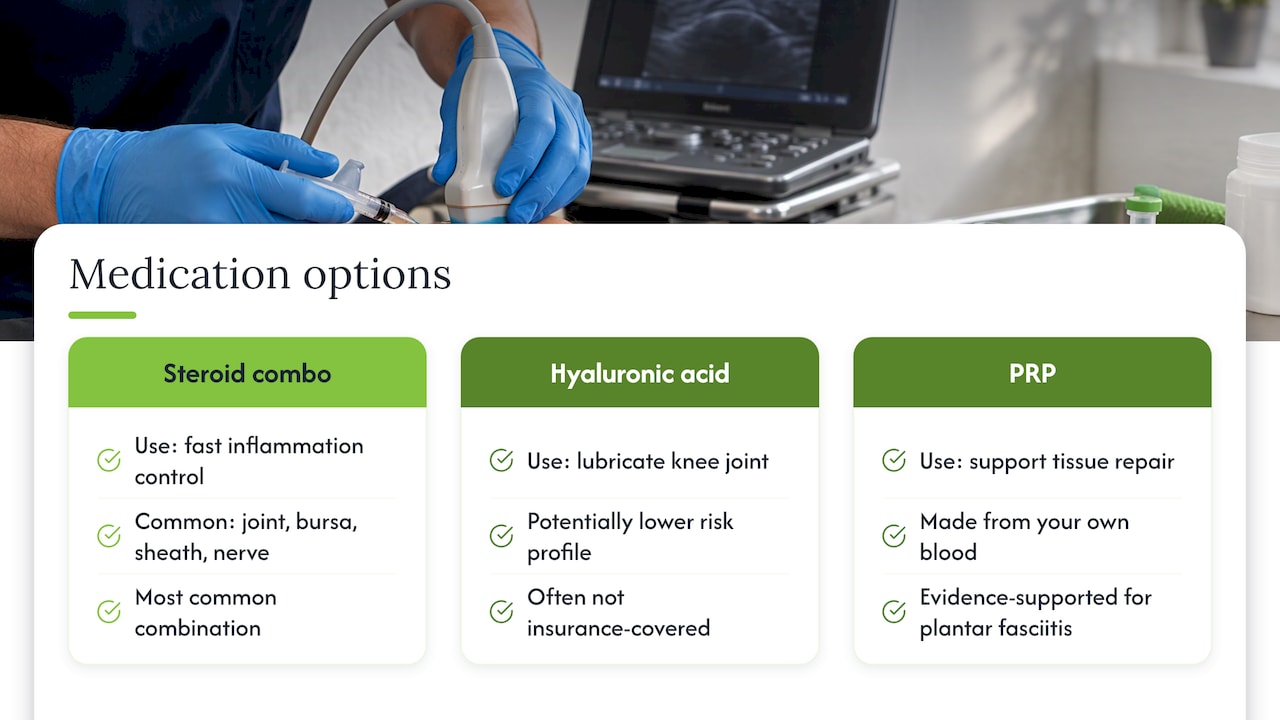
Corticosteroids with local anesthetic. A 2023 review of ultrasound-guided musculoskeletal injections identifies these as the most common combination, used for pain or swelling localized to a joint, bursa, tendon sheath or nerve. They act quickly on inflammation. We cover the trade-offs in more depth in our guides to steroid injection side effects and whether steroid injections are good for arthritis.
Hyaluronic acid. This is a lubricating gel used in knee osteoarthritis. AAFP’s guidance says hyaluronic acid and prolotherapy may relieve pain with a potentially lower risk profile than corticosteroids, though they are not typically covered by health insurance. Our pages on HYALGAN injection and viscosupplementation for knee pain describe this option.
Platelet-rich plasma (PRP). PRP is made from a sample of your own blood, concentrated so that it contains more platelets and growth factors, then injected into the injured area. AAFP’s 2026 foot and ankle article identifies PRP as the evidence-supported option for plantar fasciitis. Placing it precisely matters because the goal is to deliver it to the damaged tissue itself. Out-of-pocket cost is a practical factor, because insurance often does not cover it. We offer PRP for the knee, hip, shoulder and back, and you can read what the research shows for hip osteoarthritis.
A simple way to think about it: steroids are chosen for fast control of inflammation, hyaluronic acid for joint lubrication in the knee, and PRP when the goal is to support the tissue’s own repair over time. Your physician should explain why a particular option fits your diagnosis.
Risks and how to use injections safely
Most side effects are minor and short-lived. In AAFP’s review, immediate reactions such as pain, swelling, redness, stiffness and soreness lasted hours to days and occurred in 3% to 25% of patients receiving intra-articular corticosteroids and 2% to 6% of those receiving hyaluronic acid for knee osteoarthritis.
The same review notes that corticosteroids placed in soft tissue can cause skin thinning and lightening, and that repeated injections can degrade cartilage and tendon. AAFP’s hand and wrist guidance also lists infection, cartilage damage, collagen degradation, skin thinning and skin color change as complications to discuss before treatment.
Safe use comes down to a few habits:
- Do not stack injections on a schedule. Ask your physician how many steroid injections are reasonable in the same area and how far apart they should be.
- Avoid steroid injections into weight-bearing tendons. AAFP recommends against injecting corticosteroid into the Achilles tendon because of the rupture risk. Our article on Achilles tendonitis without surgery covers other options.
- Report warning signs early: fever, increasing redness or heat at the site, or worsening pain.
- Use the pain relief to rehabilitate. The best results usually come when the injection is paired with a progressive exercise program.
If a previous injection did not work
This is the question we hear most. There are several possible reasons: the diagnosis may have been incomplete, the dose or medication may not have suited the problem, or the injection may not have reached the target. The 2023 review is clear on the last point: if a prior blind injection did not achieve the desired effect, sonographic guidance should be considered, since the first injection may have been inaccurate or suboptimal.
In practice, a second opinion starts by re-examining the diagnosis and reviewing your imaging and treatment history. From there the options can include guided injection of the same or a different medication, regenerative options such as PRP, nerve-targeted procedures, or a structured rehabilitation program. We do not promise a particular outcome, and timelines vary with the condition. We do try to make sure the next step is chosen for a reason.
Our perspective
We think of ultrasound as a way to remove guesswork from a decision that already carries some risk. When a needle is going into a joint, beside a nerve or into a tendon sheath, we would rather see where it is than assume.
Many patients come to us after trying several treatments, and they are often frustrated that a single injection or pill gave only temporary relief. Our approach is to look for the source of the pain first, then match the treatment to it: a steroid for acute inflammation where that is appropriate, hyaluronic acid or PRP where the goal is longer-term joint or tissue support, and rehabilitation alongside either one. A guided injection is one tool within that plan.
We also believe in setting honest expectations. Injections do not work the same way for everyone, results build over weeks in some cases, and the right plan depends on your examination and imaging. Our physicians are Harvard fellowship-trained and board-certified, and we build customized, non-surgical plans around your diagnosis and your goals.
Felix
Talking with us about your pain
If you live in North Dallas or the surrounding area and have joint, tendon or spine pain that has not responded to first-line care, we can examine you, review your imaging and explain which injection options fit your diagnosis. You can see everything we treat on our treatments page, learn how regenerative medicine fits into a plan, or contact us through Nortex Spine and Joint to book a consultation.
FAQ
Is an ultrasound-guided injection painful?
Most patients describe pressure and a brief sting from the skin numbing, followed by a deep ache or fullness as the medication goes in. Discomfort varies with the body area and how inflamed the tissue is. Soreness for a few days afterward is common, and your physician can tell you what to expect for your specific injection.
What should I avoid after an injection?
Avoid heavy loading and sudden or strenuous activity on the treated area for the period your physician recommends, because anesthetic can hide pain signals. Keep the site clean, and call promptly for fever, spreading redness or worsening pain. Instructions differ for a knee, a tendon and a spine injection, so follow the written guidance you receive.
Is ultrasound guidance better than a blind injection?
It is more accurate for several joints. For the hip and knee, guided injections are more accurate, and guidance may lower the risk of neurovascular injury. Pain results are not always different in studies, so the clearest advantage is placement and safety.
What is the next step if a steroid injection does not work?
Start by reviewing the diagnosis and whether the injection reached its target. A repeat injection under ultrasound guidance can be considered, and other options include hyaluronic acid, PRP, nerve-based procedures and physical therapy. Your physician will choose based on your examination and imaging.
Does insurance cover ultrasound-guided injections?
Coverage depends on your plan, the diagnosis and the medication. AAFP notes that hyaluronic acid and prolotherapy are not typically covered by health insurance, and that PRP is limited by out-of-pocket cost. Our team can review your coverage with you before treatment.
Sources
- Ultrasound-guided injections in musculo-skeletal system, PMC (2019)
- Injections of the Hip and Knee, American Family Physician (2024)
- Injections of the Foot and Ankle, American Family Physician (2026)
- Injection Therapies, AAFP FP Essentials (2026)
- Tips and tricks in ultrasound-guided musculoskeletal injections, PMC (2023)
- Joint and Soft Tissue Injections, American Family Physician (2023)
- Injections of the Hand and Wrist, Part I, American Family Physician (2024)
- Injections of the Hand and Wrist, Part II, American Family Physician (2024)
- Ultrasound-guided versus fluoroscopy-guided radicular pain management, PMC (2024)
- Intra-articular steroids for adhesive capsulitis, American Family Physician (2024)
- Medical marijuana for arthritis pain