
Laser therapy, also called photobiomodulation, uses specific wavelengths of light to stimulate cellular repair and calm inflammation in painful tissue. For back pain, it works best when it is matched to a diagnosis, delivered at the right power and dose, and combined with active rehabilitation. At Nortex Spine and Joint, we offer Class IV laser therapy as one of several non-surgical options for chronic spine and joint pain, and our physicians decide whether it fits after examining you.
Many patients come in after trying medications, rest and a few rounds of stretching. They want to know whether a light-based treatment is worth their time. This guide explains how it works, what the published research reports for low back pain, sciatica and plantar fasciitis, what a course of treatment generally looks like, and who should not have it.
TL;DR
- Laser therapy delivers light that is absorbed by cells, which is associated with more cellular energy production and a calmer inflammatory response.
- Class IV (high-intensity) lasers are built for deeper tissue, which is why they are used for lumbar spine problems.
- Research reviews report meaningful pain reductions for low back pain, lumbar disc herniation and plantar fasciitis, and the FDA has cleared laser devices for temporary pain relief.
- Results depend on the diagnosis, the dose and the number of sessions, and laser works best alongside exercise and rehabilitation.
- Pregnancy, certain conditions and warning-sign symptoms need a physician’s evaluation before any laser treatment.
Table of Contents
- What laser therapy for back pain actually is
- What the research says about low back pain
- Laser therapy and sciatica
- Laser therapy and plantar fasciitis
- What a course of treatment usually involves
- Who should talk to a physician first
- How laser fits with the rest of non-surgical care
- Questions to bring to your first visit
- Our perspective
- Next step if you live in North Dallas
- FAQ
- Sources
What laser therapy for back pain actually is
Photobiomodulation is the clinical term for therapeutic laser. A device sends light of a chosen wavelength into the skin, and tissue beneath absorbs it. A 2025 review of high- and low-level laser therapy describes the proposed mechanism: the light stimulates an enzyme in the mitochondria called cytochrome c oxidase, which increases production of ATP, the molecule cells use for energy, and modulates inflammatory signaling. In practical terms, the goal is to help irritated tissue repair itself while reducing the signals that keep it painful.
The same review separates two broad categories by power:
- Low-level laser therapy (LLLT), often called cold laser, uses lower power and is commonly applied to more superficial problems.
- Class IV, or high-intensity, laser therapy delivers higher power so the light can reach deeper structures, which matters in the lower back, where muscles, joints and discs sit well beneath the skin.
Depth is not a minor detail. Reporting on red light protocols for lumbar problems notes that reaching targets roughly 20 to 40 mm deep calls for near-infrared light around 850 nm, because shorter wavelengths may not penetrate far enough, according to one protocol review. That is a good reason to choose a clinic that selects wavelength and power for your anatomy, instead of a generic wellness device.
If you want a broader look at how light dosing is discussed for general wellness, this overview of photobiomodulation benefits and dosage covers the basics. For spine problems specifically, we find that the dose needs to be set by a physician who has examined the patient.
What the research says about low back pain
The evidence base is not one single study but a growing set of trials and reviews. Here are the findings most relevant to someone with ongoing back pain.
Pain relief compared with placebo. A 2015 review of low-level laser therapy concluded that it can relieve nonspecific chronic low back pain compared with a placebo treatment.
A federal health agency’s summary. The National Center for Complementary and Integrative Health reviewed 15 studies with 1,039 participants and found benefit in studies that used higher laser doses and in people whose pain had lasted a shorter time, under about 30 months. The same NCCIH page on low back pain notes that the FDA has cleared low-level laser devices for marketing and that studies did not find evidence of harmful effects. Dose and timing matter, which is one reason we prefer to see patients earlier rather than after years of escalating medication.
High-intensity laser. A 2023 systematic review and meta-analysis found statistically significant improvements in both pain and disability after high-intensity laser therapy for low back pain. Class IV devices belong to this high-intensity group.
Disc herniation. A 2023 meta-analysis by Lee and colleagues looked at low-level laser treatment for lumbar disc herniation. Compared with inactive controls, laser lowered leg pain by about 1.9 points on a 10-point visual analog scale and low back pain by about 0.8 points. When laser was added to usual care, rather than replacing it, the reductions were larger: roughly 2.5 points for leg pain and 1.5 points for back pain, with a 4-point improvement on the Oswestry Disability Index.
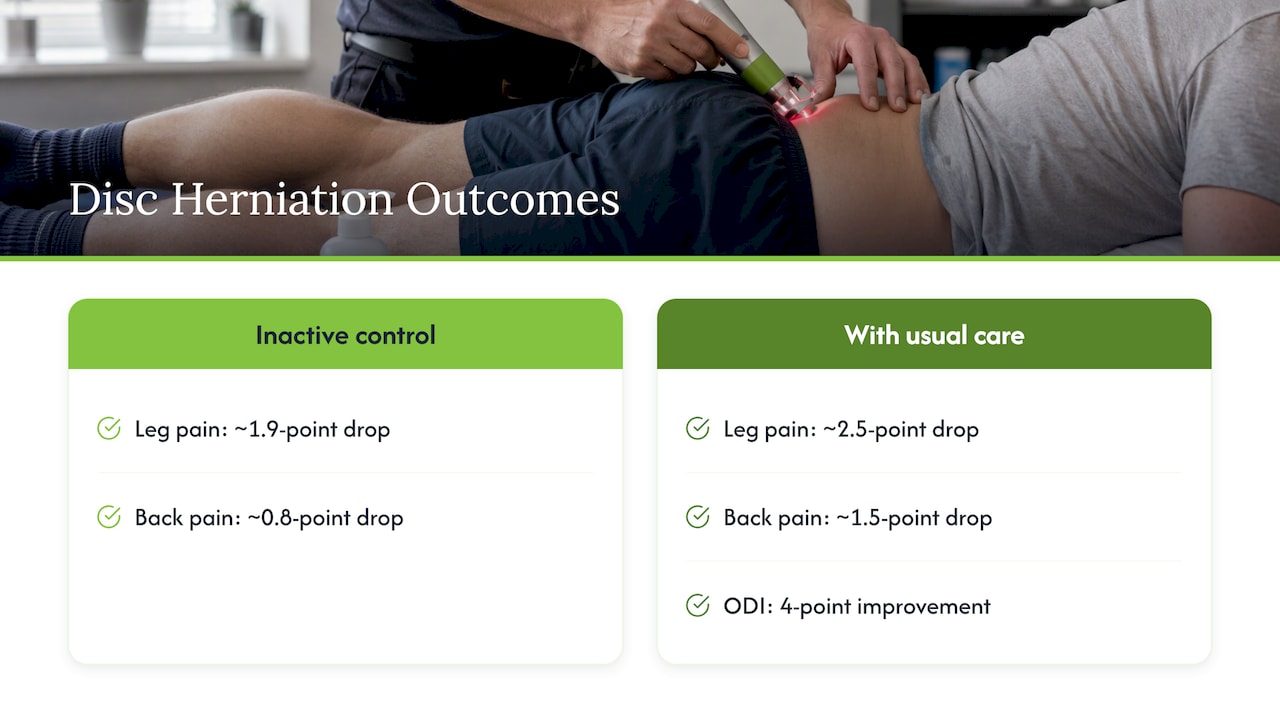
That last result matches how we think about care. Laser is rarely the only tool. It is most useful as one part of a plan that includes rehabilitation, activity modification and, when needed, other procedures.
Why results vary between studies. Reviewers attribute much of the variation to differences in laser power, wavelength, dose, treatment frequency and the condition being treated, as the 2025 review explains. The practical lesson for you is that the protocol matters as much as the machine.
Laser therapy and sciatica
Sciatica is not a diagnosis. It describes pain that travels along the sciatic nerve into the buttock and leg, and it has several possible causes. The American Academy of Family Physicians lists disc herniation, lumbar spinal stenosis, facet joint arthritis and spondylolisthesis among them. Which cause you have changes what treatment makes sense, so a proper exam and, where appropriate, imaging come first.
The most direct research involves disc herniation. In a 2024 trial of 75 patients with chronic radicular pain from a herniated lumbar disc, 15 sessions of low-level laser over three weeks at points along the sciatic nerve worked better than TENS for leg pain and neuropathic pain. Leg-pain improvement was the lasting benefit at the three-month follow-up.
In our experience, patients with sciatica often arrive having been told to wait and see. If the leg pain is the main complaint, a structured course of laser combined with targeted exercise can be a reasonable early, non-invasive step. If your symptoms are more persistent, we also evaluate the nerve root itself and discuss options on our lumbar radiculopathy and sciatica page.
Laser therapy and plantar fasciitis
People who search for laser therapy for the back often have a second problem in the foot, because a stiff lower back and a painful heel tend to travel together in active adults. A meta-analysis of low-level laser therapy for plantar fasciitis found significant pain reduction on the visual analog scale by the end of treatment, with the effect persisting for up to three months.
The treatment logic is the same as in the spine: light delivered to irritated connective tissue to support repair and reduce inflammation. We assess the foot, the gait and the lower back together, since an overloaded heel is sometimes part of a bigger mechanical pattern.
What a course of treatment usually involves
Session schedules differ by protocol, and a clinic should set yours after examining you. The published trials give a sense of the range. The 2024 sciatica trial above used 15 sessions over three weeks, five days a week. Other studies use fewer sessions spread over a longer period. A 2015 review of laser for musculoskeletal pain notes that good outcomes depend on clinical skill and an understanding of the injury, inflammation and repair process.
In general, a course follows this pattern:
- Evaluation. A physician reviews your history, examines you and decides whether your pain is neuromusculoskeletal and whether laser is appropriate. The American Society for Laser Medicine and Surgery states that a provider must diagnose the condition and rule out contraindications before photobiomodulation is used.
- Treatment planning. The area, wavelength, power and number of sessions are chosen for your condition.
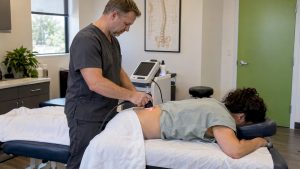
- Sessions. The handpiece is moved over the painful area. Laser is typically a short, non-invasive treatment, and you do not need to be sedated.
- Reassessment. Pain and function are checked as the course goes on, and the plan is adjusted.
Expect gradual change rather than an overnight result. Most patients do not get full relief after a single visit, so we set expectations around a series of treatments and around what you can do between them. Our article on Class IV laser side effects and what to expect walks through the experience in more detail.
Who should talk to a physician first
Laser is considered well tolerated, and the 2015 review notes few side effects, including in older adults. Still, there are people who need to be evaluated before treatment.
- Pregnancy. ASLMS states that pregnant women are not good candidates for photobiomodulation because the effects on the fetus are unknown. Tell us if you are pregnant or might be.
- Unexplained or severe pain. The goal of the first visit is to confirm that the pain comes from a musculoskeletal source. Pain that does not fit that pattern needs a different workup.
- Structural problems. A laser or LED does not correct structural deficits or instability in bone or soft tissue, as the 2015 review points out. When imaging shows a problem like that, laser is one piece of a wider plan, and we discuss the others with you.
- Warning signs. New leg weakness, numbness in the groin or saddle area, loss of bladder or bowel control, fever with back pain, or pain after a significant fall needs urgent medical care, not an appointment for laser therapy. Go to an emergency department.
Insurance is another practical point. Some insurers treat high-intensity laser for chronic musculoskeletal pain as investigational, so coverage policies vary. Our practice accepts cash, insurance and motor vehicle accident claims, and our team can explain how your situation would be handled before you book.
How laser fits with the rest of non-surgical care
Laser rarely stands alone in a good plan. For a patient with chronic low back pain, a plan might combine several elements:
- Rehabilitation. Strengthening and mobility work addresses why the back keeps getting irritated. Our physical therapy team builds this around your job, sport and daily routine.
- Targeted injections. When a specific structure such as a facet joint is the source, facet joint injections can help identify and treat it.
- Regenerative options. For degenerative problems, we also offer PRP therapy for chronic back pain, which uses your own platelets to support tissue repair.
- Other light-based therapy. Red light has its own role, and we describe it in our article on red light therapy for back pain.
The broader menu of choices is laid out in our guide to non-surgical lower back pain treatments. The right order depends on how long you have had pain, what imaging shows and what you need to get back to doing.
Questions to bring to your first visit
A productive consultation starts with specifics. These questions help you and the physician decide together:
- What is the most likely source of my pain: muscle, joint, disc or nerve?
- Is Class IV laser appropriate for that source, and at what depth does it need to work?
- How many sessions should I plan for, and how will we measure progress?
- What exercises should I do between sessions?
- If laser alone is not enough, what is the next step?
We encourage patients to keep a short pain diary for a week before the visit, noting what makes the pain better or worse and how it affects sleep, work and exercise. It gives us a baseline to compare against.
Our perspective
Many patients tell us they have been cycling through the same short-term fixes for years. Our view is that lasting relief starts with identifying where the pain comes from and then choosing the least invasive option that addresses it. Class IV laser belongs in that conversation because it is non-invasive, it reaches the deeper tissues of the spine and the research reports meaningful improvements in pain and disability.
We are also clear about what laser does best: it supports healing and calms inflammation, and it pairs well with rehabilitation. That is why our physicians, who are Harvard fellowship-trained and board-certified, build customized plans instead of offering a single treatment to everyone. Laser may be the whole answer for one patient and the first step for another, whose plan may later include injections or regenerative medicine.
If you have been living with back pain and want a plan that aims at the cause, not only the symptom, we would like to examine you and talk it through.
Felix
Next step if you live in North Dallas
If back pain, sciatica or a stubborn heel is limiting your work or your workouts, a consultation is the right place to start. We see patients across the North Dallas area, including Allen, Garland, McKinney and Plano. You can read about our approach on the back pain therapy page, or see the full list of treatments we offer and book an evaluation. Our physicians will review your history, examine you and tell you plainly whether Class IV laser, another therapy or a combination is the best fit.
FAQ
Does laser therapy work for chronic low back pain?
Reviews of clinical trials report that laser therapy can relieve chronic low back pain compared with placebo, and a 2023 meta-analysis found significant improvements in pain and disability with high-intensity laser. Results depend on the dose, the protocol and the cause of the pain. A physician exam is how you find out whether it fits your case.
Is laser therapy safe?
The FDA has cleared laser devices for the temporary relief of pain, and the NCCIH reports that studies found no evidence of harmful effects. Pregnant women are not good candidates, and a provider should rule out contraindications first. Tell your physician about all your medical conditions before treatment.
How many sessions will I need?
It depends on the condition and the protocol. One 2024 sciatica trial used 15 sessions over three weeks, and other protocols differ. We set a plan after your evaluation and reassess as you progress.
Can laser therapy help sciatica?
It can for some causes. In a 2024 trial of patients with a herniated disc, laser reduced leg pain more than TENS, and the leg-pain benefit remained at three months. Because sciatica has several possible causes, the exam comes first.
Does laser therapy help plantar fasciitis?
A meta-analysis found significant pain reduction at the end of laser treatment, with effects lasting up to three months. We also look at your gait and lower back, since they can contribute to heel pain.
Sources
- High- and Low-Level Laser Therapy review (2025)
- Red light therapy for back pain protocol review
- Effectiveness of low-level laser therapy for chronic low back pain (2015)
- NCCIH: Low-Back Pain and Complementary Health Approaches
- High-intensity laser therapy in low back pain management (2023)
- Effectiveness and Safety of Low-Level Laser Treatment for lumbar disc herniation (2023)
- Treatment of Acute Sciatica, American Family Physician
- TENS versus low-level laser for lumbar radicular pain (2024)
- Low-level laser therapy in plantar fasciitis meta-analysis (2019)
- Use of low level laser therapy for musculoskeletal pain (2015)
- Photobiomodulation, ASLMS
- High intensity laser therapy medical policy