

There is no single answer, and anyone who gives you one number is oversimplifying. In the clinical trials that exist, any benefit from a stem cell injection is usually measured over about three to six months, with a small number of studies following patients for a year or longer. Some patients report relief that lasts many months. Others notice little change. The honest range depends on the joint treated, the severity of the condition, how the cells were prepared, and what you do afterward.
This guide explains when stem cell injections typically begin to work, how long relief may last according to published research, why results differ so much from one person to the next, and how to decide whether a repeat injection or a different treatment makes sense. We also cover what the FDA has said about these products, because it affects how you should weigh any promise of durability.
TL;DR
- Early changes, if they occur, often appear within a few weeks, but meaningful improvement is generally judged at three to six months.
- Controlled trials of knee osteoarthritis suggest that stem cell injections may slightly improve pain and function for up to six months, with low confidence in that estimate.
- Evidence for benefits lasting a year or longer is mixed, and results vary widely by patient, condition, and preparation method.
- The FDA states that regenerative medicine products have not been approved for any orthopedic condition, so durability claims should be treated cautiously.
- A short flare of soreness after the injection is common, but worsening pain after the first week or signs of infection warrant a call to your clinician.
Table of Contents
- How long stem cell injections take to work
- What clinical research shows about how long results last
- Why results last longer for some people than others
- Why the first week can feel worse
- Our perspective on durability
- Can you repeat a stem cell injection?
- Comparing durability with other injection options
- What you can do to support the result
- When to consider an evaluation
- FAQ
- Sources
How long stem cell injections take to work
Most patients ask this first, and the timeline is slower than many expect. A stem cell injection is not a numbing agent or a steroid. A corticosteroid can reduce inflammation within days. A biologic injection is intended to influence the local environment of the joint or tissue gradually, so any change tends to develop over weeks to months.
In our experience, many patients come in after trying several treatments, such as anti-inflammatory medication, physical therapy, and steroid injections, and they want to know when they can stop worrying about the next step. We tell them to think in phases rather than a date on the calendar:
- The first several days. Soreness, stiffness, or a feeling of pressure at the injection site is common. This is not a sign that the treatment has failed or succeeded.
- Weeks two to six. Some patients notice early changes, such as easier mornings or less pain with stairs. Others notice nothing yet. Neither pattern predicts the final outcome reliably.
- Months two to three. This is when many clinicians begin to judge whether the treatment is helping, particularly if you have also been following a rehabilitation plan.
- Months three to six. Most clinical trials assess their primary outcomes in this window, so it is the best-studied period for any benefit.
Websites that promote stem cell treatment often describe improvement beginning in two to six weeks and continuing for a year or more. Those figures usually come from clinic experience or patient-reported surveys rather than from controlled trials, and we would not build expectations on them.
What clinical research shows about how long results last
The strongest evidence comes from systematic reviews, which pool randomized trials. Most of that research is in knee osteoarthritis, because that is where the largest number of trials exist. The findings are cautious.
A Cochrane review summarized in plain language found that, compared with placebo injections, stem cell injections may slightly improve pain and function up to six months after treatment, though confidence in these estimates is low. An updated analysis published in 2025 reached a similar conclusion, noting that the primary outcomes were evaluated at 3 to 6 months and certainty for several outcomes was very low.
A 2024 systematic review and meta-analysis of 16 randomized trials with 807 participants was less encouraging. It found that mesenchymal stem cell therapy probably produced little to no clinically important improvement in knee pain or function at 3 to 6 months, and the pain benefit also remained small at 12 months, although physical function at 12 months may have improved.
Other analyses point the other way. A meta-analysis of 11 randomized trials with 811 patients reported significant improvements in osteoarthritis pain and function, with the largest effects at 24 months. Reviews that reach different conclusions are common in this field, because the trials differ in cell source, dose, preparation, and comparison group.
The Washington State Health Care Authority reviewed the musculoskeletal literature and found no improvement in pain at 3, 6, or 12 months in several small, mostly poor-quality randomized trials comparing stem cell interventions with hyaluronic acid, placebo, or exercise. It judged the evidence insufficient or of low certainty.
For other joints, the evidence is thinner still. The American Academy of Orthopaedic Surgeons, for example, states that there is no reliable evidence regarding intra-articular stem cell therapy for symptomatic ankle osteoarthritis. We have looked at the shoulder and spine separately in our articles on shoulder stem cell therapy and stem cell therapy for back pain.
What this means in practical terms
Put together, the research supports the following realistic framing:
- A benefit, when it occurs, is most reliably documented within the first six months.
- Studies that follow patients for a year or more exist, but their conclusions conflict, and the quality of the trials varies.
- Some researchers suggest that imaging findings and patient-reported pain scores can move differently over time. A seven-year longitudinal study of knee treatment is one of the sources raising that distinction, which is a reminder that how you feel and what a scan shows are separate questions.
- No published evidence we reviewed shows that a single injection permanently reverses degenerative change. Stem cell treatment is not a cure for arthritis or a worn disc.
Why results last longer for some people than others
If you read patient stories online, you will see everything from a few weeks of help to years of relief. That spread is real, and it has identifiable causes.
The condition and its severity. A joint with mild to moderate cartilage wear has more tissue to work with than one with bone-on-bone changes. A tendon problem behaves differently from a degenerated disc.
Patient factors. Age, other medical conditions, body weight, and activity level can all influence outcome. AAOS has noted that patient age, comorbidities, disease severity, preparation, and the quantity and quality of cells may influence treatment outcomes.
Preparation and technique. The Washington State report points to the lack of standardized, validated protocols for harvesting and injecting cells, which makes firm conclusions about clinical value difficult. Two clinics offering “stem cell therapy” may be delivering quite different products.
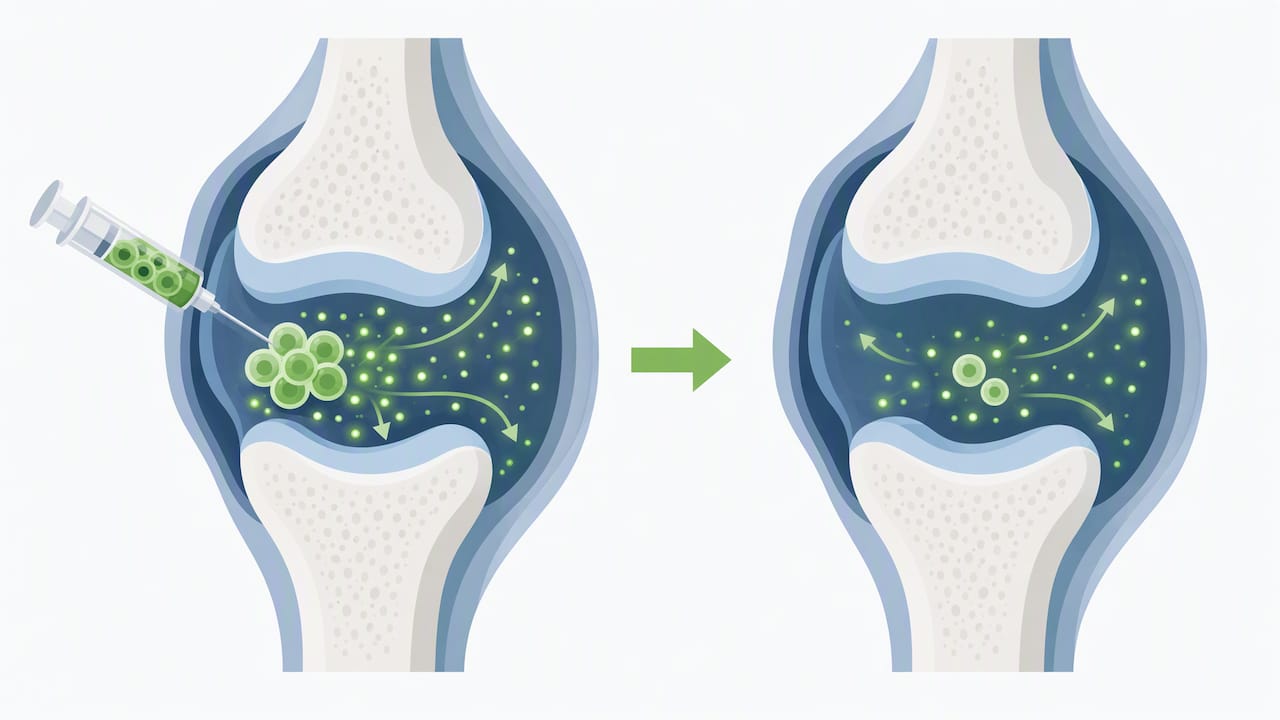
How the cells are thought to work. A consensus report from a multispecialty group describes the benefit of mesenchymal stem cells as largely attributed to paracrine effects, meaning the release of anti-inflammatory signaling molecules, rather than the cells turning into new tissue. The same report notes that fewer than 1% of injected cells may remain after as little as seven days. That helps explain why relief, when it comes, is not simply a matter of cells staying in the joint for a long time.
What happens afterward. Rehabilitation, load management, and sleep all affect how a joint feels at month four. Patients who return straight to the activity that irritated the joint often lose ground faster.
Why the first week can feel worse
It is not unusual to feel more sore after an injection before feeling better. The needle, the volume of fluid in the joint, and the body’s own response can all produce a temporary flare. Clinics that perform biologic injections commonly describe this soreness as peaking in the first two to three days and settling within about a week, although that pattern comes from clinical practice rather than from a controlled trial.
We would ask you to call us, or your treating clinician, rather than wait it out if you notice any of the following:
- Pain that is getting worse rather than better after the first week to ten days
- Redness, warmth, or swelling that is spreading
- Fever or chills
- New numbness, tingling, or weakness in a limb, particularly after a spinal injection
The FDA lists infections, tumor formation, immune responses, and reactions at the collection or administration site among the risks of regenerative medicine products. Serious complications are not the usual experience, but they are the reason follow-up matters. If your pain after a spinal injection is severe or comes with new weakness, treat that as urgent rather than waiting for an office appointment.
Our perspective on durability
We would rather tell you what we do not know than promise a timeline. In our practice, the patients who are happiest months later are rarely the ones who were told a single injection would solve everything. They are the ones who understood that a biologic injection is one part of a plan that includes strengthening, movement changes, and sometimes a second treatment.
We also take the regulatory position seriously. The FDA states that regenerative medicine therapies have not been approved for any orthopedic condition and have not been adequately studied to demonstrate safety and effectiveness. That is why we explain in plain terms that results are variable and why we cover this in more detail in our article on stem cell therapy and arthritis in the U.S. and our overview of back stem cell products.
When a patient asks how long it will last, we answer with a range, then set a checkpoint at about three months to decide whether to continue, add rehabilitation, or try something different. A treatment that has not helped by then is not likely to start helping later, and you should not feel pressured to repeat it.
— Felix
Can you repeat a stem cell injection?
Some clinics offer repeat injections once the first effect fades. Whether that makes sense depends on whether the first injection helped meaningfully, how long it helped, and what else has changed. If you had a clear improvement lasting several months and the pain has gradually returned, a repeat treatment is a reasonable conversation. If you had little or no benefit, a second injection of the same type is difficult to justify.
Be cautious about packages that commit you to several injections up front. The research does not define an optimal number of injections or an optimal interval, so a fixed schedule is a business decision, not an established medical standard.
Comparing durability with other injection options
Patients often ask how stem cell injections compare with the alternatives. These are general patterns, not guarantees, and they vary by joint and diagnosis.
| Option | Typical speed of effect | What to know |
|---|---|---|
| Corticosteroid injection | Days | Fast, but relief is often temporary, and repeated use is a concern for cartilage and tendons |
| Hyaluronic acid injection | Weeks | Commonly used for knee arthritis, with mixed evidence of benefit |
| PRP (platelet-rich plasma) | Weeks to months | Uses your own platelets; evidence varies by joint and preparation |
| Stem cell or bone marrow concentrate | Weeks to months | Evidence is low certainty, and the FDA has not approved these products for orthopedic use |
| Physical therapy and exercise | Weeks to months | Builds lasting strength and is a comparison group in many trials |
If you want to understand the differences in more detail, our guide to regenerative injection options, results, and what to ask and the article on how to select regenerative treatments for pain relief walk through the questions we suggest asking any provider.
What you can do to support the result
Nothing you do after an injection guarantees an outcome, but a few habits are consistent with good practice:
- Follow the activity instructions you are given. Rest briefly, then return gradually rather than all at once.
- Start rehabilitation on schedule. Strengthening the muscles around the joint reduces the load on it. Our physical therapy program is built around this step.
- Keep a simple pain and function log. Note stairs, walking distance, and sleep each week. It turns vague impressions into something you and your clinician can compare at three months.
- Review supplements with your clinician. Some patients ask about nutrition and collagen for joint support. Discuss anything you take, especially if you also use blood thinners or anti-inflammatory medication, since that can matter around injections.
- Avoid anti-inflammatory medication unless advised. Some providers ask patients to avoid NSAIDs around biologic injections, so ask before you take them.
When to consider an evaluation
If you live in the North Dallas area and have chronic knee, hip, shoulder, or back pain that has not responded to medication or basic therapy, a consultation is the right first step before deciding on any injection. We would examine you, review your imaging, and talk through whether a regenerative option fits your diagnosis, or whether a different approach would serve you better. You can read about our stem cell offerings, our wider regenerative medicine program, or PRP therapy, and you can book a consultation through our main site. Prices are not published on our site, so we discuss costs and coverage with you at the visit.
FAQ
How long do stem cell injections last in the knee?
In controlled trials, the most consistent finding is a possible slight improvement in pain and function for up to six months, and the confidence in that finding is low. Some studies report benefits lasting a year or more, while others find no meaningful difference from placebo. Your own result may fall anywhere in that range.
How long does it take for stem cells to work?
Some people notice a change within a few weeks, but many do not feel a clear difference until two to three months. Most clinicians judge the result at about three to six months. If there is no improvement by then, it is reasonable to reassess the plan.
Is it normal for the area to hurt more after a stem cell injection?
Temporary soreness is common and usually settles within days to about a week. Call your clinician if pain is worsening after the first week or so, or if you notice fever, spreading redness, warmth, or new numbness or weakness.
Are stem cell injections approved by the FDA for arthritis or joint pain?
No. The FDA says regenerative medicine therapies have not been approved for any orthopedic condition. That does not mean every patient will be unhappy with the treatment, but it does mean you should ask any provider what product is used, where it comes from, and what evidence supports it.
Sources
- Washington State Health Care Authority, Musculoskeletal Conditions evidence report (2020)
- Cochrane summary: benefits and risks of stem cell injections for knee osteoarthritis
- Stem cell injections for osteoarthritis of the knee (2025 review)
- Mesenchymal stem cells for chronic knee pain: systematic review and meta-analysis (2024)
- Mesenchymal stem cell-based therapy for osteoarthritis: meta-analysis (2025)
- AAOS, Management of Ankle Osteoarthritis
- Seven-year longitudinal study of knee treatment (Spasovski et al., 2024)
- AAOS technology overview: concentrated bone marrow aspirate for knee osteoarthritis
- Evidence-Based Clinical Practice Guidelines, Journal of Pain Research
- FDA, Important Patient and Consumer Information About Regenerative Medicine Therapies
- Collagen for joints