
Many meniscus tears, especially degenerative ones in adults over 45, improve without surgery. If your knee is not locking, catching, or giving way, a structured program of physical therapy, activity changes, and targeted non-surgical treatments is usually the right starting point. Surgery becomes the main conversation when the knee mechanically locks or when a genuine trial of conservative care, typically 3 to 6 months, fails to bring meaningful relief.
TL;DR:
- MRI findings alone cannot establish the pain source, since tears often appear incidentally in adults over 45 who have no knee pain.
- A trial of 321 patients aged 45 to 70 found physical therapy matched surgery for knee function at five years.
- Allow 3 to 6 months of consistent supervised care before reassessing; about 29% of physical therapy patients in one trial later chose surgery.
- Locking, inability to fully straighten the knee, inability to bear weight, or an acute traumatic tear warrant earlier clinical assessment for possible surgery.
Table of Contents
- How meniscal tears heal: anatomy, tear types, and why MRI findings can be misleading
- Conservative treatments that can relieve symptoms and restore function
- What the evidence says: randomized trials and guideline recommendations
- When conservative care may be insufficient
- Timeline and realistic outcomes with conservative care
- Clinician perspective: how we evaluate and manage meniscal tears non-surgically
- What this evidence actually tells you to do
- How we help you avoid unnecessary knee surgery
- FAQ
- Sources
How meniscal tears heal: anatomy, tear types, and why MRI findings can be misleading
We think about meniscus tears in terms of blood supply, because blood supply predicts healing. The meniscus has areas with different blood supplies, and tear location can affect how clinicians approach treatment. Your clinician can explain what your tear pattern may mean for your care.
Tear pattern matters just as much as location:
- Degenerative tears, common after age 45, often occur alongside early osteoarthritis and tend to respond well to exercise-based care.
- Some tears may respond to activity modification and rehabilitation. Your clinician can assess whether that approach fits your tear.
- Some tear patterns, particularly after a traumatic injury, may cause mechanical symptoms. If you have these symptoms, discuss them with a clinician.
One detail changes how we read every MRI: meniscal tears show up incidentally on imaging in a large share of middle-aged and older adults who have no knee pain at all. The Mayo Clinic notes that many tears are discovered incidentally, which is why we always correlate what the scan shows with what your knee actually does during the exam. A tear on a report is not automatically the cause of your pain, and treating the image instead of the patient leads to unnecessary procedures.
Conservative treatments that can relieve symptoms and restore function
When a tear looks favorable for non-surgical care, we build a plan in stages rather than throwing every treatment at the knee at once.
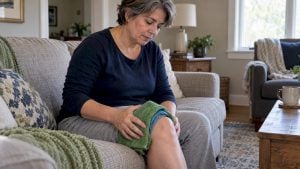
- Calm the joint first. Reduce high-impact and pivoting activities, use relative rest rather than complete immobilization, and apply ice and compression for acute swelling. Crutches for a few days are reasonable if you cannot bear weight comfortably, but prolonged immobilization weakens the muscles that protect the knee.
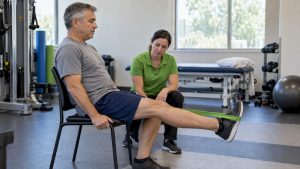
- Start supervised physical therapy. A program can progress from pain and swelling management to strengthening and neuromuscular control exercises, with the plan tailored to your symptoms and progress; here are some hip mobility exercises that support lower-extremity rehab programs. Your physical therapist can recommend a session schedule and home exercises based on your needs.
- Use medication selectively. Over-the-counter NSAIDs can control pain and swelling during flare-ups. When inflammation is more stubborn, a short corticosteroid injection is sometimes considered, though we reserve it rather than reach for it automatically, since repeated steroid use has its own tradeoffs over time.
- Add bracing when activity demands it. A clinician can help you decide whether a brace or compression sleeve is appropriate for your activities and symptoms.
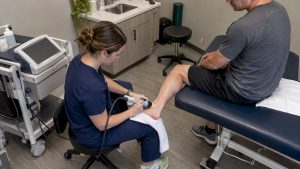
- Consider regenerative options for persistent symptoms. Some patients ask about PRP therapy or other injections when pain and swelling persist. Discuss the potential benefits and limitations with your clinician. These are not guaranteed fixes, and we present them as one part of a staged plan, not a replacement for the rehab work itself.
Pro Tip: Track pain during stairs, swelling after activity, and confidence pivoting. These can help you and your clinician discuss how your symptoms change over time.
Before your first visit, it helps to bring:
- A list of what movements consistently trigger pain or swelling.
- Any prior imaging reports or notes from other providers.
- Specific goals, whether that is returning to running, kneeling for work, or simply walking without pain.
Many patients come to us after trying rest alone for months without a structured plan, and they are often surprised at how much a properly sequenced program changes their trajectory compared to just waiting it out.
What the evidence says: randomized trials and guideline recommendations
The strongest argument for trying conservative care first comes from randomized trials, not opinion. The ESCAPE trial followed 321 patients aged 45 to 70 and found no clinically relevant difference in knee function between arthroscopic partial meniscectomy and exercise-based physical therapy at five years.
One large multicenter trial reported knee function improving by an average of 20.4 points with physical therapy versus 26.2 points with surgery over 24 months, a gap that was not considered clinically meaningful at longer follow-up. In plain terms, noninferior means PT patients ended up in roughly the same functional place as surgery patients, even though surgery sometimes looked slightly better in the short run.
Here is what that evidence means in practice:
- Short-term differences favoring surgery often narrow or disappear by 24 months.
- Some patients who start with PT later choose surgery, a pattern trials call cross-over, but many avoid the operating room entirely.
- The AAOS clinical practice guideline describes physical therapy as integral to care and notes that for many patients it is the only treatment needed.
Choosing PT first is not settling for less. For degenerative tears especially, it is the option with trial data behind it.
When conservative care may be insufficient
Certain signs tell us to stop waiting and get a surgical opinion sooner rather than later:
- A knee that locks, catches, or will not fully straighten suggests a torn fragment is mechanically blocking motion.
- Inability to bear weight or progressive loss of range of motion despite rehab points toward a structural problem PT alone will not fix.
- No meaningful improvement after a genuine 3 to 6 month trial of supervised conservative care, which the Mayo Clinic identifies as the point to reassess surgically, usually means it is time to escalate.
Acute traumatic tears may call for a different discussion from degenerative tears. Ask your clinician whether the tear pattern and your symptoms warrant early surgical evaluation.
Timeline and realistic outcomes with conservative care
- Weeks 1 to 3: Focus is swelling and pain control; walking tolerance usually improves first.
- Weeks 4 to 8: Strength work ramps up, and most patients notice more confidence on stairs and uneven ground.
- 3 to 6 months: Functional recovery becomes clearer, including return to sport or physically demanding work, depending on your starting point and tear type.
Trial data gives a useful benchmark here too: many patients following a PT-based program show similar function to those who had early surgery at the 12 to 24 month mark, though a portion of PT patients, around 29% in one trial, eventually crossed over to surgery during follow-up. That number is worth sitting with: most people in that trial did not need surgery, but a meaningful minority did.
Track pain with daily tasks, walking distance, kneeling tolerance, and pivoting confidence, and revisit your plan with your clinician if progress stalls rather than pushing through months of no change.
Clinician perspective: how we evaluate and manage meniscal tears non-surgically
We start every evaluation by matching the physical exam to the imaging, because an MRI alone does not tell us whether a tear is the actual source of your symptoms. Many patients arrive after months of self-directed rest or inconsistent home exercises, and what usually moves the needle is a properly sequenced program: focused assessment, supervised PT, and targeted injections if symptoms persist, with surgery reserved as a shared decision rather than a default.
Pro Tip: Whether conservative care is suitable depends on your symptoms, tear pattern, and participation in the PT program. Your clinician can help you set a plan that fits your situation.
A tear on an MRI is a finding, not automatically a diagnosis, and the exam room is where the two get reconciled.
What this evidence actually tells you to do
The research is more reassuring than most people expect walking in with a meniscus tear, but it is also more specific than the popular version of the story. “Physical therapy works” is true for degenerative tears without locking, and it is not a blanket statement that covers every tear pattern or every patient. The conventional advice online tends to flatten this distinction, treating all meniscus tears as one condition with one answer.
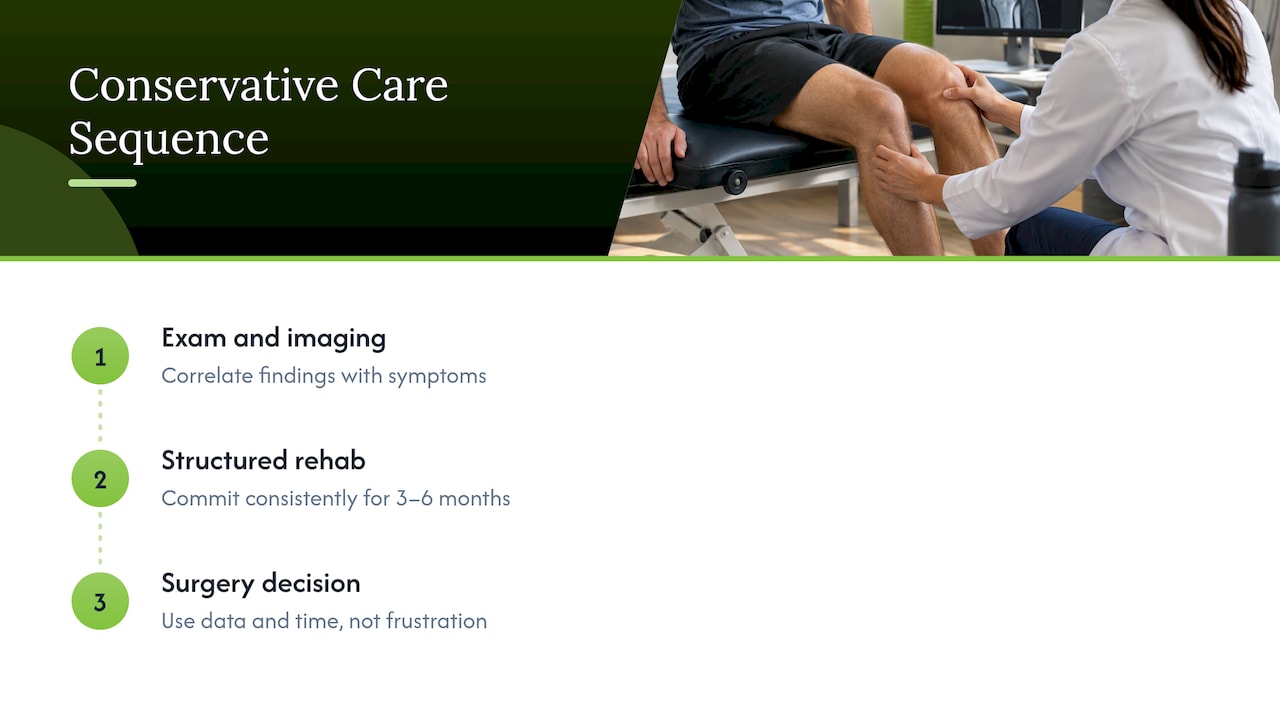
What gets underrated is the discipline of the trial period itself. A real 3 to 6 month conservative program, done consistently, is not the same as resting for a few weeks and deciding PT “didn’t work.” Most of the noninferiority findings in the research came from patients who completed structured, supervised rehab, not patients who dabbled in it.
If you take one thing from this, let it be sequencing: get the exam and imaging correlated first, commit fully to a structured program second, and treat surgery as a decision you make from data and time, not frustration.
— Felix
How we help you avoid unnecessary knee surgery
If your meniscus tear fits the profile for conservative care, we build a plan around your specific tear pattern and activity goals rather than a generic protocol. Our approach typically includes:
- A focused exam that correlates your MRI findings with your actual symptoms and movement limitations.
- Supervised physical therapy programs designed around your tear type and recovery timeline.
- Regenerative medicine options, including PRP therapy, for patients whose symptoms persist past the initial rehab phase.
- Targeted injections and other non-surgical treatments when inflammation needs more direct management.
A first visit gives us the information we need to map out a realistic, staged plan for your knee. Schedule an evaluation to find out where your tear fits and what a conservative path could look like for you.
This article is general information, not a substitute for advice from a qualified doctor. Consult a qualified healthcare professional about your own circumstances before acting on anything here.
FAQ
How to heal a meniscus tear naturally without surgery?
Rest from aggravating activity, ice and compression for swelling, and a structured physical therapy program focused on strengthening and neuromuscular control give the meniscus the best chance to settle without surgery. Research shows exercise-based PT is noninferior to surgery for many degenerative tears over the long term. Bracing and short-term NSAID use can support the process alongside PT.
What does a meniscus tear feel like?
A meniscus tear typically causes pain along the joint line, swelling, and a sensation of catching, popping, or the knee giving way during twisting or pivoting movements. Some people also notice stiffness or difficulty fully straightening the knee. Symptoms can range from mild and intermittent to severe enough to limit weight bearing.
How long can you go with a meniscus tear without surgery?
Many people manage a meniscus tear indefinitely with conservative care if there is no mechanical locking and symptoms respond to rehab. Clinical guidance points to a 3 to 6 month trial of non-surgical treatment as the point to reassess with your clinician if meaningful improvement has not occurred.
Can I test for a meniscus tear at home?
There is no reliable way to confirm a meniscus tear at home, since symptoms overlap with other knee conditions and many tears are even found incidentally on imaging in people without pain. A clinician’s physical exam, sometimes paired with MRI, is needed to correlate findings with your actual symptoms before deciding on treatment.
Sources
- Health
- Torn meniscus – Diagnosis & treatment – Mayo Clinic
- Effect of Physical Therapy vs Arthroscopic Partial Meniscectomy in People With Degenerative Meniscal Tears: Five-Year Follow-up of the ESCAPE Randomized Clinical Trial – PMC
- Cinical Practice Guideline for Management of Acute Isolated Meniscal Pathology