
For joint and tendon pain, the relief from a PRP (platelet-rich plasma) injection often lasts somewhere between several months and a year or longer. The range is wide because the answer depends on what is being treated, how advanced the damage is, how the PRP is prepared, and what you do afterward. It also starts slowly. Most people do not feel the full effect for weeks, so the question of how long PRP lasts is tied to how long it takes to start working.
Below, we walk through the timeline in the order you will live it: the first days, the weeks when improvement builds, the months when it holds, and what can shorten or extend it.
TL;DR
- PRP works gradually. Improvement commonly appears over 4 to 12 weeks, and some tendon problems take 3 to 6 months to show a clear change.
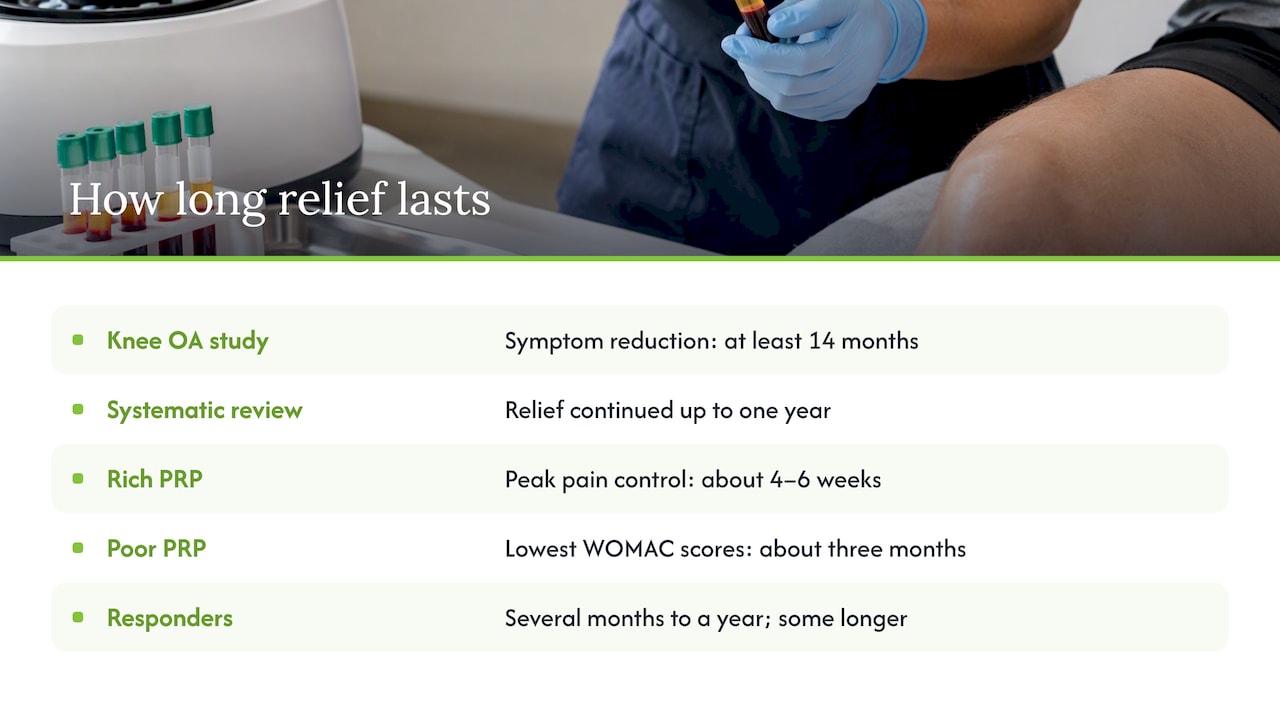
- Duration varies. Studies of knee osteoarthritis report relief lasting up to a year, and one study followed symptom reduction for at least 14 months. Individual results differ.
- Downtime is usually short: light activity in the first week, then a gradual return to normal activity. Return to full sport is typically a matter of weeks and depends on the tissue treated.
- PRP works best as part of a plan that includes physical therapy and load management, not as a stand-alone cure.
Table of Contents
- What PRP is actually doing in the first weeks
- How long PRP takes to work
- How long PRP lasts once it works
- PRP recovery time and downtime
- What to expect after a PRP knee or joint injection
- How PRP compares with other options on duration
- How to make the result last longer
- Our perspective
- Considering PRP in North Dallas
- FAQ
- Sources
What PRP is actually doing in the first weeks
PRP is made from your own blood. A small sample is drawn, spun in a centrifuge to concentrate the platelets, and the concentrated plasma is injected into the joint, tendon, or other treated area, usually with imaging guidance. Because it is autologous (from you), the concern about rejection does not apply, although any injection carries its own small risks.
Platelets release growth factors that influence inflammation and tissue repair. That is a biological process, not a switch, and it unfolds over weeks. This is why the first question patients ask, “Why don’t I feel better yet?”, is usually answered with patience rather than a second procedure.
How long PRP takes to work
A 2026 narrative review in Frontiers in Medicine describes improvement that often emerges gradually over 4 to 12 weeks, with peak effects reported around 12 to 16 weeks in some studies. The same review notes that timing depends on the condition treated, the comparison used in the study, the PRP formulation, and how long patients were followed.
Harvard Health gives a similar window for knee osteoarthritis: after light activity for the first week, you progress back toward normal activity, and improvement can take six weeks to three months to notice.
Tendons are slower. A systematic review of musculoskeletal PRP studies found that for some tendinopathies, effectiveness can take 3 to 6 months to become apparent. Tendons have a limited blood supply, so remodeling is gradual. If you are treating chronic tendon pain, plan around months rather than weeks. We discuss this further in our guide to PRP for tendonitis.
A realistic timeline
The table below summarizes what the published ranges suggest. Your own course may be faster or slower.
| Phase | Typical window | What many patients notice |
|---|---|---|
| Immediately after | Days 1 to 3 | Soreness, stiffness, or a feeling of pressure at the injection site |
| Early recovery | Week 1 | Light activity only; the area may feel no better, or slightly worse |
| Building | Weeks 2 to 6 | Gradual change in morning stiffness and everyday pain |
| Noticeable improvement | Weeks 6 to 12 | The window in which many joint patients report clearer benefit |
| Peak effect | Roughly 3 to 4 months | Reported in some studies; tendons may take longer |
| Durability | Months to a year or more | Varies by condition and severity |
How long PRP lasts once it works
This is the part everyone wants a number for, and it is the part where we try to be most careful.
Research on knee osteoarthritis offers the most data. A 2023 study in the European Journal of Orthopaedic Surgery & Traumatology observed that symptom reduction persisted for at least 14 months in knee osteoarthritis patients. A systematic review indexed on PubMed found that relief continued up to one year, and that the timing of the best results differed by preparation: leukocyte-rich PRP reached maximum pain control at about 4 to 6 weeks, while leukocyte-poor PRP reached its lowest WOMAC (knee pain and function) scores at about three months.
So a fair summary is this: many patients with knee osteoarthritis who respond report benefit that lasts from several months to a year, and some longer. Some do not respond meaningfully at all. We do not promise a duration, and you should be wary of any clinic that does.
Why the same injection lasts differently in different people
In practice, several patterns shape how long relief holds:
- Severity of the condition. The 2023 study suggests patients with mild (Kellgren-Lawrence grade 1) osteoarthritis often did better than those with advanced disease. Once cartilage is largely gone, there is less for a biologic signal to work with.
- The tissue treated. Joint, tendon, and spine-related structures heal differently, as noted above.
- PRP preparation. Platelet concentration and whether white blood cells are included both change the response. Our article on how platelet dose affects knee outcomes goes into detail.
- Load and body mechanics. An injection does not fix the reason a joint was overloaded. Weight, muscle strength, and movement patterns matter.
- Age, general health, and activity level. These influence recovery, though not in a way that lets us predict one person’s result from a chart.
Many patients come to us after trying several treatments: anti-inflammatory medication, a corticosteroid injection or two, perhaps a course of therapy that stopped when pain eased. Their expectations are often high because they are tired of temporary fixes. Part of our job is to explain that PRP is a slower, biologic option with variable results, and to help you decide whether it fits your situation.
Is the benefit permanent?
No. PRP can reduce symptoms and may support tissue repair, but it does not reverse arthritis. The Frontiers review cautions that lasting symptom relief or imaging changes alone do not prove disease-modifying effect. In plain terms, feeling better for a year is valuable, but it does not mean the joint has been rebuilt. Symptoms can return, and some patients choose to repeat treatment.
PRP recovery time and downtime
PRP is an outpatient procedure. You can go home the same day, and most people do not need extended time off. The details depend on the treated area and the instructions your physician gives you, so treat the following as a general guide.
The first few days
Soreness, a feeling of fullness, and stiffness around the injection site are common in the first days. This is generally expected rather than a complication, because the goal is to prompt a healing response. Your physician will tell you what to do about pain control and whether to avoid certain medications. Do not decide this on your own, since advice differs between clinicians and between conditions. Contact the office promptly if you develop fever, increasing redness, spreading warmth, or severe pain that is getting worse rather than better, since these can signal infection.
Week one
Harvard Health describes light activity during the first week, followed by gradual progression to normal activity. For a knee, that usually means walking and normal daily tasks, but not long runs, deep squats under load, or a return to competitive play.
Weeks two to six: rehab and return to activity
This is where protocols differ most. A systematic review of 84 tendinopathy protocols found that stretching commonly began 2 to 7 days after injection, strengthening within 2 to 3 weeks, and return to full activity most often at 4 to 6 weeks. The authors also stress that evidence for the best post-injection protocol is limited, so your plan should be individualized.
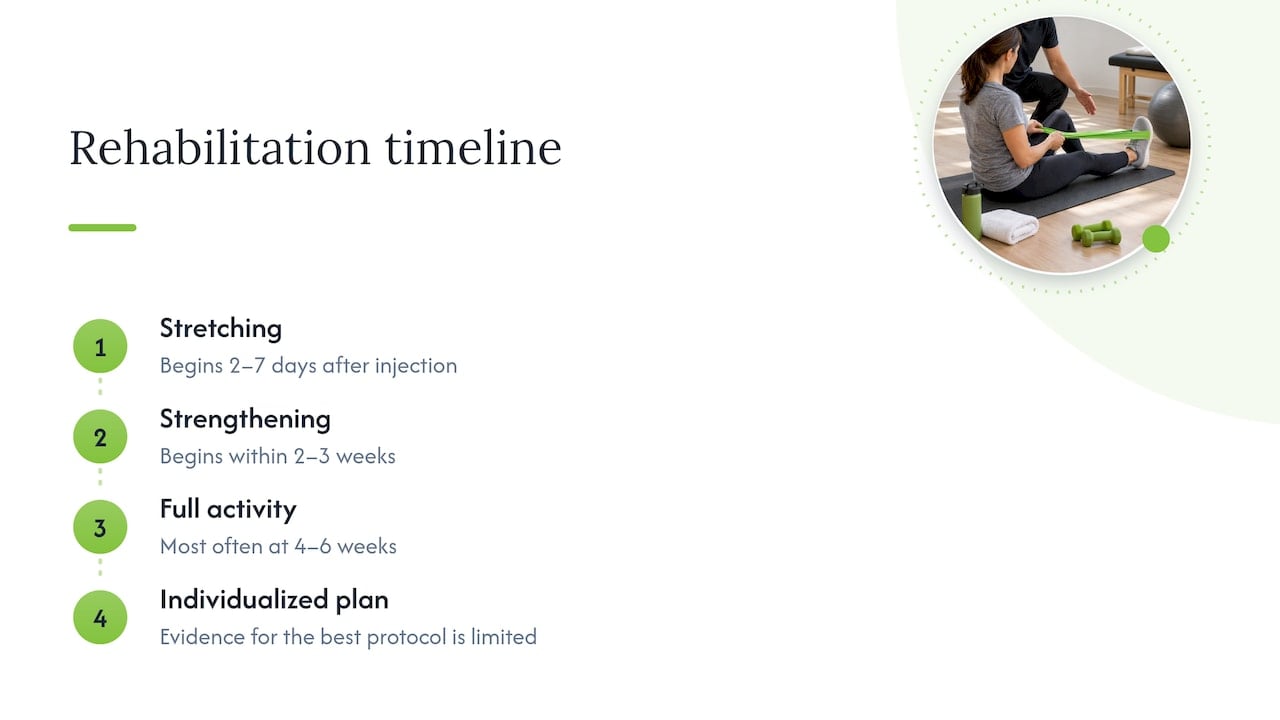
In our experience, this is the window where patients most often make mistakes in one of two directions: resting too long and getting stiff, or feeling a bit better and returning to full intensity too fast. Our article on post-PRP rehabilitation explains why we favor progressive strengthening beginning around two weeks, and our knee recovery timeline applies the same principles to knees.
What to expect after a PRP knee or joint injection
While each person differs, here is a typical sequence for a joint injection:
- Day of the procedure. After the injection, you rest briefly and then go home. Someone else driving you is a good idea, particularly if the area was numbed or you feel unsteady.
- First 48 to 72 hours. Mild to moderate soreness and swelling. Keep activity gentle and follow the instructions for medication and icing that your physician gives you.
- First week. Light walking and daily movement. Many people have little change in pain during this period, and that is normal.
- Weeks two to six. Start guided physical therapy as directed. Pain may begin to ease, but not always in a straight line.
- Weeks six to twelve. This is the point at which we reassess. If you are improving, we continue strengthening. If you are not, we talk honestly about why.
- Month three onward. Many patients reach their plateau. Whether the benefit holds depends on the factors above.
If you have been wondering how many PRP injections knee pain may require, that decision is best made after the first response is assessed, not before.
How PRP compares with other options on duration
It helps to place PRP next to other common treatments, without overstating the evidence.
- Corticosteroid injections tend to act faster, often within days, but their benefit is generally shorter. They can be the right choice when you need quick relief for a flare or to make rehabilitation possible.
- Hyaluronic acid injections are a viscosupplement for knee osteoarthritis. The 2023 study reports that PRP-treated patients had a lower need for reintervention than patients who received intra-articular hyaluronic acid. We offer both approaches, including HYALGAN injections for knee pain, and the better choice depends on your imaging, your history, and your goals.
- Physical therapy is not a competitor to PRP but its partner. It supports whatever the injection starts.
- Surgery remains appropriate for some patients, particularly with severe structural damage. Avoiding it is a reasonable goal, but not at any cost.
Harvard Health experts describe PRP as an adjunct that complements, rather than replaces, weight management and targeted physical therapy. We agree with that framing.
How to make the result last longer
Nobody can guarantee duration, but some habits improve the odds that you get the most from the injection.
- Follow the rehab plan. Strength around a joint reduces the load placed on it. Our physical therapy program is built to follow regenerative treatment.
- Manage body weight and training load. Extra load on the knee and hip adds up with every step.
- Avoid returning too quickly. Feeling better is not the same as tissue being ready.
- Add supportive care thoughtfully. Some patients also explore complementary measures for inflammation and joint comfort, such as red light therapy for arthritis. These can sit alongside PRP, but they do not replace it or the rehabilitation work.
- Keep follow-up appointments. A reassessment at six to twelve weeks tells us far more than how you feel on day five.
Our perspective
We see many people who have been told some version of “nothing more can be done short of surgery,” or who have cycled through medications and injections that helped for a few weeks. PRP is not the answer for all of them, and we say so. When it is a reasonable option, we want you to understand three things before you decide.
First, it is slow. If you expect relief by the weekend, you will be disappointed. Second, the result depends heavily on what is being treated and how advanced it is. A mildly arthritic knee or a tendon that has not yet fully degenerated generally gives us more to work with than a joint with bone on bone. Third, the injection is one part of a plan. The patients who do best tend to be those who treat it as the start of a rehabilitation process.
We would rather set a modest expectation and exceed it than the reverse. If you have already tried several treatments, bring your imaging and records to your consultation, and we will tell you plainly whether we think PRP, another biologic, or a different path is the better fit.
— Felix
Considering PRP in North Dallas
If you are weighing PRP for a knee, hip, shoulder, back, or tendon problem, we can review your history and imaging and explain what a realistic timeline looks like for you. Learn more about PRP therapy at Nortex Spine and Joint, or see how it fits within our broader regenerative medicine services. Pricing is not published online, so the consultation is where we discuss costs and whether your insurance or other coverage applies.
FAQ
How long do PRP injections last for knee pain?
In studies of knee osteoarthritis, relief has been reported for up to a year, and one study observed symptom reduction for at least 14 months. Results are individual, and milder disease tends to respond better. Some patients do not benefit.
How long does PRP take to work?
Most patients notice change gradually, often between 4 and 12 weeks. Some tendon problems can take 3 to 6 months. Feeling no difference in the first week or two is common and does not mean the treatment failed.
What is the downtime after a PRP injection?
There is usually no extended downtime. Most people limit themselves to light activity for the first week and then progress gradually, with your physician’s guidance. Return to full sport often takes several weeks and depends on the area treated.
Will I need more than one PRP injection?
Sometimes. Some patients respond to a single injection, while others are treated with a series or return for a repeat after the benefit fades. The decision should follow a reassessment of how you responded, which is why we review progress at several weeks rather than deciding in advance.
Sources
- The effects of platelet-rich plasma injections in different grades of knee osteoarthritis (European Journal of Orthopaedic Surgery & Traumatology)
- Systematic review of PRP in knee osteoarthritis, PubMed
- Platelet-rich plasma in the management of musculoskeletal conditions (Frontiers in Medicine)
- Update on the Use of Platelet-Rich Plasma Injections (PMC)
- PRP injection for knee osteoarthritis: Does it work? (Harvard Health)
- Post-procedure protocols following platelet-rich plasma injections (PubMed)