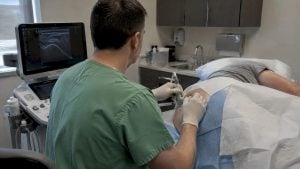

Recovery from a medial branch block is usually short. Most people go home the same day, and any soreness at the injection site typically settles within a few days. The relief you feel in the hours after the injection matters more than the recovery itself, because the block is mainly a diagnostic test. How much your pain drops, and for how long, tells us whether the small joints in your neck or back are the source of your pain and whether radiofrequency ablation is a reasonable next step.
This guide walks through the day of the procedure, the following week, how long relief lasts, what to track in a pain diary, and what the result means for your treatment plan.
TL;DR
- A medial branch block is a diagnostic injection. Relief from the numbing medicine often lasts only a few hours, and that is expected.
- Soreness at the injection site and brief numbness or weakness are common and usually resolve within hours to several days.
- Record your pain carefully for the first 24 hours. That record, not the calendar, is what guides the next decision.
- If the block clearly reduces your pain, radiofrequency ablation can be discussed as a longer-lasting option.
- Call the clinic for fever, spreading redness, worsening weakness, or pain that is escalating rather than easing.
Table of Contents
- What a medial branch block is meant to do
- The first hours after the injection
- How long recovery takes
- How long does the relief last?
- What to do after: driving, work, exercise, and your pain diary
- Side effects and when to call
- What your response means for the next step
- Why we do not judge a block by the clock
- Our perspective
- Other options while you decide
- Talk with our team
- FAQ
- Sources
What a medial branch block is meant to do
The medial branch nerves are tiny nerves that carry pain signals from the facet joints, the small joints that sit along the back of your spine and in your neck. When those joints become irritated by arthritis, wear, or old injury, they can cause an ache that often feels deeper and more diffuse than patients expect. It may sit across the low back, at the base of the skull, or between the shoulder blades, depending on the level involved.
During the procedure, a physician uses imaging guidance to place a small amount of local anesthetic next to these nerves. If the facet joints are the pain generator, the signal is interrupted and your pain drops. If your pain barely changes, we learn something just as useful: the source is probably elsewhere, and we can stop pursuing a treatment that would not have helped.
That is why the University of Toledo’s pain management program describes the block as intended to give only short-term relief, as distinct from a steroid-containing facet injection, which is meant to provide longer-lasting benefit. Many patients come in after trying several treatments, and they sometimes feel discouraged when relief fades after an afternoon. In a diagnostic block, that is not a failure. It is the test working as designed.
If you want to read about the procedure itself, we describe the lumbar medial branch block and the cervical medial branch block on separate pages.
The first hours after the injection
The injection itself takes a short time, and you will be monitored briefly before you leave. The details vary by facility, but the general pattern is consistent: a nurse reviews your instructions, checks that you are steady on your feet, and confirms you have a ride if you were sedated or if your leg or arm feels unusual.
In the first few hours, you may notice any of the following:
- Numbness or heaviness in the back, buttock, shoulder, or arm. This happens when the anesthetic spreads slightly beyond the target nerves. The Toledo program notes that temporary weakness or numbness can last several hours.
- Marked pain relief. This is the response we are looking for, and it can feel dramatic, especially if you have been in pain for months.
- Little or no change. This is also useful information.
- A sore spot at the needle site, similar to the tenderness after a blood draw but sometimes deeper.
Because numbness can affect balance, move carefully the rest of the day. Take the first steps from the exam table slowly, use handrails on stairs, and avoid carrying anything heavy until normal sensation returns. If your leg feels weak or unreliable, sit down and let it wear off rather than testing it.
How long recovery takes
For most people, the physical recovery is measured in a day or two, with residual soreness occasionally lasting longer. The University of Toledo advises that increased or localized pain at the injection site can last several days. Soreness that fades gradually is normal. Soreness that grows sharper each day is not, and it is worth a phone call.
A reasonable timeline looks like this:
| Time after injection | What is typical |
|---|---|
| First few hours | Possible numbness or heaviness; the diagnostic relief window, when you track your pain |
| Evening of the procedure | Local soreness; the anesthetic has usually worn off or is wearing off |
| Days 1 to 3 | Mild to moderate soreness at the site; your original pain may return to its usual level |
| Days 3 to 7 | Soreness settles for most people; follow-up visit to review your diary |
This is a general pattern. Your own course depends on the spinal level treated, how many levels were injected, your baseline pain, and whether any steroid was included. Your physician will give you instructions specific to your procedure, and those take priority over any general timeline.
A note on one common point of confusion: if your pain returns within hours, you have not recovered from a failed procedure. The anesthetic has simply worn off, which is what it is supposed to do. We have a separate piece on how long a nerve block lasts if you want a broader timeline across block types.
How long does the relief last?
For a diagnostic block, the honest answer is a few hours. The research behind that is more nuanced than most patient handouts suggest.
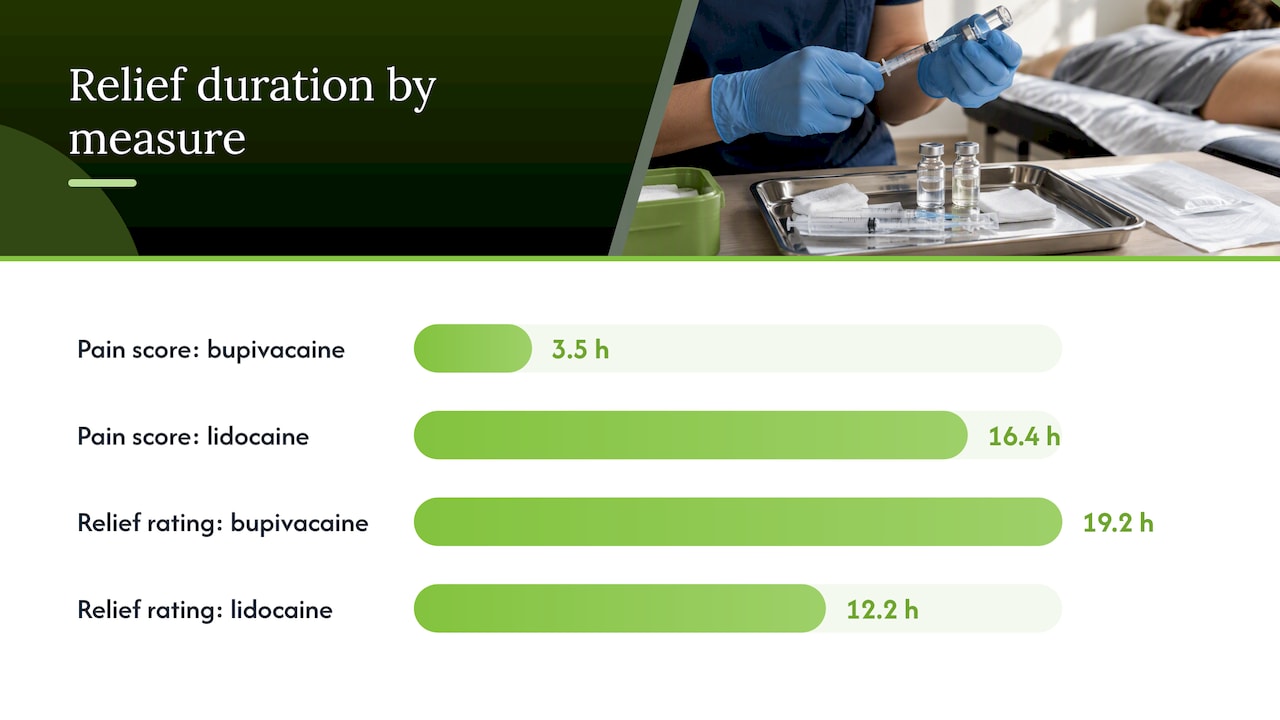
A 2022 retrospective study of 150 pain diaries from four academic medical centers looked at how long patients who got at least 80% relief actually stayed relieved. The results depended on how relief was measured. By pain score, the mean was 3.5 hours with bupivacaine versus 16.4 hours with lidocaine. By percentage-relief ratings, it was 19.2 hours versus 12.2 hours. The authors found no statistically significant difference between the two drugs.
Three practical lessons follow from that:
- Duration varies a great deal between people, even with the same medication.
- You cannot judge a block by the drug’s textbook duration. The study’s authors caution against judging a diagnostic block only by whether its length matches the expected duration of lidocaine or bupivacaine.
- What matters is the degree of relief, and whether it clearly occurred, not whether it lasted exactly as long as someone predicted.
If steroid was included as part of a therapeutic injection, the picture changes. The Toledo program explains that a steroid-containing facet injection may take 24 to 72 hours to work and last weeks to months. Ask your physician which type of injection you are having, because the expectations are different. If a steroid was part of your plan, our guide to steroid injection side effects covers what to watch for.
What to do after: driving, work, exercise, and your pain diary
This is the part patients ask about most, and where clear instructions help the most. Your physician’s discharge instructions come first. In general, the approach we take with patients is as follows.
Driving and work
If you had sedation, arrange a ride home and do not drive until the next day. Even without sedation, numbness or weakness in a leg or arm can make driving unsafe, so wait until normal strength and sensation have returned. Many people return to desk work the same day or the next morning. If your job involves lifting, climbing, or operating machinery, plan for at least the rest of the day off, and ask us about your specific duties.
Exercise and activity
Light walking is generally fine once you feel steady. Here is the subtle part: the block is a test, and test conditions matter. If you feel relief and immediately do the activities that usually provoke your pain, you get the best information about whether the block worked. If you feel relief and then overdo it, you may confuse the result with a flare from overexertion. So we ask patients to do the movements that normally hurt, at a gentle level, and record what happens. We do not ask them to push through a heavy workout or a long yard project that day.
Hold off on hot tubs and soaking baths until the needle site has closed. A shower is usually fine. A cold pack at the injection site for short periods can ease soreness; follow the instructions you were given.
Keeping a pain diary
This is the most valuable thing you can do. For the first 24 hours, or as long as your physician advises, record:
- Your pain level (0 to 10) before the injection, as a baseline
- Your pain level at regular intervals afterward, such as every hour while awake for the first several hours
- The specific activities you tested (bending, sitting, walking, turning your head) and how each felt
- The time your pain started to return, and how fast it came back
- Any numbness, weakness, or unusual symptoms
Be specific about percentage relief as well. “About 80% better when I bent forward, 50% better sitting” is far more useful than “it helped.” The 2022 study above used pain diaries precisely because patient-reported relief is the measurement that matters.
Side effects and when to call
Most reactions after a medial branch block are minor. The Toledo program lists temporary numbness or weakness, increased pain at the injection site, a short-term rise in blood sugar for people with diabetes when steroid is used, and fluid retention lasting one to two weeks in susceptible people. If you have diabetes, tell us before the procedure and monitor your glucose as your physician directs.
Contact the clinic promptly, or seek emergency care if you cannot reach us, if you notice:
- Fever or chills
- Redness, warmth, swelling, or drainage at the injection site
- Weakness that is getting worse rather than gradually improving
- New loss of bladder or bowel control
- Severe pain that escalates instead of easing
- Shortness of breath, chest pain, or a spreading rash
None of these is common, but each one deserves a same-day call rather than waiting to see what happens.
What your response means for the next step
The block is the first step in a decision, not the end of it. According to the Toledo program, if you get relief from a medial branch block, radiofrequency ablation will be discussed as a more permanent procedure. The response pattern generally falls into one of three categories.
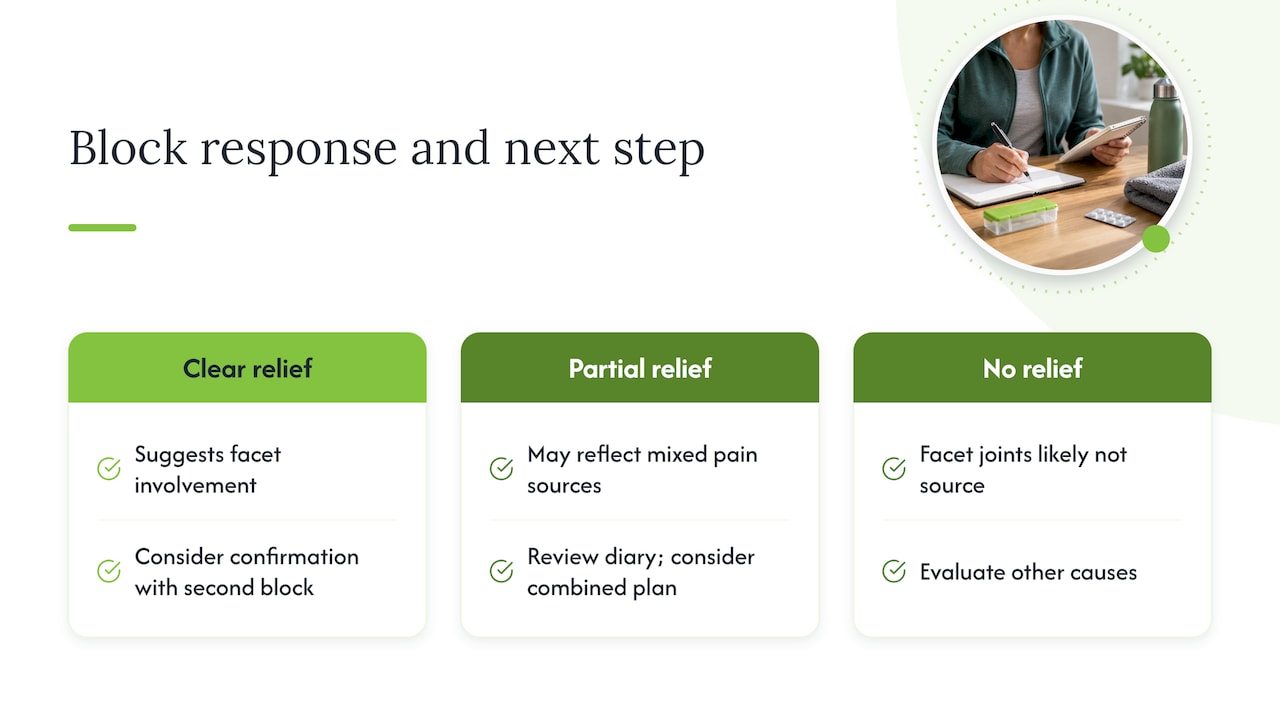
Clear relief. Your pain dropped substantially during the anesthetic window and returned afterward. This suggests the facet joints are involved. Many pain specialists confirm this with a second block before moving forward, to reduce the chance of a false positive. Our article on medial branch ablation after dual blocks reach 80% relief explains how that decision is made, and the six safety checks before radiofrequency ablation is worth reading before you agree to it.
Partial relief. Pain improved somewhat, but not enough to be convincing. This is where careful diary entries help. Partial relief can mean the facet joints contribute alongside another source, such as a disc, the sacroiliac joint, or a nerve root. A plan may combine approaches, such as physical therapy, a different injection, or further testing.
No relief. The facet joints are probably not the main source. That narrows the search. We may look next at epidural or transforaminal approaches, such as a transforaminal epidural steroid injection, or reconsider the imaging and exam findings.
For knee pain, the same logic applies to a related procedure, genicular nerve ablation, which is preceded by a diagnostic block of the nerves that supply the joint.
Why we do not judge a block by the clock
Patients sometimes call after a block to say, “It only lasted three hours, so it didn’t work.” We understand the reaction. But a short window does not mean a poor result. If your pain fell by most of its usual intensity while the anesthetic was active, the block did its job, regardless of whether the window was three hours or twenty. The research supports caution here: in the 2022 study, measured durations among patients with at least 80% relief varied substantially, and they did not line up neatly with what each drug is expected to do.
The reverse also happens. Someone feels relief that lasts longer than expected and assumes the problem is solved. Ongoing relief after a diagnostic block can come from other factors, including a placebo response, reduced irritation, or a therapeutic steroid effect. This is another reason we ask for diaries and consider a confirmatory block before recommending ablation.
Our perspective
Many patients arrive after months of medication, a round of physical therapy, and perhaps one or two injections that helped briefly and then faded. By the time they sit in our office, they want an answer more than another treatment. A medial branch block is one of the cleaner ways we have to get one.
We value the procedure because it asks a precise question: are these particular nerves carrying your pain? The recovery is easy, but the information it produces shapes the whole plan. That is why we spend as much time reviewing your diary at follow-up as we do performing the injection. We would rather take a careful week to be sure than move quickly to a procedure that might not fit.
Our physicians are Harvard fellowship-trained and board-certified, and our approach is to build a customized, non-surgical plan around what the block shows. For some patients that means radiofrequency ablation. For others, it means rehabilitation, a different targeted injection, or regenerative options. We would set expectations honestly each time: the block is a test, relief from ablation is not permanent, and nothing replaces an exam and a conversation about your goals.
If you are not sure whether your result was a yes, a maybe, or a no, bring the diary in. We will go through it with you.
Felix
Other options while you decide
Not every back or neck pain pattern resolves with one test. While you work through the diagnosis, some patients explore adjuncts, and a few ask about peptides for joint pain and what the evidence supports. Whatever you consider, share it with your treating physician so it does not cloud the interpretation of your block response, especially in the first days when your diary is still being used for decision-making.
Between visits, gentle movement guided by a therapist often helps more than rest. Stiff, guarded muscles can keep irritated facet joints sore, and a progressive program can improve how your spine tolerates daily load.
Talk with our team
If you live in North Dallas and have back or neck pain that has outlasted the usual treatments, we can evaluate whether a medial branch block is appropriate and walk you through the recovery in plain terms. You can review our treatment options or contact us through Nortex Spine and Joint to schedule a consultation.
FAQ
How long does a medial branch block last?
A diagnostic block typically relieves pain for a few hours, though studies show wide variation between patients. In a 2022 multicenter study, the mean duration of at least 80% relief ranged from about 3.5 to 19.2 hours depending on the drug and measurement method. If a steroid is included, benefit may build over a few days and last longer.
Can I go back to work the day after a medial branch block?
Most people with desk-based jobs return within a day, once any numbness or weakness has resolved. If your work involves heavy lifting, climbing, or driving long distances, ask your physician how much time to take. Follow the discharge instructions you were given.
What if my pain comes back the same day?
That is expected with a diagnostic block, because the anesthetic wears off. What matters is how much your pain dropped while it was active. Record your relief in a diary and bring it to your follow-up visit so we can interpret the result.
Is soreness after a medial branch block normal?
Yes. Localized soreness at the injection site can last several days and usually improves steadily. Call the clinic if soreness worsens, or if you develop fever, spreading redness, drainage, or progressive weakness.
What happens if the block works?
If you get meaningful relief, radiofrequency ablation may be discussed as a longer-lasting option. Some physicians repeat the block first to confirm the result. Your physician will explain which path fits your diary and exam findings.
Sources
- Patient-perceived duration of effect of lidocaine and bupivacaine in diagnostic medial branch blocks (PubMed Central, 2022)
- Facet and Medial Branch Blocks, University of Toledo Health Science Campus
- Peptides for Joint Pain: Evidence and Clinician Questions