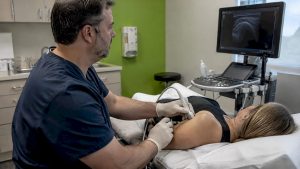

Most people with plantar fasciitis never need an operation. The large majority improve with a structured, stepwise plan: consistent stretching, load management, supportive footwear, and, when heel pain lingers past the first few months, clinician-directed options such as physical therapy, shockwave therapy, and PRP (platelet-rich plasma, a concentrate made from your own blood). At Nortex Spine and Joint in North Dallas, our plantar fasciitis care follows that same progression: start conservatively, match the next step to how long you have had symptoms, and keep surgery as a distant last resort.
This guide walks through that progression in the order we would walk through it with you in an exam room, including the home steps, the realistic timeline, and the point at which it makes sense to stop doing the same thing and have the heel evaluated.
TL;DR
- More than 90% of people with plantar fasciitis improve within 10 months of simple, nonsurgical treatment, according to the American Academy of Orthopaedic Surgeons.
- Stretching the calf and the plantar fascia is the foundation. Add supportive shoes, a night splint if mornings are the worst part, and a plan to reduce repeated strain.
- If pain persists beyond about 3 months, that is a signal to change the plan, not to wait longer. Physical therapy, shockwave therapy, and PRP are the usual next conversations.
- Surgery is generally considered only after about 12 months of thorough nonsurgical care.
Table of Contents
- What is happening in your heel
- A realistic timeline
- The first six weeks: what to do at home
- When home care is not enough: physical therapy
- Persistent heel pain: clinician-directed options
- A sensible order of treatment
- When to have your heel looked at sooner
- How we approach it at Nortex
- Our perspective
- FAQ
- Sources
What is happening in your heel
The plantar fascia is a thick band of tissue that runs from the heel bone to the base of the toes and supports the arch. Every step stretches it. The cause of plantar fasciitis is not completely understood, but JAMA’s patient information notes it may be partly due to small tears from repeated stress and strain. The American College of Foot and Ankle Surgeons describes it as primarily a problem of mechanical overload, meaning the tissue is asked to handle more load than it can recover from.
That is why the classic pattern looks the way it does: sharp pain with the first steps in the morning or after sitting, easing as the tissue warms up, then returning after a long day on your feet.
Plantar fasciitis accounts for more than 1 million clinic visits a year in the United States and is most common between ages 45 and 64. JAMA lists a body mass index above 25, work that requires prolonged standing, and reduced ankle flexibility (specifically, limited ability to pull the foot upward) as higher-risk factors. If you are a professional in the 35 to 65 range who stands through meetings, coaches on turf, or has recently ramped up running, this is a familiar profile.
A realistic timeline
Setting expectations is the most useful thing we can do early, because frustration with slow progress is one of the main reasons people abandon a plan that would have worked.
The American College of Foot and Ankle Surgeons describes phases by how long symptoms have lasted:
| Phase | Time since onset |
|---|---|
| Acute | First 4 to 6 weeks |
| Subacute | About 6 to 12 weeks |
| Chronic | More than 3 months |
| Refractory | No improvement for more than 6 months despite appropriate treatment |
The AAOS figure of more than 90% improving within 10 months is encouraging, but it also tells you the honest answer to “how long?”: often months, not days. JAMA adds that heel pain frequently resolves on its own, yet it can last months to years, and some people have lingering, usually milder, discomfort long after. That range is exactly why the quality of the plan matters. A consistent routine and a timely step up in care shorten the stretch more than waiting does.
Many patients come to us after trying one thing at a time for a few weeks each: a new pair of shoes, then an insole, then an over-the-counter anti-inflammatory, then nothing. The tissue needs several measures working together for long enough to respond.
The first six weeks: what to do at home
Standard first-line care is a combination, not a single fix. StatPearls summarizes a first-line period of about 6 weeks built around stretching, soft-tissue work, supportive footwear or orthotics, ice, and activity modification.
Stretch the calf and the fascia
Stretching is the single most useful measure. The AAOS calls stretching the calves and plantar fascia the most effective way to relieve the pain, and a summary of physical therapy guidelines published in American Family Physician found low- to moderate-quality evidence that stretching improves pain and disability, with plantar fascia stretching more beneficial than calf stretching alone. So do both.
- Calf stretch. Stand facing a wall, one foot back with the knee straight and the heel down. Lean forward until you feel a pull in the calf. The AAOS suggests holding 10 seconds and repeating 20 times per foot.
- Plantar fascia stretch. Sit, cross the affected foot over the opposite knee, and pull the toes back toward the shin until you feel tension along the arch. Repeat about 20 times. The AAOS recommends doing this in the morning before you stand up.
- Frequency. The VA’s patient guidance suggests stretching 2 to 3 times a day.
A common mistake is stretching hard for three days, feeling sore, and stopping. Gentle and daily beats aggressive and occasional. For a broader look at building a movement habit you can keep, this overview of daily stretching and movement routines is a helpful companion.
Ice, heat, and the water bottle
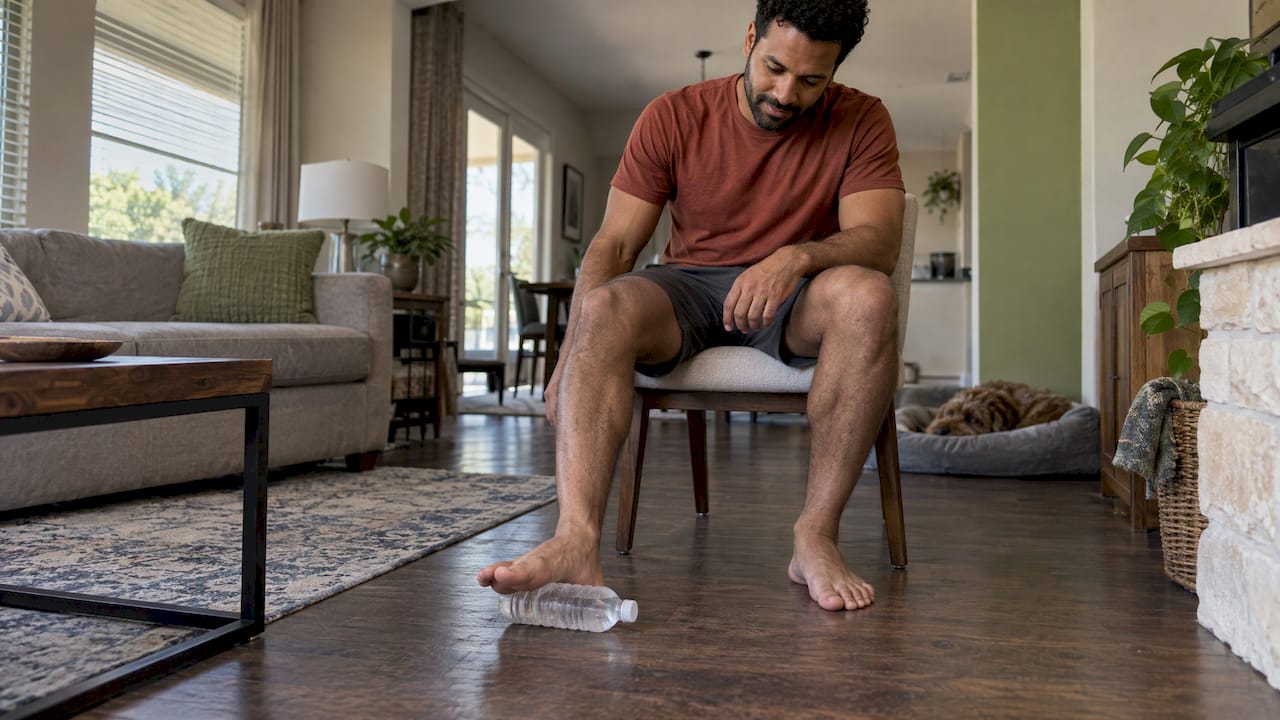
People often ask whether heat or ice is better. The American Family Physician summary reports that combined stretching may be more beneficial than heat treatment and anti-inflammatory medication, so neither should replace stretching. Ice is practical for soreness after activity. The AAOS describes rolling the foot over a cold water bottle or ice for 20 minutes, 3 to 4 times a day, and the VA likewise lists freezing a water bottle and gently massaging the area. Roll with light to moderate pressure. If the heel feels numb or the skin turns very red, stop.
Footwear, heel cups, and orthotics
The VA lists supportive footwear, gel heel cups, and orthoses as ways to reduce strain, and the foot and ankle surgeons’ panel found that biomechanical support is safe and effective. You do not necessarily need the most expensive option: JAMA reports that over-the-counter orthotics provide pain relief similar to custom-made ones at lower cost. Cushioned shoes with a firm arch and heel, worn consistently, including around the house, matter more than any single product. Walking barefoot on hard floors undoes a lot of good work.
Night splints for morning pain
The AAOS explains the mechanism: most people sleep with their feet pointed down, which lets the plantar fascia relax and shorten overnight, so the first step of the day stretches it abruptly. A night splint holds the foot in a stretched position while you sleep, and the AAOS describes it as very effective at reducing that first-step pain. StatPearls suggests using one every night for 1 to 3 months when first-morning pain persists.
Anti-inflammatories and weight
Over-the-counter anti-inflammatories such as ibuprofen or naproxen can take the edge off, but the AAOS advises not using them for more than a month without talking to a doctor. This matters especially if you have kidney disease, stomach ulcers, are on blood thinners, or have heart disease. Check with your physician first in those situations.
Losing extra weight reduces strain on the fascia, which is stretched each time the foot strikes the ground, as the VA notes. It is a gradual lever, not a quick fix, but it counts for people whose BMI is in the higher-risk range.
Reduce the repeated load
The VA also advises avoiding running on hard or uneven ground. You rarely need to stop moving entirely. Swapping some running for cycling or swimming, shortening long stretches on concrete, and building mileage gradually keeps conditioning while the tissue calms down.
When home care is not enough: physical therapy
If you have done the basics for 4 to 6 weeks and are not clearly better, the most productive next step is usually a skilled physical therapy program rather than more of the same at home. The therapy guidelines summarized in American Family Physician found that manual techniques help in measurable, if time-limited, ways: trigger point release improves mobility and pain for up to 2 weeks, subtalar joint mobilization for up to 3 weeks, deep massage and neural mobilization for up to 6 weeks, and instrument-assisted soft-tissue mobilization for up to 90 days.
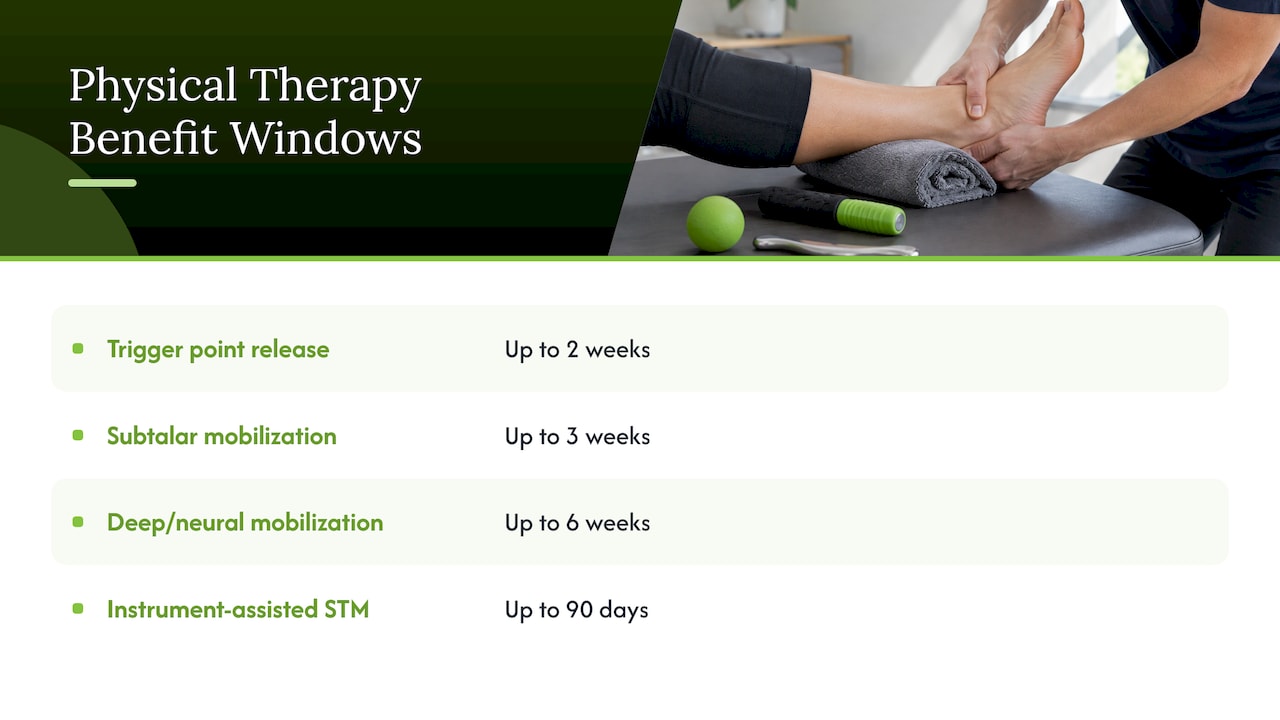
Those windows explain why manual therapy works best as a bridge. It makes the tissue more tolerant so the stretching and strengthening can do the lasting work. Our physical therapy program is where that supervised, progressive work happens, and it can sit alongside any of the treatments below.
Persistent heel pain: clinician-directed options
The foot and ankle surgeons classify heel pain that has lasted more than 3 months as chronic. At that point we generally stop asking whether to repeat the home routine and start asking what is keeping the tissue from healing. This is also when people dissatisfied with a cycle of temporary fixes tend to arrive.
Shockwave therapy
Extracorporeal shockwave therapy (ESWT) delivers focused acoustic pulses through the skin to the painful area. The foot and ankle surgeons’ panel found ESWT safe and effective. The physical medicine and rehabilitation specialists’ reference, PM&R KnowledgeNow, reports significant improvement in pain and walking ability at 3 and 6 months compared with a sham treatment, with 50 to 65% of patients noting significant pain relief within a week.
We offer shockwave therapy at Nortex. Plans typically involve a series of sessions rather than a single visit, and the number of sessions can range from 3 to 10 depending on the condition and how the tissue responds.
Platelet-rich plasma (PRP)
PRP is made by drawing a small amount of your own blood, concentrating the platelets, and injecting them at the site of the injury. Platelets carry growth factors involved in tissue repair, which is the rationale for using PRP in tendons and ligaments that heal slowly.
The evidence compared with corticosteroid injections is encouraging. A clinical policy review from Molina Healthcare summarizing a 2025 technology assessment found that in six of seven randomized trials comparing the two, pain reduction favored PRP, and it concluded that a single PRP injection is safe and may provide greater benefit than corticosteroids. JAMA’s patient information likewise notes PRP heel injections may provide longer-term relief than corticosteroid injections. PM&R KnowledgeNow adds that PRP shows effectiveness regardless of how thick the fascia is, while a thickness above 7 mm predicts good response to a corticosteroid injection.
Our PRP therapy uses your own blood, so the preparation is autologous. For background on how we weigh the benefits and the practical considerations, see our overview of the pros and cons of PRP injections. Because PRP is a biologic procedure, results and recovery vary from person to person, and we plan the timing around your activity and your other treatments.
Corticosteroid injections
The foot and ankle surgeons found corticosteroid injections safe and effective for short-term pain reduction, with relief lasting up to about a month. For that reason they are best used as part of a broader plan that includes stretching and support, not as the only treatment.
Other non-invasive modalities
If you have already tried the standard measures, other options can be discussed. Our clinic also offers Class IV laser, EMTT (electromagnetic transduction therapy, sometimes called magnet therapy), and red light therapy as part of non-surgical pain care. If you are exploring PEMF-type approaches in general, PEMF for pain research summarizes what has been studied and who it suits.
Stem cell therapy is a different category from PRP, and in the foot it should be discussed with a physician rather than assumed. The FDA has raised safety concerns about unproven stem cell products, so that conversation belongs in an exam room, with your history in front of the physician.
A sensible order of treatment
| Stage | What it usually involves |
|---|---|
| Weeks 0 to 6 | Daily calf and fascia stretching, supportive shoes, heel cups or orthotics, ice, activity changes |
| Weeks 6 to 12 | Add a night splint if mornings are worst; start supervised physical therapy |
| Beyond 3 months | Clinician evaluation; discuss shockwave therapy, PRP, or an injection |
| Beyond 6 months | Reassess the diagnosis and the plan; confirm nothing else is contributing |
| About 12 months | Surgery considered only after aggressive nonsurgical care |
The 12-month mark comes from PM&R KnowledgeNow, which says surgery should be considered only after 12 months of aggressive nonsurgical treatment. Even then, it is a conversation, not a default.
When to have your heel looked at sooner
Heel pain is not always plantar fasciitis. See a physician promptly if you have significant swelling, redness, or warmth in the heel, numbness or tingling, pain at night even when resting, pain after a fall or injury, or a fever. If you have diabetes or poor circulation, do not wait through weeks of home care; foot problems carry higher stakes for you. Pain that has run past 6 months with the right measures deserves a fresh look at the diagnosis, which is one reason a hands-on exam matters.
How we approach it at Nortex
Nortex Spine and Joint is a regenerative medicine and pain management clinic serving North Dallas, with board-certified, Harvard fellowship-trained physicians. Our care for heel pain is built around customized, non-surgical treatment plans aimed at the underlying cause of pain, not just the symptoms. Depending on your stage, that can include physical therapy, shockwave therapy, and regenerative medicine options such as PRP. We do not publish prices for these services, so the first step is a consultation, where we examine the foot and talk through what fits your timeline and your goals.
If you also deal with tendon pain elsewhere in the lower leg, our guide to Achilles tendonitis without surgery covers a closely related path.
Our perspective
The pattern we see most often is not a lack of effort. It is a plan with one or two ingredients missing, or a plan that continues unchanged long after it has stopped moving the needle. Stretching, supportive shoes, and load management are the base of treatment, and we want patients to do them well. But a heel that is still painful at three months is giving us information.
That is when we think a more targeted approach is worth discussing. Shockwave therapy and PRP are designed to act on the tissue itself, and they pair well with a therapy program that corrects the mechanics behind the overload. We prefer to build a customized plan around the stage of the problem, your work, your sport, and your goals, rather than apply one protocol to everyone.
We also set expectations plainly. Recovery is measured in weeks to months, results differ from person to person, and no treatment replaces the daily habits that keep the fascia from being overloaded again. Our aim is to help you get back on your feet, and to do it without surgery whenever that is a reasonable path.
Felix
FAQ
Can losing weight help plantar fasciitis?
Yes. The VA lists losing extra weight as a way to reduce strain on the plantar fascia, which is stretched with every step. A 2018 study of patients who had weight-loss surgery found that 90% of those with plantar fasciitis had resolution of their heel symptoms afterward, though that is a different situation from gradual weight change. Even modest reductions lower the load per step.
Is heat good for plantar fasciitis?
Gentle heat can make the foot feel looser before stretching, and many people find it comfortable. The evidence, however, favors stretching itself: the physical therapy guideline summary found combined stretching may be more beneficial than heat. Use heat as a warm-up, then stretch.
How long should I roll a frozen water bottle under my foot?
The AAOS describes rolling the foot over a cold water bottle or ice for about 20 minutes, 3 to 4 times a day. Use light to moderate pressure, keep a thin sock between the bottle and your skin if it feels too cold, and stop if the area goes numb.
Do I need surgery if nothing has worked for six months?
Not necessarily. PM&R KnowledgeNow says surgery should be considered only after about 12 months of aggressive nonsurgical treatment. A pain that has lasted over 6 months is a reason to have the diagnosis and the plan re-evaluated by a physician, and options such as shockwave therapy or PRP can be part of that discussion.
Sources
- What Is Plantar Fasciitis? JAMA Patient Information
- Plantar Fasciitis and Bone Spurs, AAOS OrthoInfo
- Treating Plantar Fasciitis, Veterans Affairs
- Plantar Fasciitis: Guidelines From the American Physical Therapy Association, American Family Physician
- Plantar Heel Pain, StatPearls
- ACFAS Heel Pain Clinical Consensus Statement
- Plantar Fasciitis, PM&R KnowledgeNow
- Plantar Fasciitis Treatments Clinical Policy, Molina Healthcare
- Effect of Surgical Weight Loss on Plantar Fasciitis, PubMed
- Daily Stretching and Movement for Better Circulation
- PEMF for Pain: What the Research Shows