
Platelet-rich plasma (PRP) is a reasonable question to ask when ankle arthritis keeps you from walking, hiking, or playing the way you used to. The honest answer is that the best current evidence does not support PRP as a routine treatment for ankle osteoarthritis. A well-designed placebo-controlled trial found no meaningful benefit, and the 2026 national orthopedic guideline does not suggest it routinely. Some smaller studies show short-term improvement, and a few patients may still be reasonable candidates after a careful conversation. This article explains what PRP is, what the research does and does not show, and what we would look at first if you came to us with ankle pain.
TL;DR
- In a randomized trial, PRP did not improve ankle symptoms or function more than saline (a placebo) in people with ankle osteoarthritis.
- The American Academy of Orthopaedic Surgeons (AAOS) guideline adopted in June 2026 says PRP injected into the ankle joint is not routinely suggested for symptomatic ankle osteoarthritis.
- Some lower-quality studies report short-term pain relief, and one meta-analysis suggested more benefit for talar cartilage injuries, but that needs confirmation.
- Physical therapy, home exercise, weight management, bracing, and over-the-counter medication have better support and should usually come first.
Table of Contents
- What PRP is and how it is meant to work
- Why the ankle is different from the knee
- What the research actually shows
- Who might still be considered for PRP
- What a PRP injection involves
- Side effects and risks
- Non-surgical options with better support
- Our perspective
- Talking with us about ankle pain
- FAQ
- Sources
What PRP is and how it is meant to work
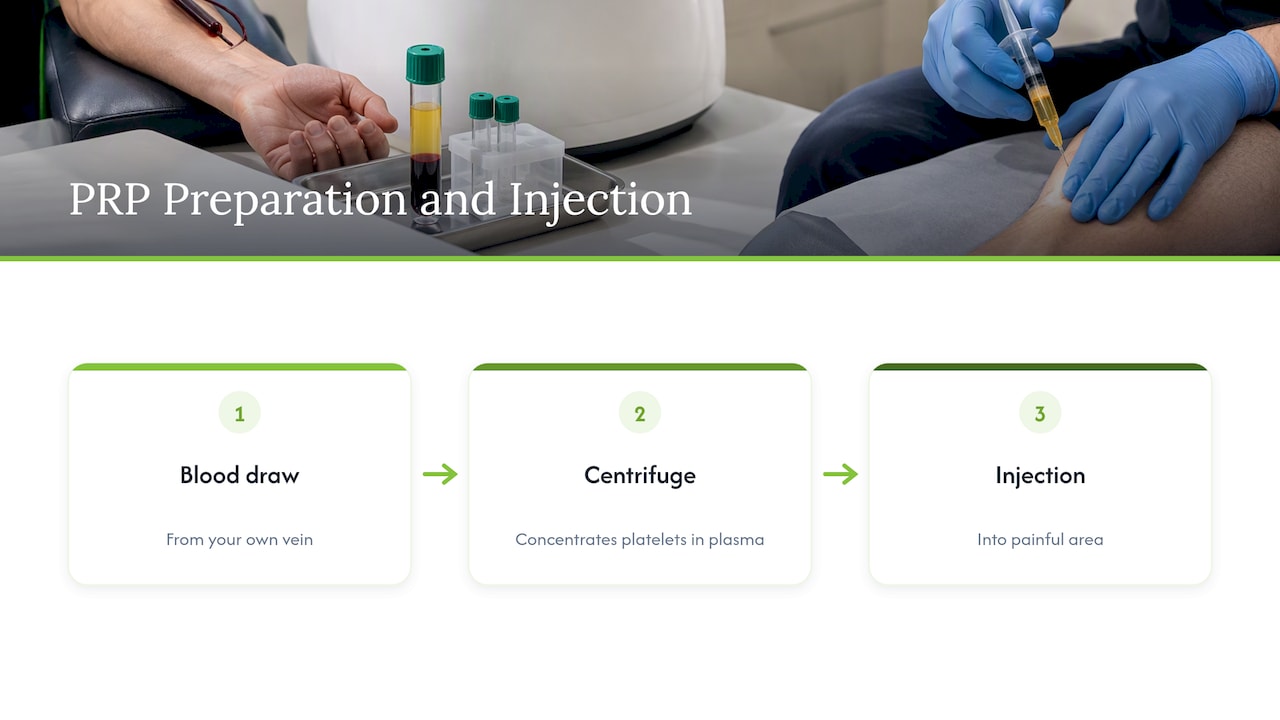
Platelet-rich plasma is an autologous product, meaning it is made from your own blood. Blood is drawn from a vein, spun in a centrifuge to concentrate the platelets, and the resulting plasma, which contains growth factors, is injected back into the painful area. A review of clinical applications describes this process and notes that how well PRP works in foot and ankle conditions is still unclear.
The theory is reasonable. Growth factors released by platelets are involved in tissue repair and in modulating inflammation, so concentrating them near an injured tendon or joint might support healing. That is why PRP has a track record of interest for tendon problems. Arthritis is a different situation. In osteoarthritis the problem is gradual wear of cartilage, along with changes in the bone and the joint lining. Asking a concentrated blood product to reverse that is a much larger task than helping a tendon recover.
Why the ankle is different from the knee
Most people who research PRP find far more information about knees. Knee osteoarthritis is common and heavily studied. Ankle osteoarthritis is less common, and it tends to arise differently. A review of ankle arthritis points out that post-traumatic causes are more prevalent in the ankle than in the knee or hip, so patients are often younger and more active, and treatment strategies have to be adapted to that.
In our experience, a typical ankle arthritis patient has a story: an old sprain or fracture, sometimes decades ago, followed by years of stiffness and swelling that gradually became pain with ordinary walking. That history matters, because it shapes which treatments are sensible and which are likely to disappoint. If you are curious how this compares with joints where we use PRP more often, our pages on PRP for knee pain and PRP for hip arthritis cover those conditions.
What the research actually shows
The evidence is mixed in a specific way: the more rigorous the study, the less impressive the result.
The strongest trial: no benefit over placebo
The most informative study is a randomized clinical trial published in JAMA, conducted in the Netherlands. Participants with ankle osteoarthritis received either PRP or a saline placebo. Over 26 weeks, PRP did not significantly improve ankle symptoms or function compared with saline. Because the comparison group also received an injection, the study accounts for the fact that any injection, and the attention around it, can make people feel better for a while.
The national guideline
The AAOS adopted its Management of Ankle Osteoarthritis guideline on June 4, 2026. It states that intra-articular PRP is not routinely suggested for symptomatic ankle osteoarthritis. The same document says there is no scientific evidence that PRP can regenerate ankle cartilage, and no evidence that it delays the need for surgery in people with ankle osteoarthritis. If you have seen claims online that PRP rebuilds cartilage or lets you avoid an ankle fusion or replacement, this is the most current professional statement on the subject, and it does not support them.
Smaller studies and reviews that look more positive
There is another side. A 2023 systematic review indicated that PRP may give short-term improvements in pain and function compared with where patients started. The caveat is that many of the included studies lacked the rigor of high-quality placebo-controlled trials. Before-and-after comparisons cannot separate a true treatment effect from the placebo response, natural fluctuation in symptoms, and the fact that people often seek care when pain is at its worst.
A 2024 meta-analysis of PRP in ankle disease found no significant overall difference in the AOFAS score (a common foot and ankle function rating) between PRP and control groups. It did find greater benefit for talar cartilage injuries, and the authors concluded more studies are needed. That is a useful signal about a different problem, a focal cartilage defect in the talus, rather than diffuse arthritis across the joint.
Why studies are hard to compare
PRP is not one standardized product. The same ankle arthritis review notes that formulations vary in platelet and leukocyte concentration, growth-factor content, and in how they are prepared and activated. One study’s PRP may be quite different from another’s, which makes pooling results difficult and means a negative trial of one preparation does not rule out a benefit from another. It also means a positive claim from a single clinic or a single small study deserves caution.
Who might still be considered for PRP
Given this, PRP for ankle osteoarthritis is not a first-line treatment. That does not mean the conversation ends. Some people reasonably ask about it after other options have been tried and surgery is the next step they want to avoid or delay, understanding that the guideline does not support PRP for that purpose.
The AAOS has long urged that clinicians be aware of the risks, benefits, regulatory status, and labeled indications of biologic products. In practice, that means a candid discussion before any injection. Questions we would want answered include:
- Is the ankle really the source of your pain? Foot, subtalar joint, tendon, and nerve problems can mimic ankle arthritis, and imaging has to match your symptoms.
- How advanced is the arthritis? Severe joint space loss and deformity are unlikely to respond to any injection.
- Is there a focal cartilage injury, such as a talar lesion, rather than widespread arthritis? The meta-analysis above hints that this may behave differently.
- Have you given a structured rehabilitation program a real chance?
- Are your expectations realistic? Even in the studies with positive findings, the benefit described is short-term pain improvement, not repair of worn cartilage.
If, after that discussion, you decide you want to explore PRP, we would describe it as a trial of a therapy with limited and conflicting evidence, not as a treatment likely to change the course of the disease.
What a PRP injection involves
The procedure itself is simple, and it helps to know what to expect.
In the JAMA trial, 15 mL of blood was drawn from a vein at the elbow and centrifuged for 5 minutes, and 2 mL of the result was injected into the ankle under ultrasound guidance, with injections given 6 weeks apart. The AAOS guideline likewise describes PRP injections as involving a blood draw, centrifugation, and injection into the joint, often requiring multiple sessions.
The general sequence looks like this:
- Evaluation. Examination, review of imaging, and a discussion of what you have already tried.
- Blood draw. A small amount of your blood is taken, much like a routine lab draw.
- Processing. The sample is spun to concentrate platelets.
- Image-guided injection. The ankle joint is small and tightly packed with structures, so ultrasound or similar guidance helps place the injection accurately.
- Afterward. You typically go home the same day, with guidance on activity and what soreness is normal.
Because the research protocols often used more than one injection, it is worth asking how many sessions would be expected and what you would be measuring to decide whether the treatment is working.
Side effects and risks
Because PRP comes from your own blood, allergic reactions to the product itself are not the main concern. The 2023 systematic review reported adverse events that included injection-site pain or swelling and muscle soreness, and no serious adverse events were documented. Expect some soreness or swelling for a few days after any joint injection.
The larger risk is not physical. It is cost and time spent on a treatment that may not help, particularly when it delays proven approaches such as rehabilitation. PRP is also commonly not covered by insurance for this use, so ask about the full cost before you start. Call your physician promptly if you develop increasing redness, warmth, fever, or severe pain after any injection, since joint infection, although uncommon, needs urgent attention.
Non-surgical options with better support
The AAOS guideline lists several non-surgical options for ankle osteoarthritis: skilled physical therapy, home exercise, weight reduction, durable medical equipment such as bracing, and NSAIDs or acetaminophen. For mild to moderate symptomatic ankle osteoarthritis, the guideline says skilled physical therapy may improve patient-reported outcomes, and that home exercise may improve satisfaction, pain, and global rating of change.
That matches what many of our patients experience. People often arrive after trying several things in a scattered way: a few weeks of rest, an anti-inflammatory, a brace from a pharmacy, and then an injection. A structured program works differently. It addresses ankle mobility, calf and foot strength, balance, gait mechanics, and the load you place on the joint each day. Our physical therapy program is built around that kind of plan.
A practical order of steps for most people looks like this:
- Confirm the diagnosis with an exam and weight-bearing imaging.
- Start supervised rehabilitation and a home exercise routine you can keep up.
- Use a brace or supportive footwear if the ankle feels unstable or painful when walking.
- Address body weight if it applies, since the ankle carries many times your body weight with each step.
- Reassess after a defined period, and only then discuss injections or surgical consultation if function is still limited.
Our perspective
We see many patients who have already been through a long list of treatments and want to know whether a regenerative option can finally change things. PRP is a legitimate tool in our practice, and we use it for conditions such as knee, hip, and shoulder problems, where we can discuss the evidence for those joints. For the ankle, we think the honest position is more cautious. The best trial did not show a benefit over placebo, and the most recent national guideline does not support routine use.
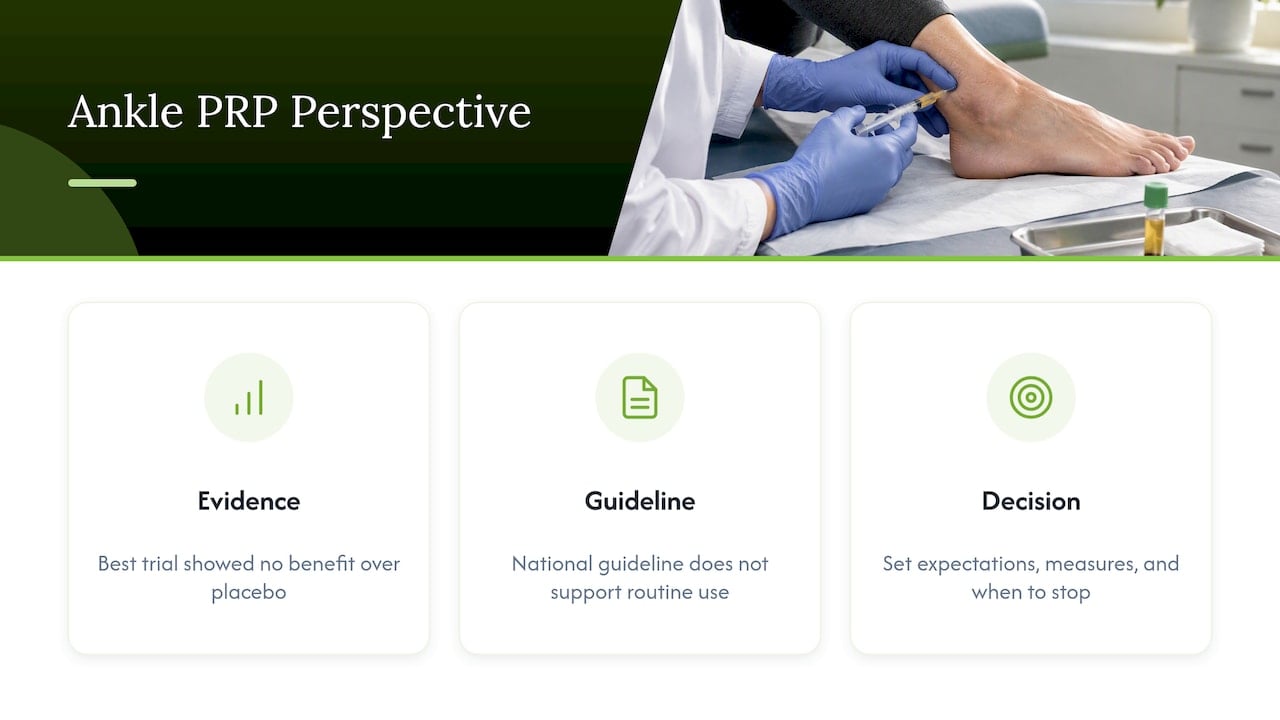
What we try to do is separate three questions that often get blurred together: what is causing your pain, what has the strongest evidence for that cause, and what would you want to try if the evidence is limited. Sometimes the answer to the first question changes everything. A patient who believes they have ankle arthritis may have a tendon problem or a focal cartilage injury, and those can be different conversations.
We would rather tell you that a treatment has limited support than sell you hope. If you choose to try PRP after hearing that, we will say plainly what we expect, how we will judge whether it helped, and when to stop.
— Felix
Talking with us about ankle pain
If ankle pain is limiting your work, exercise, or daily walking, we can evaluate it and go through the options with you, including rehabilitation, injections, and when a surgical opinion makes sense. You can learn more about our regenerative medicine services and how PRP therapy is used in our practice, or contact us through our website to schedule a consultation in North Dallas.
FAQ
Does PRP work for ankle arthritis?
The strongest evidence says no. A randomized trial found PRP no better than saline for ankle symptoms and function over 26 weeks, and the 2026 AAOS guideline does not suggest it routinely. Some smaller, less rigorous studies report short-term pain relief, so individual responses vary, but you should not expect it to change the underlying arthritis.
Can PRP regenerate ankle cartilage or help me avoid surgery?
The AAOS guideline states there is no scientific evidence that PRP regenerates ankle cartilage or delays the need for surgery in ankle osteoarthritis. If a provider promises either, ask to see the studies behind the claim. Rehabilitation and activity changes are better supported ways to stay functional for as long as possible.
Is PRP helpful for ankle pain that is not arthritis?
It depends on the cause. Tendon problems have drawn more research interest than arthritis, and a meta-analysis suggested possible benefit for talar cartilage injuries, though the authors said more studies are needed. An exam and imaging to identify the actual source of pain should come before any injection.
What are the side effects of PRP injections?
Reported effects are generally mild: pain or swelling at the injection site and temporary muscle soreness, with no serious adverse events documented in a 2023 systematic review. Contact your physician promptly for fever, spreading redness, or worsening pain after an injection.
Is walking good for ankle arthritis?
For many people, regular low-impact activity and a guided exercise program help, and the AAOS guideline notes that home exercise may improve pain and satisfaction in mild to moderate disease. How much walking suits you depends on your pain, alignment, and footwear, so a physical therapist or physician can tailor it.
Sources
- Advances in the clinical application of platelet-rich plasma (PMC)
- Effect of platelet-rich plasma injections vs placebo on ankle symptoms and function (JAMA)
- Management of Ankle Osteoarthritis clinical practice guideline (AAOS)
- Platelet-rich plasma injection for the treatment of ankle osteoarthritis (PMC)
- The efficacy of platelet-rich plasma in ankle disease: a meta-analysis (Journal of Orthopaedic Surgery and Research)
- AAOS position statement on biologic treatments for osteoarthritis
- Ankle Arthritis review (PMC)