
Red and near-infrared photobiomodulation can reduce pain for some people with chronic nonspecific low back pain when delivered at clinical dosages and paired with rehabilitation. A 2026 randomized trial found a substantially higher effective rate for combined red and infrared LED therapy compared to sham treatment after 28 days. Results vary by device, dose, and whether you combine light therapy with supervised exercise, so think of it as one tool in a larger plan rather than a stand-alone fix.
TL;DR:
- The 2026 trial shows that combining red and infrared light therapy with rehabilitation can produce meaningful pain reduction in chronic nonspecific low back pain within 4 weeks.
- The effectiveness depends heavily on device type, wavelength, dose, and patient adherence, with clinic-grade devices providing more reliable results than home units.
- The biological mechanisms involve increasing cellular energy, improving blood flow, and reducing inflammation, which may help alleviate pain but do not correct structural issues.
- Light therapy is most beneficial as part of a comprehensive rehab plan and is unlikely to shrink herniated discs or fix structural problems.
- Safety is generally good with supervised use, but proper screening for red flags and contraindications is essential before starting treatment.
Table of Contents
- What Red Light Therapy Actually Is
- What the Clinical Evidence Shows for Back Pain
- How Red Light Therapy May Relieve Pain
- Which Kinds of Back Pain Respond Best
- Using Red Light Therapy Safely and Effectively
- Safety, Side Effects, and Contraindications
- Where Red Light Therapy Fits in a Treatment Plan
- Our Clinical Perspective
- Our Take: Don’t Let the Device Distract From the Dose
- How We Can Help With Chronic Back Pain
- FAQ
- Sources
What Red Light Therapy Actually Is
When patients ask us about red light therapy, they are usually describing photobiomodulation, sometimes still called low-level laser therapy, or LLLT. The term covers any device that delivers red or near-infrared light to tissue at doses too low to generate heat damage but high enough to trigger a biological response. It is not the same as a heating pad or infrared sauna, and it is not a laser that cuts or ablates tissue the way surgical lasers do.
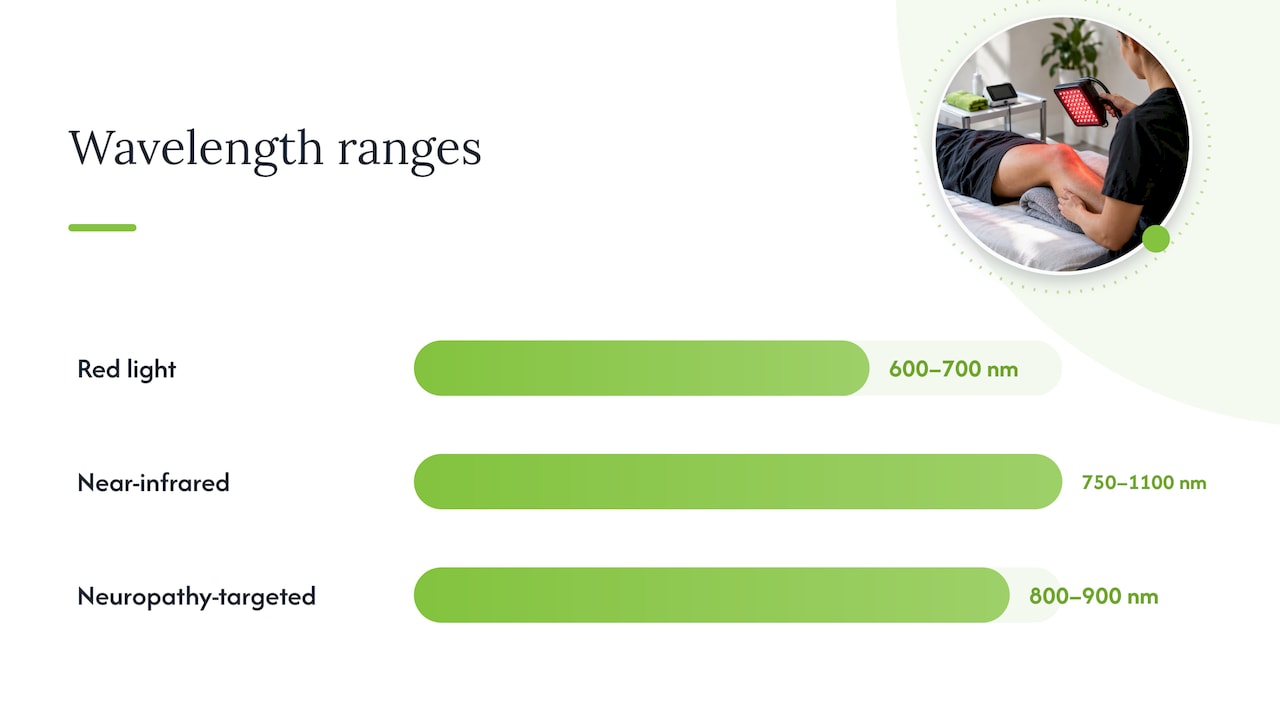
Two wavelength ranges matter here. Red light, roughly 600 to 700 nanometers, tends to act more superficially, which makes it useful for skin and shallow soft tissue. Near-infrared light, in the range of about 750 to 1,100 nanometers, penetrates deeper, which is why most back pain protocols pair it with red light or use it alone to reach muscle and nerve tissue closer to the spine. A recent wavelength review confirms this depth relationship, noting that near-infrared wavelengths around 800 to 900 nanometers are commonly chosen for neuropathic or nerve-targeting protocols specifically because they reach further than red light alone.
Devices vary widely in what they can actually deliver:
- Clinical Class IV lasers produce higher power output and allow a clinician to control dose precisely over a short session.
- Floor-standing or panel LED units used in clinics cover larger areas and are common for spine and back protocols.
- Consumer handheld or wearable LEDs are convenient for home use but typically output far less irradiance, meaning a longer exposure time is needed to approach clinical doses, if it is reachable at all.
Regulation matters more than most people expect. The FDA has cleared specific devices, such as the Erchonia FX-635, as an adjunctive treatment for minor chronic low back pain under its 510(k) pathway. That clearance applies to that model and that indication. It does not mean every red light product on the market carries the same evidence or the same safety data behind it.
What the Clinical Evidence Shows for Back Pain
The strongest recent data point comes from a 2026 randomized controlled trial examining LED red and infrared light combined with rehabilitation for chronic nonspecific low back pain. The trial used combined 630 and 850 nanometer wavelengths and measured outcomes against a sham device over 28 days.
The treatment group showed a markedly higher effective rate than the sham group, with a between-group difference in pain scores that exceeded the minimal clinically important difference by about 2 points on a standard 0 to 10 scale, according to the trial results. That is a meaningful gap, not a marginal one, and it reflects what we would call a clinically relevant improvement rather than a statistical curiosity. No serious adverse events were reported, though the trial’s authors noted limitations including a relatively short follow-up window and retrospective registration, both of which temper how far the findings can be generalized.
Earlier evidence is more mixed. A 2015 systematic review and meta-analysis found that low-level laser therapy reduced pain scores in nonspecific chronic low back pain compared with placebo, but it found no clear benefit for disability or range-of-motion outcomes. That pattern repeats across the literature: pain scores often move, function does not always follow at the same pace.
A systematic review covering low-level laser therapy for nonspecific low back pain adds an important caution. The review found substantial heterogeneity in dosing protocols, device types, and study quality across trials, which makes it difficult to draw firm conclusions about durable functional benefit. Notably, when PBM was added to an existing exercise program in some trials, it produced little or no additional benefit over exercise alone. That does not mean light therapy is useless alongside rehab. It means the added value is inconsistent across studies, and a lot depends on dose, device, and how closely the protocol matches what worked in the trial that is being cited.
What should you take from this if you are the one dealing with the pain?
- Expect a plausible but not universal pain reduction, most reliably over a 4 to 8 week supervised trial.
- Expect less consistent evidence for improved function or disability scores compared with pain scores alone.
- Expect that the device, dose, and your own adherence to the protocol matter as much as the general concept of “red light therapy.”
The honest clinical summary is that PBM is a real, mechanistically plausible, moderately supported option for a specific type of back pain, not a universal cure, and not something you should expect to work the same way every time regardless of how it is delivered.
How Red Light Therapy May Relieve Pain
The mechanism behind photobiomodulation sits at the cellular level, which is part of why it took years of research to pin down. A mechanistic review of photobiomodulation describes light in the red and near-infrared range being absorbed by cytochrome c oxidase, an enzyme inside mitochondria, the structures that generate cellular energy. That absorption appears to increase ATP production, essentially giving cells more energy to carry out repair processes.
The same review describes a second effect: modulation of nitric oxide, a molecule involved in blood vessel dilation and circulation. Improved microcirculation in treated tissue may help deliver oxygen and nutrients more efficiently to areas under chronic stress, which matters in a region like the lower back where muscle guarding and reduced blood flow often accompany persistent pain.
A third pathway involves inflammation. The review notes that PBM appears to alter cytokine profiles, the signaling proteins that drive or resolve inflammatory responses, and may reduce oxidative stress in treated tissue. Chronic low back pain often involves a low-grade inflammatory component, so a treatment that can shift that balance, even modestly, offers a plausible route to reduced nociception, the nervous system’s pain-signaling process.
Near-infrared light’s deeper penetration matters practically here. Spinal musculature and the structures surrounding the lumbar discs sit deeper than skin, so a wavelength that only affects superficial tissue is unlikely to reach the structures generating pain in many back cases. This is why most effective back pain protocols combine red and near-infrared wavelengths rather than relying on red light alone.
What we want patients to understand is that these mechanisms are well documented in preclinical and cell-based research, but translating a mitochondrial effect observed in a lab into a reliable clinical outcome in a person with years of accumulated muscular and structural changes is a different challenge. The biology is consistent. The size of the real-world effect is still being refined through trials like the one from 2026.
Which Kinds of Back Pain Respond Best
In our experience, patients who come in asking about red light therapy are often picturing it as a universal remedy, and that is where we slow things down and talk about which presentations actually have evidence behind them.
Chronic nonspecific low back pain, meaning pain without a clearly identified structural cause like a fracture, tumor, or significant disc herniation, has the strongest supporting evidence. This is the population studied in the 2026 trial and in most of the earlier systematic reviews. Some neuropathic pain presentations, where nerve signaling itself is part of the problem, also show plausible benefit given PBM’s effects on nerve tissue and inflammation.
Where the evidence gets thinner is structural pathology. If you have a significant disc herniation pressing on a nerve root, spinal stenosis narrowing the canal, or an unstable segment, red light therapy is, at best, an adjunct that might ease associated muscle pain and inflammation. It is not going to shrink a herniated disc or correct spinal mechanics, and no credible study claims that it does.
A few patterns should prompt you to see a clinician before trying light therapy at all:
- Pain accompanied by fever, unexplained weight loss, or a history of cancer.
- New numbness, weakness, or loss of bladder or bowel control, which can signal nerve compression requiring urgent evaluation.
- Pain following a significant trauma or fall, particularly in older adults or those with osteoporosis.
Pro Tip: If your pain has lasted less than six weeks and has no red flag features, conservative care and activity modification often resolve it before any device-based therapy becomes relevant.
Using Red Light Therapy Safely and Effectively
The trials that show meaningful results share some common ground on parameters, and it is worth knowing them before you evaluate a device or a clinic protocol.
- Match the wavelength to the evidence. The 2026 trial used combined 630 and 850 nanometer light, a red and near-infrared pairing that appears repeatedly across effective protocols.
- Keep sessions in the range studies actually used. Most clinic protocols run around 20 minutes per session, with trial windows of about 4 weeks before assessing response, consistent with the 2026 RCT’s 28-day design.
- Understand irradiance, not just wavelength. Irradiance, the power delivered per unit area, determines whether a device can reach a therapeutic dose in a reasonable session length. A consumer LED with low irradiance may need far longer exposure to approach what a Class IV clinical laser delivers in minutes, if it can get there at all.
- Track your response with a simple pain scale. Using a 0 to 10 visual analog scale (VAS) before starting and at regular intervals gives you and your clinician an objective marker rather than a vague impression.
- Reassess at 4 to 8 weeks. This mirrors both the trial timeline and standard clinical practice: if you are not seeing a meaningful shift in pain or function by then, the protocol likely needs to change.
The 2026 trial’s between-group VAS improvement of roughly 2 points exceeded the minimal clinically important difference, which is the threshold researchers use to decide whether a change is large enough to matter to a patient, according to the study data. That threshold is a useful benchmark for your own tracking: a half-point change over a few sessions is not the same signal as a 2-point shift sustained over several weeks.
Clinic-grade devices offer two practical advantages over home units: precise, FDA-cleared dosing protocols and a clinician who can adjust the plan based on your response. Home devices offer convenience and lower cost, but with less certainty that you are hitting a therapeutic dose. For a trial period, many patients do best starting under supervision, then discussing whether a home device makes sense for maintenance.
Safety, Side Effects, and Contraindications
The safety data across trials is reassuring. The 2026 RCT reported no serious adverse events, and the Erchonia FX-635’s FDA clearance documentation similarly reported no device-related serious adverse events across its trial data. That consistency across independent devices and trials is part of why we feel comfortable recommending a supervised trial for appropriate patients.
That said, “generally safe” does not mean “safe for everyone without screening.” The mild effects we see most often include:
- Transient warmth at the treatment site during or shortly after a session.
- A brief, temporary increase in pain or soreness in the first day or two, which usually settles.
- Mild skin redness in people with more photosensitive skin.
Certain patients need medical screening before starting, a point we cover in more detail in our discussion of red light therapy side effects. The main categories to flag include active cancer in or near the treatment area, known photosensitizing medications, pregnancy, and implanted electronic devices such as pacemakers, where manufacturer guidance should be checked. An independent patient resource on red light therapy contraindications covers similar precautions and is worth a look if you want a second reference point.
None of this makes PBM a high-risk therapy. It makes it a therapy that, like most things in medicine, works best when someone with clinical training has reviewed your history first.
Where Red Light Therapy Fits in a Treatment Plan
We treat red light therapy as an adjunct, not a replacement for exercise and movement-based rehabilitation. The evidence supports this framing directly: when PBM is layered onto an already well-designed exercise program, some trials show little additional benefit, while trials combining PBM with rehabilitation from the outset, like the 2026 study, show the strongest results. The light therapy may work best by reducing pain and inflammation enough that you can engage more fully in the exercise that actually rebuilds strength and mobility, a point our exercise guidance for lower back pain covers in more depth.
A pragmatic path looks like this: start with a clinical assessment to rule out red flags and classify your pain as nonspecific or structural. If you are a reasonable candidate, begin a supervised trial combining PBM with a rehab program, typically physical therapy, for 4 to 8 weeks. Our overview of what to expect during physical therapy walks through what that timeline usually involves. At the reassessment point, if you are seeing meaningful pain and function improvement, continue and taper as appropriate.
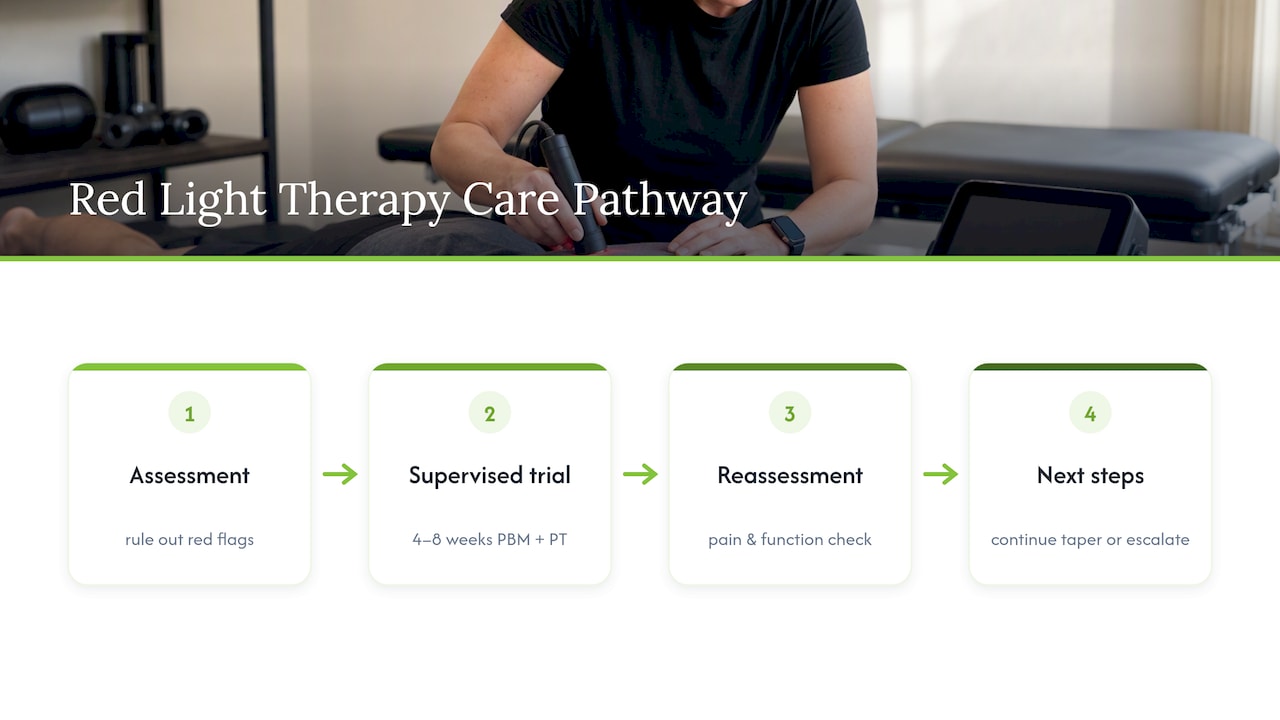
If you are not responding after a genuine trial, that is useful information, not failure. It tells us the pain generator may be more structural than the light therapy can address, and it is reasonable to discuss escalation to options like PRP, targeted injections, or Class IV laser therapy, which work through different mechanisms and may suit a different pain pattern.
Our Clinical Perspective
Many patients come to us after trying a handheld red light device at home for a few weeks with no clear improvement, often because the device could not deliver a clinically meaningful dose or because it was used without a rehab component. We provide red light therapy combined with other non-surgical pain management treatments tailored to individual evaluation results.
A typical visit starts with a history and exam to rule out red flags, followed by a discussion of whether nonspecific low back pain, a structural issue, or a combination is driving your symptoms. For appropriate candidates, we recommend a supervised PBM trial paired with physical therapy rather than light therapy alone, since the evidence consistently favors that combination over either approach, in isolation.
We set expectations early: meaningful improvement, when it happens, tends to show up within 4 to 8 weeks. If it does not, we have other non-surgical tools to consider before any conversation about surgery becomes necessary.
Our Take: Don’t Let the Device Distract From the Dose
The most overrated part of this conversation is the device itself. Patients ask which red light panel to buy, when the real variable that predicts outcomes is dose: wavelength, irradiance, session length, and consistency, delivered against the right diagnosis. A $50 home LED and a clinical laser are not interchangeable just because both emit red light.
The most underrated part is pairing light therapy with movement. The evidence that holds up best involves PBM alongside rehabilitation, not as a passive substitute for it. If you take one thing from the 2026 trial data, it should be that the combination of light therapy and rehabilitation produced substantially better outcomes than the sham, highlighting the benefit of combined treatment over light therapy alone.
Treat a trial of red light therapy as a time-boxed experiment with a clear endpoint, not an open-ended routine. Track your pain honestly, give it a real 4 to 8 weeks under reasonable supervision, and let the data, your own data, decide whether to continue.
— Felix
How We Can Help With Chronic Back Pain
If you have tried a home device or read every study you can find and still aren’t sure what will actually move the needle on your pain, a proper evaluation is usually the fastest way to get clarity. Treatment plans should be based on your exam and history, not a single device or technique applied uniformly.
Depending on what we find, your plan might include:
- Supervised red light therapy paired with a structured physical therapy program.
- Regenerative medicine options such as PRP therapy for patients whose pain has a regenerative component beyond what conservative care addresses.
- Imaging referral if your exam shows signs that point toward a structural issue rather than nonspecific pain.
At your first visit, expect a thorough screening, a conversation about realistic timelines, and a plan built around your specific presentation rather than a one-size approach. If chronic back pain has been running your schedule for long enough, our back pain therapy page is a good place to see the full range of non-surgical options we offer and request an evaluation.
This article is general information, not a substitute for advice from a qualified doctor. Consult a qualified healthcare professional about your own circumstances before acting on anything here.
FAQ
What’s the worst thing you can do for back pain?
Prolonged bed rest and complete inactivity tend to make chronic low back pain worse, since muscles weaken and stiffness increases the longer you avoid movement. Most current guidance favors staying as active as your pain allows, with gradual reintroduction of movement rather than strict rest.
What is the downside of red light therapy?
The main downsides are inconsistent evidence for improving function and disability, even when pain scores improve, and variability in home device quality. Mild, temporary side effects like warmth or a brief increase in soreness can occur, and certain patients need medical screening first, as covered in our red light therapy side effects guidance.
How long should I do red light therapy for back pain?
Most clinical protocols use sessions of about 20 minutes, with a reassessment point around 4 weeks, matching the design of the 2026 randomized trial. If you see no meaningful change in pain or function by 4 to 8 weeks, it is reasonable to revisit the plan with a clinician.
Can red light therapy heal a bulging disc?
Red light therapy has no evidence showing it can shrink or repair a bulging disc, since its documented effects involve mitochondrial activity, circulation, and inflammation rather than structural disc tissue. It may ease associated muscle pain and inflammation as an adjunct, but structural disc issues generally need a separate evaluation and treatment approach.
Sources
- Clinical efficacy study of LED red and infrared light therapy for chronic non-specific low back pain
- Erchonia® FX-635 510(k) Summary
- Low-level laser therapy for nonspecific low-back pain – PMC