
Shockwave therapy is generally safe when a trained physician delivers it, but it is not right for everyone. The firm reasons to avoid it are active infection in the treatment area, a malignant tumor in the path of a focused shockwave, and a fetus in the treatment field. Other situations, such as bleeding disorders, anticoagulant use, pacemakers, growth plates in children and teenagers, and recent steroid injections, call for a careful conversation and sometimes a modified plan. Below we explain which is which, why, and what to tell your clinician before your first session.
TL;DR
- Absolute contraindications include active infection, pregnancy (a fetus in the shockwave field), and a malignant tumor in the focus of a focused shockwave, according to a 2022 clinical review.
- Relative contraindications for high-energy treatment include significant coagulopathy, the lung or pleura, major nerves or brain tissue in the focus, and an open growth plate.
- Tell your clinician about blood thinners, NSAIDs, recent corticosteroid injections, and any pacemaker or implanted device before treatment.
- Most side effects are mild and short-lived: soreness, redness, bruising, or temporary tingling at the treated site.
- A good clinic screens you in person, examines the exact area, and explains why your plan is or is not appropriate.
Table of Contents
- What a contraindication actually means
- Absolute contraindications
- Relative contraindications and special situations
- Medications and habits to disclose before treatment
- How safe is shockwave therapy when you are a good candidate?
- Is it the right treatment for your pain?
- What a careful screening visit looks like
- Questions to ask any provider before you start
- Perspective
- Considering shockwave in North Dallas?
- FAQ
- Sources
What a contraindication actually means
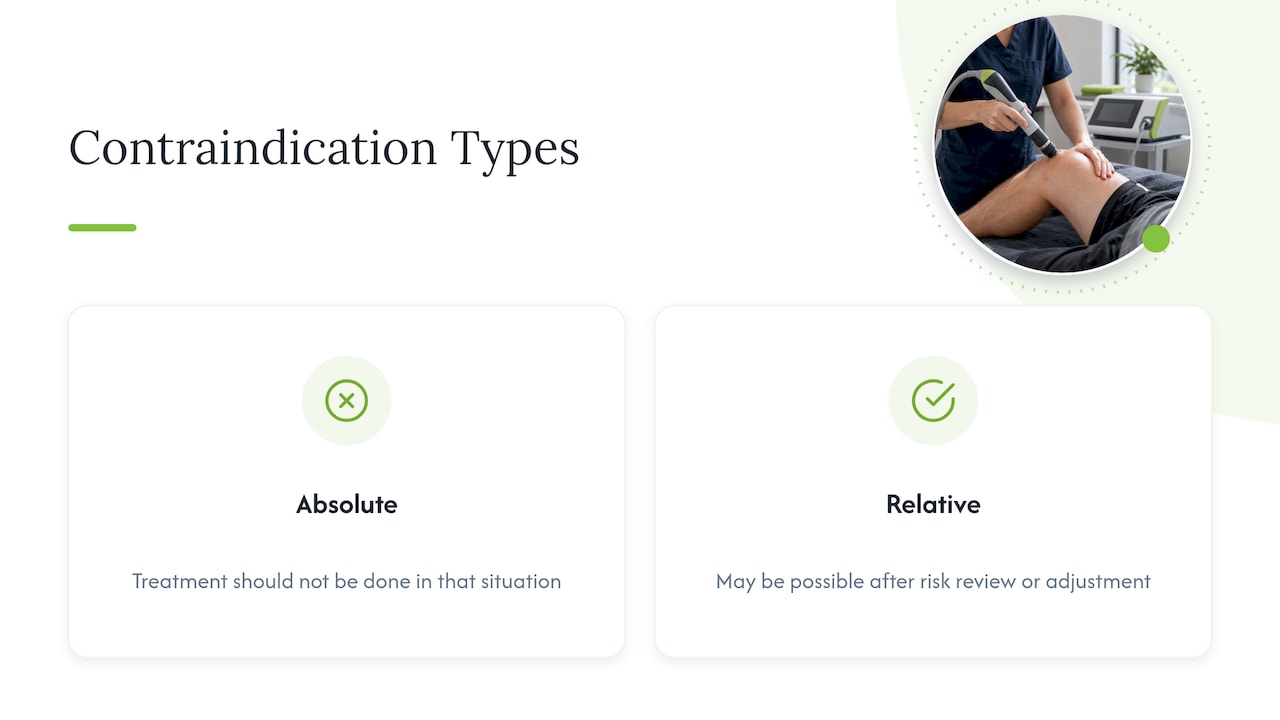
A contraindication is a reason not to use a treatment because the risk to you outweighs the likely benefit. Clinicians separate these into two groups.
An absolute contraindication means the treatment should not be done in that situation. A relative contraindication means the treatment may still be possible, but only after weighing the risk, adjusting the energy or location, coordinating with another physician, or waiting until a condition resolves.
This distinction matters because many of the lists you find online present every item with the same weight. A reader with a pacemaker and a reader with an active bone infection are in very different positions, and a useful screening conversation treats them differently.
Extracorporeal shockwave therapy (ESWT) delivers acoustic pulses through the skin to a targeted tendon, joint, or bony attachment. Because the energy is physical rather than chemical, most of the cautions concern what lies in the path of the wave: tissue that is infected, abnormal, still growing, or fragile.
Absolute contraindications
The best-organized summary we use comes from a 2022 best-practices review of ESWT in clinical practice, which lists the following absolute contraindications for all energy treatments or for focused shockwave specifically.
Active infection
If you have an active infection in or near the treatment area, including a bone infection such as osteomyelitis, shockwave therapy should wait. Mechanical stimulation of infected tissue is not something any careful physician wants to attempt, and the infection needs its own treatment first. Once it has resolved and your physician confirms it, shockwave can be reconsidered.
Malignant tumor in the treatment focus
Focused shockwave should not be applied over a malignant tumor. The International Society for Medical Shockwave Treatment (ISMST) frames this carefully: the contraindication is a malignant tumor in the shockwave field, not the cancer diagnosis itself. Someone with a cancer history whose tumor is nowhere near the painful heel or elbow is in a different position than someone with a mass in the treatment path. This is a decision to make with your oncologist and treating physician together, not on your own.
Pregnancy and fetus in the field
Pregnancy is listed as a contraindication in the clinical review above. The ISMST wording is again specific: it is the fetus in the shockwave field that matters. In practice, most clinics simply decline to treat pregnant patients, because the effects on a developing fetus have not been established and there is no urgency that justifies the unknown. If there is any chance you are pregnant, say so before your first session.
Relative contraindications and special situations
These are the situations where the answer is often “it depends,” and where an in-person examination matters most.
Bleeding disorders and blood thinners
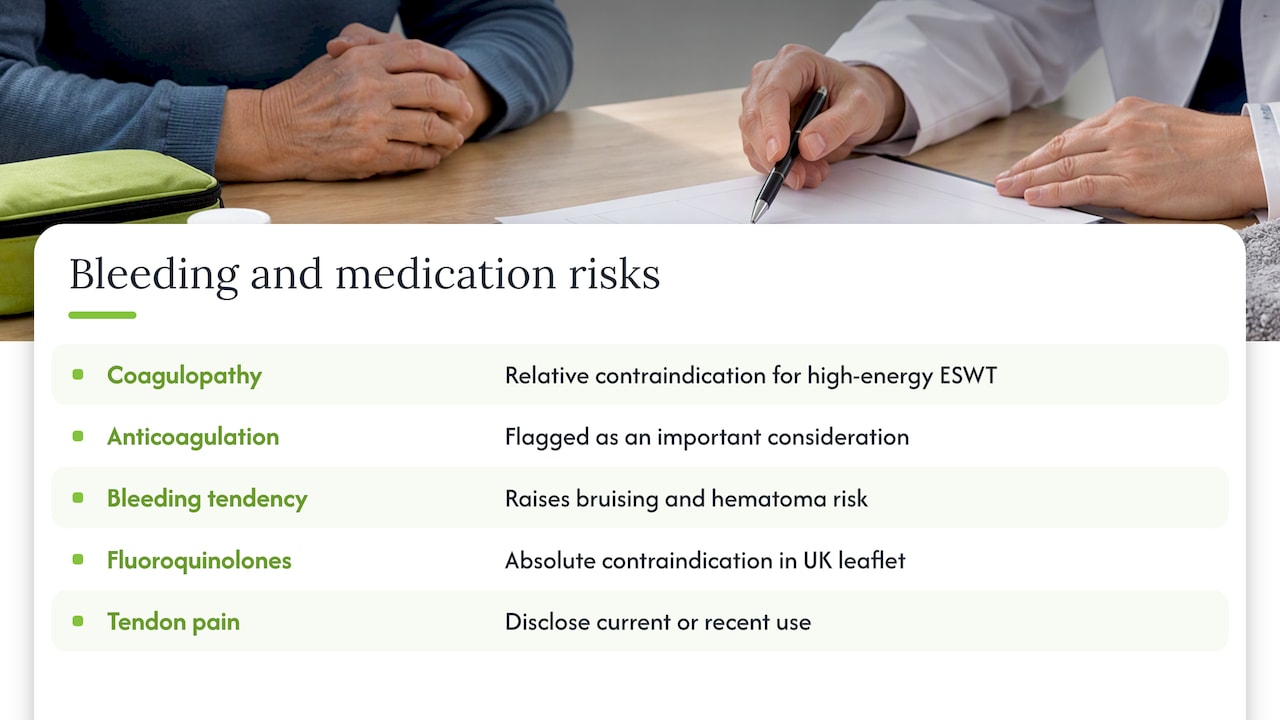
Significant coagulopathy is a relative contraindication for high-energy shockwave, according to the same 2022 review, and a 2020 update on ESWT likewise names severe coagulopathy for high-energy treatment. Shockwaves can cause bruising and, occasionally, a hematoma, so a tendency to bleed raises the stakes. Anticoagulation is also flagged in the 2022 review as an important consideration, and an insurer’s clinical policy summary notes that anticoagulant medications are listed among contraindications.
Do not stop a prescribed blood thinner on your own. Stopping one can be dangerous, and the decision belongs to the physician who prescribed it. What you should do is tell us exactly which medication you take, at what dose, and why. Our guide to disclosing anticoagulants before shockwave therapy walks through what to bring to your appointment.
A UK hospital patient leaflet also lists certain antibiotics called fluoroquinolones as an absolute contraindication. Because fluoroquinolones are associated with tendon problems, tell your clinician if you are taking or have recently taken one, such as ciprofloxacin or levofloxacin, especially if your pain is in a tendon.
Pacemakers and implanted devices
People often ask whether shockwave can affect the heart. The 2022 review identifies cardiac pacemakers and other implantable devices as important considerations when deciding whether to offer ESWT. It does not say every device holder is excluded. It says the question has to be asked and answered deliberately, with the treatment site, the device type, and the device’s location all taken into account. If you have a pacemaker, defibrillator, spinal cord stimulator, or similar implant, bring the device card or the manufacturer’s information to your visit.
Treatments over the chest or near an implant are a different risk from treating a heel or elbow far from the device, but that judgment should come from your physician, not from a general website.
Lung, major nerves, and blood vessels
The lungs should be kept out of the sound field, because shockwaves can cause tears, bleeding, or pneumothorax. The same review notes that misdirecting the wave could injure adjacent nerves or blood vessels, which is why operator technique and correct positioning matter as much as the machine. The 2022 review lists brain or nerve tissue and lung or pleura in the focus as relative contraindications for high-energy treatment.
This is one of the reasons we examine and palpate the area, and often confirm the target with your imaging, before delivering a single pulse around the shoulder, upper back, or chest wall.
Growth plates in children and teens
The 2022 review lists an epiphyseal plate in the treatment focus as a relative contraindication for high-energy treatment. An FDA summary for an orthopedic shockwave device describes it as contraindicated over or near bone growth centers until growth is complete, and over ischemic tissues in people with vascular disease. In plain terms: if your child is still growing, treating near the ends of long bones requires a different conversation, and for many young athletes other rehabilitation approaches come first.
Recent corticosteroid injections
The 2022 review advises disclosing recent corticosteroid injections. Many patients come to us after trying steroid injections for a tendon, and the timing between that injection and shockwave can affect planning. Tell us the date and the location of every injection you have had in the area.
Medications and habits to disclose before treatment
Before a first session, we ask about the following. You can prepare a short list ahead of time.
- Blood thinners or antiplatelet drugs: name, dose, and the physician who prescribes them.
- NSAIDs: ibuprofen, naproxen, and similar medications. The 2022 review lists current NSAID use as an important consideration, and it advises avoiding NSAIDs for breakthrough pain after treatment because parts of the inflammatory cascade may contribute to tissue healing. Ask your clinician what to use instead for soreness.
- Recent steroid injections: date, site, and medication.
- Fluoroquinolone antibiotics: current or recent use.
- Implants: pacemakers, stimulators, joint hardware, or pumps.
- Pregnancy or possible pregnancy.
- Cancer history: where the tumor was or is, and what treatment you received.
- Bleeding history: easy bruising, prior hematomas, or known clotting conditions.
None of these automatically ends the conversation. Several simply change the plan. Disclosing them is what lets us choose the right device, energy level, and treatment area.
How safe is shockwave therapy when you are a good candidate?
For appropriately selected patients treated by a qualified physician, the evidence is reassuring. The 2022 review describes ESWT as generally safe and well-tolerated. The common effects it lists are pain at the applicator site, skin redness or bruising, hematoma, nerve irritation with numbness or tingling, and superficial swelling. Most of these settle within days.
A systematic review in osteoarthritis described ESWT as noninvasive, with no serious adverse reactions in the included studies. A 2024 preprint review of energy-based therapies concluded that ESWT is probably effective and safe in clinical practice, while calling for larger, better-designed studies. That is a measured conclusion, and it matches what we tell patients: the safety record is good, the research is still maturing, and results vary from person to person.
What to expect during and after a session
You may feel tapping or a brief, intense pulse, particularly over a tender area. Soreness for a day or two afterward is common. Bruising can appear in some patients. Numbness or tingling that does not fade, spreading redness, warmth, fever, or pain that is clearly escalating deserves a call to the clinic rather than waiting it out.
Is it the right treatment for your pain?
Avoiding a contraindication is only half the question. The other half is whether shockwave suits your diagnosis. Conditions that are commonly treated include plantar fasciitis, tennis elbow, and calcific shoulder tendinitis. We have written about focused shockwave for shoulder calcific tendinitis and clinic-backed results for tennis elbow if you want to see how the evidence looks for those conditions.
If you are screened out of shockwave, you still have options. A patient with a bleeding disorder, for example, may be a better candidate for a gentler approach such as SoftWave therapy, or for EMTT, after your physician confirms those are appropriate for you. Those devices have their own screening rules, so none of them is a shortcut around the conversation.
Similar screening logic applies across energy-based therapies. For example, this overview of PEMF contraindications and screening shows how pregnancy, implanted devices, and certain medical conditions shape who should avoid a given modality, which is a useful comparison when you are choosing among options.
What a careful screening visit looks like
A responsible clinic does not hand you a form and start treatment. Here is what we think the process should include.
- A history: your pain pattern, previous treatments, medications, medical conditions, and implants.
- A physical examination: locating the exact painful structure and checking nearby nerves, vessels, and skin.
- Review of imaging: when it exists, to confirm the diagnosis and rule out anything unexpected in the treatment path.
- A clear explanation: why shockwave is or is not appropriate, what the alternatives are, and what a realistic outcome looks like.
- A plan with checkpoints: the number of sessions varies by condition and response, as we explain in our article on why shockwave plans range from 3 to 10 sessions.
If a provider offers shockwave without asking about your medications, pregnancy status, or implants, treat that as a reason to ask more questions before you agree.
Questions to ask any provider before you start
- Who will operate the device, and what is their training?
- Is this focused or radial shockwave, and at what energy range?
- Have you reviewed my medications, including blood thinners and NSAIDs?
- What will you avoid treating near, given my anatomy and any implants?
- What should I do for soreness afterward?
- How will we decide whether to continue after the first few sessions?
If cost is part of your decision, our pages on shockwave therapy cost and Dallas shockwave prices explain how pricing is typically structured.
Perspective
Many patients come to us after trying several treatments, and they often assume that a newer or more advanced therapy must be safe for everyone. We see it the other way around. The better a treatment is, the more carefully it should be matched to the person receiving it.
At Nortex Spine and Joint, we look at shockwave as one tool among many non-surgical options, alongside physical rehabilitation, regenerative medicine, and image-guided injections. Our physicians are Harvard fellowship-trained and board-certified, and that training shows up less in the device than in the screening: asking about the medication that is easy to forget, the implant that is not on the intake form, or the old injection that changes the timing.
We would rather tell you that shockwave is not right for you today, and offer another path, than treat you because the schedule had an opening. Set realistic expectations as well: shockwave tends to work gradually, results vary, and some patients need a different approach. A plan built around your diagnosis, your medical history, and your goals is what gives non-surgical care its best chance.
Felix
Considering shockwave in North Dallas?
If you are unsure whether shockwave fits your history, a consultation is the right first step. We review your medications, implants, and imaging, then explain whether shockwave therapy at Nortex or another option, such as physical therapy or regenerative medicine, makes the most sense. Not sure where to start? Our guide to step-by-step pain management outlines how we think about progressing from conservative care to more advanced treatment.
FAQ
Is shockwave therapy safe?
For appropriately screened patients treated by a qualified physician, ESWT is generally considered safe and well-tolerated. The usual effects are temporary soreness, redness, bruising, or mild tingling. Safety depends heavily on screening and on correct positioning of the applicator.
Can shockwave therapy affect your heart?
The concern is mainly about pacemakers and other implanted devices, which the 2022 clinical review lists as important considerations. Treatment far from the chest is a different situation than treatment near it, and the decision belongs with your physician. Bring your device information to your appointment.
What should you avoid before shockwave therapy?
Do not stop prescribed medications on your own, but tell your clinician about blood thinners, NSAIDs, and recent steroid injections. Ask whether you should hold over-the-counter anti-inflammatories before and after treatment. Also let the clinic know if you might be pregnant.
Who is a good candidate for shockwave therapy?
Good candidates typically have a persistent tendon or soft-tissue problem, such as plantar fasciitis, tennis elbow, or calcific shoulder tendinitis, with no active infection, no tumor in the treatment area, and no major bleeding risk. A physical examination and review of your history confirm whether you fit.
Can you have shockwave therapy with a cancer history?
Possibly. The contraindication concerns a malignant tumor in the shockwave field, not a past diagnosis in itself. Your treating physician and oncologist should weigh in, especially if the tumor site is near the area you want treated.
Sources
- Best practices for extracorporeal shockwave therapy in clinical practice (PMC, 2022)
- Extracorporeal shock wave therapy: an update (PMC, 2020)
- FDA summary for an orthopedic extracorporeal shock wave device
- Shockwave Therapy patient leaflet (NHS)
- ESWT for the treatment of osteoarthritis, systematic review (PMC)
- Effectiveness and safety of type- and energy-based therapies (medRxiv, 2024)
- ISMST Recommendations
- Extracorporeal Shock-Wave Therapy clinical policy bulletin (Aetna)