
If you keep getting a short, sharp pain in your head that feels like a jolt at the base of the skull or behind one ear, the most likely explanations are occipital neuralgia or cervicogenic headache, not a mystery neurological disease. Your next move should be a focused neck and scalp exam, and if that exam points to irritated occipital nerves, a diagnostic occipital nerve block is usually the fastest way to confirm the source.
Both conditions trace back to structures in your neck and the nerves that run up into your scalp. The greater and lesser occipital nerves get compressed, irritated, or inflamed, or the upper cervical joints refer pain upward. Either way, you don’t need to guess your way through this.
Here’s what a reasonable first step looks like:
- Track the pattern. Note how long each jab lasts (seconds versus minutes), where it starts, and whether turning your neck triggers it.
- Get a focused exam, not just a headache questionnaire. A clinician should press along the base of your skull and move your neck through its range before ordering anything.
- Ask about a diagnostic occipital nerve block if palpation reproduces your exact pain. It doubles as a short-term treatment.
- Watch for red flags — sudden weakness, fever, or a “thunderclap” onset unlike anything before — and seek emergency care if those appear.
The International Headache Society maintains diagnostic criteria that most pain specialists, including the team at Nortex Spine and Joint, use to separate occipital neuralgia from other headache disorders before choosing treatment.
Key Takeaways
Short, sharp pain in the head from the neck or occipital nerves responds best to a diagnosis-first sequence: focused exam, diagnostic nerve block, conservative rehab, then stepped injections or PRF only if needed.
| Point | Details |
|---|---|
| Start with a focused exam | Palpation and neck range-of-motion testing localize the pain source before any procedure. |
| Diagnostic block does double duty | A positive occipital nerve block confirms the nerve as the source and provides temporary relief in one step. |
| Conservative care comes first | Physical therapy, posture correction, and TENS deserve a four to eight week trial before escalating. |
| Injection relief varies widely | Local anesthetic, corticosteroid, and botulinum toxin injections range from 30 minutes to several months of relief. |
| PRF and RFA suit different pain sources | PRF fits nerve-based pain safely; RFA suits facet-driven cervicogenic pain but carries more risk. |
| Nortex follows the diagnosis-first model | Nortex Spine and Joint sequences ultrasound-guided blocks, injections, and rehab based on exam findings, not a fixed protocol. |
This article is general information, not a substitute for advice from a qualified doctor. Consult a qualified healthcare professional about your own circumstances before acting on anything here.
Table of Contents
- Is It Occipital Neuralgia or Cervicogenic Headache?
- What Happens at a Diagnostic Visit?
- Try Conservative Care Before Interventional Procedures
- Do Injections Help With Occipital Neuralgia Pain?
- What If Injections Wear Off Too Fast?
- When Is Surgery the Right Call?
- What Should You Look for in a Pain Clinic?
- What a Typical Patient Journey Looks Like at Nortex
- How Nortex Approaches This and How to Get Evaluated
- Sources
- FAQ
Is It Occipital Neuralgia or Cervicogenic Headache?
The two conditions overlap enough to confuse even experienced clinicians on a first visit, but a few features usually separate them.
Occipital neuralgia tends to produce electric, shooting, or stabbing pain that lasts seconds to a couple of minutes at a time, concentrated at the back of the skull and sometimes shooting toward the top of the head. Cervicogenic headache, by contrast, often starts as a duller ache in the neck that refers forward to the temple or behind one eye, though it can carry sharp spikes on top of that baseline ache. Patients frequently describe both: a constant low-grade pressure with occasional short, stabbing pain in the head layered on top.
A few exam clues help sort out which is dominant:
- Tenderness directly over the greater or lesser occipital nerve, often reproducing the sharp pain with light pressure, points toward occipital neuralgia.
- Restricted neck rotation or extension, especially when it reproduces the referred head pain, points toward a cervicogenic source.
- Trigger points in the upper trapezius or suboccipital muscles frequently accompany both conditions and often need treatment regardless of which diagnosis leads.
- Pain reproduced by sustained neck posture (like looking down at a phone) suggests a cervical joint or muscular contributor rather than pure nerve irritation.
Seek urgent evaluation if your head pain arrives with sudden severe intensity unlike any prior episode, new weakness or numbness on one side, a high fever, or vision changes. These are not typical features of occipital neuralgia or cervicogenic headache, and they need same-day medical attention rather than a routine pain clinic visit.
What Happens at a Diagnostic Visit?
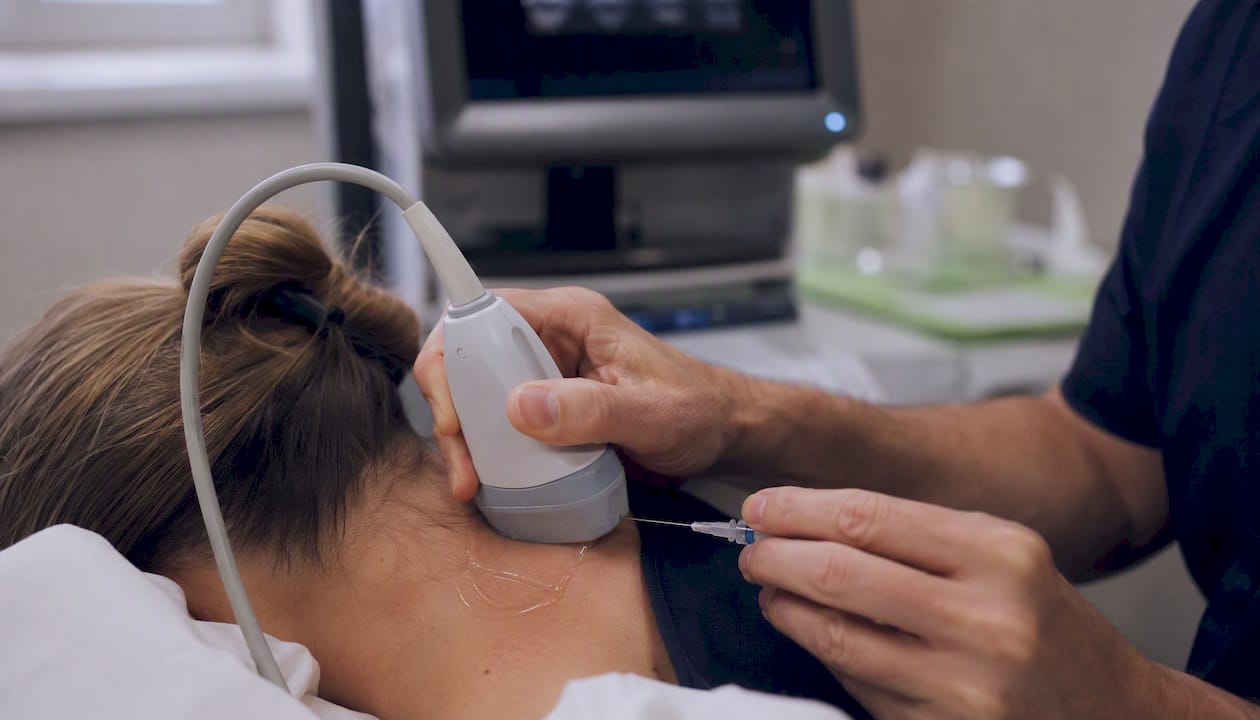
The most useful diagnostic tool in this entire process is often the occipital nerve block itself, because it works as both a test and a treatment in one step. If a small dose of local anesthetic injected near the greater or lesser occipital nerve eliminates your exact pain within minutes, that confirms the nerve as the source far more reliably than any imaging study.
Before reaching for a needle, a thorough clinician walks through a set process:
- Focused history. When did the pain start, how long does each episode last, and what triggers it?
- Palpation of the greater and lesser occipital nerves, checking whether direct pressure reproduces the sharp pain.
- Cervical range-of-motion testing, looking for restriction or pain reproduction with rotation and extension.
- Provocative maneuvers, including sustained neck positions that mimic daily triggers like desk work.
- Basic neurologic screening to rule out deficits that would suggest something beyond a nerve or joint source.
Imaging has a narrower role than most patients expect. A cervical x-ray or MRI is worth ordering when the history suggests structural pathology, prior trauma, or a red flag, but for straightforward occipital neuralgia or cervicogenic headache, imaging rarely changes what happens next. The exam and the diagnostic block usually do more of the work than a scan does.
Pro Tip: Ask whether your clinic uses ultrasound guidance for occipital nerve blocks. Ultrasound-guided injections tend to localize the nerve more precisely than a landmark-based blind injection, and that added accuracy has been associated with longer pain-free intervals in some studies.
Try Conservative Care Before Interventional Procedures
Conservative care comes first for nearly every patient we see, and it’s often enough on its own. Clinical reviews consistently recommend education, physical therapy, TENS, and non-opioid medication as the starting point before any injection or procedure, and that guidance matches what we see in daily practice.
A reasonable conservative plan includes:
- Pain education so you understand what’s driving the pain and what’s not dangerous.
- Posture and ergonomic changes, particularly for anyone spending hours at a desk or looking down at a phone. A clinician-backed desk posture plan can meaningfully reduce trigger frequency.
- Neck-focused physical therapy targeting the suboccipital and upper trapezius muscles, plus postural retraining.
- TENS units for at-home symptom control between visits.
- Non-opioid medications, typically NSAIDs or muscle relaxants for short courses; opioids are not appropriate for this kind of benign, recurring pain.
Give physical therapy and posture correction four to eight weeks before deciding whether it’s working. Many patients see meaningful improvement in that window, especially when trigger points and neck mechanics get addressed together, as outlined in this guide to neck arthritis and headache relief. If you’re still getting frequent sharp pain in your head after two months of consistent conservative effort, that’s the point to escalate toward injection-based options.
Do Injections Help With Occipital Neuralgia Pain?
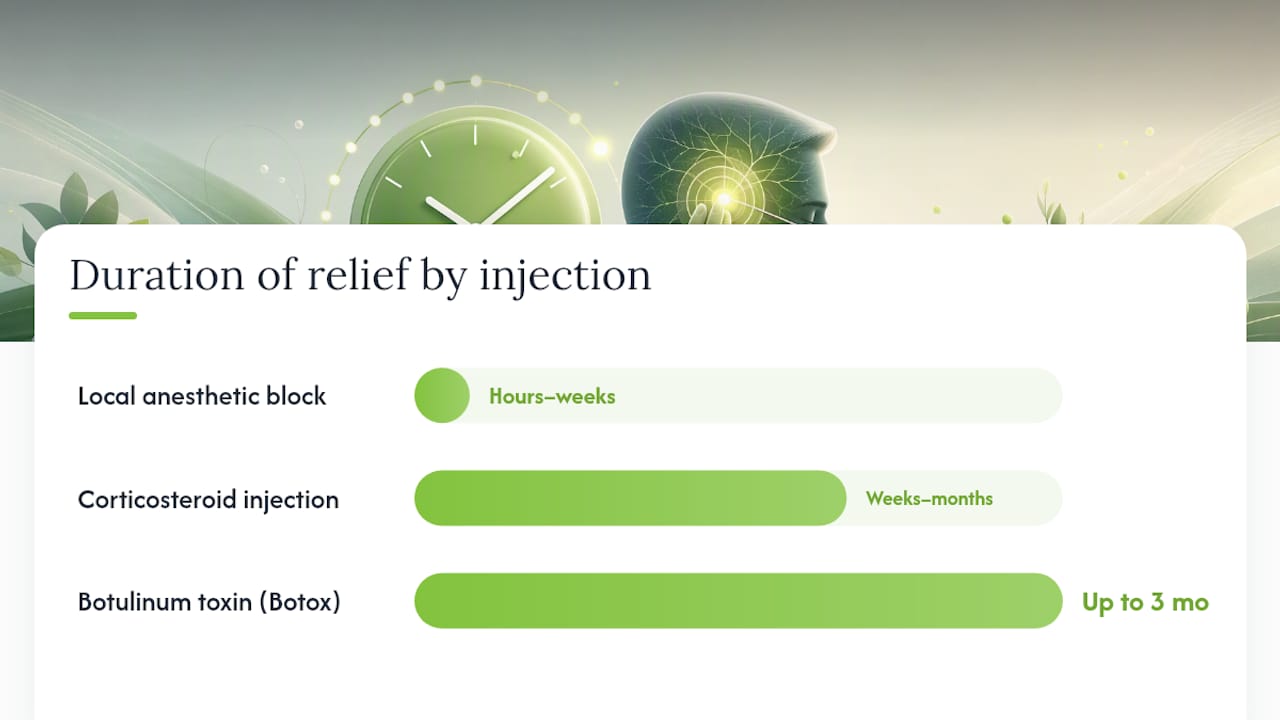
Yes, injection therapies generally provide good short-term relief, though how long that relief lasts varies widely by injection type and by patient. A systematic review and meta-analysis found relief ranging from as little as 30 minutes to several months across different injection approaches, which is why setting realistic expectations upfront matters.
| Injection Type | Duration of Relief | Reported Success Rate | Invasiveness | Typical Candidate |
|---|---|---|---|---|
| Local anesthetic occipital nerve block | Hours to weeks | Often good short-term results in many patients | Minimally invasive, office-based | Diagnostic confirmation, first therapeutic trial |
| Corticosteroid injection | Weeks to a few months | Frequently good results reported | Minimally invasive, office-based | Patients needing longer relief than anesthetic alone |
| Botulinum toxin (Botox) | Up to three months | High rates of good results reported in small studies, though evidence is limited | Minimally invasive, requires repeat dosing | Recurrent cases or those failing steroid injections |
A trigger-point injection or a Botox injection each has tradeoffs worth weighing before you commit to a plan.
- Local anesthetic blocks are fast and low-risk, but relief is often short, which is exactly why they double as a diagnostic tool.
- Corticosteroid injections last longer but shouldn’t be repeated indefinitely due to tissue effects with frequent steroid exposure.
- Botulinum toxin shows strong numbers in small studies, though evidence specific to occipital neuralgia remains limited compared to migraine research.
Across these injection categories, reported adverse events were generally mild and transient, including dizziness, nausea, and temporary local swelling, occurring in a pooled minority of patients.
What If Injections Wear Off Too Fast?
When injections work but don’t last, pulsed radiofrequency (PRF) is typically the next step for nerve-based pain, while radiofrequency ablation (RFA) becomes the better option when facet joints in the cervical spine are the primary driver. PRF avoids destroying nerve tissue, which makes it a safer long-term option for occipital nerve pain specifically, while RFA can offer longer relief for facet-mediated cervicogenic headache at the cost of more invasiveness.
- PRF: Duration of relief often extends to three to six months or longer with repeat treatments; some series report roughly half of patients achieving over 50% relief at three to six months. Evidence quality is still limited but generally favorable.
- RFA: Tends to show the longest duration of benefit among interventional options for facet-driven pain, but carries higher procedural risk than PRF and is generally reserved for confirmed facet-joint pain rather than pure nerve irritation.
- Occipital nerve stimulation (ONS): An implantable option considered only after multiple less-invasive treatments fail; appropriate for a narrow group of patients with confirmed occipital nerve pain that hasn’t responded to blocks or PRF.
Many patients do well with a staged approach: a diagnostic block confirms the source, PRF extends the relief window, and repeat PRF sessions maintain benefit for a year or more without escalating to a permanent implant.
When Is Surgery the Right Call?
Surgical decompression is appropriate only for a small, carefully selected group of patients: those with a clearly identified compression site, a positive diagnostic block confirming the nerve as the pain generator, and a documented history of failed conservative and interventional treatment over a reasonable trial period.
Candidates typically share these features:
- Repeated, well-documented failure of conservative care and at least one round of injections or PRF.
- A diagnostic block that reliably reproduces and then eliminates the exact pain pattern.
- Imaging or exam findings consistent with an identifiable structural compression.
Reported success rates for occipital nerve decompression surgery vary across the literature, generally landing in a moderate-to-good range for well-selected patients, but they come with real surgical risks: infection, scar tissue formation, incomplete relief, and the possibility that pain returns over time. Any surgeon discussing this option should walk you through those risks specifically, not just the upside.
What Should You Look for in a Pain Clinic?
The clinics that get this right combine three things: real experience with occipital nerve blocks and PRF/RFA, integrated rehabilitation rather than injections alone, and a habit of using ultrasound guidance for precision.
Before booking, check for:
- Clinician credentials specific to interventional pain management, not general practice.
- Documented experience performing GON/LON blocks, PRF, and RFA, not just familiarity with the terms.
- In-house or closely coordinated physical therapy, since rehab and injections work better together than either alone.
- A shared decision-making approach where you’re walked through options rather than pushed toward one procedure.
At your first visit, ask these questions directly:
- What exactly will the diagnostic block involve, and how will we know if it’s positive?
- What’s the realistic timeline before we know if this treatment is working?
- How often do you see complications with this procedure, and what do they look like?
- What’s the follow-up plan if relief fades after a few weeks?
- How does billing work for injections versus PRF or RFA through my insurance?
What a Typical Patient Journey Looks Like at Nortex
Most patients who come through Nortex Spine and Joint with a short, sharp pain in the head follow a similar arc: conservative care and neck-focused rehab first, a diagnostic occipital nerve block if the exam points to a nerve source, then targeted injections or PRF if relief from that block is real but temporary. Staged options like ONS come into the conversation only for the small minority who don’t respond to everything before it.
Many patients come in after trying over-the-counter medication and general chiropractic adjustments for months without lasting change. What often turns things around isn’t a single dramatic procedure. It’s the sequence: an accurate diagnosis, a properly placed block, and rehab that addresses the neck mechanics driving the irritation in the first place. Patients who skip the diagnostic step and go straight to a procedure sometimes get relief that doesn’t hold, because the target wasn’t confirmed first.
Pro Tip: If a diagnostic block gives you clear, if temporary, relief, don’t skip the rehab phase that follows. Addressing the neck mechanics that irritated the nerve in the first place is often what makes later procedures, if you need them, last longer. Case patterns like these are documented in Nortex’s chiropractic pain case series, which reflects the same conservative-first, diagnosis-driven approach.
How Nortex Approaches This and How to Get Evaluated
Nortex Spine and Joint treats occipital neuralgia and cervicogenic headache through the same diagnostic sequence described throughout this article: a focused exam, ultrasound-guided nerve blocks when indicated, and a stepwise path through injections, PRF, or RFA based on what the diagnostic block reveals. Rehabilitation runs alongside every stage rather than as an afterthought, and regenerative options like PRP therapy are available when broader joint or soft-tissue issues in the neck are contributing to the problem.
A clinical evaluation starts with a detailed history and hands-on exam, not a reflexive scan or a prescription. If your exam points to occipital nerve involvement, we’ll discuss whether a diagnostic block makes sense as your next step, and what a realistic timeline looks like from there. You can review the full range of non-surgical pain treatments Nortex offers, or schedule a first evaluation directly to get a specific answer about what’s driving your pain.
Sources
- Nonsurgical Treatment of Neuralgia and Cervicogenic Headache: A Systematic Review and Meta-analysis
- Cervicogenic headache and occipital neuralgia (clinical review)
- Efficacy of interventional treatment strategies for managing patients with cervicogenic headache: a systematic review
FAQ
What Does a Short, Sharp Pain in the Head Usually Mean?
In adults with neck-related symptoms, it usually points to occipital neuralgia or cervicogenic headache, both driven by irritated occipital nerves or cervical spine structures rather than a primary brain disorder.
How Long Does an Occipital Nerve Block Last?
Relief from a diagnostic occipital nerve block using local anesthetic typically lasts hours to a few weeks, while adding corticosteroid can extend relief to weeks or a few months.
Is Physical Therapy Enough to Fix Occipital Neuralgia?
For many patients, yes. Neck-focused physical therapy combined with posture correction resolves symptoms within four to eight weeks, and it’s the recommended first step before any injection.
What’s the Difference Between PRF and RFA?
PRF avoids destroying nerve tissue and is generally preferred for occipital nerve pain, while RFA creates a longer-lasting lesion and tends to suit facet-joint-driven cervicogenic headache better despite carrying more risk.
When Should I Consider Nortex Spine and Joint for This Pain?
If conservative care hasn’t resolved your symptoms after several weeks, or you want an accurate diagnosis before committing to a procedure, Nortex’s diagnosis-first approach to occipital neuralgia and cervicogenic headache is a reasonable next step.