
Most herniated discs do not need surgery. According to the American Association of Neurological Surgeons, the leg or arm symptoms caused by a herniated disc improve in roughly 9 out of 10 people, usually over a few days to a few weeks. For the minority whose pain lingers, a structured sequence of non-surgical care, from physical therapy to targeted injections to regenerative options, is where a specialist adds the most value. If you live in North Dallas and your pain has outlasted the first few weeks, we can look at your imaging and your symptoms together and build a plan around them.
This guide explains what to do first, what the evidence says about each non-surgical option, which symptoms mean you should not wait, and how to tell when it is time to see a spine specialist.
TL;DR
- Most herniated discs improve without surgery, and the first-line approach is activity modification, anti-inflammatory medication when it is safe for you, and physical therapy.
- Bed rest is not recommended. Walking as tolerated and staying gently active is the guidance from neurosurgical and military guideline bodies.
- If radiating pain persists beyond roughly 4 to 6 weeks, epidural steroid injections and nerve root blocks are the usual next step, and regenerative injections such as PRP are an additional option for selected patients.
- Leg weakness, loss of bladder or bowel control, or numbness in the groin or saddle area needs urgent medical care, not an appointment next week.
- Pain that lasts is a reason to get a precise diagnosis and a customized plan, not to keep repeating the same treatment.
Table of Contents
- What a herniated disc is, and why many heal on their own
- Warning signs that should not wait
- The first few weeks: what actually helps
- When pain persists: targeted injections
- Regenerative options for a disc that keeps hurting
- How to tell which path fits you
- Seeing a specialist in North Dallas
- Our perspective
- FAQ
- Sources
What a herniated disc is, and why many heal on their own
The discs in your spine are cushions between the vertebrae. Each has a tough outer ring and a softer, gel-like center. A herniation happens when part of that center pushes through a weakness in the outer ring. If the displaced material presses on or irritates a nearby nerve root, you feel it as sharp, burning or electric pain traveling into a leg (sciatica, when it comes from the lower back) or an arm (when it comes from the neck). You may also notice numbness, tingling or weakness in the same area.
Two points explain why so many people recover without an operation. First, the body treats displaced disc material as something to clear away, and the inflammation around the nerve usually settles over time. Second, many herniations shrink on their own. The AANS describes the typical course as improvement over days to weeks for most people with sciatica or radiculopathy (nerve root irritation), which is why the world’s neurosurgical societies lean toward starting conservatively. The World Federation of Neurosurgical Societies spine committee states that, in the absence of cauda equina syndrome or motor or other serious neurologic deficits, conservative treatment should be first-line for lumbar disc herniation, and that a combination of activity modification, medication and physical therapy gives good outcomes in most patients.
That is reassuring, but it is a population statistic. It does not tell you how your own disc will behave, and “most people improve” can be little comfort in week three when you cannot sit through a work meeting or sleep through the night. Realistic expectations matter here: improvement is often gradual, flare-ups are common along the way, and a plan that fits the level of the herniation, your job and your activity goals does better than a generic one.
Warning signs that should not wait
Before any discussion of treatment, one safety point. Conservative care is appropriate only when there is no sign of serious nerve compression. The AANS lists these as reasons for urgent evaluation and imaging:
- Significant weakness in a leg or arm
- Loss of sensation in the genital or rectal area
- Loss of control over urine or stool
- A history of metastatic cancer
- A significant recent infection, or fever together with radiating pain
- Pain that began after a fall or injury
Loss of bladder or bowel control, numbness in the saddle area, or rapidly worsening weakness can signal cauda equina syndrome, in which the bundle of nerves at the base of the spine is compressed. If any of these apply to you, go to an emergency department rather than waiting for a clinic appointment.
The same AANS page says surgery may be considered when radicular pain limits normal activity, when neurological deficits are progressing, when standing or walking becomes difficult, or when medication and physical therapy have not worked. If you reach that point, a surgeon’s opinion is the right conversation to have, and we will tell you so plainly.
The first few weeks: what actually helps
The early phase is about calming irritation without losing strength or mobility.
Stay moving, with limits
The AANS recommends limiting your activities for 2 to 3 days, then walking as tolerated, and it advises against bed rest. A 2025 systematic review of treatment guidelines reached the same place: bed rest scored zero for recommendation, and both the AANS and the VA/DoD explicitly recommend against it. In practice, that means short, frequent walks, changing positions often, and avoiding the activities that clearly spike your leg pain, such as heavy lifting, prolonged forward bending and long stretches in a low, soft seat.
Anti-inflammatory medication
The AANS suggests an anti-inflammatory such as ibuprofen if it is not contraindicated for you. The WFNS committee likewise notes that NSAIDs significantly improve acute low back and sciatic pain. “Not contraindicated” is doing real work in that sentence: NSAIDs can be a problem for people with kidney disease, stomach ulcers, bleeding disorders or certain heart conditions, and for people taking blood thinners. Check with your physician or pharmacist before starting them. A 2023 systematic review found little evidence supporting oral corticosteroids or muscle relaxants such as cyclobenzaprine for this problem, and it reserved opioids for severe pain that does not respond to over-the-counter painkillers. That is one reason many patients who have cycled through several prescriptions end up asking for something more targeted.
Physical therapy and the right kind of movement
In the 2025 guideline review, physical therapy was recommended by 8 of 10 guidelines. Good therapy for a herniated disc is not a stock list of stretches. The WFNS committee notes that extension-based exercises, such as the McKenzie extension program, and posture changes can improve low back pain by encouraging disc material to move toward the front of the disc, away from the nerve. Yoga or tai chi routines built on extension can produce similar effects. Flexion movements, such as repeated toe touches or full sit-ups, may push disc material backward and aggravate pain in some people.

That is why the same exercise helps one patient and flares another. The direction of movement that centralizes your pain, meaning it pulls the symptoms out of the leg and back toward the spine, tells a therapist which program to use. Our physical therapy program is part of the same clinic as our injection and regenerative services, so your rehabilitation can be adjusted alongside any procedure rather than running on a separate track.
The committee also reports that traction therapy improves pain only temporarily and carries risks, including nerve injury, ligament tears and vertebral fractures. If a clinic suggests it, ask what outcome it is meant to achieve and for how long.
Pain is not only in the disc
Persistent pain changes how the nervous system responds, and sleep loss, worry and fear of movement can amplify it. The 2025 guideline review gave cognitive behavioral therapy (CBT) one of the highest recommendation scores among non-invasive options, at 2.2, just ahead of NSAIDs at 2.0. CBT is a structured form of counseling that teaches practical ways to handle pain-related thoughts and behaviors, and it works alongside physical treatment rather than replacing it. If distance or schedule is a barrier, online therapy for chronic pain is one way to build it into a busy week.
When pain persists: targeted injections
If you are still limited by radiating pain after four to six weeks of appropriate care, the 2023 systematic review lists epidural injections and selective nerve root blocks as second-line treatments. An epidural steroid injection places an anti-inflammatory medication near the irritated nerve root, using imaging guidance so the medication goes where it is needed. The goal is to lower inflammation enough that you can participate in physical therapy and return to normal activity while the disc settles.
The guideline evidence is specific about timing. The 2025 review found definite consensus for short-term epidural steroid injections, with transforaminal injections scoring 2.3, caudal 2.1 and interlaminar 2.0, and it did not recommend long-term, repeated use. We read that as a clear instruction: an injection is a window of relief to build on, not a standing prescription.
We offer several approaches, and the route depends on where the herniation is:
| Approach | Typical target | Our page |
|---|---|---|
| Lumbar transforaminal epidural steroid injection | A specific nerve root in the lower back | Transforaminal injection |
| Caudal epidural steroid injection | The lower epidural space, reaching several lower spinal levels | Caudal injection |
| Cervical epidural steroid injection | Nerve roots in the neck, for arm symptoms | Treatments overview |
If you want to understand the procedure before deciding, our guides on epidural steroid injections and whether spinal injections are right for you walk through what the visit involves and how to prepare. Injections carry risks like any procedure, including temporary soreness, and your physician should review your medications, allergies and bleeding risk with you beforehand.
Regenerative options for a disc that keeps hurting
Some patients arrive after physical therapy, medication and one or more steroid injections have given only partial or short-lived relief. For them, regenerative medicine is a reasonable next conversation, particularly if the goal is to avoid surgery and support the tissue rather than only quiet the symptoms.
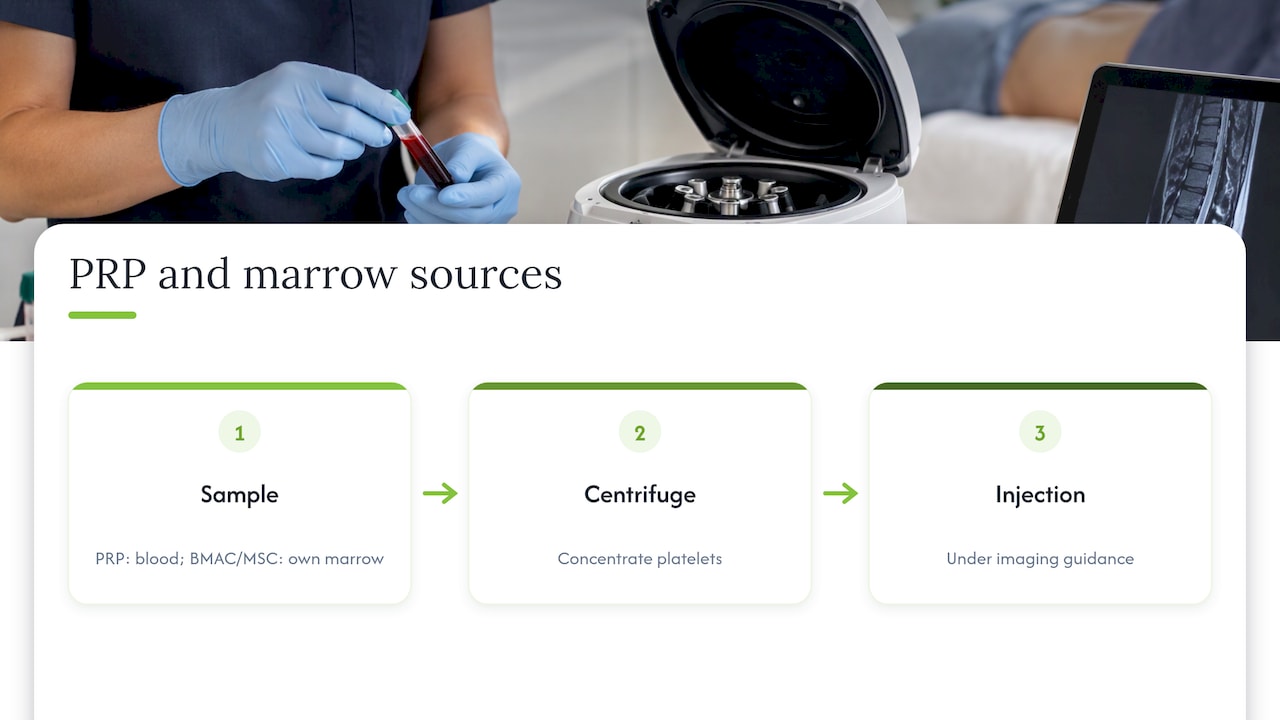
Platelet-rich plasma (PRP) is made from your own blood. A small sample is drawn, spun to concentrate the platelets, and the concentrate, which is rich in growth factors, is injected under imaging guidance. Because it is autologous, meaning it comes from you, there is no donor tissue involved. Bone marrow aspirate concentrate (BMAC) and mesenchymal stem cell injections follow a similar idea, using cells and signaling proteins from your own marrow.
The 2025 ASIPP guideline update on regenerative therapies, produced by 33 experts who reached 100% consensus on 19 recommendations, supports lumbar intradiscal PRP and BMAC or mesenchymal stem cell injections, as well as epidural PRP, with Level III (fair) evidence and moderate consensus-based recommendations. The same panel notes that clinicians must follow FDA regulations, which is a standard worth holding any provider to. Most regenerative treatments are not covered by commercial insurance, so ask about coverage and costs at the start. The Mayo Clinic Proceedings-era literature describes an early pilot of 10 patients who had failed at least six months of conservative therapy: after cultured stem cell injection, pain fell by 61.5% and disability by 48% at three months, with modest further gains at six and twelve months.
What this means for you: regenerative treatment is an evidence-informed option for selected patients, not a guaranteed cure, and healing is gradual. Our overview of stem cell therapy for back pain explains why we frame the timeline in months rather than days. We offer PRP therapy, PRP for chronic back pain and stem cell therapy for spinal discs as part of our regenerative medicine program, and our guide to regenerative injections lists the questions worth asking any clinic.
How to tell which path fits you
Guidelines are not a script. The North American Spine Society states that its lumbar disc herniation guideline is an educational tool, not a fixed standard of care, and that treatment should rest on the individual patient’s needs and the physician’s professional judgment. These are the questions we use to place a patient:
- How long has it been? Under four to six weeks, the emphasis is on activity modification, medication and therapy. Beyond that, injections come into play.
- Where does the pain go? Pain that travels below the knee, or into the arm past the elbow, points toward nerve root involvement and informs which injection route fits.
- Is there any weakness or numbness? Progressive deficits change the conversation toward urgent evaluation and a surgical opinion.
- What have you already tried, and for how long? A rehabilitation course that was cut short is not the same as one that failed.
- What do you need to get back to? A desk job, a golf swing and a warehouse shift ask different things of a lumbar spine.
Imaging helps, but it does not decide the plan on its own. Many people with no symptoms show disc bulges on an MRI, so findings are interpreted against your examination. Our page on lumbar radiculopathy and sciatica explains how the nerve is evaluated, and this overview of lower back pain and herniated discs is a good companion read.
Seeing a specialist in North Dallas
If you have been managing a herniated disc on your own for several weeks and your pain is not retreating, an in-person evaluation is the useful next step. Our physicians are Harvard fellowship-trained and board-certified, and each plan is customized to the patient rather than drawn from a fixed protocol. Treatment can include back pain therapy, physical therapy, epidural injections and regenerative options, with the aim of treating the source of the pain rather than only the symptoms. You can start with our treatments page or contact the clinic through nortexspineandjoint.com to schedule a consultation.
Our perspective
Many patients come to us after they have tried several things in a row: a course of anti-inflammatories, a few weeks of rest, perhaps a round of therapy that ended before it had a chance to work. They are not looking for hype. They want to know what is causing the pain and what the realistic options are.
We start with the fact that most herniated discs improve, and we say so. Then we ask what stands in the way of your improvement. Sometimes it is the wrong exercise direction. Sometimes it is inflammation around the nerve that an image-guided epidural injection can calm enough to let you rehabilitate. And when the disc itself keeps hurting, we believe regenerative treatment, using your own platelets or cells, deserves a place in the plan, because the guideline literature supports it as an option for selected patients and because avoiding an operation matters to the people we treat.
We do not promise outcomes, and healing takes time. What we can promise is a precise evaluation, a plan built around you, and an honest answer if surgery is the better route.
Felix
FAQ
How long does a herniated disc take to heal without surgery?
The AANS reports that sciatica symptoms improve in about 9 out of 10 people within a few days to a few weeks. Full recovery of strength, stamina and confidence in your back often takes longer, and flare-ups along the way are common. If you are not clearly improving after four to six weeks, it is reasonable to have your plan reviewed.
Should I rest in bed with a herniated disc?
No. The AANS and the VA/DoD both recommend against bed rest. Limit demanding activity for the first two to three days, then walk as tolerated and change positions often, since gentle movement supports recovery better than lying still.
Are epidural steroid injections a long-term fix?
They are best understood as a short-term tool. The 2025 guideline review found definite consensus for short-term use and did not recommend long-term repeated injections. The relief is meant to give you room to do physical therapy and return to activity while the nerve settles.
Can PRP or stem cell therapy repair a herniated disc?
The 2025 ASIPP guidelines support lumbar intradiscal PRP and BMAC or mesenchymal stem cell injections, and epidural PRP, with Level III evidence and moderate consensus-based recommendations. Results vary from person to person and develop over months. A specialist can tell you whether you are a candidate after reviewing your imaging and history.
When is surgery the right choice?
The AANS says surgery may be considered when radicular pain limits normal activity, when neurological deficits progress, when bowel or bladder control is lost, when standing or walking is difficult, or when medication and physical therapy have not worked. Loss of bladder or bowel control or new leg weakness needs emergency care.
Sources
- Herniated Disc, American Association of Neurological Surgeons
- The role of conservative treatment in lumbar disc herniation, WFNS spine committee, 2024
- Management of Lumbar Disc Herniation: A Systematic Review, 2023
- A Systematic Review of Treatment Guidelines for Lumbar Disc Herniation, 2025
- Comprehensive Evidence-Based Guidelines for Regenerative Medicine, ASIPP 2025 update
- Treatment of chronic low back pain: new approaches, 2017