
SI joint ablation, also called sacroiliac joint radiofrequency ablation (RFA) or radiofrequency neurotomy, uses heat from radio waves to interrupt the small nerves that carry pain signals from the back of the sacroiliac joint. It is considered for people whose low back and buttock pain has been traced to that joint and has not improved with conservative care. It does not repair the joint. It quiets the nerves that report pain from it, and the relief is meant to last months rather than days.
Many patients arrive after months of anti-inflammatory medication, stretching, and one or two injections that helped briefly. This guide explains how SI joint pain is confirmed, how ablation differs from an SI joint injection, what the evidence says about relief and its duration, and what recovery usually looks like.
TL;DR
- SI joint ablation heats and disables the small sensory nerves (the lateral branches of S1 to S3 and often L5) that supply the back of the joint, so they stop sending pain signals.
- It is generally considered only after conservative care has failed and diagnostic blocks have confirmed the joint region as the pain source.
- In published trials, roughly half or more of selected patients reported at least 50% relief at 3 to 6 months. Results vary and are not guaranteed.
- Most side effects are temporary soreness or numbness. Infection, bleeding, and nerve injury are uncommon but are part of consent.
- An SI joint injection is a different procedure: it can diagnose and calm inflammation, while ablation targets the nerves for longer relief.
Table of Contents
- What SI joint ablation actually does
- Why the sacroiliac joint is hard to pin down
- SI joint injection versus SI joint ablation
- Who may be a candidate
- What happens during the procedure
- How much relief to expect
- Risks and side effects
- Recovery: the first days and weeks
- Our perspective
- Related options if the SI joint is not the source
- Getting evaluated at Nortex Spine and Joint
- FAQ
- Sources
What SI joint ablation actually does
The sacroiliac joints connect the base of the spine (the sacrum) to the pelvis. They move very little, but they bear load every time you walk, climb stairs, or rise from a chair. When the joint or its supporting ligaments become irritated, pain typically shows up in the low back, buttock, and sometimes the thigh.
RFA works on the nerves, not the joint surface. A needle is guided to the target under imaging, and radio waves create a current that heats a small area of nerve tissue and stops that segment from sending pain signals to the brain. In the sacroiliac region, the most common approach treats the lateral branches of the S1 to S3 dorsal rami along with the medial branches of L5, and sometimes L4, according to the American Society of Pain and Neuroscience guideline. A 2021 review in Pain Medicine describes the target as the posterior sacroiliac joint complex, meaning the posterior ligaments and the back portion of the joint.
The nerve does regrow over time, which is why relief is long but not permanent. When pain returns, the procedure can often be considered again if the first round helped.
Types of radiofrequency used
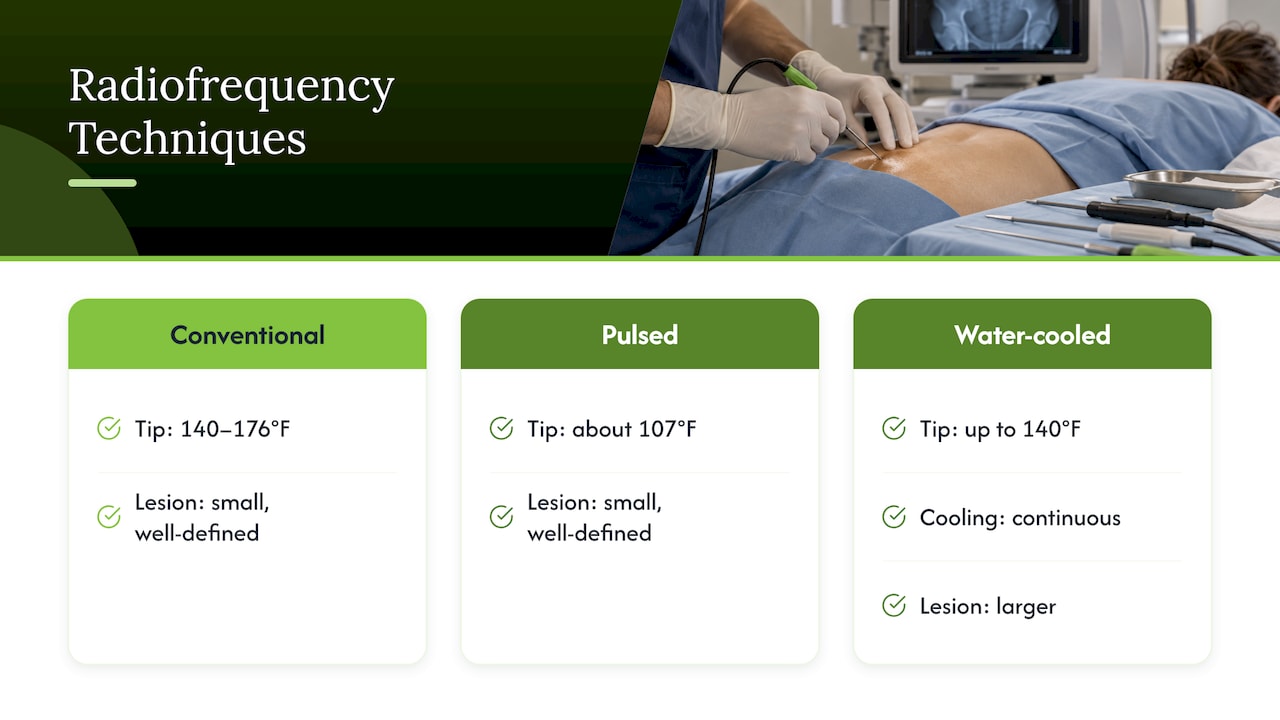
Three techniques appear in the literature. According to Spine-Health, conventional continuous RFA heats the needle tip to roughly 140 to 176 degrees Fahrenheit, pulsed RFA to about 107 degrees, and water-cooled RFA up to about 140 degrees with continuous cooling. Conventional and pulsed methods create small, well-defined lesions, while water-cooled RFA creates a larger one. The larger lesion is one reason cooled methods are discussed for the sacroiliac region, where nerve branches vary from person to person.
Why the sacroiliac joint is hard to pin down
SI joint pain is easy to confuse with a lumbar disc problem, facet joint pain, or hip trouble. The joint’s nerve supply is variable. A 2009 review of radiofrequency neurotomy notes that the innervation spans several spinal levels and differs between people, so symptoms are often variable too, with pain referred to nearby areas.
That is why we do not treat a back pain complaint as SI joint pain just because it sits near the belt line. In our experience, a careful history and physical exam come first. Pain below L5 that you can point to with one finger, pain that worsens when rising from sitting or lying on one side, and several positive provocative exam maneuvers all raise suspicion. Research cited in a 2026 clinical review reports that three or more positive provocative tests have a sensitivity of 91% and a specificity of 78%. That is helpful, but it is not proof, which is why a diagnostic block follows.
The same review and a payer clinical policy describe the sacroiliac joint as an identifiable cause of chronic low back pain in about 15 to 30% of patients. It is common enough to deserve a proper workup, and uncommon enough that the other 70 to 85% need something else.
SI joint injection versus SI joint ablation
People searching for one often find the other, so it helps to separate them.
| SI joint injection | SI joint ablation (RFA) | |
|---|---|---|
| What it targets | The joint space or surrounding tissue | The sensory nerves behind the joint |
| Main purpose | Diagnosis, and short to medium relief | Longer relief after the pain source is confirmed |
| Typical medication or energy | Local anesthetic, often with a steroid | Radiofrequency heat |
| How long relief may last | Hours (anesthetic only) to weeks or months (with steroid) | Months in many responders, up to 6 to 12 months in some studies |
| Where it fits | Early in the workup | After conservative care and positive diagnostic blocks |
The ASPN guideline states that anesthetic-only injections are expected to give rapid relief lasting only hours, while steroid injections may give delayed relief lasting weeks to months. A university pain clinic explains that the numbing medicine wears off in roughly six hours, the steroid may take 24 to 72 hours, sometimes up to a week, to work, and the effect can last from days to months. Soreness at the injection site for a day or two is common.
If you want to understand the injection side, we describe our approach on the page for SI joint steroid injection.
Who may be a candidate
A candidate typically has pain that has lasted a few months, has not responded enough to medication and physical therapy, and has been tied to the sacroiliac region through diagnostic blocks. Cleveland Clinic lists a positive response to a nerve block and chronic pain unresponsive to other treatment as the main signs that RFA may fit, and notes that pregnancy, infection, or a bleeding problem may rule it out. The ASPN guideline adds sacral fracture, malignancy, infection, and coagulation problems as contraindications to neuroablative treatment.
What diagnostic blocks show
Before ablation, most guidelines call for a diagnostic block, and the thresholds are specific:
- The ASPN guideline recommends a diagnostic block of the lateral sacral branches (S1 to S3) and the L5 dorsal rami, with a cutoff of 50% or greater relief from the lateral branch block.
- A Medicare coverage determination summarized by ASIPP describes two diagnostic blocks with at least 75% relief of the index pain, with pain measured before and after on a consistent scale. Insurers and Medicare contractors vary, so coverage rules matter.
- The older gold-standard approach uses two comparative blocks, because a single uncontrolled injection carries a false positive rate of about 20%.
There is also an ongoing debate. Yang and colleagues note that most studies used an injection into the joint itself to select patients, yet some pain comes from tissues outside the joint, and they describe multisite, multi-depth lateral branch blocks as the only validated way to identify pain from the posterior structures. In plain terms, the more precisely the block matches the nerves we plan to treat, the more meaningful the result.
A practical point from the clinic: keep a pain diary after any block. Note your pain level before, then at intervals over the next several hours. Relief that tracks the length of the anesthetic is the signal your physician is looking for. It is better to be specific than to say you felt better.
What happens during the procedure
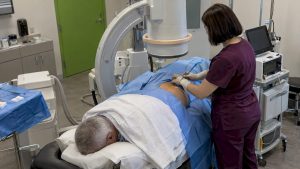
SI joint ablation is an outpatient procedure. According to Spine-Health’s procedure guide, the entire RFA procedure usually takes 30 to 90 minutes, and if sedation is used, you rest in a recovery area for 15 minutes to an hour afterward. A typical sequence looks like this:
- You lie face down, and the skin over the lower back and buttock is cleaned and numbed.
- Using X-ray (fluoroscopic) guidance, the physician positions the needles near the target nerve branches.
- A small test stimulation may be used to check needle placement.
- Radiofrequency energy is delivered at each site for a set period.
- The needles are removed and small bandages are applied.
People often ask how painful it is. The skin and deeper tissues are numbed, and many patients feel pressure rather than sharp pain. Some feel a brief burning or tingling during stimulation. Discuss sedation options with your physician in advance.
How much relief to expect
Evidence for SI joint RFA is encouraging but not uniform, and honest expectations matter more than good numbers. Here is what the studies report.
- Pooled randomized trials. Yang and colleagues report that patients treated with sacral lateral branch RFA were about four times more likely to reach at least 50% pain reduction at three months than those treated with sham, with a wide confidence interval. A systematic review in the same paper put the responder rate at approximately 50% at three months.
- Cooled RFA trial. In one randomized trial described in the ASPN guideline, 79% of cooled RFA patients had at least 50% relief at one month, compared with 14% in the placebo group. Persistent benefit was reported in 64% at three months and 57% at six months.
- RFA versus steroid injection. A 2024 meta-analysis of thirteen studies found steroid injection patients had higher pain scores than RFA patients at three and six months, with no significant difference at 12 months. The 2026 review reports one trial in which at least 50% relief occurred in 73%, 60%, and 53% of RFA patients at 1, 3, and 6 months, while only 20% of steroid patients had similar relief at one month and none sustained it beyond three months.
- Duration. The same review says cooled or bipolar methods may offer benefit for 6 to 12 months.
- Real-world series. A 2023 case series of cooled RFA reported that the average pain score fell from about 7.9 to 1.5 at 1.5 months, and that the full effect took two to six weeks to appear.
Some caution belongs here. Not everyone responds, and quality of evidence varies between techniques. A payer policy notes an AHRQ finding that cooled radiofrequency is probably moderately more effective than sham for sacroiliac pain in younger populations, and also notes that further trials are needed to compare techniques and to follow patients beyond 12 months, as stated in the clinical policy. Many of our patients find that this honest range, rather than a promise, helps them decide.
Risks and side effects
The risks are real but, when image guidance and careful technique are used, typically mild. The 2026 review notes that the most frequent complications are transient local soreness and neuritis, usually resolving within weeks. Temporary numbness or tingling can occur, and nerve damage, infection, and motor weakness are uncommon.
The 2023 case series reported side effects in about 10% of patients, including buttock soreness, patchy numbness, and nerve-type pain, all resolving within six weeks. Broader reviews list infection, hematoma, burns, and sensory changes among potential adverse outcomes.
Safe use points that matter in practice:
- Tell your physician about blood thinners before the procedure so they can advise whether and how to adjust them. Do not stop a prescribed anticoagulant on your own.
- Report fever, spreading redness, or drainage at a needle site promptly, since these can signal infection.
- Let your physician know if you may be pregnant, have an active infection, or have diabetes. Steroid used in a diagnostic or therapeutic injection can temporarily raise blood sugar.
- Call the office if you notice new weakness in a leg or changes in bladder or bowel control.
We also list six questions patients can ask before any radiofrequency procedure in our guide to radiofrequency ablation safety checks.
Recovery: the first days and weeks
Recovery is usually short. Some people notice superficial burning, slight skin numbness, or a sunburn-like sensitivity at the treated sites. Spine-Health suggests icing for 15 to 20 minutes at a time with at least two hours between applications, preferring warm showers to baths for a day or two, and notes that pain relief is typically felt one to three weeks after the procedure. Rest for several days before returning to normal activity, and guided physical therapy may be prescribed.
That delay surprises many people. The first week can feel the same as, or slightly worse than, before the procedure because the treated nerves and surrounding tissue are irritated. Relief tends to build as that settles. Our day-by-day outline in RFA recovery time walks through what is typical.
Rehabilitation matters
Ablation can reduce pain enough to make exercise tolerable again, and that window is the best opportunity to strengthen the hips, core, and gluteal muscles that stabilize the pelvis. One trial summary in the payer policy found no statistically significant added benefit of RFA over exercise alone in chronic low back pain overall, which underlines why we pair a procedure with a rehabilitation plan rather than treating it as a stand-alone fix. Our physical therapy program is built for that stage.
Some patients also explore complementary options such as red light therapy for arthritis and joint health during recovery. Talk with your physician about what suits your situation before adding anything.
Our perspective
We approach SI joint pain with a simple principle: confirm the source before treating it. Many patients come to us after trying several treatments, and the missing step is usually precision. A back pain label can describe a disc, a facet joint, a hip, or the sacroiliac joint, and each calls for a different plan.
That is why we lean on a careful exam and diagnostic blocks before considering ablation, and why we are candid about outcomes. Studies show meaningful relief for many selected patients over several months, and we say just as plainly that some people respond partly or not at all.
Our practice is built around non-surgical care: radiofrequency ablation, nerve blocks, injections, regenerative options, and rehabilitation, with physicians trained to match the treatment to the cause rather than to the symptom. We see ablation as one step in a plan, not a stand-alone answer. When it fits, it can create room for rehabilitation to do its work.
If you have been living with one-sided low back and buttock pain, a focused evaluation is a reasonable next step.
Felix
Related options if the SI joint is not the source
A diagnostic workup sometimes points elsewhere, and that is useful information too. If blocks do not reproduce relief at the sacroiliac region, the pain may come from the lumbar facet joints, where we use a lumbar medial branch block and, if it is positive, lumbar radiofrequency neurotomy. Our article on medial branch ablation after dual blocks explains how that decision is made. For leg-radiating pain from an irritated nerve root, an epidural steroid injection may be the better fit. You can read about transforaminal epidural injections here.
Getting evaluated at Nortex Spine and Joint
If you live in North Dallas and have lasting low back or buttock pain, we can review your history, examine you, and explain whether sacroiliac joint pain is likely and which steps make sense. You can read about our SI joint pain evaluation and our broader non-surgical treatment options, or contact us through nortexspineandjoint.com to schedule a consultation. Coverage varies by plan, so bring your insurance information.
FAQ
Is SI joint ablation the same as an SI joint injection?
No. An injection places medication in or around the joint to diagnose the problem and reduce inflammation, with relief lasting hours to months depending on the medication. Ablation uses radiofrequency heat on the nerves behind the joint, aiming for longer relief once the pain source is confirmed.
How long does SI joint RFA last?
It varies. Trials report that more than half of treated patients had at least 50% relief at six months, and some reviews describe benefit lasting 6 to 12 months with cooled or bipolar methods. Because nerves regrow, pain can return, and the procedure may be repeated in people who responded well.
Is radiofrequency ablation painful?
The skin is numbed and sedation may be offered, so most people feel pressure and some brief burning. Afterward, soreness or a sunburn-like sensitivity at the needle sites is common and usually settles within days to weeks. Ask your physician which comfort options are available.
What are the negatives of radiofrequency ablation?
The most common are temporary soreness, numbness, or nerve irritation. Uncommon risks include infection, bleeding, and nerve injury. Relief is also not guaranteed, and it does not last forever, which is why careful patient selection and rehabilitation matter.
How soon can I return to normal activities?
Many people rest for several days and then resume activity gradually, often with guided physical therapy. Pain relief typically begins one to three weeks after the procedure, so your physician will tailor the timeline to your work and activity level.
Sources
- ASPN Best Practice Guidelines on sacroiliac joint pain
- Yang et al., Radiofrequency Ablation for Chronic Posterior Sacroiliac Joint Pain, Pain Medicine, 2021
- Soin et al., Sacroiliac joint injections and radiofrequency ablation, 2026
- Review article: radiofrequency neurotomy for the treatment of sacroiliac joint syndrome, 2009
- Clinical Policy: Sacroiliac Joint Interventions for Pain, 2025
- ASIPP: Sacroiliac Joint Injections and Procedures, new LCD
- University of Toledo: Sacroiliac Joint Injection
- Spine-Health: RFA for facet and sacroiliac joint pain
- Spine-Health: RFA procedure and recovery
- Maalouly and Rao, Cooled radiofrequency ablation of the sacroiliac joint, 2023
- Xu et al., Radiofrequency vs steroid injections, 2024 meta-analysis